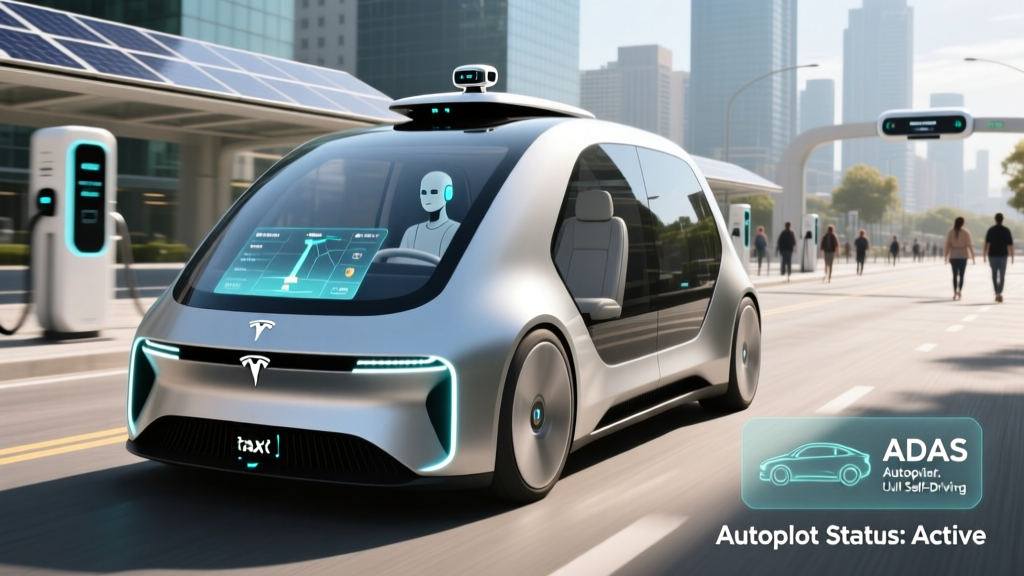
The Tesla Robotaxi — the dedicated, steering-wheel-free vehicle Tesla unveiled in late 2024 — has been inching toward commercial deployment ever since. But as limited pilot programs expand in 2026, a practical question keeps surfacing in search forums and Tesla owner groups: What is the Tesla robotaxi age limit? Who can actually ride in one, and where?
Before we get to the eligibility rules, it's essential to separate Tesla's consumer driver-assist features (Autopilot and Full Self-Driving Supervised) from the actual robotaxi service. They are fundamentally different products with different regulatory frameworks, different safety profiles, and different rider requirements.
SAE Automation Levels: Why the Distinction Matters
The single most common source of confusion around Tesla's autonomous offerings is the gap between what Tesla sells to consumers and what a true robotaxi requires. Here's the breakdown:
| SAE Level | Definition | Tesla Product | Robotaxi? |
|---|---|---|---|
| Level 2 | Driver-assist; human must supervise at all times | Autopilot, FSD (Supervised) | No |
| Level 3 | Conditional automation; driver must take over when requested | Not currently offered | No |
| Level 4 | High automation within defined ODD; no driver needed | Robotaxi (Cybercab) — pilot phase | Yes (limited) |
| Level 5 | Full automation everywhere, all conditions | Does not exist commercially | N/A |
Tesla Robotaxi Age Limit and Rider Eligibility Rules
Based on Tesla's pilot program documentation and the regulatory frameworks governing driverless ride-hailing services in the United States, here is what we know about rider eligibility:
- Minimum age to ride alone: 18 years old. Unaccompanied minors are not permitted in the Tesla Robotaxi during pilot operations, consistent with the rules applied to Waymo One and Cruise in their respective markets.
- Minors riding with an adult: Children may ride when accompanied by a guardian aged 18 or older. However, the Cybercab's interior configuration (two-seat layout in the initial production variant) limits practical family use.
- Account holder requirement: The ride must be requested through the Tesla app by a verified account holder who is at least 18 and has completed identity verification.
- Accessibility: Tesla has stated that ADA-compliant vehicle variants are in development, but initial pilot vehicles have limited wheelchair accessibility — a gap that regulators in California have flagged as a condition for broader deployment permits.
These rules mirror the standards set by the California Public Utilities Commission (CPUC), which oversees driverless ride-hailing permits in the state. Other states adopting robotaxi frameworks — including Arizona, Nevada, and Texas — have largely adopted similar age and accountability structures.
Where Can You Use the Tesla Robotaxi Right Now?
As of early 2026, Tesla's robotaxi pilot is geographically restricted. Here's the current landscape:
| City / Region | Status | Operational Area | Hours |
|---|---|---|---|
| Austin, TX | Limited pilot (invite-only) | Downtown + South Austin geofence (~45 sq mi) | 6 AM – 11 PM |
| San Francisco, CA | Testing (not open to public riders) | Select corridors, CPUC permit pending | N/A |
| Phoenix, AZ | Announced / site preparation | Not yet operational | N/A |
| Las Vegas, NV | Announced | Strip corridor under evaluation | N/A |
For comparison, Waymo One — the most mature Level 4 robotaxi service in the U.S. — operates commercially across greater Phoenix, San Francisco, Los Angeles, and parts of Austin, with 24/7 availability in most zones. Tesla's footprint is substantially smaller and remains invite-only for non-employees in Austin.
If you're outside these pilot zones, Tesla's robotaxi is not available to you. FSD (Supervised) in your personal Tesla is a separate product entirely and does not constitute a ride-hailing service.
Tesla Robotaxi Pricing vs. Uber and Lyft
Tesla CEO Elon Musk has repeatedly stated that the long-term goal for the Cybercab robotaxi is a per-mile cost below that of traditional rideshare — targeting approximately $0.20 per mile, which would undercut UberX and Lyft standard fares in most U.S. cities.
However, pilot-phase pricing tells a different story:
| Service | Base Fare | Per-Mile Rate | Est. 5-Mi Trip | Notes |
|---|---|---|---|---|
| Tesla Robotaxi (pilot) | $0 (promotional) | Not yet published | Free / subsidized | Invite-only; no commercial pricing yet |
| Waymo One | $2.50–$4.00 | $1.25–$1.80 | $10–$15 | Comparable to UberX in most markets |
| UberX | $2.00–$3.50 | $1.10–$1.60 | $9–$14 | Varies by city and surge pricing |
| Lyft Standard | $2.00–$3.00 | $1.00–$1.50 | $8–$13 | Varies by city and demand |
Until Tesla receives full commercial deployment permits and publishes a rate card, any per-mile pricing figures remain aspirational. The $0.20/mile target relies on achieving high fleet utilization rates and minimal remote-assistance overhead — metrics that even Waymo, with years of operational data, has not publicly confirmed reaching at scale.
How Safe Are Robotaxis? The Real Data
Here's what the data shows across the industry:
- Waymo (Level 4): By late 2025, Waymo reported over 10 million fully driverless miles completed across its commercial fleets. According to data published in collaboration with insurance researchers, Waymo's at-fault collision rate was approximately 85% lower than the human driver benchmark for comparable urban driving environments (source: NHTSA ADS reporting).
- Cruise (Level 4): Cruise's operations were suspended in California in late 2023 following a serious pedestrian-dragging incident in San Francisco. The company resumed limited testing in 2024–2025 under tighter oversight but has not returned to full commercial scale as of this writing. This incident underscores that Level 4 robotaxi safety is not a solved problem.
- Tesla FSD (Level 2): Tesla publishes quarterly safety statistics for FSD-equipped vehicles, but these reflect supervised driving with a human behind the wheel — not driverless operation. Conflating FSD safety data with robotaxi safety data is misleading and should be avoided.
- NHTSA Standing General Order: Since June 2022, the NHTSA Standing General Order requires all ADS-equipped vehicle operators to report crashes. This database is the most authoritative source for robotaxi incident data, though reporting lags and categorization differences can complicate direct comparisons.
For the Tesla Robotaxi specifically, we are waiting for sufficient operational mileage to accumulate before meaningful safety comparisons can be made. Any claims that the Cybercab is "safer than human drivers" are premature until verified by independent data at scale.
Technology Stack: Camera-Only vs. Multi-Sensor Fusion
Tesla's robotaxi relies on a camera-only (Tesla Vision) perception system — a philosophy that sets it apart from virtually every other Level 4 robotaxi operator.
- Tesla (Cybercab): Multi-camera array (estimated 8–11 cameras), no lidar, no radar (radar was removed from Tesla's sensor suite starting in 2021). Relies on neural-network-based depth estimation and occupancy networks to build a 3D understanding of the environment.
- Waymo (6th-gen): Multi-sensor fusion — lidar (custom-built), radar, cameras, and external audio sensors. Redundant perception layers for adverse conditions.
- Zoox: Lidar + cameras + radar in a symmetric sensor layout designed for bidirectional driving.
The camera-only approach offers cost advantages (lidar units remain expensive) and simplifies the hardware bill of materials. But it also introduces well-documented limitations:
- Low-light performance: Cameras are inherently limited in darkness compared to lidar's active illumination. Tesla addresses this through neural-network inference, but edge cases remain.
- Adverse weather: Heavy rain, fog, and direct sun glare can degrade camera performance. Lidar and radar provide complementary data in these conditions.
- Depth accuracy: Stereo-vision and monocular depth estimation have improved dramatically, but lidar provides direct, physics-based distance measurement that doesn't rely on learned inference.
Whether Tesla's vision-only approach can achieve Level 4 reliability at scale remains one of the most debated questions in the autonomous vehicle industry. Waymo's multi-sensor approach is the current benchmark for commercial robotaxi reliability.
Regulatory Landscape: Who Approves Robotaxi Operations?
Robotaxi deployment in the United States is governed by a patchwork of state and local regulations. There is no single federal permit that authorizes nationwide robotaxi service.
- California (CPUC + DMV): The DMV issues testing permits; the CPUC issues commercial deployment permits for passenger-carrying driverless service. Tesla would need both to operate commercially in the state.
- Texas (TxDOT + city authorities): Texas has a lighter regulatory framework, which is partly why Tesla chose Austin for its initial pilot. However, city-level approval is still required for commercial ride-hailing operations.
- Arizona (ADOT): Arizona was an early adopter of permissive AV regulation (Waymo launched commercially in Phoenix in 2020). State law allows driverless operations with minimal permitting hurdles.
- Federal (NHTSA): NHTSA sets vehicle safety standards (FMVSS) and investigates defects. The Cybercab's lack of a steering wheel and pedals requires an FMVSS exemption or a rule change — something NHTSA has been evaluating. As of early 2026, NHTSA has not issued a blanket exemption for steering-wheel-free production vehicles at scale.
This regulatory fragmentation means that even if Tesla perfects the technology, rolling out the robotaxi service will be a city-by-city, state-by-state process — not a single "launch day."
Current Limitations: What the Tesla Robotaxi Cannot Do
- Geofencing: The vehicle operates only within pre-mapped, approved zones. If your destination falls outside the geofence, the ride cannot be completed.
- Weather restrictions: Heavy rain, snow, ice, and dense fog can trigger service suspension. Camera-only systems are particularly sensitive to these conditions.
- Construction zones: Unmapped road changes, temporary barriers, and lane shifts require remote assistance or route avoidance, increasing wait times or causing cancellations.
- No highway driving (pilot phase): Initial pilot operations are restricted to surface streets. Highway-capable robotaxi service has not been approved for Tesla's Cybercab.
- Limited passenger capacity: The initial Cybercab variant seats two passengers, making it unsuitable for groups or airport runs with significant luggage.
- No manual override: Without a steering wheel or pedals, passengers cannot intervene if the system encounters an unexpected scenario. This places enormous weight on system reliability and remote-assistance infrastructure.
- Edge cases: Emergency vehicles, unusual road users (horse-drawn carriages, oversized loads), and complex multi-point intersections remain challenging scenarios that may require remote teleoperations intervention.
Frequently Asked Questions
What is the Tesla robotaxi age limit?
Riders must be at least 18 years old to request a ride through the Tesla app. Minors may ride when accompanied by an adult guardian aged 18 or older, though the two-seat Cybercab configuration limits practical family use.
Is Tesla's robotaxi truly self-driving?
The Tesla Robotaxi (Cybercab) targets SAE Level 4 autonomy — no driver, no steering wheel — within geofenced zones. This is fundamentally different from FSD (Supervised) in consumer Teslas, which is Level 2 and requires active driver supervision at all times.
Where is the Tesla robotaxi available right now?
As of early 2026, the Tesla Robotaxi is in a limited, invite-only pilot in Austin, Texas. It is not available to the general public and has not launched commercially in any city. Waymo One remains the most widely available Level 4 robotaxi service in the U.S.
How much will a Tesla robotaxi ride cost?
Tesla has stated a long-term target of approximately $0.20 per mile, but no commercial pricing has been published. Pilot rides have been free or heavily subsidized. For comparison, Waymo One charges rates comparable to UberX in most markets.
How safe is the Tesla robotaxi compared to human drivers?
There is not yet enough Tesla-specific robotaxi mileage data to make a statistically valid comparison. Waymo's published data suggests an ~85% reduction in at-fault collisions versus human benchmarks, but Tesla's camera-only approach and limited operational history mean independent verification is still pending.
Can I use FSD (Supervised) as a robotaxi?
No. FSD (Supervised) is a Level 2 driver-assist feature that requires you to remain alert and ready to take control. It does not qualify as a ride-hailing or robotaxi service, and using it as one would violate both Tesla's terms of service and applicable traffic laws.