The Autopilot Shake-Up: Why Tesla Restructured Its Driver-Assist Tiers
For years, Tesla bundled its baseline driver-assistance suite—lane centering, adaptive cruise control, and automatic emergency braking—under the "Autopilot" name at no additional cost on every vehicle it sold. That era is ending. Through a series of packaging changes rolling across the 2026 model year, Tesla has begun removing Autopilot as a standard inclusion on certain base trims, shifting key features behind a paywall or into its subscription ecosystem. The move has left prospective buyers and current owners alike asking: what exactly do you get for free now, what requires a subscription, and is the hardware still there even if the software isn't?
This article breaks down the technical architecture behind Tesla's driver-assist systems, what's actually changing in the 2026 lineup, and how Tesla's approach compares to Ford BlueCruise, GM Super Cruise, and other SAE Level 2 systems on the market.
What Tesla's Driver-Assist Features Actually Do
Tesla's driver-assistance ecosystem is layered into distinct tiers, each building on the last. Understanding what each tier controls is essential before evaluating what's being removed or restructured.
| Feature Tier | Capabilities | Driver Requirement | SAE Level |
|---|---|---|---|
| Basic Driver Assistance (formerly part of Autopilot) | Traffic-Aware Cruise Control, Automatic Emergency Braking, Lane Departure Warning, Blind Spot Monitoring | Full attention, hands on wheel | Level 1–2 |
| Enhanced Autopilot | All Basic features + Auto Lane Change, Autopark, Navigate on Autopilot, Summon | Full attention, hands on wheel | Level 2 |
| Full Self-Driving (Supervised) | All Enhanced features + Traffic Light & Stop Sign Control, city street navigation, steering on complex roads | Full attention, hands on wheel, active supervision | Level 2 |
The key distinction: none of these tiers operate without continuous driver supervision. Tesla's system, regardless of tier, requires the driver to maintain hands-on-wheel contact (or demonstrate attentiveness via steering torque and camera monitoring) and to be prepared to take over at any moment. This is a firm requirement of SAE Level 2 automation.
SAE Automation Level Context: Tesla Autopilot and FSD (Supervised) are classified as SAE Level 2 driver-assistance systems. The driver is responsible for all vehicle operation and must continuously monitor the driving environment. Only fully driverless robotaxi services like Waymo One (operating in designated geofenced areas in Phoenix, San Francisco, and Los Angeles) qualify as SAE Level 4. No consumer vehicle sold in the U.S. in 2026 is Level 3 or above for general use. (SAE International J3016)
What "Tesla Removing Autopilot" Actually Means
When reports surfaced about Tesla removing Autopilot, the reality was more nuanced than a blanket elimination. Here's what's actually happening across the 2026 lineup:
On the base Model 3 and Model Y trims: Tesla has stripped the Enhanced Autopilot features (lane change automation, Navigate on Autopilot, Autopark, and Summon) from the standard equipment list. What remains on base models is a more limited driver-assist package: Traffic-Aware Cruise Control and basic lane-keeping assist are still included, but the richer feature set that previously came standard on mid-level trims now requires either a one-time purchase or a monthly subscription.
On Long Range and Performance trims: Enhanced Autopilot features continue to be bundled as standard equipment on most higher trims, though Tesla has adjusted packaging regionally and by model year build date. Always confirm the exact feature list on the Tesla configurator at the time of order—packaging has shifted multiple times during the 2026 production year.
FSD (Supervised) remains optional across all trims and is never included in the base price. It must be purchased outright or subscribed to monthly.
The Hardware Is Still There—The Software Is What's Gated
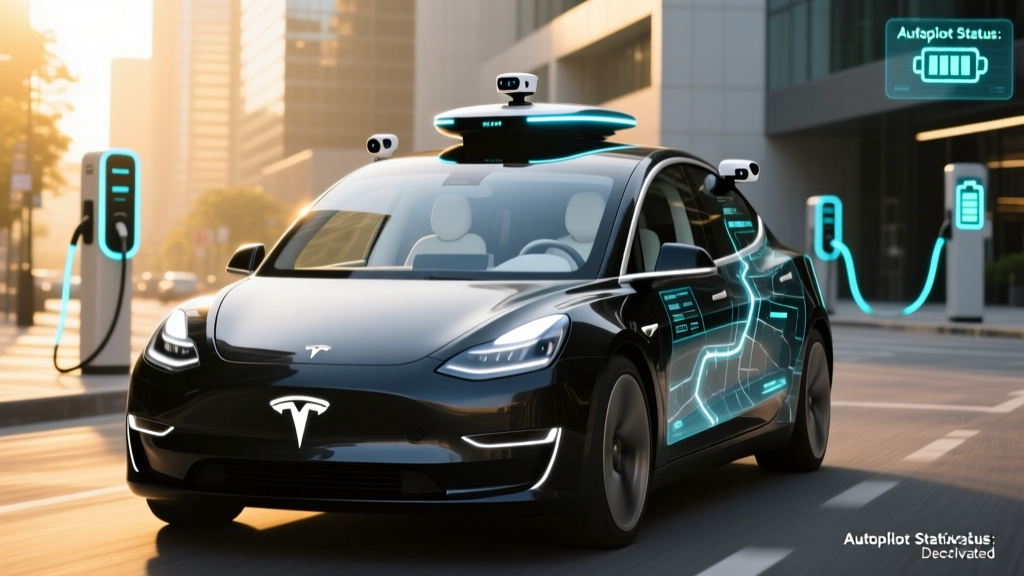
Every 2026 Tesla vehicle rolls off the factory floor with the same sensor suite, regardless of trim or software tier. Tesla's current hardware platform (HW4, also referred to as AI4 in some Tesla communications) includes:
- 8 cameras providing 360-degree surround view (front narrow, front wide, front main, left/right forward-looking repeaters, left/right rearward-looking, rear-view)
- No radar — Tesla removed ultrasonic sensors and radar starting with 2022–2023 production, relying entirely on its Tesla Vision camera-only approach
- Neural network processing via a custom onboard inference computer capable of processing camera feeds in real time
This means a base-trim Model 3 without Enhanced Autopilot has physically identical perception hardware to a fully equipped Model S with FSD (Supervised). The difference is purely software licensing. Tesla gates features at the software level and can enable or disable them remotely via over-the-air updates tied to the vehicle's VIN and the owner's account status.
Real-World Capabilities and Limitations
Tesla's driver-assist systems perform well under specific conditions but exhibit meaningful limitations that every buyer should understand before relying on them.
What Tesla Autopilot and FSD (Supervised) Do NOT Do:
- Do NOT drive autonomously. The driver must remain fully engaged, monitor the road, and be prepared to intervene instantly. NHTSA has investigated multiple incidents involving Tesla vehicles operating on Autopilot and FSD where driver inattention was a contributing factor. (NHTSA)
- Do NOT reliably handle construction zones. Cone detection, lane-shift recognition, and temporary barrier identification remain inconsistent, particularly in complex or poorly marked work areas.
- Do NOT perform well in degraded weather. Heavy rain, fog, snow, and direct sun glare can overwhelm the camera-only Tesla Vision system. Unlike radar-equipped competitors, Tesla has no redundant sensor modality to fall back on when camera visibility drops.
- Do NOT recognize all emergency vehicles. NHTSA's Standing General Order data has shown incidents where Tesla vehicles on Autopilot failed to slow or stop for stationary emergency vehicles with active lighting.
- Do NOT handle unmapped or newly altered roads. FSD (Supervised) relies on a combination of real-time perception and map data. Road changes, new traffic patterns, or GPS-degraded environments (tunnels, urban canyons) can cause system confusion.
Where it works well: On clearly marked, well-maintained divided highways in good weather and daylight conditions, Tesla's lane centering and adaptive cruise control are smooth and confidence-inspiring. Traffic-Aware Cruise Control handles stop-and-go traffic competently. FSD (Supervised) has improved substantially in city environments since 2024, handling unprotected left turns and multi-lane intersections with greater consistency—though it still makes conservative errors (unnecessary stops, overly cautious merging) and occasional assertive ones (rolling through stop signs at low speed, cutting corners on tight turns).
Cost Breakdown: Purchase, Subscription, and What's Included
Tesla's pricing for its driver-assist tiers has fluctuated over the past several years. As of early 2026, here is the cost structure (pricing subject to change by Tesla at any time):
| Tier | One-Time Purchase | Monthly Subscription | Included on Base Trim? |
|---|---|---|---|
| Basic Driver Assistance | N/A (standard) | N/A | Yes (TACC, AEB, LDW) |
| Enhanced Autopilot | ~$6,000 | Not available standalone | No (removed from base 2026 trims); standard on Long Range/Performance |
| Full Self-Driving (Supervised) | ~$8,000 | ~$99/month | No — optional on all trims |
A few important notes on cost:
- The FSD subscription at ~$99/month is the most cost-effective entry point for drivers who want to evaluate the system before committing $8,000. Over a 36-month lease, the subscription totals roughly $3,564 versus the $8,000 outright purchase.
- FSD purchase does not currently transfer between vehicles (Tesla has occasionally offered limited-time transfer promotions—check current terms before purchasing).
- Neither Enhanced Autopilot nor FSD purchase qualifies as a separate item for the §30D federal clean vehicle tax credit. The credit applies to the vehicle MSRP subject to income caps, MSRP caps ($55,000 for sedans, $80,000 for SUVs/trucks), and battery sourcing requirements. Software add-ons do not change the vehicle's eligibility calculation.
How Tesla Compares to Ford BlueCruise and GM Super Cruise
Tesla's decision to gate driver-assist features behind paywalls contrasts with how legacy automakers structure their competing Level 2 systems.
| Attribute | Tesla Autopilot / FSD (Supervised) | Ford BlueCruise | GM Super Cruise |
|---|---|---|---|
| SAE Level | Level 2 | Level 2 | Level 2 |
| Hands-Free Allowed? | No (hands-on-wheel required) | Yes, on pre-mapped divided highways (Blue Zones) | Yes, on pre-mapped compatible roads (~750,000+ miles in North America) |
| Sensors | Cameras only (Tesla Vision) | Cameras + radar + infrared driver monitoring | Cameras + radar + LiDAR map data + infrared driver monitoring |
| Driver Monitoring | Camera-based + steering torque | Infrared camera (eye tracking) | Infrared camera (eye tracking) |
| Auto Lane Change | Yes (Enhanced AP and FSD) | Yes (BlueCruise 1.0+) | Yes (on compatible roads) |
| City Street Navigation | Yes (FSD Supervised only) | No (highway only) | Limited (expanding with Ultra Cruise) |
| Cost Structure | $6,000–$8,000 purchase or $99/mo FSD sub | Included on select trims; $2,100 one-time or ~$75/mo on others | Included free for first 3 years on equipped trims; then ~$25/mo |
| Weather Limitation | High (camera-only, no radar backup) | Moderate (radar + camera fusion) | Moderate (radar + LiDAR map data + camera) |
The critical differentiator: Ford and GM allow true hands-free driving on pre-mapped divided highways, with robust infrared driver-monitoring cameras ensuring the driver's eyes remain on the road. Tesla does not permit hands-free operation on any road, despite its system being capable of sustained lane centering and speed management. Tesla's camera-only approach also means it lacks the sensor redundancy (radar, LiDAR) that competitors use to maintain function in rain, fog, or low-light conditions.
On the other hand, Tesla's FSD (Supervised) offers a broader operational design domain—it can attempt navigation on virtually any road, not just pre-mapped highways. This is both a strength (more coverage) and a weakness (more unpredictable edge cases). Ford and GM take a narrower, more conservative approach: their hands-free features only activate where they have high-confidence mapping data.
Which 2026 Tesla Models Are Affected?
Here's the current status of driver-assist packaging across Tesla's 2026 lineup:
- Model 3 (Base / Rear-Wheel Drive): Basic driver assistance (TACC, AEB, lane departure warning) remains standard. Enhanced Autopilot features have been removed from the standard package and are available via purchase or as part of an option bundle. FSD (Supervised) is an add-on.
- Model 3 Long Range / Performance: Enhanced Autopilot features remain included as standard equipment. FSD (Supervised) is optional.
- Model Y (Base / Rear-Wheel Drive): Same restructuring as Model 3 base—Enhanced Autopilot is no longer standard.
- Model Y Long Range / Performance: Enhanced Autopilot features included. FSD optional.
- Model S / Model X: Enhanced Autopilot included across all trims. FSD optional.
- Cybertruck: Enhanced Autopilot included on all trims as of 2026. FSD (Supervised) optional. Note: Cybertruck's steer-by-wire architecture introduces unique tuning considerations for lane centering that Tesla has been refining through OTA updates.
Buyer advice: Always verify the exact feature list on Tesla's online configurator at the time you place your order. Tesla has a history of adjusting packaging mid-year without prominent announcement. If Enhanced Autopilot features matter to you, confirm they appear on your order summary before delivery.
Frequently Asked Questions
Is Tesla completely removing Autopilot from all vehicles?
No. Basic driver-assistance features—Traffic-Aware Cruise Control, Automatic Emergency Braking, and Lane Departure Warning—remain standard on all 2026 Tesla vehicles. What has been removed from certain base trims is the Enhanced Autopilot package, which includes Auto Lane Change, Navigate on Autopilot, Autopark, and Summon. These features are now gated behind a purchase or included only on higher trims.
Is Tesla FSD actually self-driving?
No. Tesla Full Self-Driving (Supervised) is an SAE Level 2 system. The "Supervised" designation, which Tesla added to the product name in 2024, explicitly communicates that a human driver must remain fully engaged and ready to take over at any moment. The system does not meet the definition of autonomous or self-driving operation. Only Level 4 robotaxi services operating in geofenced areas (such as Waymo One) qualify as truly driverless.
Can I subscribe to FSD month-to-month without a long commitment?
Yes. As of 2026, Tesla offers FSD (Supervised) at approximately $99/month with no long-term contract. You can cancel and resubscribe at any time. This is the lowest-risk way to evaluate whether the system meets your expectations before committing to the ~$8,000 one-time purchase.
Does the removal of Enhanced Autopilot from base trims affect safety features?
No. Core active safety features—Automatic Emergency Braking, collision warnings, lane departure warning, and blind spot monitoring—remain standard on all trims. The features removed from base trims are convenience-oriented driver-assist functions (auto lane change, summon, automated parking), not safety-critical systems.
How does Tesla's camera-only approach compare to radar-equipped competitors?
Tesla Vision relies entirely on cameras and neural network processing, with no radar or ultrasonic sensor backup. In clear conditions, this works well. In heavy rain, fog, snow, or direct sun glare, camera-only systems can experience degraded performance. Competitors like Ford (BlueCruise) and GM (Super Cruise) use sensor fusion combining cameras with radar—and in GM's case, LiDAR-derived map data—providing redundancy when one sensor modality is compromised. This is a meaningful trade-off to consider if you frequently drive in adverse weather.
Will FSD features I purchase transfer to my next Tesla?
Generally, no. As of 2026, FSD purchases are tied to the vehicle, not the owner's account. Tesla has occasionally offered limited-time FSD transfer promotions (typically around end-of-quarter delivery pushes), but the default policy is that FSD does not transfer. Check Tesla's current terms before purchasing outright—if you plan to sell or trade within a few years, the monthly subscription may be more economical.