What Tesla's On-Board FSD Actually Does
When Tesla owners refer to "on-board FSD," they mean the Full Self-Driving (Supervised) software running locally on the vehicle's Hardware 4 (HW4) computer — not a cloud-dependent system. In 2026, FSD Supervised is Tesla's most advanced driver-assistance tier, sitting above Basic Autopilot and Enhanced Autopilot in the feature stack. It handles highway lane-keeping, adaptive cruise control, automatic lane changes, navigation-guided off-ramps, traffic-light and stop-sign recognition, and low-speed city-street steering on mapped and unmapped roads.
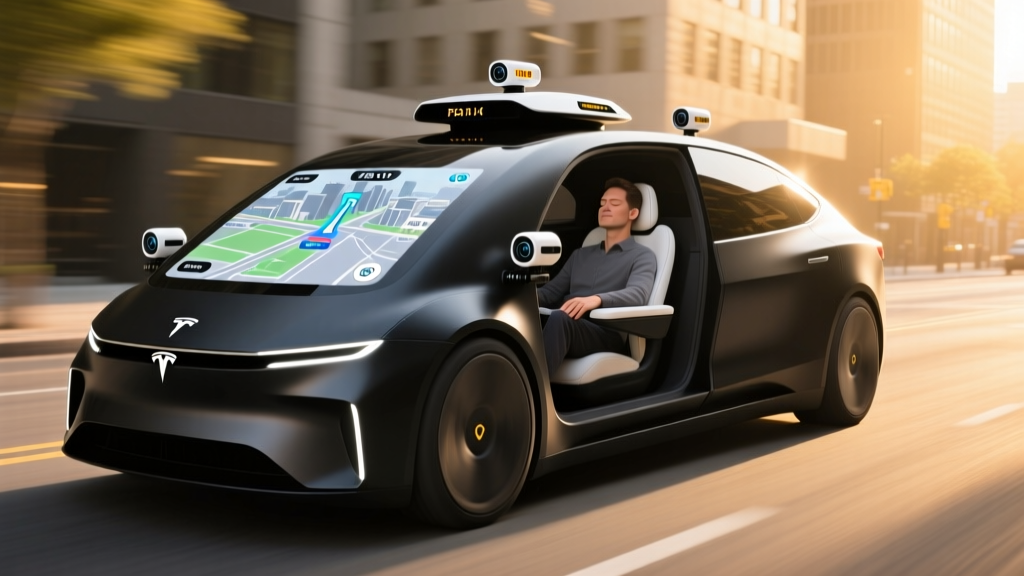
Technically, the system relies entirely on a vision-only sensor suite. Current Tesla vehicles (Model 3 Highland, Model Y Juniper, refreshed Model S/X) ship with HW4, which integrates up to 8 exterior cameras with 5-megapixel sensors, a 12-volt lithium-iron-phosphate auxiliary battery, and a dual-chip neural-network processor capable of roughly 300 trillion operations per second (TOPS). Tesla removed ultrasonic sensors and radar from new production starting in 2022–2023, betting fully on its neural-net vision pipeline — a decision that continues to define how FSD perceives the world.
Despite the "Full Self-Driving" name, FSD Supervised is classified as SAE Level 2 per the SAE J3016 standard. The driver must remain attentive, keep hands available for immediate takeover, and bear full legal responsibility for the vehicle's actions at all times. This is fundamentally different from Level 4 robotaxis like Waymo, which operate without a human driver in defined geofenced zones.
How On-Board FSD Works: Sensors, Compute, and Software
The phrase "on-board" matters because it distinguishes Tesla's edge-compute approach from cloud-dependent systems. Every inference — object detection, lane-line prediction, path planning, occupancy-network modeling — runs on the HW4 silicon inside the car. No internet connection is required for real-time driving decisions, though Tesla periodically pushes over-the-air (OTA) updates that retrain the neural networks on fleet-driving data collected from millions of customer miles.
| Component | Specification | Role |
|---|---|---|
| Compute Platform | HW4 (dual FSD chips) | ~300 TOPS neural-net inference |
| Cameras | 8 exterior, 5 MP each | 360° vision, up to 250m forward range |
| Radar | None (removed 2022+) | N/A — vision-only pipeline |
| Ultrasonic Sensors | None (removed 2022+) | N/A — occupancy network replaces |
| GPS / IMU | Integrated | Localization, inertial reference |
| Software Architecture | End-to-end neural net (v13+) | Perception → planning in unified model |
Starting with FSD v12 in early 2024 and refined through v13 and subsequent 2025–2026 releases, Tesla shifted to an end-to-end neural-network architecture. Instead of modular code stacks (one module for lane detection, another for path planning, etc.), the system now processes raw camera input through a single trained model that outputs steering, acceleration, and braking commands directly. This reduced hard-coded rules and improved behavior in ambiguous scenarios — but it also means the system's decisions are less transparent and harder to predict at edge cases.
Real-World Capabilities: Where FSD Supervised Excels
In extensive real-world use across Model 3, Model Y, Model S, and Model X vehicles, FSD Supervised demonstrates genuine competence in several domains:
- Highway driving: Lane-centering, adaptive cruise, and navigation-guided lane changes on divided highways remain the system's strongest use case. Interventions are rare on well-marked interstates in clear weather.
- Suburban streets: Stop-sign and traffic-light recognition, unprotected left turns, and right-turn-on-red handling have improved substantially in v13+. The system now yields to pedestrians at crosswalks with fewer false-positive stops than earlier versions.
- Parking: FSD includes automatic parking (parallel and perpendicular) and the Summon/Smart Summon feature that navigates parking lots at low speed.
- Road adaptation: The occupancy network allows FSD to handle roads without clear lane markings, construction zones with cones, and temporary detours — scenarios that confused older rule-based systems.
Real-World Limitations: Where You Must Stay Ready
No honest assessment of FSD is complete without detailing where the system still demands immediate driver intervention. These are not rare edge cases — they are recurring scenarios every FSD user encounters.
- Heavy rain, fog, and snow: Camera-only perception degrades significantly when lenses are obscured. The system may issue a takeover request with only 2–3 seconds of warning in heavy precipitation.
- Sun glare and low-angle light: Direct sunrise/sunset into forward cameras can blind the vision system, causing phantom braking or lane-departure drift.
- Construction zones: While improved, complex multi-stage construction zones with shifted lanes, temporary barriers, and flaggers still require frequent takeovers.
- Unprotected left turns across heavy traffic: The system sometimes hesitates excessively or, conversely, initiates turns with insufficient gap judgment in fast-moving oncoming traffic.
- Faded or conflicting lane markings: Roads with old markings visible alongside new ones can confuse the lane-assignment model.
- Emergency vehicles: Response to approaching ambulances, fire trucks, and police vehicles remains inconsistent — always verify manually.
A NHTSA standing general order requires Tesla and other manufacturers to report crashes involving Level 2+ systems. Reviewing these reports provides context: the majority of reported incidents involve rear-end collisions where the human driver was not supervising adequately — reinforcing that Level 2 means you are the fallback system.
FSD Cost: Purchase vs. Subscription in 2026
Tesla has adjusted FSD pricing multiple times. As of the current 2026 model year, here is the cost structure for US buyers:
| Option | Cost | Notes |
|---|---|---|
| Monthly Subscription | $99/month | Cancel anytime; no long-term commitment |
| One-Time Purchase | $8,000 | Tied to vehicle; transfers if you sell the car |
| Basic Autopilot | Included (no extra cost) | Traffic-aware cruise + lane-keeping only |
| Enhanced Autopilot | $6,000 (one-time) | Auto lane change, auto park, summon, Navigate on Autopilot |
For most buyers, the $99/month subscription makes more financial sense unless you plan to keep the vehicle for 7+ years. At $99/month, you'd spend $7,128 over 6 years — still less than the $8,000 upfront purchase. The subscription also lets you pause FSD during months you don't drive much (winter storage, extended travel) and resume later.
Important note: FSD does not qualify for the federal §30D EV tax credit. The credit applies to the vehicle's battery and powertrain, not software add-ons. Check current IRS §30D guidelines for vehicle-level eligibility, which includes MSRP caps ($55,000 for sedans, $80,000 for SUVs/trucks/vans), buyer income limits, and battery critical-mineral sourcing requirements.
Which Tesla Models Include FSD — and What's Standard?
No Tesla ships with FSD Supervised as standard equipment in 2026. Basic Autopilot (traffic-aware cruise control and lane-keeping assist) is included on every new Tesla. FSD is an optional upgrade available at purchase or added later via the Tesla app. Here's the model-level breakdown:
| Model | Standard | FSD Available | Hardware |
|---|---|---|---|
| Model 3 (Highland) | Basic Autopilot | Yes — $99/mo or $8,000 | HW4 |
| Model Y (Juniper) | Basic Autopilot | Yes — $99/mo or $8,000 | HW4 |
| Model S (Refresh) | Basic Autopilot | Yes — $99/mo or $8,000 | HW4 |
| Model X (Refresh) | Basic Autopilot | Yes — $99/mo or $8,000 | HW4 |
| Cybertruck | Basic Autopilot | Yes — $99/mo or $8,000 | HW4 |
Owners of older Tesla vehicles equipped with HW3 (roughly 2019–2022 production) can still run FSD Supervised, though Tesla has indicated HW3 may eventually reach its processing ceiling as neural-network models grow in complexity. A paid HW4 retrofit option has been discussed but not formally offered as of early 2026.
FSD vs. Competing Systems: BlueCruise, Super Cruise, and More
Tesla's FSD is not the only advanced Level 2 system on the market. Understanding how it compares helps frame the purchase decision:
- GM Super Cruise: Operates on 400,000+ miles of pre-mapped divided highways in the US and Canada. Uses LiDAR-mapped HD maps plus a driver-facing camera for attention monitoring. Hands-free on compatible roads — but does not handle city streets or unmapped roads. Included for 3 years on select trims, then ~$25/month.
- Ford BlueCruise: Similar hands-free highway model on 130,000+ miles of pre-approved divided highways. Uses cameras, radar, and a driver-monitoring camera. Available on Mustang Mach-E, F-150 Lightning, and select Lincoln models. Typically $75/month or $2,000 one-time after a trial period.
- Hyundai/Kia Highway Driving Assist 2 (HDA2): Standard or available on many models. Handles highway lane-centering and adaptive cruise but lacks city-street capability and automatic lane changes on base trims.
- Mercedes-Benz Drive Pilot: The only SAE Level 3 system available in the US (Nevada and California), allowing the driver to legally disengage in traffic jams below 40 mph on mapped freeways. Extremely limited operational design domain compared to FSD's broad availability.
The key differentiator: Tesla's FSD attempts to work everywhere — any road, any city — using vision-only perception. GM and Ford restrict hands-free operation to pre-mapped highways, which is more conservative but arguably more predictable. Neither approach is universally "better"; the right choice depends on your driving patterns and risk tolerance.
Safety Context: What the Data Shows
Tesla publishes quarterly vehicle safety reports claiming lower crash rates per million miles driven with Autopilot engaged versus disengaged. However, these reports have methodological limitations — they do not isolate FSD from Basic Autopilot, and the driving environments where Autopilot is used (divided highways) are inherently safer than urban driving where it's typically off.
Independent testing by the Insurance Institute for Highway Safety (IIHS) has consistently rated Tesla's Autopilot/FSD as "acceptable" or lower in its partial-automation evaluation, citing insufficient driver-monitoring safeguards compared to systems like GM's Super Cruise, which earned higher marks for its infrared eye-tracking camera and escalating alert protocol.
The practical takeaway: FSD Supervised can reduce driver fatigue on long trips and handle routine driving competently. But it is not a replacement for attention. Budget your cognitive load as if you're driving — because legally and physically, you are.
Frequently Asked Questions
Is Tesla FSD truly self-driving?
No. Tesla FSD Supervised is SAE Level 2, meaning the driver must remain fully engaged and responsible. The "Full Self-Driving" name is a product label, not a technical classification. Only Level 4 systems like Waymo's robotaxi service operate without a human driver, and those are limited to specific geofenced cities.
Can I add FSD to my Tesla after purchase?
Yes. Any Tesla with HW3 or HW4 can subscribe to or purchase FSD through the Tesla app at any time. The software downloads over-the-air and activates after the next drive cycle.
Does FSD transfer if I sell my Tesla?
If you purchased FSD outright ($8,000), it stays with the vehicle and transfers to the new owner — which can improve resale value. Subscription-based FSD does not transfer; the new owner would need their own subscription.
How does FSD perform in winter weather?
Moderately to poorly, depending on conditions. Light snow on the road is manageable if cameras remain clear. Heavy snowfall, freezing rain coating camera lenses, or fogged optics will trigger immediate takeover requests. Keep camera lenses clean and use the defrost setting proactively in cold weather.
Will HW3 vehicles eventually lose FSD support?
Tesla has not announced a cutoff date, but HW3's processing capacity is significantly lower than HW4's. As neural-network models grow, HW3 may be unable to run the latest FSD versions. Owners should monitor Tesla communications regarding any HW4 retrofit programs.
How does FSD's cost compare to GM Super Cruise or Ford BlueCruise?
Tesla FSD at $99/month is the most expensive subscription among mainstream Level 2 systems. GM Super Cruise runs ~$25/month after a 3-year trial, and Ford BlueCruise is ~$75/month. However, FSD operates on far more road types than the highway-only GM and Ford systems, which partially justifies the premium for drivers who want city-street assistance.