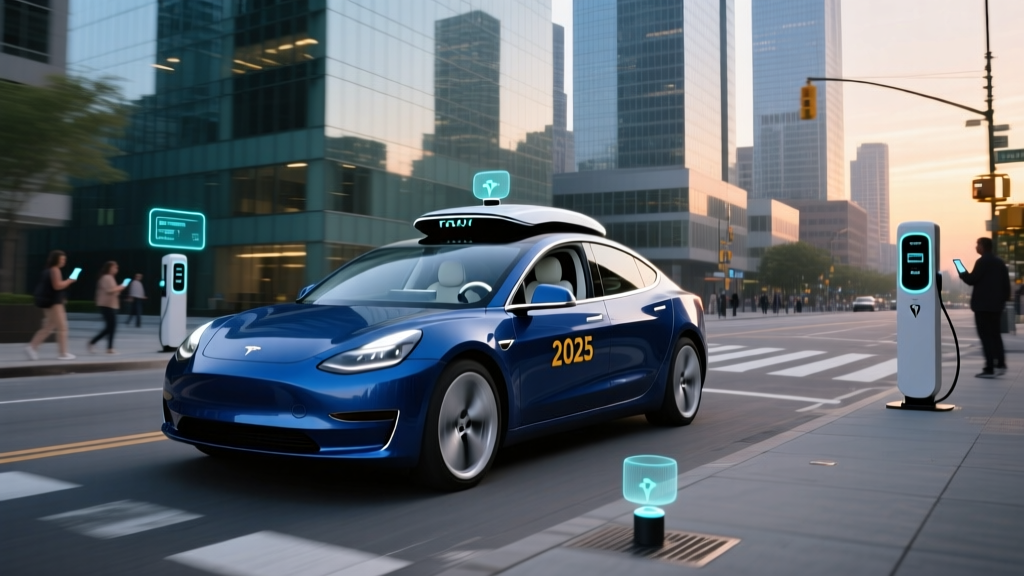
The idea of a Tesla Model 3 operating as a driverless Uber has dominated EV forums and investor threads since 2019. As of early 2026, however, the gap between Tesla's Full Self-Driving (Supervised) and true robotaxi services like Waymo remains substantial. This guide breaks down exactly where Tesla Model 3 autonomous Uber rides capabilities stand in 2025 and heading into 2026, what you can legally do today, and how it compares to Level 4 robotaxi networks that are actually carrying paying passengers without a driver behind the wheel.
SAE Automation Levels: Where Tesla FSD Actually Sits
Before evaluating any autonomous ride-hailing claim, you need a firm grasp of the SAE J3016 automation levels as defined by the National Highway Traffic Safety Administration (NHTSA). The distinction between Level 2 and Level 4 is not a footnote — it determines who is legally responsible when something goes wrong.
SAE Automation Levels at a Glance
| Level | Name | Who Drives | Example |
|---|---|---|---|
| Level 0 | No Automation | Human | Basic cruise control |
| Level 1 | Driver Assistance | Human (one axis assisted) | Adaptive cruise OR lane-keep |
| Level 2 | Partial Automation | Human (must supervise) | Tesla FSD Supervised, GM Super Cruise, Ford BlueCruise |
| Level 3 | Conditional Automation | System (human must take over on request) | Mercedes DRIVE PILOT (limited markets) |
| Level 4 | High Automation | System (no human needed in geofence) | Waymo, Zoox, Cruise (pre-suspension) |
| Level 5 | Full Automation | System (everywhere, all conditions) | Does not exist commercially |
Tesla FSD (Supervised) is Level 2. The driver must remain attentive, keep hands available, and be prepared to intervene at any moment. Tesla's own owner's manual and NHTSA documentation confirm this classification. No regulatory body in the United States has certified any Tesla system as Level 3, 4, or 5.
⚠️ Critical Distinction
Tesla FSD (Supervised) requires an alert, licensed driver in the driver's seat at all times. It cannot legally operate a vehicle without a human supervisor. Any "autonomous Uber" scenario using a Tesla Model 3 today requires a human driver — making it a standard rideshare, not a robotaxi.
Tesla's Robotaxi Ambitions: What's Announced vs. What's Live
In October 2024, Tesla unveiled the Cybercab concept — a dedicated two-seat, steering-wheel-free robotaxi platform. CEO Elon Musk stated production would begin before 2027 and projected a per-mile cost below $0.20. Tesla has also discussed launching an "unsupervised" FSD mode in Austin, Texas, and parts of California in 2025, initially for Tesla-owned fleet vehicles.
As of Q1 2026, here is the status:
- Cybercab: Announced concept. Not in production. No vehicles on public roads carrying passengers.
- Unsupervised FSD fleet trials: Tesla has conducted limited supervised testing in Austin. No publicly available, fare-charging robotaxi service has launched.
- Tesla Model 3/Y as robotaxi: No regulatory approval exists in any U.S. state for a Tesla vehicle to operate without a driver for commercial ride-hailing.
Tesla has not published peer-reviewed safety data for unsupervised FSD operation. The company's quarterly safety reports cover supervised driving only and report "miles per accident" — a metric that differs significantly from the disengagement and intervention rates tracked by Level 4 operators under state DMV reporting requirements.
Where Can You Actually Ride in a Robotaxi Right Now?
If you want to hail a vehicle with no driver today, Level 4 robotaxi services are operational — but only in specific, geofenced areas. Tesla is not among them.
Active U.S. Robotaxi Services (Q1 2026)
| Operator | SAE Level | Live Cities | Availability | Vehicle |
|---|---|---|---|---|
| Waymo (Alphabet) | Level 4 | Phoenix, San Francisco, Los Angeles, Austin (limited) | 24/7 in core zones | Jaguar I-PACE, custom "Waymo Driver" Gen 6 |
| Zoox (Amazon) | Level 4 | Las Vegas (limited), Foster City, CA (testing) | Limited invite/employee | Custom Zoox vehicle (bidirectional) |
| Cruise (GM) | Level 4 | Suspended nationwide (Oct 2023); limited Phoenix return 2025 | Safety driver present during relaunch | Chevrolet Bolt EV / Origin (delayed) |
| Motional (Hyundai/Aptiv) | Level 4 | Las Vegas (via Uber/Lyft partnerships) | Limited hours, safety driver | Hyundai Ioniq 5 |
| Tesla (FSD) | Level 2 | N/A — no driverless service | Not available | Model 3/Y (driver required) |
Where can I use this robotaxi service right now? If you're in Phoenix, San Francisco, Los Angeles, or parts of Austin, you can download the Waymo app and request a fully driverless ride within the geofenced service area. Waymo has completed over 10 million paid trips as of late 2024 and continues expanding. Tesla offers no equivalent service.
How Much Does a Robotaxi Cost vs. Uber and Lyft?
Pricing for robotaxi rides varies by city, time of day, and distance. Waymo's pricing is generally competitive with UberX and Lyft standard rides, with occasional promotional pricing significantly below market rates.
Typical Ride Pricing Comparison (Q1 2026 Estimates)
| Service | 5-Mile Ride (Avg) | 10-Mile Ride (Avg) | Surge Pricing? | Notes |
|---|---|---|---|---|
| Waymo (Phoenix/SF) | $8–$14 | $15–$25 | Yes (moderate) | Promotional rates sometimes as low as $3–$5 |
| UberX | $10–$18 | $18–$32 | Yes (frequent) | Varies heavily by city and demand |
| Lyft Standard | $9–$17 | $17–$30 | Yes (frequent) | Comparable to UberX |
| Tesla Model 3 as Uber (human driver) | $10–$18 | $18–$32 | Yes | Standard UberX/Lyft rates; FSD does not change fare |
| Tesla Cybercab (projected) | ~$3–$6 (claimed) | ~$5–$10 (claimed) | TBD | Announced target; no service exists |
How much does it cost vs Uber/Lyft? Today, a Waymo robotaxi ride costs roughly the same as an UberX trip in the same city. Tesla's projected Cybercab pricing of under $0.20/mile would be dramatically cheaper — roughly $2 for a 10-mile ride — but this is an announced target for a vehicle that hasn't entered production. Any Tesla Model 3 on Uber today is driven by a human and charges standard rideshare rates.
Technology Stack: Camera-Only vs. Lidar + Sensor Fusion
The technology powering Tesla's FSD differs fundamentally from Level 4 robotaxi systems. This isn't a minor engineering preference — it shapes what each system can and cannot do.
Tesla FSD (Supervised) — Vision-Only
- Cameras: 8 cameras (front, side, rear) providing 360° vision
- Radar: Removed from 2022+ vehicles (Tesla Vision only)
- Lidar: None
- Ultrasonic sensors: Removed from late 2022+ vehicles
- Compute: HW4 (AI5 expected in future models)
- Approach: End-to-end neural network trained on fleet driving data; no HD maps; no geofencing
Waymo (Level 4) — Multi-Sensor Fusion
- Cameras: 29+ cameras for redundant visual perception
- Lidar: Custom-built 360° lidar arrays (Gen 6) with 500m+ range
- Radar: Multiple radar units for all-weather object detection
- Audio sensors: External microphones to detect emergency vehicles
- Compute: Custom Waymo Driver hardware
- Approach: HD-mapped geofenced areas; sensor redundancy; remote assistance capability
Tesla's camera-only approach offers scalability — any road with visible lane markings is theoretically drivable. However, camera systems face inherent limitations in heavy rain, fog, direct sun glare, and darkness without street lighting. Lidar provides direct depth measurement independent of lighting conditions, which is why every operational Level 4 robotaxi uses it.
The geofencing tradeoff matters too: Waymo must pre-map every street in its service area, limiting expansion speed but increasing reliability within the zone. Tesla's FSD can theoretically drive anywhere but operates at a lower confidence level and requires human supervision as a fallback.
Safety Data: What the Numbers Actually Show
How safe are robotaxis (real data)? This is the most consequential question in autonomous vehicles, and the data landscape is uneven. Level 4 operators like Waymo report disengagement data to the California DMV and publish trip counts. Tesla reports fleet-wide crash statistics but does not break out FSD-specific disengagement or intervention data in a comparable format.
Safety Data Snapshot
| Metric | Waymo (Level 4) | Tesla FSD Supervised (Level 2) |
|---|---|---|
| Total driverless miles (public) | 40+ million (as of late 2024) | 0 (no driverless operation) |
| Paid trips completed | 10+ million | 0 |
| CA DMV disengagement reports | Published annually; ~1 disengagement per 10,000–15,000 miles (2023 data) | Not reported in comparable format |
| Fatalities (driverless mode) | 0 reported | N/A |
| Fatalities (supervised/Level 2) | N/A | NHTSA has investigated multiple crashes involving Autopilot/FSD; specific FSD-only fatality count not publicly isolated |
| Injury crash rate vs. human baseline | Waymo reports ~85% fewer injury-causing crashes per million miles vs. human benchmark (internal study, 2024) | Tesla reports ~1 crash per 4–5 million miles on Autopilot vs. ~1 per 670,000 miles U.S. average (Tesla Q3 2024 report) |
Important caveats on both sides: Waymo's data comes from geofenced, well-mapped urban areas in favorable weather — not a direct comparison to Tesla's anywhere-goes approach. Tesla's crash statistics are self-reported, combine Autopilot and FSD data, and have been scrutinized by NHTSA for methodology. NHTSA's Standing General Order requires all ADS and Level 2+ manufacturers to report crashes, providing the most neutral dataset, though analysis is ongoing.
Regulatory Landscape: Who Approves Robotaxi Operations?
Deploying a driverless vehicle for commercial passenger service in the U.S. requires navigating a patchwork of state and federal regulations:
- Federal (NHTSA): Sets vehicle safety standards (FMVSS). Currently, FMVSS requires a steering wheel, pedals, and mirrors — which blocks vehicles like the Tesla Cybercab and Zoox from street deployment without exemption. NHTSA also investigates safety defects and can issue recalls.
- State DMVs: California, Arizona, Texas, and Nevada have specific permitting frameworks for driverless testing and commercial deployment. California's CPUC additionally regulates commercial passenger service.
- California CPUC: Granted Waymo its driverless commercial deployment permit in August 2024 for San Francisco, later expanding. Cruise's permit was suspended in October 2023 after safety incidents.
- Arizona: Largely permissive — no specific DMV permit required for testing or deployment, which is why Waymo launched in Phoenix first.
- Texas: Austin allows autonomous vehicle testing and operation under state law (HB 3026, 2023). Tesla is headquartered in Austin and has conducted testing there.
For Tesla to legally operate a driverless Model 3 or Cybercab as a paid ride-hailing service, it would need: (1) state-level deployment permits in each operating jurisdiction, (2) potential FMVSS exemptions for vehicles without steering controls (Cybercab), and (3) commercial passenger service authorization from local regulators. None of these have been secured as of early 2026.
Current Limitations: What Robotaxis (and FSD) Cannot Do
What are the current limitations? Both Level 2 and Level 4 systems have significant operational boundaries that buyers and riders should understand.
Tesla FSD (Supervised) Limitations
- Driver required: A licensed, attentive human must be in the driver's seat. This disqualifies it from robotaxi use entirely.
- Weather degradation: Camera-only system struggles in heavy rain, snow, fog, and direct sun glare. System may disengage and require immediate human takeover.
- Construction zones: Frequently confused by temporary lane markings, cones, and flaggers. Intervention rates spike in work zones.
- Unmapped or changed roads: While FSD doesn't use HD maps, recent road changes can cause routing errors and unexpected maneuvers.
- No remote assistance: If the system encounters an unresolvable scenario, it disengages — there is no remote teleoperations team to guide it.
Level 4 Robotaxi Limitations (Waymo, Zoox)
- Geofenced only: Service operates within pre-mapped boundaries. Rides that cross the geofence edge are not available.
- Weather restrictions: Most Level 4 services reduce availability or suspend operations during heavy rain, snow, or dense fog. Phoenix and LA benefit from favorable weather.
- Limited highway operation: Most robotaxi services operate on surface streets only. Highway merging and high-speed operation remain restricted in most deployments.
- Pickup/dropoff constraints: Vehicles can only stop at approved locations within the geofence. You may need to walk a block from your exact address.
- No rural or suburban coverage: Services are urban-only. Suburban expansion is slow due to mapping and regulatory requirements.
Decision Framework: What Should You Do Today?
Choose a Waymo Robotaxi If:
- You live in or visit Phoenix, San Francisco, Los Angeles, or Austin
- You want a genuinely driverless ride with no human behind the wheel
- Your trip falls within the geofenced service area
- You value a safety record backed by 40+ million driverless miles and published data
Choose a Tesla Model 3 with FSD If:
- You want an advanced Level 2 driver-assist system for your own personal driving
- You're comfortable remaining the responsible driver at all times
- You drive in diverse conditions outside any geofence — highways, rural roads, road trips
- You understand that FSD (Supervised) is not autonomous and cannot be used for driverless ride-hailing
Wait on Tesla's Robotaxi (Cybercab) If:
- You're expecting to earn passive income from your Model 3 as a robotaxi — this is not possible in 2026
- You're making a purchase decision based on promised unsupervised capability — timelines remain unconfirmed
- You need regulatory approval certainty before investing in autonomous ride-hailing infrastructure
Frequently Asked Questions
Is Tesla FSD truly self-driving or driver-assist?
Tesla Full Self-Driving (Supervised) is a Level 2 driver-assist system. The driver must remain attentive, keep hands available for steering input, and be prepared to take over immediately. Tesla's own documentation, NHTSA classification, and the "Supervised" label in the product name all confirm this. It is not self-driving.
Can I use my Tesla Model 3 for autonomous Uber rides in 2025 or 2026?
No. There is no regulatory approval in any U.S. state for a Tesla vehicle to operate as a driverless commercial ride-hailing vehicle. You can drive for Uber or Lyft in a Tesla Model 3, but you must be in the driver's seat and actively supervising the vehicle at all times. Tesla has not launched a robotaxi service.
How does Tesla's camera-only system compare to Waymo's lidar?
Cameras provide rich visual data and scale well across road types, but they lack direct depth measurement and degrade in poor lighting and weather. Lidar provides precise 3D spatial data regardless of lighting, at the cost of higher hardware expense. Every operational Level 4 robotaxi in the U.S. uses lidar alongside cameras and radar for redundancy. Tesla has chosen to eliminate lidar, radar, and ultrasonic sensors in favor of vision-only.
What would a Tesla Cybercab ride cost if it launches?
Tesla has projected a per-mile operating cost below $0.20 for the Cybercab, which would translate to roughly $2–$4 for a 10-mile ride — substantially cheaper than current UberX or Waymo pricing. However, the Cybercab is an announced concept with no production timeline confirmed, no regulatory approvals secured, and no published third-party safety validation.
Which is safer: Waymo robotaxi or Tesla FSD?
Direct comparison is difficult because the systems operate differently. Waymo has 40+ million driverless miles with zero reported fatalities in driverless mode, operating in controlled geofenced areas. Tesla FSD operates everywhere but requires a human driver, and its safety data is self-reported in a different format. NHTSA's Standing General Order crash database provides the most neutral comparison, but comprehensive analysis is still evolving. Neither system should be considered infallible.
When will Tesla actually launch a driverless robotaxi service?
Tesla has targeted 2025–2026 for limited unsupervised FSD fleet trials in Austin, Texas. The Cybercab production timeline has been stated as "before 2027." These are company projections, not regulatory commitments. Tesla has a history of announcing autonomy timelines that shift significantly. As of early 2026, no Tesla robotaxi service is operational, and no state has granted Tesla a driverless commercial deployment permit.