Tesla's FSD Packaging Shift: What Changed and Why It Matters
If you've been tracking Tesla's option sheets, you may have noticed a significant shift in how Full Self-Driving (Supervised) is bundled and sold. The headline: Tesla limited FSD in luxe packages to the original owner, effectively ending the era where a loaded vehicle's premium software suite could transfer freely to a second buyer on the used market. This move has implications for resale value, used-EV shopping strategy, and how buyers should think about a $8,000 software investment.
For years, FSD (Supervised) was one of Tesla's most debated features — a $8,000 one-time purchase or $99/month subscription that promised progressive capability improvements. Now, by tethering FSD bundled in luxury-tier packages to the original purchaser, Tesla is reshaping the economics of its highest-trim vehicles and forcing buyers to make sharper decisions at the point of sale.
Here's a complete breakdown of what FSD (Supervised) actually does, how this packaging change works, and what it means whether you're ordering a new Model S, buying a used Model Y, or comparing Tesla's system to BlueCruise and Super Cruise.
What FSD (Supervised) Actually Does — and Doesn't Do
Tesla's Full Self-Driving (Supervised) is a Level 2 driver-assistance system per the SAE J3016 standard. This means the system can simultaneously manage steering, acceleration, and braking under certain conditions, but the driver must remain fully engaged, monitor the road at all times, and be prepared to take over instantly. It is not autonomous driving. Tesla's own owner's manual and the "Supervised" suffix in the branding make this explicit.
FSD (Supervised) builds on Tesla's base Autopilot system, which handles adaptive cruise control and lane centering on highways. FSD adds several layers of functionality:
| Feature | Description | Requires FSD? |
|---|---|---|
| Traffic-Aware Cruise Control | Maintains set speed and following distance | No (Autopilot) |
| Autosteer (Lane Centering) | Keeps vehicle centered in marked highway lanes | No (Autopilot) |
| Auto Lane Change | Initiates lane changes when turn signal is activated | Yes |
| Navigate on Autopilot | Suggests and executes highway exits, interchanges, and overtakes based on navigation route | Yes |
| Autopark | Detects parking spaces and steers vehicle into parallel or perpendicular spots | Yes |
| Smart Summon | Vehicle navigates a parking lot to the driver's phone location at low speed | Yes |
| Traffic Light & Stop Sign Control | Detects and responds to traffic lights and stop signs (driver confirmation required) | Yes |
| City Street Autosteer | Handles turns, intersections, and urban driving on surface streets | Yes |
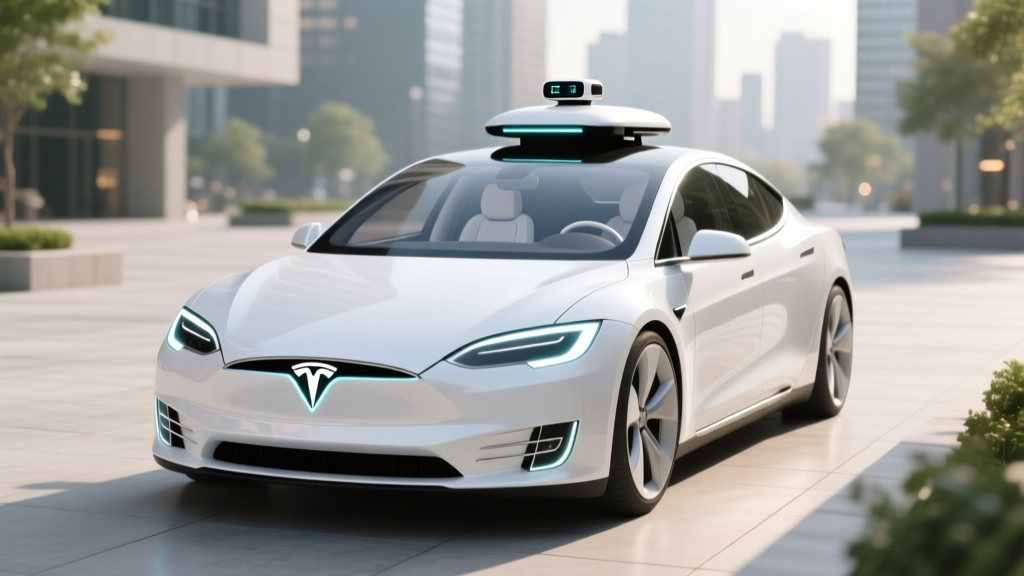
Technically, FSD (Supervised) relies entirely on a camera-only vision system. Tesla removed ultrasonic sensors (USS) from new production vehicles starting in late 2022 and radar from most models by 2023. The current hardware suite (HW4, also called AI4) includes up to 8 cameras providing 360-degree coverage, processed by a dual-chip FSD computer capable of approximately 300 trillion operations per second (TOPS). There is no LiDAR, no radar, and no ultrasonic backup — a deliberate architectural bet on neural-network-driven vision processing.
This distinguishes Tesla from competitors like GM's Super Cruise, which uses LiDAR-mapped highway data, and Ford's BlueCruise, which combines cameras and radar. Tesla's approach allows broader geographic coverage (no pre-mapped roads required) but introduces different edge-case behaviors in poor visibility.
The Packaging Change: FSD Tied to the Original Owner
Tesla's decision to limit FSD bundled in luxe packages to the original owner means that when a vehicle equipped with FSD through a premium trim or package is sold or transferred, the FSD capability does not carry over to the new owner. The software license is effectively non-transferable in these bundled configurations.
Here's what this looks like in practice:
- Standalone FSD purchase ($8,000): Historically, FSD purchased outright was tied to the vehicle and could transfer to subsequent owners. Tesla has periodically changed this policy — verify current terms at purchase.
- FSD bundled in luxe packages: Now explicitly limited to the original owner. If you sell the vehicle, the new owner does not inherit FSD capability.
- FSD Subscription ($99/month): Always tied to the original owner's Tesla account. Cancels upon vehicle transfer.
- Promotional FSD transfers: Tesla has occasionally offered limited-time FSD transfer promotions (e.g., early 2024 and mid-2025). These are exceptions, not policy.
This change primarily affects the resale market. A used 2025 Model S Plaid that originally shipped with FSD bundled in a luxury package will arrive at its second owner without FSD capability, regardless of what the original buyer paid. Used-car listing sites and Tesla's own CPO inventory may still advertise "FSD equipped," but buyers should verify transferability before paying a premium.
Which Tesla Models and Trims Include FSD?
As of the 2026 model year, here's how FSD availability breaks down across Tesla's lineup. Note that base Autopilot (TACC + Autosteer) is standard on every Tesla vehicle.
| Model / Trim | Base MSRP (2026) | Autopilot | FSD (Supervised) Availability |
|---|---|---|---|
| Model 3 Rear-Wheel Drive | $38,990 | Standard | $8,000 add-on or $99/mo subscription |
| Model 3 Long Range AWD | $44,990 | Standard | $8,000 add-on or $99/mo subscription |
| Model Y Long Range AWD | $44,990 | Standard | $8,000 add-on or $99/mo subscription |
| Model S Long Range | $74,990 | Standard | Available in luxe package (original owner only) or standalone |
| Model S Plaid | $89,990 | Standard | Available in luxe package (original owner only) or standalone |
| Model X Long Range | $77,990 | Standard | Available in luxe package (original owner only) or standalone |
| Cybertruck AWD | $60,990 | Standard | $8,000 add-on or $99/mo subscription |
The "luxe packages" referenced in the packaging change primarily apply to the Model S and Model X, where Tesla bundles FSD with other premium features (premium interior upgrades, enhanced connectivity, accelerated performance modes) into a higher-tier configuration. By limiting FSD in these bundles to the original owner, Tesla effectively makes the software a consumable tied to the first purchase, not a permanent vehicle asset.
FSD Cost Breakdown: Purchase vs. Subscription
| Option | Cost | Transferable? | Best For |
|---|---|---|---|
| One-Time Purchase | $8,000 | Varies — standalone may transfer; bundled in luxe packages does not | Owners planning to keep the vehicle 5+ years |
| Monthly Subscription | $99/month | No — tied to original Tesla account | Buyers who want to try FSD or don't plan to keep the car long-term |
| Included in Luxe Package | Bundled in trim price (varies by model) | No — limited to original owner | Original buyers wanting a fully loaded vehicle |
The breakeven math on the subscription versus purchase is straightforward: at $99/month, you hit $8,000 in approximately 81 months (6 years and 9 months). If you plan to keep the car longer than that and intend to use FSD regularly, the one-time purchase makes financial sense — but only if you're confident the transferability policy won't change again before you sell.
For buyers of used Teslas where FSD is listed as included, always confirm with Tesla directly (via the vehicle's VIN) whether the FSD license will actually transfer. The original owner's purchase method — standalone, subscription, or bundled package — determines this, and listing descriptions are frequently inaccurate.
Real-World Performance and Limitations
FSD (Supervised) has improved substantially since its initial beta rollout, but real-world usage reveals consistent patterns that buyers should understand before committing $8,000.
Where it excels:
- Highway driving on well-marked interstates: lane changes, merge handling, and navigation-based exits are generally smooth and predictable
- Adaptive cruise behavior in stop-and-go traffic: the system is less aggressive than many human drivers and handles cut-ins competently
- Low-speed parking maneuvers: Autopark works reliably in clearly marked spaces with adequate clearance
Known limitations:
- Weather degradation: Heavy rain, fog, snow, and direct sun glare can cause the vision-only system to disengage or reduce confidence. Unlike radar-equipped competitors, Tesla has no sensor redundancy for low-visibility conditions.
- Construction zones: Temporary lane markings, cones, and shifted lanes remain challenging. Expect frequent disengagements in active work zones.
- Unprotected left turns: City-street FSD still hesitates or misjudges gaps during unprotected left turns across oncoming traffic in many scenarios.
- Faded or conflicting lane markings: The system can become confused by old markings, lane reconfigurations, or roads where paint has degraded significantly.
- Phantom braking: While reduced compared to earlier versions, sudden deceleration without an apparent obstacle still occurs occasionally, particularly on highways with overpasses or shadows.
- Rural and unmapped roads: Performance degrades on poorly marked rural roads, gravel surfaces, and roads absent from Tesla's map data.
FSD (Supervised) requires continuous driver attention. Tesla's cabin camera monitors eye gaze and will issue escalating warnings — visual, audible, then system lockout — if it detects inattention. You are legally and operationally the driver at all times. NHTSA has investigated multiple crashes involving Autopilot and FSD, and the NHTSA's ongoing investigation into Tesla driver-assist systems underscores that these systems require active supervision. Hands must remain on or near the wheel (Tesla uses torque-based detection on the steering wheel).
How Tesla FSD Compares to Competing ADAS Systems
Tesla's FSD is not the only advanced Level 2 system on the market. Here's how it stacks up against the major competitors in the 2026 model year:
| Feature | Tesla FSD (Supervised) | GM Super Cruise | Ford BlueCruise | Hyundai/Kia HDA2 |
|---|---|---|---|---|
| SAE Level | Level 2 | Level 2 | Level 2 | Level 2 |
| Sensor Suite | Cameras only (8 cameras) | Cameras + LiDAR map + radar | Cameras + radar | Cameras + radar |
| Hands-Free Highway? | No — torque detection on wheel | Yes — on pre-mapped highways (500,000+ mi) | Yes — on pre-mapped highways (130,000+ mi) | No — hands-on required |
| City Street Driving? | Yes (all roads) | No (highway only) | No (highway only) | No (highway only) |
| Auto Lane Change? | Yes | Yes | Yes | Yes (with confirmation) |
| Cost | $8,000 or $99/mo | $2,200 (one-time) or included in select trims | $2,100 (one-time) or $75/mo (after trial) | Included in higher trims |
| Geographic Coverage | Any road (no pre-mapping) | Pre-mapped divided highways only | Pre-mapped divided highways only | Any marked highway |
The fundamental tradeoff is coverage versus precision. Tesla's vision-only approach works on virtually any road, making it the most geographically flexible system. However, GM's Super Cruise and Ford's BlueCruise offer genuine hands-free driving on mapped highways — something Tesla does not permit — and their sensor redundancy (LiDAR or radar) provides more robust performance in challenging conditions.
If your driving is predominantly highway commuting on major interstates, Super Cruise or BlueCruise may deliver a more relaxed, confidence-inspiring experience at a lower price point. If you want driver-assist capability on surface streets, rural roads, and in urban environments, FSD (Supervised) remains the only consumer system offering that breadth.
What This Means for Your Purchase Decision
The decision framework for FSD in light of Tesla's packaging change comes down to three scenarios:
Buy FSD outright ($8,000) if: You're the original buyer, plan to keep the vehicle 5+ years, drive in varied conditions where city-street assist adds value, and understand the system's limitations. Verify current transferability terms before purchase.
Subscribe ($99/month) if: You want to evaluate FSD before committing, plan to keep the vehicle under 4 years, or want the flexibility to cancel during months where you don't use it (e.g., winter in regions with heavy snow).
Skip FSD entirely if: Your driving is mostly highway commuting (base Autopilot handles this well), you're buying a used Tesla where FSD transfer is uncertain, or you're comparing against Super Cruise/BlueCruise and find those systems adequate for your needs at a lower cost.
Buying used with "FSD included"? Demand written confirmation from Tesla (via VIN lookup) that the FSD license transfers. Listings that claim FSD is included but where the original owner received it through a luxe package will leave you without the feature after transfer.
Frequently Asked Questions
Is Tesla FSD actually self-driving?
No. Tesla FSD (Supervised) is an SAE Level 2 driver-assistance system. The driver must remain fully engaged, monitor the road continuously, and be prepared to take control at any moment. The "Supervised" designation in the product name reflects this requirement. Only Level 4 systems — such as Waymo's robotaxi service operating in designated geographic zones — qualify as truly driverless.
Why did Tesla limit FSD in luxe packages to the original owner?
While Tesla hasn't published a detailed rationale, the move aligns with a broader industry trend of treating advanced software as a service tied to the purchaser rather than a permanent vehicle feature. It also protects Tesla's recurring revenue model by preventing second-hand buyers from inheriting software they never paid for, and it may incentivize new vehicle purchases over used.
Can I add FSD to a used Tesla that doesn't have it?
Yes. Any Tesla vehicle with HW3 or newer hardware (essentially all vehicles built from April 2019 onward) can purchase FSD (Supervised) as an aftermarket add-on for $8,000 or subscribe at $99/month through the Tesla app, regardless of ownership history.
Does FSD improve over time with updates?
Yes. Tesla regularly pushes over-the-air updates to FSD that modify driving behavior, add capabilities, and address known limitations. Major version updates have historically changed system behavior significantly. However, improvement pace and specific capability additions are at Tesla's discretion and not guaranteed on any timeline.
How does the §30D federal tax credit interact with FSD?
The IRS §30D clean vehicle credit applies to the vehicle purchase price, not to standalone software purchases. If FSD is bundled into the vehicle's MSRP (as in a luxe package), it's part of the total price subject to MSRP caps ($55,000 for sedans, $80,000 for SUVs/pickups). If purchased separately as a $8,000 add-on after vehicle delivery, it is not covered by the tax credit. Income limits ($150,000 single / $300,000 joint AGI) and battery sourcing requirements also apply. Consult a tax professional for your specific situation.
What happens to FSD if I trade in my Tesla?
If you purchased FSD standalone and it's designated as transferable, it remains with the vehicle for the next owner. If FSD was bundled in a luxe package or purchased via subscription, it does not transfer — the new owner will receive the vehicle without FSD capability. Tesla's trade-in valuation tools may or may not account for this distinction, so verify before accepting a trade offer.
Is Tesla's camera-only approach less safe than systems with LiDAR or radar?
This is a subject of ongoing debate and IIHS testing has not awarded Tesla's Autopilot/FSD its top driver-assist rating, while some radar-equipped competitors have performed well in controlled evaluations. Tesla argues that a sufficiently advanced vision system can match or exceed human perception. Critics point to edge cases — heavy rain, fog, direct glare — where radar or LiDAR provides redundancy that cameras lack. Real-world safety data remains mixed, and NHTSA investigations continue.