What Tesla's HW4 FSD Computer Actually Is
Since early 2023, Tesla has been installing its Hardware 4 (HW4) computer — also called AI4 — into new Model S, Model X, Model 3 Highland, and Model Y Juniper vehicles. The HW4 FSD computer represents the most significant sensor and compute overhaul Tesla has executed since the transition from HW2.5 to HW3 in 2019. For buyers evaluating a new Tesla or owners wondering whether their HW3 vehicle is falling behind, understanding these hardware changes is essential to setting realistic expectations about what the system can and cannot do.
HW4 is not a software update you can download. It is a physical suite of upgraded cameras, a redesigned neural-network processing chip, and a reconfigured sensor layout that Tesla's engineering team has been iterating on since late 2022. The changes affect how the car perceives the world around it — resolution, field of view, low-light performance, and processing throughput — which in turn determines the ceiling for what Full Self-Driving (Supervised) can achieve.
SAE Automation Level: Level 2 — Not Self-Driving
Despite the "Full Self-Driving" name, Tesla's FSD (Supervised) operates at SAE Level 2 automation. This means the system provides combined steering, acceleration, and braking assistance, but the driver must remain fully engaged — eyes on the road, hands available to take over immediately. Tesla's owner manuals and the NHTSA's automation framework confirm this classification. Only fully driverless robotaxi services like Waymo operate at Level 4. No consumer Tesla vehicle is autonomous.
HW4 vs HW3: The Camera Suite Overhaul
The most visible change in the HW4 platform is the camera array. Tesla moved from a suite of eight cameras on HW3 vehicles to a reconfigured set of seven to eight cameras on HW4, depending on the model and production date. The differences are not cosmetic — they represent fundamental upgrades in sensor capability.
| Attribute | HW3 (2019–2023) | HW4 / AI4 (2023–2026) |
|---|---|---|
| Front-facing main camera | 1.2 megapixels, single lens | 5 megapixels, narrower FOV (~50°) |
| Front wide camera | 1.2 MP, ~120° FOV | 5 MP wide lens retained |
| Side repeater cameras (fenders) | 1.2 MP each | 5 MP each, improved low-light |
| Rear camera | 1.2 MP | 5 MP on newer builds |
| Total camera count | 8 | 7–8 (varies by model/year) |
| Ultrasonic sensors (USS) | 12 sensors (pre-Oct 2022) | Removed — Tesla Vision only |
| Radar | Removed (mid-2021 onward) | No radar (Tesla Vision only) |
The jump from 1.2 MP to 5 MP sensors is the headline spec, but the practical impact goes deeper. Higher resolution allows Tesla's neural networks to identify objects — pedestrians, lane markings, debris — at greater distances. On a highway at 70 mph, a 5 MP front camera can resolve a stopped vehicle approximately 300–400 meters ahead versus roughly 150–200 meters with the older 1.2 MP unit. That extra detection distance buys the FSD software more time to plan lane changes or deceleration.
The removal of ultrasonic sensors (USS), which began in October 2022 under Tesla's "Tesla Vision" initiative, means HW4 vehicles rely entirely on camera-based depth estimation for low-speed maneuvers like parking. Tesla replaced USS with a vision-based parking-assistance system that uses neural-network-generated occupancy maps. In practice, this has been a mixed bag: early implementations struggled with curb detection and tight-space judgment, though iterative software updates through 2025 and into 2026 have improved accuracy. Still, many owners report that the old USS-equipped HW3 cars felt more confident in tight parallel-parking scenarios.
The Compute Upgrade: AI4 Inference Chip
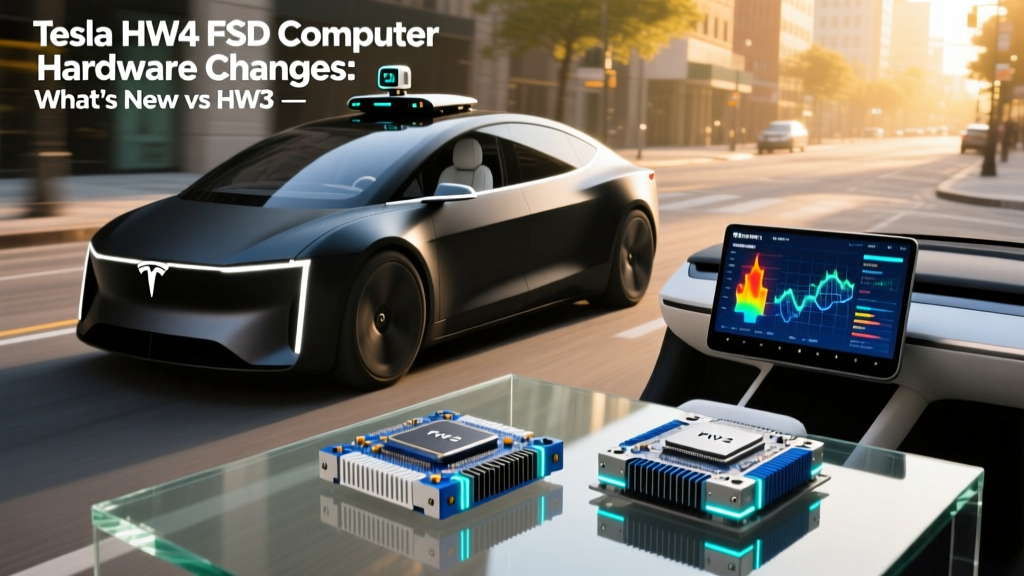
Beneath the camera changes sits a redesigned FSD computer. The HW3 unit used a dual-chip configuration with Tesla's custom 14nm neural-network accelerator, delivering approximately 144 TOPS (trillions of operations per second) of inference throughput. The HW4 (AI4) chip, fabricated on a more advanced process node (believed to be 7nm-class, manufactured by Samsung), is estimated to deliver roughly 3 to 5 times the effective inference performance of HW3.
What does that mean in practical terms? More TOPS allows Tesla's FSD software to run larger, more complex neural networks in real time. This includes:
- Higher-resolution occupancy networks — the car builds a more detailed 3D model of its surroundings, voxel by voxel, rather than relying on pre-trained object labels alone.
- End-to-end neural planning — FSD v12 and later moved toward a neural-network-based planning architecture (replacing much of the older C++ heuristic code). This approach demands significantly more compute for inference at every decision cycle.
- Multi-camera fusion at higher frame rates — processing eight 5 MP streams simultaneously at 36 fps requires substantial memory bandwidth and parallel processing capacity.
Tesla has not published official TOPS figures for AI4, and teardown analyses by third-party hardware researchers have provided estimates rather than confirmed specifications. The consensus from engineering analyses is that AI4 provides enough headroom for Tesla's current end-to-end FSD architecture and anticipated near-term model complexity increases.
Real-World Capabilities and Limitations of HW4 FSD
On paper, HW4's superior sensors and compute should translate directly into better driving performance. In real-world use across 2024, 2025, and into 2026, the picture is more nuanced.
What HW4 FSD (Supervised) Does NOT Do
- Drive without supervision. You must monitor the road at all times. The system will issue escalating alerts and eventually disengage if it detects inattention.
- Handle all weather conditions. Heavy rain, fog, snow, and direct sun glare can degrade camera performance. The system may disengage or behave unpredictably.
- Navigate construction zones reliably. Temporary lane markings, cones, and shifted lanes remain challenging edge cases.
- Replace driver judgment at complex intersections. Unprotected left turns across traffic, roundabouts with heavy flow, and non-standard road geometries require active driver oversight.
- Operate without lane markings. Rural roads with faded or absent markings reduce system confidence and may trigger disengagement.
Where HW4 shines: On well-marked highways and freeways, FSD (Supervised) on HW4 hardware delivers noticeably smoother lane-keeping, more confident lane changes, and better speed management than the same software running on HW3. The higher-resolution cameras provide the neural network with more information about adjacent-lane vehicles' trajectories, which translates to fewer phantom braking events and more natural following-distance adjustments.
City streets remain the frontier. FSD (Supervised) on city streets — navigating traffic lights, stop signs, crosswalks, and multi-lane intersections — has improved substantially with the v12.x and v13.x end-to-end neural architecture. However, this is precisely where HW4's camera-only approach shows its constraints. Without radar or lidar for redundant depth sensing, the system depends entirely on monocular and stereo depth estimation from cameras. In low-contrast conditions (dusk, heavy overcast, wet roads reflecting light), depth estimation can introduce latency or errors that a lidar-equipped system like Waymo's would not encounter.
Cold-weather and adverse conditions: Camera lenses can accumulate ice, road salt spray, and condensation in winter conditions. Tesla added a camera-cleaning system (washer nozzles for the front cameras) on some HW4-equipped models, which helps, but rear and side cameras remain vulnerable to obscuration. Any blocked camera can trigger FSD disengagement. In sub-freezing testing, owners have reported needing to manually clear camera lenses before FSD would engage — a practical limitation that sensor-fusion approaches with radar would partially mitigate.
Cost, Availability, and Which Models Include HW4
As of 2026, all new Tesla vehicles rolling off the production line are equipped with HW4 (AI4) hardware. Here is how the feature and cost structure breaks down:
| Feature | What's Included | Cost |
|---|---|---|
| Basic Autopilot | Traffic-aware cruise control, autosteer (lane-keeping on marked highways) | Included with every new Tesla |
| Enhanced Autopilot (EAP) | Auto lane change, autosteer on highways, navigate on Autopilot, auto park, summon | $6,000 one-time purchase |
| Full Self-Driving (Supervised) | All EAP features plus traffic light and stop sign control, city street autosteer | $8,000 one-time purchase or $99/month subscription |
| Model | HW4 Availability | FSD (Supervised) Eligible |
|---|---|---|
| Model S (2023+) | Yes — all builds from ~March 2023 | Yes |
| Model X (2023+) | Yes — all builds from ~March 2023 | Yes |
| Model 3 Highland (2024+) | Yes — all refreshed builds | Yes |
| Model Y Juniper (2025+) | Yes — all refreshed builds | Yes |
| Cybertruck (2024+) | Yes — HW4 from launch | Yes (FSD rolled out progressively through 2024–2025) |
| Model 3 pre-refresh (2019–2023) | No — HW3 hardware | Yes, but on HW3 compute |
Can you upgrade from HW3 to HW4? Tesla has not offered a general HW3-to-HW4 retrofit program. Some early reports suggested that vehicles purchased with a one-time FSD license might receive hardware upgrades if Tesla deems HW3 insufficient for future FSD versions, but as of early 2026, no broad upgrade program has materialized. If you own an HW3 vehicle with FSD purchased, your system continues to receive software updates, but it runs on the older compute and camera platform. The practical gap is widening as Tesla's neural networks grow in complexity and are optimized for AI4's throughput.
Tesla's FSD pricing has fluctuated over the years. The $8,000 purchase price and $99/month subscription reflect early-2026 pricing; Tesla has historically adjusted FSD pricing without warning. The Tesla Autopilot page lists current pricing and feature breakdowns.
How HW4 FSD Compares to Competing ADAS Systems
Tesla's camera-only, neural-network-heavy approach stands apart from most competitors, who use sensor fusion combining cameras, radar, and sometimes lidar. Here is how HW4 FSD stacks up against the leading Level 2 systems available in 2026:
- Ford BlueCruise (GM Super Cruise on mapped highways): Both Ford's BlueCruise 1.5 and GM's Super Cruise use driver-monitoring cameras and allow true hands-off driving on pre-mapped divided highways — something Tesla's FSD (Supervised) still does not officially permit. However, neither system handles city streets. Their highway coverage is limited to roughly 130,000–200,000 miles of pre-scanned roads. Tesla FSD covers any road, but requires hands-on engagement.
- Mercedes-Benz Drive Pilot (Level 3, limited): Mercedes received approval for conditional Level 3 operation in Nevada and California, allowing the driver to disengage in traffic jams under 40 mph on specific highways. This is a genuine step above Level 2, but it is geofenced to narrow conditions. Tesla FSD operates everywhere but stays at Level 2.
- Hyundai/Kia Highway Driving Assist 2 (HDA2): A capable Level 2 system with machine-learning-based lane-centering and adaptive cruise, but it lacks city-street capability and Tesla's end-to-end neural architecture.
- Waymo (Level 4 robotaxi): Waymo's fully driverless vehicles use a roof-mounted lidar array, multiple radars, and cameras — a sensor suite costing tens of thousands of dollars per vehicle. Waymo operates in defined metro areas (Phoenix, San Francisco, Los Angeles, Austin as of 2025–2026). It is genuinely autonomous within its service area but is not a consumer product you can purchase.
The fundamental tradeoff with Tesla HW4 FSD is breadth versus assurance. Tesla's system attempts to drive on any road in any condition, which is an enormously difficult engineering problem. Competing Level 2 systems restrict their operational domain (mapped highways only, specific speeds, specific conditions) and deliver more consistent performance within that domain. Neither approach is universally "better" — the right choice depends on where and how you drive.
The Retrofit Question and Long-Term Outlook
Owners of HW3 Teslas with purchased FSD licenses face an uncomfortable reality: Tesla's software development is increasingly optimized for HW4 hardware. While HW3 vehicles continue to receive FSD updates, the neural-network models deployed to HW3 may be pruned or simplified versions of what HW4 runs, constrained by the older chip's memory and compute limits. Over time, this could mean HW3 vehicles receive fewer feature improvements or experience performance gaps compared to HW4 counterparts.
Tesla's history with hardware transitions offers a partial precedent. When Tesla moved from HW2.5 to HW3 in 2019, the company did eventually offer free hardware upgrades to customers who had purchased FSD on the older platform. Whether Tesla will repeat this for HW3-to-HW4 remains unannounced. If you are buying a used Tesla today, verifying the hardware version (visible in the vehicle's Software menu under "Additional Vehicle Information") should factor into your purchase decision — especially if you plan to subscribe to or purchase FSD.
Looking ahead, Tesla has referenced a next-generation AI5 chip in development, with CEO Elon Musk suggesting it could deliver another order-of-magnitude improvement in inference performance. No timeline or deployment details have been confirmed, and as with all forward-looking Tesla hardware statements, treat announcements as preliminary until vehicles ship with the hardware in hand.
Frequently Asked Questions
Is Tesla FSD on HW4 actually self-driving?
No. Tesla FSD (Supervised) is an SAE Level 2 driver-assistance system. The driver must remain engaged, monitor the road, and be prepared to take over at any moment. Calling it "self-driving" is inaccurate and potentially dangerous. The "Supervised" designation Tesla added to the product name in 2024 reflects this regulatory and technical reality.
How can I tell if my Tesla has HW3 or HW4?
On your Tesla's touchscreen, navigate to Controls > Software > Additional Vehicle Information. The "Autopilot Computer" field will list either "Hardware 3" or "Hardware 4" (sometimes labeled "AI4"). Additionally, HW4 vehicles have noticeably different camera housings — the front camera module above the rearview mirror is larger and has a different lens arrangement visible from outside the car.
Can I upgrade my HW3 Tesla to HW4?
As of early 2026, Tesla has not announced a general retrofit program for HW3-to-HW4 upgrades. Some customers who purchased FSD on HW3 may eventually be offered upgrades if Tesla determines HW3 cannot support future FSD versions, but this is unconfirmed. If HW4 capability is important to you, purchase a vehicle confirmed to have HW4 hardware.
Does HW4 improve range or efficiency?
Not directly. HW4 is a sensor and compute platform — it does not change the powertrain, battery, or aerodynamics. However, the more efficient AI4 chip may draw marginally less power than the HW3 computer under heavy inference loads. Any efficiency difference would be negligible relative to the vehicle's total energy consumption (measured in Wh/mi).
What is the monthly cost of FSD on a HW4 Tesla?
Tesla FSD (Supervised) is available as a $99/month subscription or an $8,000 one-time purchase as of early 2026. Pricing has changed multiple times in the past, so check Tesla's official Autopilot page for the latest figures before committing. The subscription model is a lower-risk way to evaluate FSD before committing to the full purchase price.
Why did Tesla remove ultrasonic sensors and radar?
Tesla's stated rationale is that a pure vision-based approach ("Tesla Vision") using neural networks can match or exceed the performance of sensor-fusion systems at lower cost and complexity. The company argues that human drivers navigate the world using only vision (eyes), and that sufficiently advanced neural networks can achieve the same. Critics, including many robotics and autonomous-driving researchers, point out that cameras lack the direct depth measurement and all-weather reliability of lidar and radar. The real-world results are mixed: Tesla Vision parking has improved significantly but still lags the consistency of ultrasonic-equipped vehicles in tight spaces.
Does FSD work in winter and bad weather?
FSD (Supervised) can operate in rain and overcast conditions, but performance degrades in heavy precipitation, snow, fog, and situations where camera lenses become obscured by road spray or ice. Tesla's camera-washer system (on equipped models) helps with front-camera visibility, but side and rear cameras lack active cleaning. If any critical camera is blocked, FSD will disengage and alert the driver. In winter conditions, expect to manually clear cameras and accept that FSD availability will be intermittent. For more on how EVs perform in cold weather generally, see the Department of Energy's EV technology overview.