Understanding Tesla Hardware 3 and Full Self-Driving
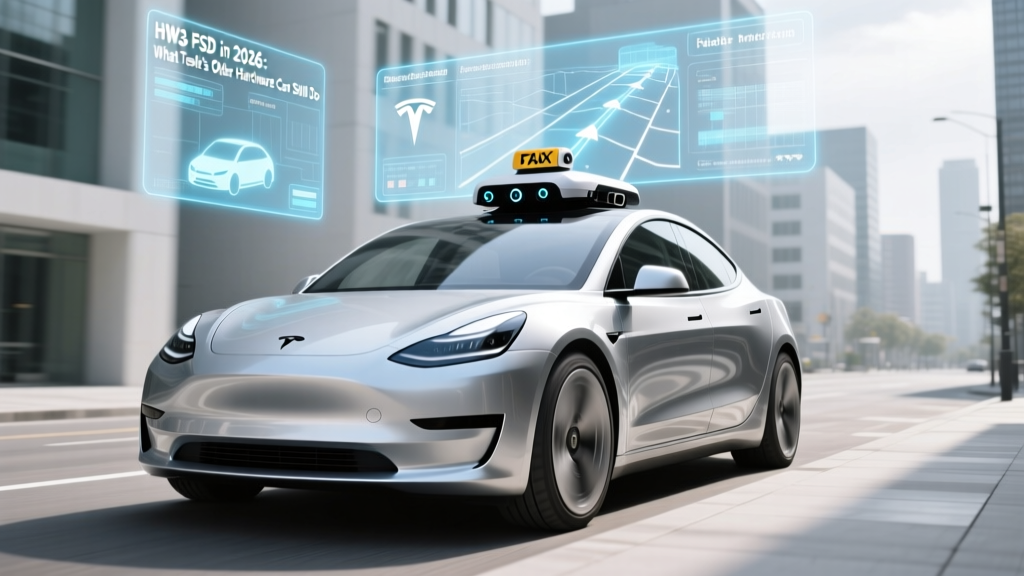
If you own a Tesla built between April 2019 and early 2023, your vehicle is equipped with Hardware 3 (HW3), also known as the "Full Self-Driving Computer." As Tesla has moved to Hardware 4 (HW4/AI4) on newer vehicles, many owners are asking whether HW3 FSD remains a capable, supported platform in 2026 — or whether they're being left behind. The short answer: HW3 still runs Tesla's latest FSD (Supervised) software, but with meaningful hardware constraints that affect real-world performance.
HW3 uses a custom Tesla-designed neural network processor that replaced the older Nvidia Drive PX2 chip. It processes input from Tesla's camera-only vision stack — eight exterior cameras providing 360-degree coverage — without any radar or ultrasonic sensor assistance (Tesla removed ultrasonic sensors starting in late 2022 on many models). The chip delivers approximately 144 TOPS (trillions of operations per second) of inference performance, which was industry-leading at launch but is now outpaced by HW4's estimated 300+ TOPS and higher-resolution camera inputs.
Tesla's FSD (Supervised) — whether running on HW3 or HW4 — is classified as SAE Level 2 driver assistance. This means the system provides combined steering and acceleration/braking support, but the driver must remain fully engaged, monitor the road at all times, and be prepared to take over instantly. It is not "self-driving." No consumer Tesla vehicle operates at Level 3, 4, or 5. True driverless operation (Level 4) in the consumer space currently exists only in geofenced robotaxi services like Waymo.
What HW3 FSD Actually Does on the Road
Tesla's FSD (Supervised) on HW3 handles a broad set of driving tasks under active driver supervision. Here's a breakdown of what the system manages in its current 2026 software iteration:
| Capability | HW3 Support | Notes |
|---|---|---|
| Highway lane-keeping & auto lane changes | ✅ Yes | Handles merges, exits, and overtaking on divided highways |
| Navigate on Autopilot (on-ramp to off-ramp) | ✅ Yes | Route-based guidance with automatic interchanges |
| City street traffic light & stop sign recognition | ✅ Yes | Identifies and responds to signals; driver confirmation often required |
| City street turns & navigation | ✅ Yes (reduced confidence) | Lower-res cameras + less compute = more disengagements in complex intersections |
| Smart Summon / Valet | ✅ Yes | Low-speed parking lot navigation via phone app |
| Autopark (parallel & perpendicular) | ✅ Yes (vision-only) | Relies on camera-based obstacle detection without USS |
| Emergency lane departure avoidance | ✅ Yes | Part of base active safety suite |
| Automatic emergency braking | ✅ Yes | Standard on all trims regardless of FSD purchase |
In practice, HW3 FSD excels on well-marked divided highways where its camera suite and neural net can track lanes, maintain following distance, and execute lane changes reliably. City street driving is where the hardware gap becomes more apparent — complex intersections with faded lane markings, unprotected left turns, and dense pedestrian activity demand higher-resolution inputs and faster inference than HW3 can consistently deliver.
HW3 vs. HW4: The Hardware Gap That Matters
The transition from HW3 to HW4 (which Tesla began rolling out in early 2023 on the refreshed Model S/X and subsequently on Model 3/Y) introduced several hardware improvements that directly affect FSD performance:
- Camera resolution: HW4 uses cameras with approximately double the resolution of HW3's 1.2-megapixel sensors, providing more detail at distance — critical for identifying small objects, distant traffic lights, and partially obscured signs.
- Compute throughput: HW4's dual-chip design delivers roughly 2–2.5× the inference throughput of HW3, allowing Tesla's neural networks to run larger, more complex models with lower latency.
- Focal length: HW4 cameras have a longer effective focal length on the forward-looking unit, improving object detection at 200+ meters — important for highway-speed braking decisions.
- Thermal headroom: HW4's improved thermal design sustains peak compute longer without throttling, which matters on extended drives in hot climates.
Tesla has not announced plans to discontinue FSD software support for HW3 as of early 2026, and the company continues to ship FSD (Supervised) updates to HW3 vehicles. However, some advanced neural network features may be optimized primarily for HW4's architecture, and HW3 owners may experience more frequent "caution" alerts, lower confidence scores on city streets, and occasional features that arrive later — or in a reduced form — compared to HW4 vehicles.
- Heavy rain, fog, or snow significantly degrades camera-only vision. Unlike systems that supplement cameras with radar (e.g., GM Super Cruise, Ford BlueCruise), Tesla's pure-vision approach has no redundant sensor to fall back when cameras are obscured.
- Low sun / direct glare can saturate forward cameras, causing phantom braking or lane-tracking errors — particularly at dawn and dusk.
- Construction zones with temporary lane markings, cones, and shifted lanes remain challenging. HW3's lower resolution makes it harder to distinguish old (crossed-out) markings from active ones.
- Unmapped or poorly mapped roads may cause FSD to default to basic Autopilot behavior or request immediate driver takeover.
- Phantom braking — sudden, unwarranted deceleration — has been documented by NHTSA investigations and remains a concern across all Tesla hardware generations, though frequency varies by software version.
Cost Breakdown: FSD Pricing and Subscription Options
Tesla offers FSD (Supervised) through two pricing models. Whether you're buying a new Tesla with HW4 or activating FSD on an existing HW3 vehicle, the cost structure is the same:
| Option | Price (2026) | Details |
|---|---|---|
| One-time purchase | $8,000 | Perpetual license tied to the vehicle; transfers if you sell the car |
| Monthly subscription | $99/month | Cancel anytime; no long-term commitment; good for testing before committing |
| Base Autopilot (included) | $0 | Traffic-aware cruise control + lane-keeping on marked highways; standard on all Teslas |
| Enhanced Autopilot | Discontinued (rolled into FSD tiers) | Previously $6,000; features now part of FSD package |
Breakeven math for HW3 owners: At $99/month, the subscription equals the $8,000 one-time purchase at approximately 81 months (6.75 years). If you plan to keep your HW3 vehicle for 3–4 more years before upgrading, the subscription is the clear financial winner — you'd pay $3,564–$4,752 total versus $8,000 upfront. The one-time purchase only makes sense if you're confident you'll drive the car for 7+ more years and believe FSD capability will meaningfully improve on HW3 during that time.
Which Tesla Models Have HW3 in 2026?
Hardware 3 was installed in Tesla vehicles produced roughly from April 2019 through early 2023. The exact cutoff varies by model and factory:
- Model 3: HW3 from April 2019 through approximately mid-2023 (pre-Highland refresh). The refreshed 2024+ Model 3 "Highland" uses HW4.
- Model Y: HW3 from production start (early 2020) through approximately early 2023. Post-refresh 2025+ Model Y "Juniper" uses HW4.
- Model S: HW3 from April 2019 through the 2022 refresh transition. Late 2023+ Model S vehicles use HW4.
- Model X: Same timeline as Model S.
- Cybertruck: Launched with HW4; no HW3 units exist.
If you're shopping for a used Tesla and want to verify hardware generation, check the vehicle's "Software" menu under "Controls" — it will display the FSD computer type. You can also visually inspect the camera housings: HW4 forward cameras have a noticeably different lens profile and are mounted slightly higher on the windshield.
How HW3 FSD Compares to Competing ADAS Systems
Tesla's FSD on HW3 doesn't exist in a vacuum. Here's how it stacks up against the leading Level 2 systems from other automakers in 2026:
| Feature | Tesla FSD (HW3) | GM Super Cruise | Ford BlueCruise | Hyundai/Kia HDA2 |
|---|---|---|---|---|
| SAE Level | Level 2 | Level 2 | Level 2 | Level 2 |
| Hands-free highway driving | No (hands-on detection) | Yes (on pre-mapped roads) | Yes (on pre-mapped roads) | No (hands-on) |
| City street navigation | Yes (supervised) | Limited (point-to-point on mapped routes) | No | No |
| Sensor suite | Cameras only | Cameras + LiDAR + radar | Cameras + radar | Cameras + radar |
| Driver monitoring | Cabin camera (steering wheel torque) | Infrared eye-tracking camera | Infrared driver-facing camera | Steering wheel touch detection |
| Cost | $8,000 or $99/mo | $2,200–$2,500 + $25/mo after trial | $2,100 one-time or $75/mo | Included in select trims |
| Road coverage | Any road (theoretically) | 400,000+ miles of pre-mapped highways | 130,000+ miles of pre-mapped highways | Any divided highway |
The key tradeoff: Tesla's FSD attempts to handle the widest variety of roads (including city streets) but requires constant hands-on engagement and relies solely on cameras. GM Super Cruise and Ford BlueCruise offer genuine hands-free highway driving on pre-mapped routes with redundant sensor suites and more robust driver monitoring — but they don't attempt city street navigation. For IIHS-evaluated systems, those with infrared driver monitoring and hands-free capability on controlled-access highways tend to score better on driver engagement metrics.
Safety Record and Regulatory Context
Tesla's Autopilot and FSD systems have been the subject of multiple NHTSA investigations, including probes into crashes involving stationary emergency vehicles and phantom braking incidents. As of 2026, NHTSA has not issued a recall specific to HW3 hardware but has required software updates to address driver monitoring responsiveness across all Tesla vehicles.
Tesla publishes quarterly safety reports claiming approximately 1 crash per 4–5 million miles driven with Autopilot engaged, compared to the U.S. average of roughly 1 crash per 670,000 miles (per NHTSA data). However, these figures are not directly comparable: Tesla's data includes all Autopilot engagement (primarily highway driving in good conditions), while NHTSA's national average includes all driving environments, weather conditions, and vehicle types. Independent, peer-reviewed comparison of Tesla's FSD safety record versus conventional driving or competitor ADAS remains limited.
For HW3 owners specifically, the safety equation includes the hardware limitations noted above — lower camera resolution and reduced compute mean the system may detect hazards later than HW4, particularly at highway speeds or in marginal visibility. Maintaining vigilant driver supervision is not optional; it's the primary safety system.
Frequently Asked Questions About HW3 FSD
Can Tesla upgrade my HW3 to HW4?
Tesla has not offered a paid or free retrofit program to upgrade HW3 vehicles to HW4 as of 2026. The hardware architectures are fundamentally different — different camera connectors, different mounting points, different wiring harnesses, and different compute modules. While some third-party shops have explored aftermarket conversions, Tesla does not support them, and doing so would likely void related warranty coverage. Elon Musk has periodically mentioned the possibility of an upgrade path, but no official program has materialized.
Will Tesla stop supporting HW3 FSD with software updates?
Tesla has not announced an end-of-life date for HW3 FSD support. As of 2026, HW3 vehicles continue to receive FSD (Supervised) updates alongside HW4 vehicles. However, as Tesla's neural networks grow more computationally demanding, HW3 may eventually be unable to run the latest models at acceptable latency. If that happens, Tesla could either freeze HW3 on a legacy software branch or reduce feature parity. There is no public timeline for this.
Is HW3 FSD worth buying on a used Tesla?
If you're buying a used Tesla with HW3 and the previous owner already purchased the $8,000 FSD license (which transfers with the vehicle), it's a no-cost bonus. If you're considering subscribing at $99/month, try it for 2–3 months on your typical routes and evaluate how often you need to intervene. For highway commuting on well-marked roads, HW3 FSD is a genuine fatigue reducer. For city driving with complex intersections, expect to stay highly engaged and treat it as advisory rather than autonomous.
Does HW3 FSD work in bad weather?
Tesla's camera-only vision system is more vulnerable to weather degradation than radar-equipped competitors. Heavy rain, snow accumulation on cameras, fog, and direct sun glare can all cause the system to issue a "camera visibility reduced" warning and limit or disable Autopilot/FSD functions. Keep camera lenses clean and be prepared to take full control in precipitation. If you live in a climate with frequent snow or heavy rain, a radar-equipped system like GM Super Cruise or Ford BlueCruise may offer more consistent availability.
How does FSD affect my insurance?
Insurance treatment of FSD varies by carrier and state. Some insurers (including Tesla's own insurance product in select states) offer discounts for active safety features, but most do not currently offer specific ADAS discounts for FSD. In some cases, Tesla owners report higher premiums due to the vehicle's repair costs and performance profile rather than FSD status. Check with your insurer directly — and note that FSD does not change your liability as the driver. You remain fully responsible for the vehicle's operation at all times.
The Bottom Line for HW3 FSD Owners
Hardware 3 FSD in 2026 remains a functional, actively updated Level 2 driver-assistance system that handles highway driving competently and city streets with variable confidence. It's not self-driving, it won't be upgraded to HW4, and its camera-only architecture has real-world limitations in poor visibility. For existing owners, the $99/month subscription is the economically rational choice over the $8,000 one-time purchase unless you plan to keep the vehicle for many more years. For used-car shoppers, a HW3 Tesla with an already-purchased FSD license represents solid value — but go in with clear expectations about what Level 2 supervision actually demands from you behind the wheel.