How Much Is Tesla Full Self-Driving? The 2026 Pricing Breakdown
If you've been searching for how much is Tesla Full Self-Driving, the answer depends on whether you buy it outright or subscribe monthly. As of early 2026, Tesla offers FSD (Supervised) through two pricing tiers:
- One-time purchase: $8,000 added to your vehicle order (down from the previous $12,000 and $15,000 price points Tesla charged in earlier years)
- Monthly subscription: $99/month, cancelable at any time
Both options unlock the same software feature set — Navigate on Autopilot, Auto Lane Change, Autopark, Summon, Smart Summon, and Traffic Light and Stop Sign Control. The critical distinction buyers must understand: FSD (Supervised) is a Level 2 driver-assistance system, not a driverless robotaxi service. You must remain engaged, hands ready, and eyes on the road at all times.
SAE Automation Level: Where Tesla FSD Actually Sits
Tesla FSD (Supervised) = SAE Level 2. The system provides combined steering and acceleration/braking assistance, but the human driver must continuously supervise and is responsible for all driving decisions. This is fundamentally different from Level 4 robotaxi services like Waymo, which operate without any human driver in designated geofenced areas. Tesla's "Full Self-Driving" name has drawn regulatory scrutiny precisely because it does not deliver full self-driving capability.
| Option | Cost | Notes |
|---|---|---|
| Outright Purchase | $8,000 | One-time, transfers with vehicle; non-refundable |
| Monthly Subscription | $99/month | Cancel anytime; tied to your Tesla account |
| Basic Autopilot (included) | $0 | Traffic-Aware Cruise Control + Autosteer on highways |
| Enhanced Autopilot | Discontinued | Folded into FSD subscription tiers in recent years |
Tesla FSD vs. True Robotaxi Services: What You're Actually Paying For
The reason this topic requires careful unpacking is that Tesla markets FSD alongside its announced Robotaxi ambitions, creating confusion about what buyers actually receive today. Here's the concrete difference:
| Attribute | Tesla FSD (Supervised) | Waymo One (Level 4) |
|---|---|---|
| SAE Level | Level 2 (driver-assist) | Level 4 (driverless in geofence) |
| Driver Required? | Yes — full supervision required | No — no human driver in vehicle |
| Where It Works | Any road (theoretically, US/Canada) | Geofenced metro areas (Phoenix, SF, LA, Austin) |
| Sensor Suite | Camera-only (Tesla Vision, HW4) | LiDAR + radar + cameras + HD maps |
| Cost to Consumer | $8,000 or $99/mo (vehicle feature) | Per-ride fare (comparable to Uber/Lyft) |
| Weather Limitations | Degraded in heavy rain, snow, fog | Service suspended in severe weather |
| Regulatory Approval | Sold as ADAS under NHTSA oversight | State-by-state DMV/CPUC permits |
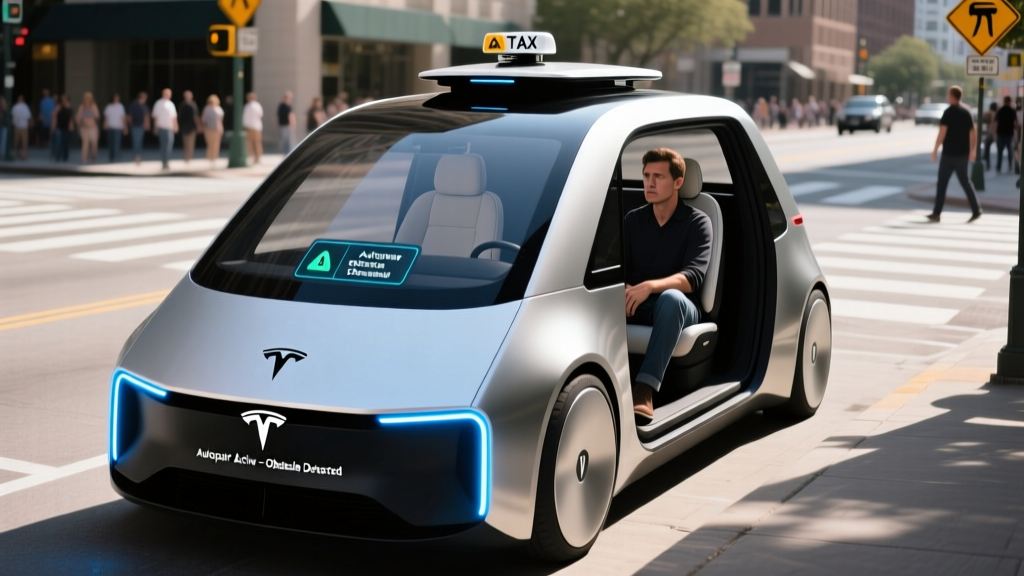
When you pay $8,000 for FSD, you're purchasing a sophisticated driver-assistance package — not access to a driverless ride-hailing network. Tesla's separate Robotaxi service (announced for Austin in 2025 with a gradual rollout) operates under a different model entirely, and availability remains limited to specific geofenced zones.
Where Can You Use Tesla's Robotaxi Service Right Now?
Tesla launched its initial supervised robotaxi pilot in Austin, Texas in mid-2025, using a limited fleet of Model Y vehicles operating within a defined geofence. As of early 2026, the service remains in a controlled expansion phase:
| City | Status | Service Area | Access |
|---|---|---|---|
| Austin, TX | Active (limited pilot) | Central/south Austin geofenced zone | Invite-only / waitlist |
| San Francisco Bay Area | Announced expansion | TBD — regulatory approval pending | Not yet available |
| Los Angeles | Announced | TBD | Not yet available |
| All other US cities | Not announced | — | — |
For comparison, Waymo One operates commercially in Phoenix, San Francisco, Los Angeles, and Austin — with open public access in most of those markets. If you need a driverless ride today, Waymo remains the only scaled option.
Tesla Robotaxi Pricing vs. Uber and Lyft
For the Austin pilot, Tesla has not published a standardized per-mile or per-ride pricing sheet available to the general public, as the service operates under invite-only conditions. However, Tesla executives have stated the long-term goal is to undercut traditional rideshare pricing significantly — targeting a cost-per-mile below $0.50 once the service scales.
| Service | Est. Cost/Mile | Est. 10-Mile Ride | Availability |
|---|---|---|---|
| Tesla Robotaxi (target) | ~$0.40–$0.50 | ~$4.00–$5.00 | Austin pilot only |
| Waymo One | ~$1.00–$1.80 | ~$10–$18 | Phoenix, SF, LA, Austin |
| UberX | ~$1.20–$2.00 | ~$12–$20 | Nationwide |
| Lyft Standard | ~$1.10–$1.90 | ~$11–$19 | Nationwide |
The key takeaway: Tesla's robotaxi pricing advantage remains theoretical until the service achieves broad public availability. Today, if you want a driverless ride, Waymo's fares are broadly comparable to Uber/Lyft — not dramatically cheaper, but not more expensive either.
Safety Data: What the Numbers Actually Show
Tesla FSD Safety — Context and Caveats
Tesla publishes quarterly safety reports claiming approximately 1 crash per 4–5 million miles driven with Autopilot/FSD engaged, compared to the US average of roughly 1 crash per 670,000 miles (NHTSA national data). However, these figures require critical context:
- Tesla's data is self-reported and not independently audited by NHTSA or IIHS
- Autopilot/FSD is primarily engaged on divided highways — the safest driving environment — creating a selection bias
- NHTSA's Standing General Order requires Tesla to report all crashes involving ADAS, and the agency has opened multiple investigations into FSD-related incidents
- The IIHS has repeatedly found that partial automation systems do not reduce crash rates and may increase driver inattention
For Level 4 robotaxis, the safety picture is different. Waymo has published peer-reviewed data showing its vehicles are involved in significantly fewer police-reported crashes per million miles than human benchmarks in comparable urban environments. Waymo's fleet has logged over 40 million autonomous miles across its operational cities as of late 2025. Tesla's Austin robotaxi pilot has not yet published equivalent mileage or intervention-rate data.
The bottom line: neither FSD nor any Level 4 robotaxi has a perfect safety record. Both require ongoing regulatory oversight, and both carry known edge-case risks. The honest answer to "how safe is it?" depends heavily on the specific operational domain — highway cruising vs. dense urban streets — and on whether a human is supervising.
Tesla's Technology Stack: Camera-Only vs. the LiDAR Competition
Tesla's approach to autonomy is philosophically distinct from every other major player in the space. Understanding this matters if you're deciding whether the $8,000 FSD investment makes sense for your use case.
Tesla Vision (Hardware 4)
Tesla removed all radar and ultrasonic sensors from its vehicles starting in 2022–2023, relying entirely on a camera suite (typically 8 cameras providing 360° coverage) paired with the HW4 computer running neural-network-based perception. The system processes visual data through Tesla's custom silicon, using a neural net architecture trained on billions of miles of real-world driving video.
The Competition: LiDAR + Sensor Fusion
Waymo, Cruise, Zoox, and most Chinese robotaxi operators (Baidu Apollo, Pony.ai) use a multi-sensor approach combining:
- LiDAR: Precise 3D point-cloud mapping unaffected by lighting conditions
- Cameras: Object classification, lane reading, traffic signal recognition
- Radar: Velocity detection in adverse weather
- HD Maps: Pre-built centimeter-accurate road models within geofenced zones
The trade-off is cost and scalability. Tesla's camera-only system is far cheaper per vehicle, enabling deployment across its entire fleet. But camera-only systems face inherent limitations in low-visibility conditions (heavy rain, snow, direct sun glare, darkness without street lighting) where LiDAR maintains reliable depth perception. This is the primary reason Tesla's robotaxi pilot is confined to Austin's relatively benign weather and well-marked roads.
Current Limitations: What FSD and Tesla Robotaxi Cannot Do
FSD (Supervised) — Known Limitations
- Weather degradation: Heavy rain, snow, fog, and ice significantly reduce camera reliability; system may disengage and require immediate driver takeover
- Construction zones: Lane shifts, temporary barriers, and flaggers frequently confuse the system
- Unprotected left turns: Complex intersections with oncoming traffic remain a high-intervention scenario
- Rural/unmapped roads: Performance degrades on roads with poor lane markings or no GPS-accurate mapping
- Phantom braking: NHTSA has investigated reports of unexpected hard braking with no apparent obstacle — a persistent issue across Tesla's ADAS lineup
- Driver monitoring: Tesla's cabin camera monitors eye gaze, but the system does not physically prevent extended inattention
Tesla Robotaxi — Additional Constraints
- Geofenced to approved zones only — cannot operate outside mapped boundaries
- Not available for personal vehicle use — the robotaxi fleet is Tesla-owned and operated
- Service suspensions during severe weather, road closures, or special events
- No highway operation in current pilot — limited to surface streets within the geofence
Regulatory Landscape: Who Approves What
Understanding the regulatory framework clarifies why Tesla's robotaxi rollout is slower than some buyers expected:
- NHTSA (federal): Oversees vehicle safety standards and investigates crash patterns. NHTSA does not "approve" ADAS features before sale but can issue recalls and enforcement actions. Tesla's FSD is sold as a consumer ADAS feature under this framework.
- State DMVs and regulators: Driverless testing and commercial robotaxi operations require state-level permits. California's DMV and CPUC have the most detailed frameworks; Texas has a more permissive environment, which is why Austin became Tesla's launch city.
- Local municipalities: Cities can impose additional restrictions on robotaxi operating hours, zones, and fleet sizes. San Francisco's Board of Supervisors famously voted to restrict Waymo and Cruise operations in 2023 before state regulators overruled portions of those restrictions.
Tesla's strategy of launching in Texas first reflects a deliberate choice to operate in a jurisdiction with fewer regulatory hurdles, while its camera-only approach avoids the cost and complexity of LiDAR but faces more scrutiny regarding all-weather reliability.
Is Tesla FSD Worth $8,000? A Decision Framework
Choose FSD ($8,000 or $99/mo) If:
- You drive frequently on well-marked highways and want reduced fatigue from lane-keeping and adaptive cruise
- You value Navigate on Autopilot's automatic on/off-ramp and lane-change suggestions
- You want access to Smart Summon for tight parking situations
- You understand you are purchasing a Level 2 driver-assist feature, not a self-driving car
Skip FSD (Stick with Basic Autopilot) If:
- You expect the car to drive itself — it will not, and relying on it to do so is dangerous
- You primarily drive in heavy snow, rain, or poorly marked rural roads
- The $8,000 cost (or $99/month) would be better allocated to home charging infrastructure, insurance, or savings
- You're buying based on the expectation that FSD will become fully autonomous and generate robotaxi income — Tesla has made this promise for years without delivery, and there is no timeline for personal-vehicle robotaxi revenue
Frequently Asked Questions
Is Tesla Full Self-Driving truly self-driving?
No. Tesla FSD (Supervised) is an SAE Level 2 driver-assistance system. The driver must remain fully engaged, with hands on or near the wheel and eyes on the road. The "Full Self-Driving" name is a product label, not a description of the system's actual capability. Only Level 4 services like Waymo operate without a human driver.
Can I transfer FSD to a new Tesla?
FSD purchased outright is tied to the vehicle, not the owner. If you sell your Tesla, FSD transfers with the car (which can add resale value). Tesla has occasionally offered limited-time FSD transfer promotions to incentivize upgrades, but these are not standard policy. The $99/month subscription is tied to your Tesla account and can be moved to a new vehicle.
Does FSD improve over time with updates?
Yes — Tesla regularly pushes over-the-air software updates that refine FSD's neural network. The transition from version 11 to version 12 (and subsequent iterations) moved to an end-to-end neural net architecture that replaced much of the prior hand-coded rules. Real-world performance has measurably improved in many scenarios, but regressions have also been reported after certain updates. Expect iterative progress, not a sudden leap to full autonomy.
How does FSD's $8,000 cost compare to buying a car with Level 4 capability?
You cannot currently buy a Level 4 vehicle as a consumer. Waymo's vehicles (Jaguar I-PACE equipped with custom sensor suites) are fleet-only and not available for purchase. The closest consumer alternatives are advanced Level 2+ systems from Mercedes-Benz (Drive Pilot, which holds Level 3 certification in Nevada and California for highway traffic jams up to 40 mph) and GM's Super Cruise. Mercedes Drive Pilot is available as a ~$2,500 option on the EQS and S-Class in approved states.
Will Tesla's robotaxi service let me earn money with my own car?
Tesla has discussed a future "Tesla Network" where owners could add their personal vehicles to a robotaxi fleet and earn revenue. As of 2026, this feature does not exist, has no announced launch date, and faces significant regulatory, insurance, and liability hurdles. Do not factor hypothetical robotaxi income into your FSD purchase decision.
Where can I use this robotaxi service right now?
Tesla's robotaxi pilot is limited to a geofenced area of Austin, Texas, accessible only to invited participants. For commercially available driverless rides, Waymo One operates in Phoenix, San Francisco, Los Angeles, and Austin with open public access.
How much does Tesla's robotaxi cost vs. Uber/Lyft?
Public pricing for Tesla's robotaxi service has not been released, as the pilot is invite-only. Tesla's stated long-term target is below $0.50/mile, which would undercut Uber and Lyft (typically $1.10–$2.00/mile). Waymo One currently charges fares comparable to Uber/Lyft in its operating cities.