The Real Question Behind Tesla Full Self-Driving Cost
If you've configured a Tesla in 2026, you've stared at the same line item: FSD (Supervised) — $8,000. That's the current one-time purchase price Tesla charges for its most advanced driver-assistance package. Alternatively, you can subscribe for $99/month. But before you click "Add," you need to understand exactly what that money buys, what it doesn't, and whether the math works for your driving routine.
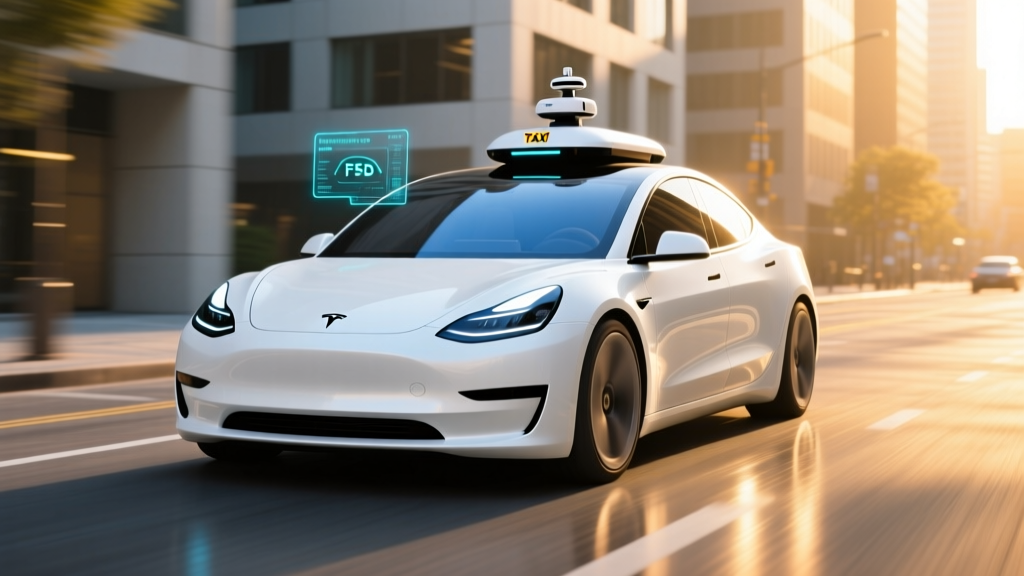
This isn't a robotaxi. Tesla's Full Self-Driving is an SAE Level 2 driver-assistance system. You are the driver. You are liable. And the system requires your continuous supervision. That distinction matters enormously when you're spending $8,000 on software.
Tesla FSD (Supervised) = SAE Level 2. The system can steer, accelerate, and brake under certain conditions, but the human driver must remain fully engaged, monitor the environment at all times, and be prepared to take over instantly. This is fundamentally different from SAE Level 4 robotaxis like Waymo, which operate without a human driver in defined service areas. Calling FSD "self-driving" is a misnomer — Tesla itself appends "Supervised" to the branding.
What Tesla FSD (Supervised) Actually Includes
As of the current 2026 software stack, FSD (Supervised) bundles several features on top of Tesla's standard Autopilot:
- Navigate on Autopilot: Highway on-ramp to off-ramp driving, including automatic lane changes and interchange navigation
- Auto Lane Change: Suggests and executes lane changes based on navigation route and surrounding traffic
- Autopark: Parallel and perpendicular parking assistance
- Summon / Smart Summon: Low-speed vehicle retrieval from parking spots (within line of sight and speed-limited)
- Traffic Light and Stop Sign Control: Detects and responds to traffic signals and stop signs
- City Street Driving: Handles urban intersections, turns, and traffic — but with frequent disengagement needs in complex scenarios
All of this runs on Tesla's camera-only vision system — no lidar, no radar (Tesla removed ultrasonic sensors from new vehicles starting in 2022 and radar earlier). The hardware suite includes multiple exterior cameras feeding Tesla's custom FSD computer (Hardware 4/AI5 depending on your vehicle's build date).
Tesla Full Self-Driving Cost Breakdown
| Option | Price | Commitment | Transferable? |
|---|---|---|---|
| One-Time Purchase | $8,000 | Permanent, tied to vehicle | No — stays with the car at sale |
| Monthly Subscription | $99/month | Cancel anytime | N/A — tied to your Tesla account |
| Standard Autopilot (included) | $0 | Comes with every new Tesla | N/A |
The breakeven math: At $99/month, the subscription reaches $8,000 in roughly 81 months (6.75 years). If you plan to keep your Tesla for five years or less, the subscription is cheaper. If you keep it longer and use FSD regularly, the one-time purchase makes more financial sense — but only if the features deliver enough value for your commute.
Important caveat: FSD does not increase your Tesla's resale value dollar-for-dollar. Used-car data consistently shows that FSD adds only a fraction of its purchase price to a Tesla's trade-in or resale value. You will not recoup the full $8,000 when you sell.
FSD (Supervised) vs. Level 4 Robotaxis: A Critical Distinction
Many buyers conflate Tesla's FSD with services like Waymo One, which operates fully driverless Level 4 robotaxis. These are fundamentally different products:
| Feature | Tesla FSD (Supervised) | Waymo One (Level 4 Robotaxi) |
|---|---|---|
| SAE Level | Level 2 (driver-assist) | Level 4 (driverless in geofenced areas) |
| Human driver required? | Yes — full attention required | No — no human driver in the vehicle |
| Operational area | Any road (with varying capability) | Geofenced metro areas (Phoenix, SF, LA, Austin) |
| Sensor suite | Camera-only (8 cameras) | Lidar + radar + cameras (redundant sensing) |
| Weather limitations | Reduced in heavy rain, fog, snow | Service suspensions in severe weather |
| Liability | Driver is fully liable | Waymo assumes operational liability |
| Cost to user | $8,000 or $99/mo (on your own car) | Per-ride pricing (comparable to Uber/Lyft) |
Tesla has announced plans for a "Robotaxi" service and the Cybercab concept, but as of 2026, no driverless Tesla ride-hail service is commercially operational. Any Tesla you buy and equip with FSD remains a Level 2 vehicle requiring your supervision.
Where Can You Actually Use FSD (Supervised)?
Unlike geofenced robotaxis, Tesla FSD (Supervised) works on any road — but capability varies enormously by context:
- Divided highways: Most capable environment. Lane-keeping, adaptive cruise, and automated lane changes work reliably.
- Suburban streets: City Street driving handles many scenarios but may hesitate at unprotected left turns, complex intersections, or construction zones.
- Dense urban cores: Frequent disengagements. Pedestrians, cyclists, double-parked vehicles, and irregular lane markings challenge the system.
- Rural/unpaved roads: Limited capability. Faded lane markings and lack of mapping data reduce reliability.
- Adverse weather: Heavy rain, snow, fog, and low-visibility conditions degrade camera-only performance significantly. Tesla's owner manual explicitly warns drivers to disable Autopilot/FSD in these conditions.
- Camera-only system lacks lidar redundancy — struggles in low light, heavy precipitation, and direct sun glare
- Construction zones with temporary lane shifts or cones require immediate driver takeover
- Unprotected left turns across traffic remain inconsistent
- Emergency vehicles stopped in travel lanes are not always detected early enough
- FSD cannot navigate parking garages, toll booths, or drive-throughs autonomously
- System may phantom-brake on highway overpasses or shadows
- Requires hands-on-wheel torque or cabin camera attention monitoring — ignoring these triggers escalating warnings and eventual system lockout for the trip
Safety Data: What We Know About FSD in 2026
Tesla publishes quarterly safety reports, but the data requires careful interpretation. According to Tesla's Q4 2025 safety report, vehicles with Autopilot engaged recorded one crash for every ~4.3 million miles driven, compared to the NHTSA national average of approximately one crash per ~670,000 miles (source: NHTSA).
Tesla's reported crash-per-mile figures for Autopilot/FSD-engaged driving are lower than the national average, but these numbers come with critical caveats:
- Autopilot is used predominantly on divided highways — the safest driving environment
- Tesla's fleet skews newer with standard active safety features (AEB, lane-departure warning) that also reduce crash rates
- The data does not isolate FSD (Supervised) from basic Autopilot — they are aggregated
- NHTSA's national average includes all road types, all vehicle ages, and all driver demographics
The Insurance Institute for Highway Safety (IIHS) has noted that partial-automation systems do not yet demonstrate clear safety benefits over attentive human driving and may introduce new risks from driver inattention and mode confusion.
The National Highway Traffic Safety Administration has conducted multiple investigations into Tesla's Autopilot and FSD systems, including crashes involving stationary emergency vehicles. As of 2026, NHTSA has issued recalls requiring Tesla to update driver-monitoring safeguards. These regulatory actions underscore that FSD is a supervised system, not an autonomous one.
Is the Tesla Full Self-Driving Cost Worth It for You?
The answer depends entirely on your driving profile and expectations:
Consider FSD if:
- You have a long, predictable highway commute and want reduced fatigue from lane-keeping and adaptive cruise
- You enjoy being an early adopter of iterative software improvements
- You understand you are paying for Level 2 driver-assist, not autonomy
- You're okay with the $8,000 not being recouped at resale
Skip FSD if:
- You expect "self-driving" and plan to disengage from the driving task
- Your driving is primarily dense urban or adverse-weather conditions
- You want a financial return on the $8,000 investment at resale
- Standard Autopilot (included) already covers your highway needs
The pragmatic middle ground: Many experienced Tesla owners recommend the $99/month subscription. Use FSD for a few months on your actual commute. If it reduces your driving fatigue meaningfully, keep it. If you find yourself disengaging it after a week, cancel the subscription and drive with standard Autopilot — which is itself an excellent adaptive cruise and lane-centering system.
How FSD Compares to Competing Driver-Assist Systems
| System | SAE Level | Cost | Hands-Off? | Key Strength |
|---|---|---|---|---|
| Tesla FSD (Supervised) | Level 2 | $8,000 / $99/mo | No — hands-on or camera-monitored | Broadest road coverage (no geofence) |
| GM Super Cruise | Level 2 | ~$2,200 + $25/mo after trial | Yes — on mapped highways (hands-off, eyes-on) | True hands-off highway driving, lidar-mapped roads |
| Ford BlueCruise | Level 2 | ~$2,100 or $75/mo | Yes — on approved highways (hands-off, eyes-on) | 130,000+ miles of pre-mapped divided highways |
| Mercedes Drive Pilot | Level 3 (conditional) | ~$2,500/yr subscription | Yes — up to 40 mph on specific highways (eyes-off) | First certified Level 3 in the US; manufacturer accepts liability when active |
GM's Super Cruise and Ford's BlueCruise both offer true hands-off driving on pre-mapped divided highways — something Tesla FSD does not provide. Mercedes-Benz's Drive Pilot, available on the EQS and S-Class, is the only SAE Level 3 system available in the US, allowing eyes-off driving at low speeds in traffic jams on approved freeway sections in Nevada and California. When Drive Pilot is active, Mercedes accepts liability for crashes — a significant legal distinction Tesla does not offer.
Frequently Asked Questions About Tesla FSD Cost
Is Tesla Full Self-Driving actually self-driving?
No. Tesla FSD (Supervised) is an SAE Level 2 driver-assistance system. The driver must remain fully attentive, keep hands available for steering input, and is legally responsible for the vehicle at all times. Tesla itself uses the "Supervised" designation to make this clear. True self-driving (Level 4) is currently offered commercially only by robotaxi services like Waymo in specific geofenced cities.
Does FSD transfer if I sell my Tesla?
FSD purchased as a one-time upgrade stays with the vehicle — it does not transfer to your next Tesla. If you subscribe at $99/month, the subscription is tied to your Tesla account and can be applied to your next eligible Tesla. This is a key reason many owners prefer the subscription model.
Will Tesla offer a driverless robotaxi service?
Tesla has announced ambitions for a "Robotaxi" network and unveiled the Cybercab concept, but as of 2026, no commercial driverless Tesla ride-hail service is operational. Any timeline for a true Level 4 Tesla robotaxi remains unconfirmed and subject to regulatory approval in each jurisdiction.
Can I get FSD features without paying $8,000?
Every new Tesla comes with standard Autopilot, which includes Traffic-Aware Cruise Control and Autosteer (lane-centering on marked roads). These features cover the majority of highway driving assistance needs. FSD adds city-street capability, Navigate on Autopilot, Smart Summon, and traffic light/stop sign control — features that are useful but not essential for most drivers.
How does FSD handle bad weather?
Tesla's camera-only system is more susceptible to degradation in heavy rain, snow, fog, and direct sun glare than lidar-equipped systems. Tesla's owner manual explicitly states that drivers should not use Autopilot or FSD in adverse weather conditions. In practice, many users report reduced confidence and more frequent phantom braking in rain compared to clear conditions.
What's the best way to try FSD before committing $8,000?
Subscribe for $99/month. Use it on your regular commute for 2-3 months. Evaluate whether the features meaningfully reduce your driving fatigue. If yes, continue subscribing or consider the one-time purchase if you plan to keep the car for 7+ years. If no, cancel and stick with standard Autopilot — you'll have spent $99-$297 for a definitive answer rather than $8,000 on a feature you don't use.