Tesla's full self-driving visualization preview — the real-time 3D rendering on your instrument cluster or center display showing detected vehicles, lane markings, pedestrians, and road edges — is one of the most visually impressive interfaces in any production car. It creates the impression of a car that sees and understands the world around it with superhuman awareness. But understanding what that visualization actually represents, and more importantly what it does not mean for vehicle autonomy, is essential for any Tesla owner or prospective buyer.
This guide breaks down the technology behind the FSD visualization preview, places it correctly within the SAE automation framework, reviews available safety data, and compares Tesla's camera-only Level 2 approach against the Level 4 robotaxi services operating in US cities today.
What the Full Self-Driving Visualization Preview Actually Shows
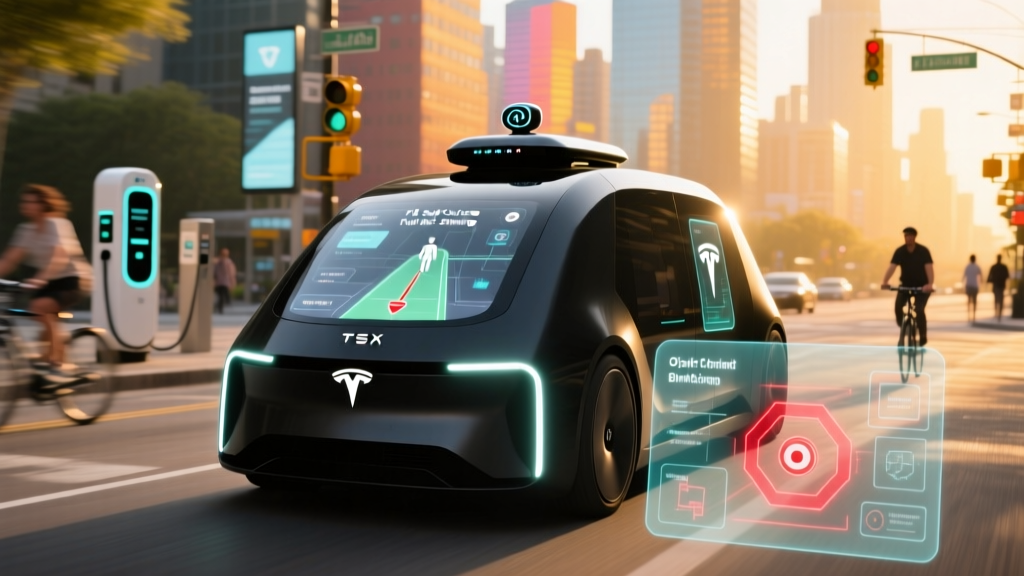
When you engage Tesla's FSD (Supervised) on a supported road, the center display and instrument cluster render a live 3D model of the driving environment. This visualization preview includes:
- Detected vehicles — rendered as simplified car, truck, and bus models with approximate positioning and relative speed
- Lane markings and road edges — painted lanes, curbs, and inferred lane boundaries
- Pedestrians and cyclists — shown as simplified figures when detected by the vision system
- Traffic signals and stop signs — rendered when recognized by the neural network
- Planned path — a blue trajectory line showing where the system intends to steer
- Speed limit and navigation cues — overlaid on the driving view
The visualization is generated by Tesla's vision-only neural network, which processes input from the vehicle's suite of cameras (typically 8 cameras on current Model 3, Model Y, Model S, and Model X). Tesla removed ultrasonic sensors and radar from new production vehicles starting in 2022–2023, relying entirely on what it calls "Tesla Vision."
The rendering quality has improved significantly since 2023, with smoother object classification, better occlusion handling, and more detailed road modeling. On highway drives, the visualization can feel remarkably confident — accurately tracking merging vehicles, construction cones, and complex lane configurations.
SAE Automation Level: Level 2 — Driver Assist, Not Self-Driving
Despite the "Full Self-Driving" branding, Tesla FSD (Supervised) is classified as SAE Level 2 automation. This means:
- The driver must remain fully engaged and attentive at all times
- The driver is legally responsible for all vehicle actions
- The system provides combined steering and acceleration/braking assistance, but does not replace the driver
- Tesla's cabin camera monitors driver attention and issues warnings if eyes are not on the road
This is fundamentally different from SAE Level 4 robotaxi services (Waymo, Zoox) where no driver is present and the system assumes full responsibility within its operational design domain.
SAE Automation Levels: Where FSD Visualization Fits
Understanding the SAE J3016 framework is critical to interpreting what Tesla's visualization preview means — and what it doesn't.
| SAE Level | Name | Who Drives | Who Is Liable | Example |
|---|---|---|---|---|
| Level 0 | No Automation | Human | Human | Traditional car, cruise control only |
| Level 1 | Driver Assistance | Human (system assists one function) | Human | Adaptive cruise OR lane-keeping |
| Level 2 | Partial Automation | Human (system assists steering + speed) | Human | Tesla FSD (Supervised), GM Super Cruise, Ford BlueCruise |
| Level 3 | Conditional Automation | System (in limited conditions); human must take over on request | Shared/conditional | Mercedes Drive Pilot (limited markets, ≤40 mph) |
| Level 4 | High Automation | System (within geofenced ODD); no human needed | Operator/company | Waymo One, Zoox (driverless robotaxi) |
| Level 5 | Full Automation | System (all conditions) | Operator | Does not yet exist in production |
Tesla's FSD visualization preview is a user interface feature of a Level 2 system. The impressive rendering does not elevate the system's automation level. The car is not driving itself — it is assisting you while you remain the responsible operator.
Tesla's Camera-Only Tech Stack vs. Robotaxi Sensor Suites
The visualization preview is a window into Tesla's perception system, but the underlying hardware and approach differ dramatically from Level 4 robotaxis.
Tesla FSD (Supervised) — Camera-Only Approach
- Sensors: 8 cameras (front narrow/wide, side repeaters, side pillars, rear) — no lidar, no radar on current production
- Processing: Tesla HW4 (AI4) computer with custom neural network inference chips
- Perception: End-to-end neural network trained on billions of miles of fleet driving data
- Mapping: Does not require pre-mapped HD routes; operates on general road networks
- Geofencing: None — FSD (Supervised) can be engaged on virtually any road
- Redundancy: Single compute platform; no independent backup perception system
Waymo (Level 4 Robotaxi) — Multi-Sensor Fusion
- Sensors: Custom lidar array (5th-gen), multiple radar units, 29+ cameras, external audio sensors
- Processing: Custom compute platform with redundant perception pipelines
- Perception: Sensor fusion combining lidar point clouds, radar returns, and camera imagery
- Mapping: Requires centimeter-precision HD maps of every operational road
- Geofencing: Strictly limited to pre-mapped, approved operational design domains
- Redundancy: Multiple independent compute and sensor systems; vehicle can stop safely if one fails
The trade-off is clear: Tesla's camera-only approach scales to any road without pre-mapping, but lacks the depth-perception certainty and hardware redundancy of lidar-equipped robotaxis. The visualization preview shows you what the neural network believes it sees — which is usually accurate but occasionally misclassifies objects, misses small obstacles, or struggles in low-visibility conditions.
Real-World Safety Data: What the Numbers Show
Tesla publishes quarterly Vehicle Safety Reports, and the National Highway Traffic Safety Administration (NHTSA) tracks incidents involving vehicles with advanced driver-assistance systems. Here's what the available data indicates as of early 2026:
Tesla FSD (Supervised) Safety Context
- Tesla's self-reported claim: Approximately 1 crash per 4–5 million miles driven with Autopilot/FSD engaged (Tesla Vehicle Safety Report, Q4 2025). This compares to the US national average of roughly 1 crash per 670,000 miles (NHTSA).
- Important caveats: Tesla's data is self-reported, not independently verified, and includes significant highway miles (safer driving environment). It does not account for driver engagement levels.
- NHTSA Standing General Order: Since July 2021, NHTSA has required manufacturers to report crashes involving Level 2+ systems. Tesla vehicles account for a significant share of reported ADAS-involved incidents, though this partly reflects Tesla's large fleet size.
- NHTSA investigations: Multiple investigations into Autopilot/FSD behavior at emergency scenes, phantom braking events, and driver-monitoring adequacy have been opened. Check nhtsa.gov for current status.
Waymo Level 4 Robotaxi Safety Context
- Waymo's published data (2024 study): Waymo reported a 85% reduction in police-reported crash rates compared to human benchmarks across 7.1+ million driverless miles in Phoenix, San Francisco, and Los Angeles.
- Operational record: Over 30 million paid driverless trips completed by early 2026, with no reported passenger fatalities.
- Third-party validation: Waymo's safety data has been reviewed by state regulators (California DMV, Arizona DOT) as part of permitting.
Direct comparison between Tesla's Level 2 system and Waymo's Level 4 service is misleading — they operate under fundamentally different paradigms. Tesla requires constant human supervision; Waymo operates without any human in the vehicle within its geofenced areas.
Where FSD (Supervised) Operates vs. Level 4 Robotaxi Availability
A common misconception is that Tesla FSD and robotaxi services are competing for the same use case. In reality, they occupy different positions on the autonomy spectrum with different availability models.
| Service | SAE Level | Availability | How to Access | Driver Required? |
|---|---|---|---|---|
| Tesla FSD (Supervised) | Level 2 | Nationwide — any road where FSD can be engaged | Purchase or subscribe ($99/mo) on a Tesla vehicle with HW3/HW4 | Yes — always |
| Waymo One | Level 4 | Phoenix, AZ (metro-wide); San Francisco, CA (most of city); Los Angeles, CA (expanding zones); Austin, TX (select areas) | Download Waymo One app; request ride in service area | No — fully driverless |
| Zoox | Level 4 | Las Vegas, NV (limited area); Foster City, CA (testing); Phoenix, AZ (testing) | Limited early rider programs; not broadly available commercially | No — purpose-built vehicle, no steering wheel |
| Cruise | Level 4 | Suspended commercial operations as of 2026; limited supervised testing in select cities | Not currently available for public rides | N/A — operations paused |
Tesla's advantage is geographic universality — FSD (Supervised) works on virtually any road in the US. The trade-off is that you, the driver, must remain engaged and are legally responsible. Waymo's advantage is true driverless operation, but only within carefully mapped and approved zones.
Pricing: Tesla FSD Subscription vs. Robotaxi Rides vs. Rideshare
If you're weighing whether to subscribe to Tesla FSD or use a robotaxi service, the economics look very different depending on your use case.
| Option | Cost Structure | Typical Cost per Trip | Best For |
|---|---|---|---|
| Tesla FSD (Supervised) Subscription | $99/month (or $8,000 one-time purchase as of 2025 pricing) | N/A — you own/drive the vehicle; fuel/charging + insurance costs apply | Daily commuters and Tesla owners who want assisted driving on their own routes |
| Waymo One (Phoenix/SF/LA) | Per-ride pricing, similar to Uber/Lyft | $8–$25 for typical 3–8 mile urban trips (varies by city, time, demand) | Urban residents and visitors in Waymo service areas who want driverless rides |
| Uber / Lyft (human driver) | Per-ride pricing with surge | $10–$30+ for similar urban trips | Universal availability; any city, any route |
| Tesla Robotaxi (announced) | Tesla has announced a future driverless ride-hailing service; as of early 2026, not yet commercially operational | Tesla has suggested pricing below Uber/Lyft; no confirmed rates | Future — not currently available |
For a Tesla owner who drives 1,000+ miles per month, the $99/month FSD subscription adds assisted-driving capability to every trip — but you're still driving. For someone in Phoenix or San Francisco who wants to be driven without owning a car, Waymo One at $10–$20 per ride competes directly with Uber and Lyft.
Current Limitations of the FSD Visualization and System
What the FSD Visualization Preview and System Cannot Reliably Handle
- Heavy rain, fog, and snow: Camera-only perception degrades significantly in low-visibility conditions. The visualization may show reduced object detection confidence or fail to classify hazards. Tesla's owner manual explicitly warns against using FSD in adverse weather.
- Direct sun glare and camera washout: Low-angle sunlight can saturate camera sensors, temporarily blinding the system. The visualization may lose lane markings or fail to detect vehicles ahead.
- Construction zones with temporary markings: While the system has improved at recognizing cones and temporary lane shifts, complex multi-phase construction zones remain challenging. The visualization may show conflicting lane markings.
- Unprotected left turns across heavy traffic: FSD (Supervised) can hesitate or misjudge gaps in oncoming traffic. Driver intervention is frequently required.
- Emergency vehicles and first-responder scenes: Despite NHTSA scrutiny and software updates, there have been documented incidents of Tesla vehicles on Autopilot/FSD failing to slow or stop for emergency vehicles with flashing lights. The visualization may render the emergency vehicle but not respond appropriately.
- Railroad crossings: The system does not reliably stop at uncontrolled railroad crossings. The driver must take over.
- Edge cases and novel scenarios: Unusual road configurations, temporary traffic-control humans (flaggers), animals on road, debris — the neural network may not classify or respond correctly.
- Phantom braking: The system occasionally brakes hard for non-existent obstacles. The visualization may briefly show a detected object that doesn't exist, or brake without a clear visual trigger.
These limitations are inherent to a camera-only Level 2 system operating on open roads without HD mapping. They are not edge cases you'll encounter once — they are regular occurrences in real-world driving. The visualization preview helps you monitor what the system sees, which is exactly why Tesla requires your constant attention.
The Regulatory Landscape: Who Overseas What
The regulatory framework for autonomous vehicles in the US is fragmented and evolving:
- Federal (NHTSA): Sets vehicle safety standards (FMVSS) and investigates safety defects. NHTSA does not "approve" ADAS or autonomous systems before sale but can order recalls and mandate reporting. Tesla's FSD is sold as a Level 2 driver-assist feature, which does not require pre-market federal approval. See NHTSA's automated vehicles page for current policy.
- State DMVs and regulators: Control where and how driverless vehicles can operate. California (DMV + CPUC), Arizona, and Texas have been the primary permitting authorities for Level 4 robotaxi services. California's DMV requires annual disengagement reports from companies testing autonomous vehicles.
- Tesla's regulatory position: Because FSD (Supervised) is classified as Level 2, Tesla does not need the state-level permits that Waymo and Zoox require for driverless operation. However, this also means Tesla cannot legally offer a driverless service under current FSD software — a true "robotaxi" would require Level 4 capability and state approval.
- FTC and advertising scrutiny: Tesla has faced criticism and legal action (including a 2024 California DMV administrative ruling) over the "Full Self-Driving" name, which regulators have argued is misleading for a Level 2 system.
Frequently Asked Questions
Is Tesla's full self-driving visualization preview showing me that the car is truly self-driving?
No. The visualization preview is a user-interface rendering of what Tesla's neural network perceives. It is a feature of a Level 2 driver-assist system. You must remain fully engaged, hands available for steering, and eyes on the road. The impressive graphics do not change the system's legal or technical classification.
Where can I use Tesla FSD (Supervised) right now?
FSD (Supervised) can be engaged on virtually any public road in the United States — city streets, highways, and rural roads — provided your Tesla has compatible hardware (HW3 or HW4) and the latest FSD software. There is no geofencing. However, system capability varies enormously by road type and conditions. It performs best on well-marked divided highways and struggles most in complex urban environments, adverse weather, and construction zones.
How much does Tesla FSD cost in 2026?
As of early 2026, Tesla offers FSD (Supervised) as a $99/month subscription or a one-time purchase (pricing has fluctuated; check Tesla's website for current purchase price, which was $8,000 as of mid-2025). FSD is not eligible for the federal §30D EV tax credit, which applies only to the vehicle purchase itself and is subject to MSRP caps, buyer income limits, and battery-sourcing requirements per IRS guidelines.
How does Tesla FSD safety compare to Waymo's robotaxi?
Direct comparison is difficult because the systems operate differently. Tesla's self-reported data claims roughly 1 crash per 4–5 million miles on Autopilot/FSD, but this data is not independently audited and includes highway-heavy driving. Waymo has published peer-reviewed data showing significantly lower crash rates than human benchmarks across 7+ million driverless urban miles. The key difference: Tesla requires a supervising driver; Waymo has no one in the driver's seat.
Will the FSD visualization preview eventually become a true self-driving system?
Tesla has been predicting full autonomy "next year" since approximately 2016. As of 2026, FSD remains a Level 2 system requiring driver supervision. Tesla has announced plans for a driverless ride-hailing service, but as of early 2026, no commercially operational driverless Tesla service exists, and significant technical, regulatory, and safety-validation hurdles remain. Buyers should evaluate FSD as a premium driver-assist feature, not as a path to imminent hands-free autonomy.
What are the biggest real-world limitations I should expect?
In daily use, expect to intervene regularly for: unprotected left turns, construction zones, emergency scenes, heavy rain or snow, phantom braking events, and complex multi-lane intersections. The visualization preview helps you anticipate when the system may struggle — if you see it misclassify an object or lose lane markings, that's your cue to take over immediately.