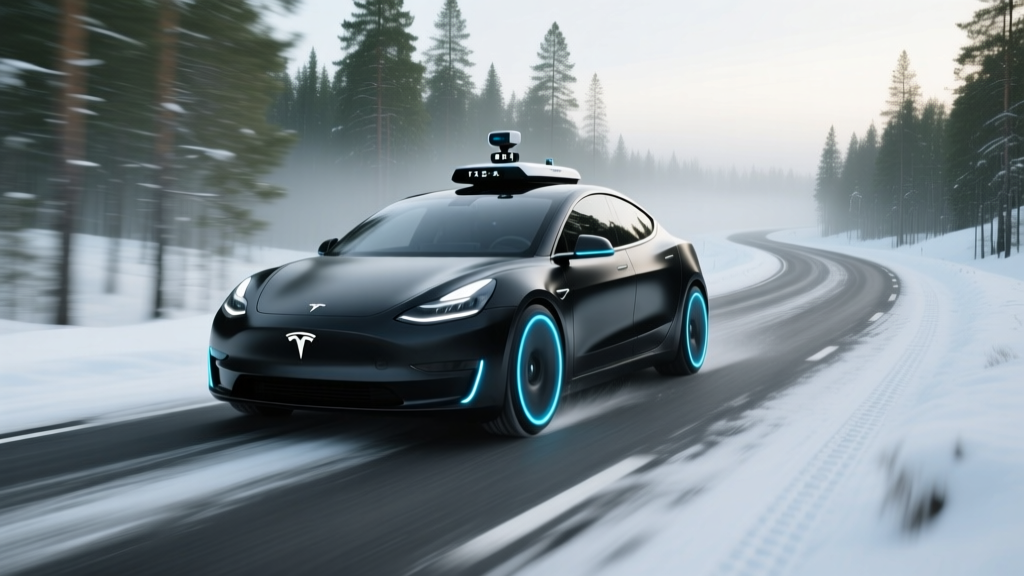
Tesla's Full Self-Driving (Supervised) software has reached version 14, and the Nordic region—particularly Sweden—presents one of the most demanding real-world proving grounds for any driver-assistance system. Narrow rural lanes, sparse highway markings, aggressive winter weather, and long stretches of low-angle sunlight create edge cases that separate marketing claims from engineering reality. This Tesla FSD v14 Sweden assessment breaks down what the system actually does, where it struggles, and whether the subscription cost makes sense for Scandinavian drivers in 2026.
Tesla FSD (Supervised) is classified as SAE Level 2 driver assistance. This means the system provides combined steering, acceleration, and braking support, but the driver must remain fully engaged, hands on or near the wheel, and eyes on the road at all times. It does not make the vehicle autonomous. Only Level 4 services like Waymo operate without a human driver—and those are geofenced robotaxis, not consumer cars.
What Tesla FSD v14 Actually Does
FSD (Supervised) v14 builds on Tesla's end-to-end neural network architecture, which replaced the older rules-based code stack starting with v12. Rather than relying on hard-coded if-then rules for lane-keeping and intersection behavior, v14 processes camera inputs through a unified neural network that outputs steering, throttle, and brake commands directly. The system uses Tesla's HW4 (AI4) computer paired with a suite of eight cameras (front-facing narrow and wide, left/right repeaters, left/right pillar, and rear). Tesla removed ultrasonic sensors and radar from its vehicles in 2022–2023, relying entirely on Tesla Vision for perception.
In practice, FSD v14 handles:
- Highway driving: Lane centering, automatic lane changes, on-ramp to off-ramp navigation, and speed adaptation to traffic and posted limits
- City streets: Traffic light and stop sign recognition, unprotected left turns, roundabout navigation, and pedestrian/cyclist detection
- Parking: Automatic parking space detection and parallel/perpendicular maneuvering
- Summon: Low-speed remote vehicle movement in parking lots (with significant limitations)
| Feature | Highway | Urban | Rural Sweden | Winter Conditions |
|---|---|---|---|---|
| Lane centering | ✅ Strong | ✅ Good | ⚠️ Faded markings | ❌ Snow-covered |
| Auto lane change | ✅ Confident | ⚠️ Hesitant | ⚠️ Limited use | ⚠️ Reduced confidence |
| Traffic light/stop sign | N/A | ✅ Reliable | ⚠️ Some misses | ⚠️ Glare/obscured |
| Roundabout handling | N/A | ✅ Good | ⚠️ Complex multi-lane | ⚠️ Snow banks |
| Pedestrian detection | N/A | ✅ Strong | ✅ Adequate | ⚠️ Dark clothing + low light |
FSD v14 on Swedish Roads: The Real-World Assessment
Sweden's road infrastructure is well-maintained by global standards, but it introduces specific challenges for camera-based ADAS. Here is how FSD v14 performs across the driving environments Swedish owners encounter most.
Highway Driving (E4, E6, E20)
On Sweden's major motorways, FSD v14 performs at its best. Lane markings are clear, interchanges are well-signed, and traffic flows predictably. The system handles speed adjustments for variable speed limits (common on Swedish highways that drop from 110 km/h to 70 km/h near urban areas) with reasonable smoothness. Lane centering is stable even in crosswinds common along the west coast. Automatic lane changes on multi-lane sections are decisive, though the system still tends to be conservative when merging into faster traffic on the E4 approaching Stockholm.
Rural Roads and Country Lanes
This is where FSD v14 shows its limitations most clearly. Many Swedish rural roads—particularly läns- and kommunvägar—have faded or absent center-line markings, narrow shoulders bordered by drainage ditches, and gravel edges. FSD v14's reliance on visible lane markings means it can become uncertain on these roads, occasionally issuing a "take over immediately" warning. On unmarked roads through forests or farmland, the system may disengage entirely, requiring the driver to resume full control without much advance notice.
Roundabouts and Urban Intersections
Sweden uses roundabouts extensively, from small single-lane circles in residential areas to large multi-lane rotaries on ring roads like Stockholm's Essingeleden. FSD v14 handles standard single-lane roundabouts competently—detecting yielding requirements, entering at appropriate speed, and exiting correctly. Multi-lane roundabouts remain a weakness: the system sometimes selects the wrong lane for the intended exit or hesitates when traffic is heavy, requiring driver intervention.
- Snow-covered lane markings: FSD v14 cannot reliably detect lanes when markings are obscured by snow or slush. Expect frequent disengagements December–March.
- Low-angle winter sun: Sweden's extreme latitude (Stockholm at 59°N) creates prolonged glare periods in winter mornings and afternoons that can saturate forward cameras.
- Black ice detection: FSD does not detect road surface friction. The system will not adjust following distance or speed for icy conditions—the driver must do this manually.
- Snow banks narrowing lanes: Plowed snow reduces effective lane width, and the system may not account for this reduced clearance.
- Moose and large wildlife: While the system may detect large animals, emergency braking response at highway speeds on icy roads is physics-limited. Never rely on FSD for wildlife avoidance.
Cost and Availability: FSD Pricing in 2026
Tesla offers FSD (Supervised) through two pricing models. Every new Tesla vehicle ships with Basic Autopilot (lane centering + adaptive cruise control) at no additional cost. FSD (Supervised) is an upgrade available across the entire current lineup.
| Option | Cost | Notes |
|---|---|---|
| Basic Autopilot | Included | Lane centering + TACC on all new Teslas |
| FSD Monthly Subscription | $99/month | Cancel anytime; requires HW3 or newer |
| FSD One-Time Purchase | $8,000 | Transfers with vehicle; not refundable |
Break-even analysis: At $99/month, the subscription reaches the $8,000 purchase price in approximately 81 months (6.75 years). If you plan to keep your Tesla for more than five years and use FSD regularly, the one-time purchase is marginally more economical. However, the subscription offers flexibility—pause it during Swedish winter months when you'll be driving manually most of the time, for example.
Hardware requirement: FSD v14 requires Tesla's HW4 (AI4) computer. Vehicles built before approximately mid-2023 with HW3 can still run FSD but may not receive all v14 optimizations. Tesla has not announced a free HW3-to-HW4 retrofit program for existing owners. Check your vehicle's software menu under Controls → Software → Additional Vehicle Information to confirm your hardware version.
How FSD v14 Compares to Competing ADAS Systems
Tesla isn't the only player offering advanced driver assistance on Swedish roads. Here's how FSD v14 stacks up against systems available in competing EVs popular in Scandinavia.
| System | SAE Level | Sensors | Hands-Off? | Cost |
|---|---|---|---|---|
| Tesla FSD (Supervised) | Level 2 | 8 cameras (vision-only) | No | $99/mo or $8,000 |
| GM Super Cruise (Cadillac Lyriq) | Level 2 | Cameras + LiDAR + radar + HD maps | Yes (mapped roads) | $2,100 + $25/mo after 3yr |
| Volvo Pilot Assist (EX90) | Level 2 | Cameras + LiDAR + radar | No | Included on Ultra trim |
| BMW Highway Assistant (iX) | Level 2 | Cameras + radar | Yes (≤130 km/h, highway) | €1,500 Driving Assistant Pro |
| Mercedes Drive Pilot (EQS) | Level 3 | Cameras + LiDAR + radar + HD maps | Yes (≤60 km/h, traffic jams) | €5,000–€9,000 (market dependent) |
Key differentiator: Tesla's camera-only approach gives FSD v14 the broadest geographic coverage—it works on any road the cameras can see, without needing pre-mapped HD routes. But this comes at the cost of sensor redundancy. GM Super Cruise and the Volvo EX90's LiDAR-equipped Pilot Assist have hardware that can perceive lane boundaries and obstacles even when markings are snow-covered or cameras are blinded by glare—a meaningful advantage in Scandinavian winters. Mercedes' Drive Pilot is the only consumer system currently certified at SAE Level 3, but it operates only below 60 km/h in heavy traffic on approved highways, and its availability in Sweden depends on local regulatory approval.
Safety Data and Regulatory Context
Tesla publishes quarterly vehicle safety reports claiming that vehicles driven with Autopilot active record fewer crashes per million miles than the U.S. average. However, these reports do not isolate FSD (Supervised) from Basic Autopilot, and they do not account for the fact that Autopilot is predominantly used on divided highways—the safest driving environment. The National Highway Traffic Safety Administration (NHTSA) has conducted multiple investigations into Tesla's Autopilot and FSD systems, including a standing General Order requiring crash reporting for all vehicles equipped with Level 2 and above systems.
In the European Union, all new vehicles sold must comply with EU Regulation 2019/2144, which mandates driver monitoring systems for advanced driver-assistance features. Tesla's cabin camera-based driver monitoring for the European market meets these requirements, but EU regulators continue to scrutinize how ADAS features are named and marketed to prevent consumer confusion about automation capability.
Models That Support FSD v14
All current-production Tesla vehicles support FSD (Supervised), though hardware generation matters for optimal v14 performance:
- Model 3 (2024+ Highland refresh and 2026 models): HW4 standard; full v14 capability. Starting at ~$38,990 (U.S. MSRP, before any incentives).
- Model Y (2025+ Juniper refresh and 2026 models): HW4 standard; full v14 capability. Starting at ~$44,990.
- Model S / Model X (2023+ production): HW4 equipped; full v14 capability. Starting at ~$79,990 / ~$84,990.
- Cybertruck (all production): HW4 standard; FSD enabled. Starting at ~$79,990 (AWD) / ~$99,990 (Cyberbeast).
- Older vehicles with HW3 (pre-2023): FSD functional but may not receive all v14 neural network optimizations. Tesla has not confirmed a timeline for HW3 parity or a retrofit program.
For Swedish buyers specifically, note that Tesla's European pricing includes VAT (25% in Sweden) and delivery fees. Check Tesla's Swedish configurator for exact SEK pricing, which fluctuates with exchange rates and Tesla's periodic price adjustments.
Verdict: Is FSD v14 Worth It for Swedish Drivers?
- You drive primarily on well-marked highways (E4, E6, E18, E20) during spring–autumn months
- You commute in Stockholm, Gothenburg, or Malmö urban areas with clear lane markings
- You want to evaluate the system before committing $8,000
- You understand you must remain attentive and ready to intervene at any moment
❌ Skip FSD (stick with Basic Autopilot) if:
- You drive mostly on rural, unmarked country roads
- Your primary driving season is winter (December–March), when snow and darkness degrade camera performance
- You expect a self-driving experience—this system is not that
- You prioritize sensor redundancy (LiDAR + radar) over broad geographic coverage
FSD v14 represents genuine progress in neural-network-based driving assistance, and on Sweden's well-maintained highways during favorable conditions, it reduces driver fatigue meaningfully. But the camera-only architecture is a real liability in Nordic winter, and the SAE Level 2 classification means you are always the responsible driver. For the $99/month subscription, it's a reasonable convenience upgrade for the months it works well—just don't expect it to replace your attention behind the wheel.
Frequently Asked Questions
Is Tesla FSD v14 self-driving?
No. Tesla FSD (Supervised) is an SAE Level 2 driver-assistance system. The driver must remain fully engaged—hands on or near the steering wheel, eyes on the road—at all times. The "Full Self-Driving" name is Tesla's branding, not a description of the system's actual automation level. Only Level 4 systems like Waymo's robotaxis operate without a human driver, and those are limited to geofenced service areas in select U.S. cities.
Does FSD v14 work in snow and ice?
Partially, but with significant degradation. Snow-covered lane markings cause frequent disengagements because the camera-only system cannot see lane boundaries. Low-angle winter sun at Swedish latitudes can blind forward cameras. Black ice is not detectable by the system. We recommend relying on Basic Autopilot (or manual driving) during active snowfall and on unplowed roads.
Can I use FSD in Sweden, or is it U.S.-only?
FSD (Supervised) is available in European markets including Sweden, though the feature set and regulatory compliance may differ slightly from the U.S. version. European FSD must comply with UNECE regulations, which impose additional constraints on lane-change behavior and system activation. City-street capabilities rolled out in Europe later than in the U.S. and may have more conservative behavior profiles.
What hardware does my Tesla need for FSD v14?
FSD v14 is optimized for Tesla's HW4 (also called AI4) computer, found in vehicles produced from approximately mid-2023 onward. HW3-equipped vehicles can still run FSD but may not receive all v14 features or performance improvements. You can check your hardware version in the vehicle's Settings → Software → Additional Vehicle Information menu.
How does FSD compare to Volvo's system for Swedish roads?
Volvo's Pilot Assist on the EX90 includes LiDAR, which provides redundant perception that works better than cameras alone in snow, fog, and darkness—common Swedish conditions. However, Volvo's system is less aggressive in urban navigation (roundabouts, city intersections) compared to FSD v14. If your driving is mostly highway, Volvo's system with LiDAR redundancy may be better suited to Nordic conditions. For maximum capability on diverse road types, FSD v14 offers broader coverage but requires more driver vigilance in marginal conditions.