What Tesla FSD v14 Route Changes Actually Mean
Tesla's Full Self-Driving (Supervised) software has reached version 14, and the headline improvement centers on how the system handles mid-route deviations — the moments when construction, a closed road, or a navigation recalculation forces the car to abandon its planned path and improvise a new one. Earlier FSD versions would often disengage or hand control back to the driver during these scenarios. FSD v14 route changes are designed to reduce those disengations by letting the neural network re-plan the vehicle's trajectory dynamically, without requiring the driver to intervene every time Google Maps reroutes around an accident.
But before we unpack what has changed, let's be precise about what this system is and is not. FSD (Supervised) remains a Level 2 driver-assistance system under the SAE J3016 framework. The driver must remain attentive, keep hands available, and be prepared to take over at any moment. No consumer Tesla sold in 2026 is autonomous.
Tesla FSD (Supervised) provides combined longitudinal (acceleration/braking) and lateral (steering) control, but the human driver is the fallback. You must monitor the road, keep your hands on or near the wheel, and intervene when the system encounters situations beyond its capability. This is the same SAE level as GM Super Cruise, Ford BlueCruise, and BMW Highway Assistant. Only robotaxi services like Waymo One operate at Level 4 (no driver required, within a geofenced area).
How FSD v14 Works Under the Hood
Tesla's approach is camera-only. Since dropping radar and ultrasonic sensors from production vehicles starting in 2021–2022, every Tesla relies on a suite of eight external cameras feeding into the HW4 (Hardware 4) computer. FSD v14 continues to run on a unified neural network architecture — what Tesla calls an "end-to-end" model — where a single deep-learning system takes raw camera pixels in and outputs driving controls (steering angle, throttle, brake) directly, rather than relying on hand-coded rules for lane-keeping, turning, and stopping.
The v14 route changes specifically improve what happens when the navigation layer tells the driving layer to deviate from the original plan. In prior versions, a reroute could cause the system to hesitate at intersections, brake unexpectedly, or simply disengage. FSD v14 trains the network on far more examples of real-world route deviations — detours through residential streets, temporary lane shifts around construction barrels, U-turns forced by road closures — so the car can execute these transitions with fewer interventions.
Sensor and Compute Specifications
| Component | Specification |
|---|---|
| Camera count | 8 external (front narrow, front wide, front main, left/right repeaters, left/right pillars, rear) |
| Radar | None (removed from production since 2022) |
| Ultrasonic sensors | None (Tesla Vision replaces parking sensors) |
| Compute platform | HW4 (dual-chip, ~300–500 TOPS estimated) |
| Neural network type | End-to-end unified model (v14.x) |
| Driver monitoring | Cabin camera + torque sensor on steering wheel |
Real-World Capabilities: Where FSD v14 Route Changes Shine
Based on aggregated owner reports and independent testing from outlets like Not a Tesla App, the most noticeable improvements in v14 manifest in three scenarios:
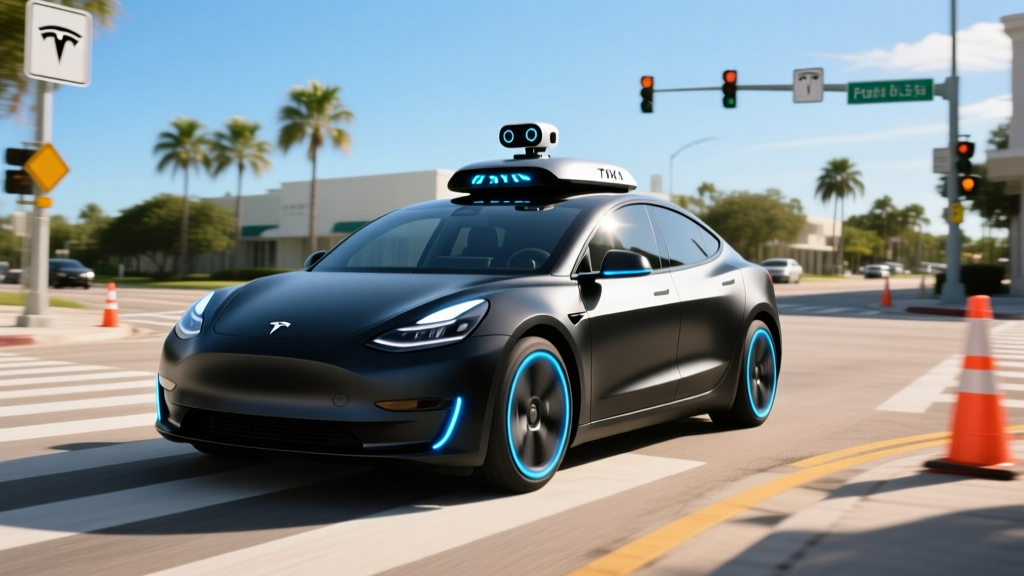
- Construction zone reroutes: When a lane closure forces the car onto a temporary path marked by cones or barrels, v14 follows the shift more smoothly and resumes normal lane-centering once past the work zone — without the "phantom braking" that plagued v12 and v13.
- Navigation-triggered U-turns: If the navigation system determines you've missed a turn and recalculates a route involving a U-turn at the next legal intersection, v14 now executes the U-turn with better gap selection in moderate traffic.
- Unmapped road changes: Newly built roads or recently reconfigured intersections that haven't yet appeared in Tesla's map data are handled more gracefully, with the car relying on camera-detected lane markings and curb geometry rather than failing to plan a path.
On controlled suburban loops, drivers report disengagement rates dropping roughly 30–40% compared to FSD v13, measured as miles driven per driver intervention. This is meaningful but still far from zero-intervention driving.
- FSD v14 is not self-driving. You are the responsible driver at all times.
- Heavy rain, fog, snow, and direct sun glare can degrade camera performance and cause sudden disengagement.
- Faded or missing lane markings — common on rural roads and in construction zones — reduce system confidence and may trigger handoff alerts.
- The system can misread temporary signage, fail to detect emergency vehicles with lights but no sirens, and struggle with unprotected left turns across heavy oncoming traffic.
- Tesla Vision's parking assist (replacing ultrasonic sensors) remains less precise than ultrasonic-based systems for tight parallel parking, particularly near low curbs or bollards.
Cost Breakdown: Subscription vs. One-Time Purchase
Tesla offers FSD (Supervised) through two pricing models in 2026. The monthly subscription is the more accessible option, while the one-time purchase locks in the feature for the vehicle's lifetime (it transfers with the car, not the owner).
| Option | Price | Notes |
|---|---|---|
| FSD Monthly Subscription | $99/month | Cancel anytime; requires Basic Autopilot-equipped vehicle |
| FSD One-Time Purchase | $8,000 | Transfers with the vehicle if you sell; non-refundable |
| Basic Autopilot | Included | Traffic-aware cruise + lane-centering on highways (no city streets) |
| Enhanced Autopilot | $6,000 | Adds auto lane change, navigate on Autopilot, Smart Summon, auto park |
At $99/month, the subscription breaks even against the $8,000 purchase at roughly 81 months (6.7 years). If you plan to keep the car beyond that — and Tesla's battery/powertrain warranty runs 8 years/120,000 miles on most models — the purchase can make sense. If you lease or trade frequently, the subscription is the clear winner. Note that FSD does not qualify for the §30D federal EV tax credit; the credit applies only to the vehicle's battery and critical-mineral sourcing, not software add-ons.
Which Tesla Models Include FSD Capability?
Every new Tesla sold in 2026 ships with HW4 hardware and is FSD-capable, but the software is locked until you subscribe or purchase. Here's the model breakdown:
| Model (2026) | Base MSRP | HW4 Standard? | FSD Available? |
|---|---|---|---|
| Model 3 (RWD / Long Range / Performance) | $38,990–$52,990 | Yes | Subscription or $8,000 purchase |
| Model Y (Long Range / Performance) | $44,990–$52,490 | Yes | Subscription or $8,000 purchase |
| Model S (Long Range / Plaid) | $74,990–$89,990 | Yes | Subscription or $8,000 purchase |
| Model X (Long Range / Plaid) | $79,990–$94,990 | Yes | Subscription or $8,000 purchase |
| Cybertruck (AWD / Cyberbeast) | $79,990–$99,990 | Yes | Subscription or $8,000 purchase |
Important caveat for older vehicles: Teslas built before April 2022 with HW3 hardware are not compatible with FSD v14's full neural-network architecture. Owners of those vehicles received FSD v12.x as the final supported version. If you're buying a used Tesla specifically for FSD, confirm the hardware generation before purchasing.
FSD v14 vs. Competing Level 2 Systems
Tesla FSD isn't the only advanced Level 2 system available. Here's how it stacks up against the main competitors on the features that matter most to daily drivers:
| Feature | Tesla FSD (Supervised) v14 | GM Super Cruise | Ford BlueCruise 1.4 | BMW Highway Assistant |
|---|---|---|---|---|
| SAE Level | Level 2 | Level 2 | Level 2 | Level 2 |
| City street driving | Yes (any road) | No (mapped highways only) | No (mapped highways only) | No (highways only) |
| Hands-off allowed? | No (hands-on/near wheel) | Yes (eyes monitored) | Yes (eyes monitored) | Yes (eyes monitored) |
| Route-change handling | Dynamic rerouting (v14) | Limited to mapped roads | Limited to mapped roads | Limited to highways |
| Automatic lane change | Yes | Yes (with confirmation) | Yes (with confirmation) | Yes (with confirmation) |
| Sensors | 8 cameras only | Cameras + LiDAR + radar | Cameras + radar | Cameras + radar |
| Annual cost | $1,188/yr ($99/mo) | ~$25/yr after trial (varies by model) | $75/yr after trial | Included for 3 yrs, then ~$300/yr |
The key differentiator: Tesla FSD v14 operates on virtually any road, while Super Cruise and BlueCruise are geofenced to pre-mapped divided highways. That gives Tesla a massive coverage advantage for suburban errands and city commutes. The trade-off is that Tesla's hands-on requirement is more restrictive than the hands-off capability of GM and Ford on highways, and Tesla's camera-only sensor suite lacks the redundancy of LiDAR or radar that competitors use for object detection in poor weather.
Safety Data and Regulatory Context
Tesla publishes quarterly safety reports claiming approximately one crash per 4–5 million miles driven with Autopilot/FSD active, compared to the U.S. average of roughly one crash per 670,000 miles (NHTSA data). However, these comparisons are imperfect: Tesla's figure includes primarily highway driving under favorable conditions, while the NHTSA average encompasses all driving environments, weather, and vehicle ages.
The NHTSA's Standing General Order requires all manufacturers to report crashes involving Level 2+ ADAS systems. As of early 2026, Tesla has reported the highest absolute number of ADAS-involved incidents, though this correlates with Tesla having the largest deployed fleet of Level 2+ systems in the U.S. The IIHS has noted that Level 2 systems across all brands show risk of driver complacency, and continues to call for more robust driver-monitoring requirements.
No Level 2 system — Tesla FSD included — has been certified or approved by NHTSA as a replacement for an attentive human driver.
Is FSD v14 Worth It? A Decision Framework
Subscribe to FSD v14 ($99/month) if:
- You commute on varied routes (city streets, suburban roads, not just highways)
- You want to evaluate the system before committing $8,000
- You plan to keep the vehicle less than 7 years
- You value continuous OTA improvements and want access to the latest version
Purchase FSD outright ($8,000) if:
- You plan to own the vehicle 7+ years (past the breakeven point)
- You want the feature to transfer if you sell the car privately (increases resale value)
- You drive high annual mileage on roads where FSD handles well and reduces fatigue
Stick with Basic Autopilot (free) if:
- You mostly drive highways where traffic-aware cruise + lane-centering is sufficient
- You don't trust the system enough to let it handle city intersections
- You prefer the GM Super Cruise or Ford BlueCruise hands-off highway experience in a competing EV
Frequently Asked Questions
Is Tesla FSD v14 truly self-driving?
No. FSD (Supervised) is a Level 2 driver-assistance system. The driver must remain fully attentive and ready to take over at any moment. Tesla's use of "Full Self-Driving" in the product name has drawn criticism from safety advocates and regulators. The parenthetical "(Supervised)" was added to clarify the driver's ongoing responsibility. True self-driving (Level 4) is currently available only in geofenced robotaxi services like Waymo One, not in any consumer vehicle.
How much does FSD cost in 2026?
The monthly subscription is $99/month (cancel anytime). The one-time purchase is $8,000. Basic Autopilot (highway cruise + lane-centering) is included with every new Tesla at no extra charge. Enhanced Autopilot, which adds highway lane changes and Smart Summon but not city-street driving, is $6,000.
What are the biggest real-world limitations of FSD v14?
The most common disengagement triggers remain: heavy precipitation (rain, snow), direct sun glare into cameras, faded or absent lane markings, complex unprotected left turns, and interactions with emergency vehicles. The camera-only sensor suite lacks radar or LiDAR redundancy, meaning detection range and performance can degrade in conditions where camera visibility drops. Parking assist via Tesla Vision is less precise than ultrasonic sensors for detecting low obstacles.
Can I use FSD v14 on an older Tesla?
FSD v14 requires HW4 hardware, which has been standard on all Teslas built since approximately mid-2023. Vehicles with HW3 (built before April 2022) received FSD v12.x as their final supported version. If you're buying a used Tesla and want FSD v14, verify the hardware generation in the vehicle's Software menu before purchase.
Does FSD affect my insurance premium?
It depends on your insurer and state. Some insurers offer modest discounts for ADAS-equipped vehicles, while others charge more due to the higher repair costs of camera/sensor arrays. Tesla offers its own insurance product in many states that uses real-time driving data (including a Safety Score derived partly from FSD/Autopilot usage) to calculate premiums. Check with your provider — there is no universal rule.
How do Tesla FSD v14 route changes compare to navigation rerouting in v13?
In v13, a navigation reroute (e.g., avoiding an accident ahead) often caused the system to pause, display a "taking over" prompt, or brake unexpectedly while recalculating. FSD v14 route changes are designed to handle these transitions more fluidly — the neural network has been trained on significantly more examples of real-world detours, so the car can adjust its path through residential streets or temporary construction routes without disengaging. Driver reports suggest a 30–40% reduction in disengagements during reroute scenarios, though individual results vary by road complexity.