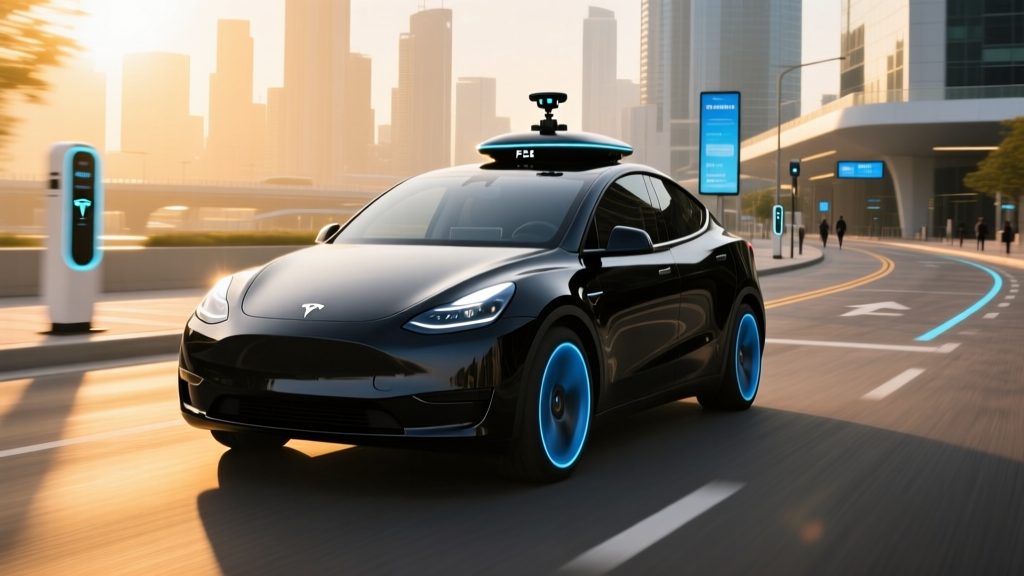
Tesla's Full Self-Driving software has reached version 14, and the gap between marketing language and real-world capability remains the most important thing every buyer must understand. FSD v14 represents Tesla's latest end-to-end neural network iteration — a system that processes camera feeds through unified AI models rather than rule-based code. It drives more smoothly than previous versions, handles complex intersections with fewer interventions, and reduces the frequency of takeovers. But it is emphatically not autonomous driving, and understanding exactly what it does, what it costs, and where it fails is critical before you spend a single dollar on it.
This review covers FSD v14 as deployed across Tesla's 2025–2026 vehicle lineup, with precise figures on cost, capability, hardware requirements, and the real-world limitations that owner forums and NHTSA data consistently surface.
What FSD v14 Actually Does: Technical Architecture
FSD v14 continues Tesla's transition to a fully end-to-end neural network approach that began with v12. Unlike traditional ADAS stacks that use separate modules for perception, prediction, and planning (each hand-coded with rules), FSD v14 feeds raw camera data into a single neural network that outputs steering, acceleration, and braking commands directly. Tesla calls this "photon in, controls out."
The system relies entirely on Tesla Vision — a camera-only sensor suite with no lidar or radar. Current 2025–2026 Tesla vehicles (Model 3 Highland, Model Y Juniper refresh, refreshed Model S/X) ship with Hardware 4 (HW4), which includes:
- 8 cameras (front-facing main + narrow, left/right repeaters, left/right pillar, rear-view)
- HW4 processor with dual SoCs for redundancy
- No ultrasonic sensors (removed starting 2022; parking relies on camera-based distance estimation)
- No radar (Tesla removed millimeter-wave radar in 2021, and the newer 4D imaging radar reintroduced selectively in some markets is not used for FSD decision-making in the US)
| Feature | How It Works | Driver Required? |
|---|---|---|
| Navigation on Autopilot (NoA) | Automatic lane changes, on/off-ramp navigation, toll-road handling | Yes — hands on wheel, eyes on road |
| Auto Lane Change | Suggests and executes lane changes based on navigation route and traffic | Yes — confirmation or supervision required depending on setting |
| Autopark | Detects parking spaces and performs parallel/perpendicular parking maneuvers | Yes — driver must monitor |
| Smart Summon | Navigates parking lots to come to the driver or a specified pin location | Yes — driver holds button and monitors via app |
| Traffic Light & Stop Sign Control | Identifies signals and signs, stops and proceeds with driver confirmation | Yes — must confirm green-light proceed |
| City Streets (FSD Supervised) | Handles turns, roundabouts, unprotected lefts, pedestrian interactions | Yes — full attention required at all times |
The key technical advancement in v14 is improved handling of "edge cases" — construction zones with temporary lane markings, unprotected left turns across multi-lane roads, and interactions with pedestrians and cyclists in ambiguous scenarios. Tesla's training data, gathered from millions of fleet miles, allows the neural network to generalize from patterns rather than relying on hard-coded rules for every scenario.
SAE Automation Level: Why FSD v14 Is Level 2, Not Level 4
FSD v14 (Supervised) is classified as SAE Level 2 under the SAE J3016 standard. This means the system can control steering, acceleration, and braking simultaneously, but the human driver must remain fully engaged — hands on the wheel, eyes on the road — and is legally responsible for all driving decisions. Level 4 (full self-driving in defined areas with no driver needed) applies only to robotaxi services like Waymo, not consumer vehicles. Tesla's "Full Self-Driving" name is a product label, not an SAE classification.
Tesla's own user interface reinforces this: FSD v14 displays a persistent "Full Self-Driving (Supervised)" label on the instrument cluster, requires torque on the steering wheel (detected via steering-column torque sensor), and issues escalating visual and audible warnings if driver attention lapses. Three missed warnings in a single drive can result in a temporary "FSD suspension" — a one-week lockout that escalates with repeated infractions under Tesla's 2025 attention-policy update.
This distinction matters legally and practically. In a collision while using FSD v14, the driver — not Tesla — bears liability. NHTSA's Standing General Order requires Tesla to report all Level 2 ADAS crashes, and the agency has opened multiple investigations into Autopilot/FSD-involved incidents. As of early 2026, NHTSA crash reporting data continues to show that Level 2 system misuse (driver inattention, hands-off operation) is a contributing factor in a significant share of reported incidents.
Cost Breakdown: Subscription vs. One-Time Purchase
Tesla offers FSD in two payment structures, and the economics depend heavily on how long you plan to keep the vehicle.
| Option | Price | Transferable? | Best For |
|---|---|---|---|
| FSD Monthly Subscription | $99/month | No — tied to your Tesla account, not the car | Drivers who want flexibility or plan to sell within 3–4 years |
| FSD One-Time Purchase | $8,000 (current US pricing) | No — Tesla removed transferability in 2024 | Long-term owners (5+ years) who use it daily |
| Basic Autopilot (included) | $0 — standard on all new Teslas | N/A — comes with the car | Drivers who only need highway lane-centering and TACC |
| Enhanced Autopilot (if available) | Discontinued as standalone in US (2024) | N/A | Legacy owners who purchased before discontinuation |
At $99/month, the subscription breaks even with the $8,000 purchase at roughly 81 months (6.75 years). If you keep your Tesla longer than that and use FSD daily, the lump sum is marginally cheaper. However, the subscription's real advantage is flexibility: you can cancel during months you don't drive much and reactivate later. Neither option transfers to a new owner if you sell the car, which significantly reduces FSD's contribution to resale value — a factor many buyers overlook.
Basic Autopilot, which comes standard on every new Tesla, includes Traffic-Aware Cruise Control (TACC) and Autosteer (lane-centering on marked highways). This covers most highway commuting needs without any additional cost. FSD adds city-street capability, navigation-based lane changes, autolane changes without confirmation (in "Mad Max" mode), traffic-light control, Smart Summon, and Autopark.
Which Tesla Models and Trims Include FSD v14?
FSD v14 is available as a software add-on across Tesla's entire 2026 consumer lineup. It is never included in the base vehicle price — you must purchase or subscribe separately. Hardware 4 (HW4) is required for FSD v14; older HW3 vehicles are limited to earlier FSD branches and will not receive v14's full capabilities.
| Model | Hardware | FSD v14 Eligible? | Base MSRP (2026) |
|---|---|---|---|
| Model 3 (Highland refresh) | HW4 | Yes — subscription or purchase | ~$38,990 (RWD) |
| Model Y (Juniper refresh) | HW4 | Yes — subscription or purchase | ~$44,990 (RWD) |
| Model S (refreshed) | HW4 | Yes — subscription or purchase | ~$74,990 (Long Range) |
| Model X (refreshed) | HW4 | Yes — subscription or purchase | ~$79,990 (Long Range) |
| Cybertruck | HW4 | Yes — subscription or purchase | ~$79,990 (AWD) |
Note that MSRP figures are approximate and subject to Tesla's frequent pricing adjustments. Federal §30D tax credit eligibility varies by model, buyer income, battery-sourcing compliance, and MSRP caps ($55,000 for sedans, $80,000 for SUVs/trucks). Consult IRS guidance on the new clean vehicle credit or a tax professional before assuming eligibility.
Real-World Performance: Where FSD v14 Excels and Where It Fails
After extensive real-world use across highway, suburban, and dense urban environments, FSD v14 shows clear strengths and persistent weaknesses. The end-to-end neural network produces notably smoother steering inputs and more human-like speed modulation compared to v12 and v13. Phantom braking — the system's tendency to decelerate abruptly for no visible obstacle — has decreased significantly, though it has not been eliminated.
Where FSD v14 Performs Well
- Highway driving: Lane-keeping is precise, lane changes are decisive and well-timed, and the system handles merging traffic with appropriate gap management. On well-marked interstates, interventions are rare over 100+ mile stretches.
- Suburban arterials: Traffic-light detection and stop-sign handling are reliable. Right turns on red are handled correctly in most cases. The system follows navigation routes accurately through multi-lane suburban roads.
- Parking: Autopark in v14 is significantly improved, handling tight parallel spaces and angled perpendicular spots with fewer multi-point adjustments than previous versions.
Persistent Limitations and Failure Modes
- Heavy rain, fog, or snow: Camera-only vision degrades rapidly in precipitation. The system will issue a "Vision Reduced" alert and disengage, requiring immediate driver takeover. Snow-covered lane markings render the system unreliable.
- Construction zones: Temporary barriers, shifted lanes, and orange cones confuse the system. While v14 handles simple cone-lined lane shifts better than predecessors, complex multi-phase construction zones still require frequent takeovers.
- Unprotected left turns across heavy traffic: The system sometimes hesitates excessively or, conversely, initiates a turn with an insufficient gap. Driver readiness to intervene is essential here.
- Unusual road geometries: Five-way intersections, non-standard roundabouts, and roads with faded or conflicting lane markings produce unpredictable behavior.
- Night driving on unlit rural roads: Camera dynamic range is limited. The system may not detect pedestrians, animals, or debris at the distances a human driver scanning with high beams would.
- Sun glare and camera washout: Direct low-angle sunlight into front cameras can cause temporary blindness, triggering disengagement.
Cold weather compounds these limitations. At temperatures below 32°F, camera lenses can accumulate frost or condensation, and Tesla's cabin preconditioning for battery thermal management draws from the same energy budget as cabin heating — reducing effective range by 15–30% in winter conditions. FSD's compute load is relatively minor compared to HVAC draw, but the combination of reduced visibility and reduced range means winter FSD use requires extra planning.
FSD v14 vs. Competing ADAS: BlueCruise, Super Cruise, and Others
Tesla's FSD is often compared to GM's Super Cruise, Ford's BlueCruise, and emerging systems from Hyundai/Kia, Mercedes-Benz, and others. The fundamental architectural difference: Tesla uses cameras only; most competitors supplement cameras with radar, lidar, or both, and many rely on pre-mapped HD road networks rather than real-time perception alone.
| System | Brand | SAE Level | Hands-Free? | Geofenced? | Cost |
|---|---|---|---|---|---|
| FSD (Supervised) v14 | Tesla | Level 2 | No — hands on wheel required | No — works on most roads | $99/mo or $8,000 |
| Super Cruise | GM (Cadillac, Chevy, GMC) | Level 2 | Yes — on mapped highways | Yes — ~750,000+ mi of pre-mapped roads | $2,100–$2,500 (3-yr plan) or included on select trims |
| BlueCruise 1.4 | Ford/Lincoln | Level 2 | Yes — on mapped highways | Yes — ~130,000+ mi of divided highways | $75/mo, $800/yr, or $2,100 one-time |
| Drive Pilot | Mercedes-Benz | Level 3 (limited) | Yes — under 40 mph, mapped highways | Yes — very limited roads (NV, CA approved) | $2,500/yr subscription |
| Highway Driving Assist 2 | Hyundai/Kia/Genesis | Level 2 | No | No — works on most highways | Included on mid/high trims |
The trade-off is clear: Tesla's FSD v14 covers the widest geographic area (it works on virtually any road) but requires constant hand-on-wheel supervision. GM Super Cruise and Ford BlueCruise offer true hands-free operation, but only on pre-mapped divided highways — they revert to basic adaptive cruise elsewhere. Mercedes-Benz Drive Pilot is the only consumer Level 3 system available in the US, meaning Mercedes accepts liability during activation, but its operating envelope is extremely narrow (under 40 mph, specific highways, good weather).
For a driver who commutes 80 miles daily on a well-mapped interstate, Super Cruise or BlueCruise may provide a more relaxed experience because hands-free is genuinely less fatiguing than hands-on-wheel monitoring. For a driver who navigates varied urban and suburban routes and values broad coverage, FSD v14's geographic flexibility is the advantage — provided you accept the supervision burden.
Safety Context: What the Data Shows
Tesla publishes quarterly safety reports claiming that vehicles with Autopilot engaged record fewer crashes per million miles than the US fleet average. However, these statistics require careful interpretation. Tesla's Autopilot is used predominantly on limited-access highways — the safest road type — while the fleet average includes all road types, weather conditions, and driver demographics. Direct comparison is methodologically flawed.
IIHS research on partial automation systems consistently finds that driver monitoring remains the critical safety variable. Systems with robust attention monitoring (camera-based eye tracking, as in GM Super Cruise and Ford BlueCruise) show lower rates of driver disengagement than torque-sensor-based systems. Tesla relies on steering-wheel torque detection, which can be satisfied by resting a hand on the wheel without genuine attention — a known limitation that Tesla has addressed with escalating warning policies but not with a camera-based driver-monitoring system in the US market.
The practical safety recommendation: treat FSD v14 as a workload-reduction tool, not a replacement for driving. Keep your eyes on the road, maintain situational awareness, and be prepared to intervene within 1–2 seconds at any time. The system is a capable co-pilot. It is not a chauffeur.
Frequently Asked Questions
Is Tesla FSD v14 truly self-driving?
No. FSD v14 is SAE Level 2 partial automation. The driver must remain fully engaged — hands on the steering wheel, eyes on the road — at all times. The "Full Self-Driving" name is a Tesla product label, not an indication of autonomous capability. Only Level 4 systems like Waymo's robotaxi service operate without a human driver.
How much does FSD v14 cost in 2026?
FSD is available as a $99/month subscription or an $8,000 one-time purchase. Neither option transfers to a new owner if you sell the vehicle. Basic Autopilot (highway lane-centering and adaptive cruise) is included free on all new Teslas.
Does FSD v14 work in bad weather?
No. FSD relies on camera-only vision, which degrades in heavy rain, snow, fog, and low-visibility conditions. The system will display "Vision Reduced" warnings and disengage when cameras are obscured. Snow-covered or faded lane markings also cause unreliable behavior.
Can I use FSD v14 on any road?
Yes — unlike geofenced competitors (Super Cruise, BlueCruise), FSD v14 operates on virtually any public road, including city streets, rural roads, and parking lots. However, performance varies dramatically by road type, marking quality, and complexity. Well-marked highways yield the best results; unmarked rural roads and complex urban intersections require the most driver vigilance.
What hardware do I need for FSD v14?
Hardware 4 (HW4) is required for full FSD v14 capabilities. All new 2025–2026 Tesla vehicles ship with HW4. Older vehicles with HW3 may receive limited FSD updates but will not get the full v14 feature set. Check your vehicle's Software menu to confirm hardware version.
How does FSD v14 compare to GM Super Cruise or Ford BlueCruise?
FSD v14 works on more roads (no geofencing) but requires hands-on-wheel supervision. Super Cruise and BlueCruise offer hands-free driving on pre-mapped divided highways but revert to basic cruise control elsewhere. If your driving is primarily highway commuting, hands-free systems may reduce fatigue more effectively. If you drive varied routes, FSD's broader coverage is the advantage.