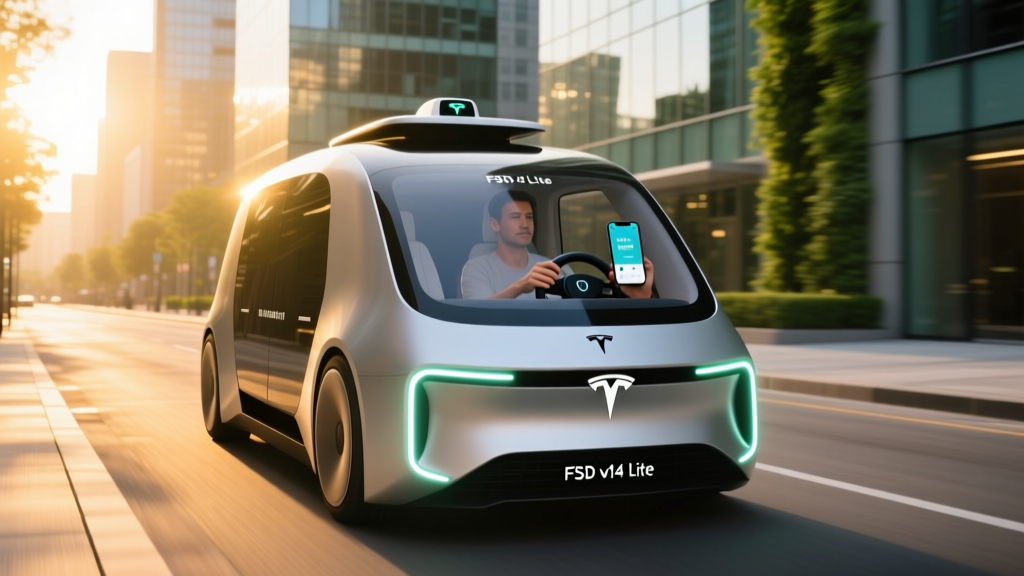
Tesla's Full Self-Driving software has evolved rapidly on newer hardware, but owners of older Model 3, Model Y, Model S, and Model X vehicles have often wondered whether their cars would be left behind. The answer is taking shape: Tesla plans to launch FSD v14 Lite for older vehicles, a streamlined version of its latest neural-network-based driver-assistance stack designed to run on Hardware 3 (HW3) computers that shipped in vehicles from roughly 2019 through 2023.
This move matters for hundreds of thousands of Tesla owners who purchased or subscribed to FSD expecting continued feature parity. Here is exactly what FSD v14 Lite is, what hardware it targets, what it can and cannot do, and how it compares to the full v14 running on newer Tesla AI hardware.
What FSD v14 Lite Actually Does
FSD (Supervised) is Tesla's most advanced driver-assistance package. It handles highway and city-street driving tasks including lane changes, intersection navigation, turn-signal-activated lane positioning, stop-sign and traffic-light recognition, and speed-limit adaptation. With v12 and later, Tesla shifted to an end-to-end neural network architecture that relies primarily on camera input rather than hard-coded rules for driving decisions.
FSD v14 Lite for older vehicles is a constrained version of this stack. The "Lite" designation reflects the computational ceiling of the HW3 chip, which processes camera feeds at lower throughput than the HW4 (also called AI4) and next-generation hardware found in 2024-and-later vehicles. In practical terms, FSD v14 Lite is expected to deliver:
- City-street navigation with supervised intersection handling
- Highway lane changes and on-ramp/off-ramp merging
- Traffic-light and stop-sign detection with automatic response
- Speed-limit-aware cruise control
- Neural-network-based path planning (scaled to HW3 compute limits)
| Capability | FSD v14 (HW4/AI5) | FSD v14 Lite (HW3) |
|---|---|---|
| City-street navigation | Full neural-net planning | Yes, reduced resolution |
| Highway auto lane change | Yes | Yes |
| Traffic-light response | Yes | Yes |
| Camera resolution processed | Up to 5MP per camera | ~1.2MP per camera (HW3 ISP limit) |
| Camera count supported | 8+ high-res | 8 standard-res |
| Inference speed (frames/sec) | ~36+ fps | ~12–18 fps (estimated) |
| Complex unprotected left turns | High confidence | More conservative / may pause |
| Parking lot navigation | Yes (v14 full) | Unclear / likely limited |
Which Tesla Models and Hardware Versions Qualify
The primary audience for FSD v14 Lite is any Tesla running Hardware 3 — the dual-chip FSD computer introduced in April 2019. This hardware was standard in:
- Model 3: 2019 through approximately mid-2023 production
- Model Y: 2020 through approximately early 2023 production
- Model S: 2019 through 2022 refresh (pre- or early Palladium)
- Model X: 2019 through 2022 refresh
Vehicles with the older Hardware 2.5 (HW2.5) or earlier — generally pre-April 2019 builds — are not expected to receive FSD v14 in any form. Tesla previously offered HW3 retrofit upgrades to some HW2.5 owners who had purchased the FSD package, though availability of that program has varied.
Starting in 2024, Tesla began transitioning to HW4 (AI4) with higher-resolution cameras and a more powerful inference chip. The 2025 and 2026 model-year vehicles ship with HW4 or the newer AI5 platform. These vehicles run the full, unconstrained FSD v14 stack.
SAE Automation Level: This Is Not Self-Driving
FSD (Supervised), including the v14 Lite variant, is classified as SAE Level 2 automation. This means the system provides combined steering and acceleration/braking assistance, but the human driver must remain fully engaged, hands on or near the wheel, eyes on the road, and ready to take over instantly. Tesla's own branding — "FSD (Supervised)" — reflects this legal and technical reality. Only driverless robotaxi services like Waymo operate at SAE Level 4 in geofenced areas.
Tesla's cabin camera monitors driver attentiveness and will issue escalating warnings — visual, audible, and eventually disabling Autosteer for the remainder of the drive — if it detects inattention. The National Highway Traffic Safety Administration (NHTSA) has investigated multiple incidents involving Tesla's driver-assist systems, reinforcing that no consumer-available system replaces an alert human driver.
- Drive without a supervising human in the driver's seat
- Handle all weather conditions — heavy rain, fog, snow, or direct sun glare can degrade camera-only perception
- Navigate unmapped or poorly marked roads reliably
- Guarantee correct responses at complex construction zones or temporary lane shifts
- Eliminate the need for driver insurance or liability — you are the responsible driver at all times
Cost: Purchase Price and Subscription Options
Tesla has offered FSD through two primary models: a one-time purchase and a monthly subscription. Pricing has shifted over the years, and as of 2026, the structure is as follows:
| Option | Cost | Notes |
|---|---|---|
| FSD one-time purchase | $8,000 | Transfers with vehicle; non-refundable |
| FSD monthly subscription | $99/month | Cancel anytime; no long-term commitment |
| Basic Autopilot | Included (standard) | Traffic-aware cruise + Autosteer on highways |
| Enhanced Autopilot (if available) | $6,000 | Includes auto lane change, Navigate on Autopilot, Smart Summon, autopark |
A critical question for HW3 owners: will FSD v14 Lite require a separate purchase, or does an existing FSD license cover it? Based on Tesla's past approach, owners who already purchased FSD outright or maintain an active subscription should receive v14 Lite as an over-the-air update at no additional charge. Tesla has historically treated FSD as a software entitlement tied to the vehicle, not a per-version purchase.
However, Tesla has not historically offered refunds or partial credits if a "Lite" version delivers fewer features than the full package. Owners who paid $8,000+ for FSD on a HW3 vehicle should expect v14 Lite as the maximum capability their hardware supports going forward, unless Tesla announces a subsidized HW4 retrofit program.
Real-World Performance and Limitations on HW3
The HW3 chip was a significant leap when introduced in 2019, delivering roughly 144 TOPS (trillions of operations per second) of inference performance. By comparison, HW4/AI4 is estimated at over 300 TOPS with higher-resolution camera inputs. This gap creates tangible differences in real-world driving scenarios.
Where FSD v14 Lite should perform well:
- Highway driving with clear lane markings — this is the least compute-intensive scenario
- Suburban streets with well-maintained signage and lane paint
- Traffic-light detection at standard intersections in good lighting
- Moderate-density traffic with predictable vehicle behavior
Where HW3 limitations become apparent:
- Low-light and adverse weather: HW3 cameras are 1.2 megapixels vs. 5MP on HW4. Less pixel data means the neural network has less information to work with in rain, dusk, or poorly lit roads.
- Complex intersections: Unprotected left turns across multiple lanes of oncoming traffic require rapid multi-object tracking. HW3's lower frame rate (~12–18 fps vs. 36+ fps on HW4) may cause the system to be more conservative — pausing longer, requesting driver takeover more frequently.
- Construction zones: Temporary barriers, shifted lanes, and flaggers require rapid scene reinterpretation. Higher-resolution, higher-framerate input gives HW4 a meaningful edge.
- Dense urban environments: Cities with heavy pedestrian traffic, cyclists, and irregular road geometry stress the perception stack. HW3 can handle these but with more frequent disengagements.
Based on community driving data and Tesla's own safety reports, expect HW3 FSD disengagement rates to be roughly 2–3x higher than HW4 in city-street scenarios. On highways, the gap narrows considerably.
How FSD Compares to Competing ADAS Systems
| System | Brand | SAE Level | Hands-Free? | City Streets? | Monthly Cost |
|---|---|---|---|---|---|
| FSD (Supervised) | Tesla | Level 2 | No (supervised) | Yes | $99/mo or $8,000 |
| Super Cruise | GM (Cadillac/Chev) | Level 2 | Yes (mapped highways) | No | ~$25/mo after trial |
| BlueCruise | Ford/Lincoln | Level 2 | Yes (mapped highways) | No | $75/mo or $2,100 |
| Autopilot (basic) | Tesla | Level 2 | No | No | Included |
| Toyota Safety Sense 3.0 | Toyota | Level 2 | No | No | Included |
| ProPILOT Assist 2.0 | Nissan | Level 2 | Yes (mapped highways) | No | Included on select trims |
Tesla's FSD remains the only consumer system that attempts full city-street navigation without geofencing to pre-mapped highways. GM's Super Cruise and Ford's BlueCruise offer genuine hands-free operation but only on roughly 750,000+ miles of pre-mapped divided highways in the US and Canada. They do not handle city streets, intersections, or traffic lights.
This makes FSD v14 Lite a unique proposition: even in its constrained form, it offers city-street capability that competitors simply do not attempt. The trade-off is that Tesla requires hands-on supervision, while Super Cruise and BlueCruise allow hands-free driving in their approved corridors.
For drivers whose primary use case is highway commuting, Super Cruise or BlueCruise may actually feel more polished because they are optimized for that specific scenario. For drivers who want door-to-door assistance across varied road types — and who accept the supervision requirement — FSD v14 Lite remains the broadest available option on older hardware.
What HW3 Owners Should Do Now
If you own a Tesla with HW3 and have been waiting for FSD improvements, here is a practical decision framework:
If you already own FSD outright: Keep your subscription active or simply wait for the v14 Lite OTA update. There is no additional cost, and you will receive whatever capability HW3 can support. Monitor Tesla's release notes for specific version numbers rolling out to HW3 vehicles.
If you are considering subscribing: The $99/month subscription is a low-risk way to evaluate whether v14 Lite meets your daily driving needs. Try it for two to three months on your typical routes. If disengagement rates are acceptable for your commute, continue. If the system feels too conservative, cancel — there is no lock-in.
If you are considering a vehicle upgrade: Any 2025 or 2026 Tesla with HW4 or AI5 will run the full FSD v14 stack. If city-street FSD performance is a priority and your current HW3 vehicle's capabilities frustrate you, a hardware upgrade via a new vehicle purchase is the most direct path to full capability. Tesla has not announced a paid HW3-to-HW4 retrofit program as of early 2026.
Check your hardware version: On your Tesla's touchscreen, go to Controls > Software > Additional Vehicle Information. Look for "Autopilot computer" — it will read either "Hardware 3" or "Hardware 4" (or "AI4"). This confirms which FSD track your vehicle will receive.
Frequently Asked Questions
Is FSD v14 Lite truly self-driving?
No. FSD v14 Lite, like all versions of FSD (Supervised), is SAE Level 2 driver assistance. You must remain alert, keep your hands on or near the steering wheel, and be prepared to take over at any moment. The driver is legally and practically responsible for the vehicle at all times.
Will I need to pay extra for FSD v14 Lite if I already purchased FSD?
Based on Tesla's historical approach, no. FSD is a software entitlement tied to the vehicle. If you purchased FSD outright or have an active $99/month subscription, v14 Lite should arrive as a free over-the-air update when it rolls out to HW3 vehicles.
Can I upgrade my HW3 Tesla to HW4 to get full FSD v14?
As of 2026, Tesla has not announced a consumer retrofit program to upgrade HW3 vehicles to HW4. The HW4 system requires different camera modules (higher resolution), different wiring harnesses, and a different compute unit. While technically possible, it would be costly and Tesla has not offered it as a service option.
How does FSD v14 Lite perform in rain or snow?
Tesla's vision-only system (no radar on most vehicles since 2021) is more susceptible to weather degradation than sensor-fusion systems using lidar or radar. In heavy rain, fog, or snow, camera visibility drops and FSD may become more conservative, reduce speed, or request driver takeover. HW3's lower-resolution cameras are at a further disadvantage compared to HW4 in these conditions. The IIHS notes that all current ADAS systems have performance limitations in adverse weather.
What happens if FSD v14 Lite encounters a scenario it cannot handle?
The system will issue a visual and audible alert requesting immediate driver takeover. If the driver does not respond, the vehicle will activate hazard lights, gradually decelerate, and come to a stop. This is consistent with Tesla's existing fallback behavior across all FSD versions.
Does FSD v14 Lite affect my Tesla's warranty or insurance?
Using FSD does not void your vehicle warranty. However, some insurance providers may adjust premiums based on ADAS usage. Because FSD is Level 2, the driver remains fully liable for any incidents. Tesla's own insurance product (available in select states) factors in real-time driving behavior via a safety score, which may be affected by FSD usage patterns.
Which Tesla models will receive FSD v14 Lite first?
Tesla typically rolls out major FSD updates to a limited fleet first — often employees and early-access program participants — before expanding to the broader HW3 fleet. Model 3 and Model Y vehicles from 2021–2023 are the most numerous HW3 vehicles and are likely to be in the first expansion wave. Model S and Model X with HW3 should follow. Watch for version numbers in Tesla's OTA update notes for HW3-specific build identifiers.
Tesla plans to launch FSD v14 Lite for older vehicles as a pragmatic acknowledgment that hardware generations create capability ceilings. For HW3 owners, this means continued software support and meaningful city-street driver assistance — but not parity with the latest HW4/AI5 vehicles. Understanding those boundaries, costs, and real-world expectations is essential before you decide whether to subscribe, keep your existing FSD purchase, or consider a hardware upgrade through a new vehicle.