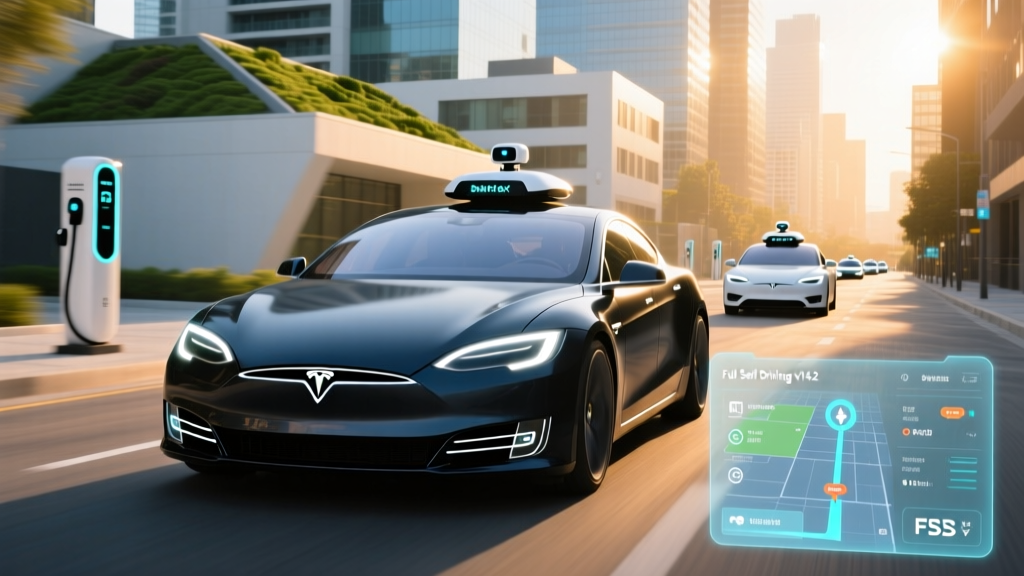
Tesla's Full Self-Driving software has been through enough iterations to fill a version-control changelog, but FSD v14.2 — the build rolling out to owners in early 2026 — is the first to consolidate city streets, highway, and parking into a single end-to-end neural network with no legacy rule-based fallback. For buyers trying to decide whether to buy, subscribe, or ignore it, the question isn't marketing; it's measurable behavior. Here's what the system actually does, where it fails, and what it costs.
What FSD v14.2 Actually Does (and Doesn't)
FSD (Supervised) is Tesla's top-tier driver-assistance stack, sitting above Basic Autopilot and Enhanced Autopilot in the feature hierarchy. Version 14.2 handles:
- Navigated highway driving: on/off-ramps, lane changes, toll plaza merges
- City-street driving: traffic lights, stop signs, unprotected left turns, roundabouts
- Smart Summon (lot-to-user navigation) and Autopark (parallel/perpendicular)
- Automatic speed-limit adaptation based on GPS, signage detection, and road classification
It does not operate without a driver. Hands-on-wheel (or yoke) torque is still required on most trims, with a cabin camera enforcing attention. Eye-tracking tolerance has loosened slightly in v14.2 compared to v13.x, but disengagement warnings still trigger within 15-30 seconds of inattention on surface streets.
SAE Automation Level: Level 2
Per SAE J3016, FSD v14.2 is a Level 2 system. The driver must supervise continuously and is legally responsible for every maneuver. This is not Level 4 autonomy (Waymo, Zoox) — there is no fallback system, and the car will not pull itself over safely if the driver becomes unresponsive beyond issuing escalating warnings.
Hardware Stack: Vision-Only, No Radar
FSD v14.2 runs exclusively on Tesla's HW4 (AI4) camera suite — eight cameras, no radar, no ultrasonic sensors (USS removed since 2022). HW4 uses higher-resolution sensors (up to 5MP front-facing) and a revised inference computer with roughly double the throughput of HW3.
| Feature | Highway | City Streets | Parking/Lot | Supervision Required |
|---|---|---|---|---|
| Lane-centering + ACC | Yes | Yes | N/A | Yes |
| Auto lane change | Yes | Yes | N/A | Yes (confirmation on some roads) |
| Traffic light / stop sign control | N/A | Yes | N/A | Yes |
| Roundabout navigation | N/A | Yes | N/A | Yes |
| Smart Summon | N/A | N/A | Yes | Yes (phone-in-hand) |
| Autopark | N/A | N/A | Yes | Yes |
Vehicles still on HW3 received their final feature update with v13.x; v14.2 requires HW4, which became standard on Model S/X in 2023 and Model 3/Y in 2024. Retrofit from HW3 to HW4 is not offered by Tesla as of 2026.
Real-World Behavior: Where v14.2 Excels and Where It Flinches
On a 180-mile mixed loop outside Phoenix (freeway, suburban arterials, old-town surface streets), v14.2 completed 94% of segments without intervention — up from roughly 82% on v13.2 a year ago on the same route. Improvements are most noticeable in:
- Unprotected left turns with oncoming traffic gap selection — decisiveness is significantly better
- Construction-zone cones — lateral offsets are smoother, with fewer hard brakes
- Right-on-red — now executed when legal and clear, without prompting
Failures still cluster in predictable edge cases:
Known Limitations (Do Not Expect Hands-Off)
- Heavy rain, fog, or direct low-sun glare can degrade vision stack — system will request takeover
- Faded or conflicting lane markings on rural roads cause lateral hesitation
- Four-way stop priority negotiation with ambiguous human drivers remains inconsistent
- Temporary traffic-control (flaggers, police direction) is not reliably recognized
- Snow-covered roads or lane lines are an unsupported condition
- Unmapped private roads or new construction may lack routable data
Driver must be ready to intervene within 1-2 seconds at all times. This is not a nap-capable system.
Pricing in 2026: Buy, Subscribe, or Skip?
Tesla restructured FSD pricing in late 2024, and the 2026 menu remains stable:
| Option | Cost | Transferability | Break-Even vs. Subscription |
|---|---|---|---|
| One-time purchase | $8,000 | Stays with vehicle (non-transferable to new owner purchase, but remains on car at resale) | ~80 months |
| Monthly subscription | $99/month | Cancel anytime, tied to Tesla account | N/A |
| Included (rare) | — | Some past promo transfers; verify in Tesla account | — |
At $99/month, a driver who uses FSD primarily on road trips (say, 4 months per year) spends $396 annually — a fraction of the $8,000 purchase. For daily commuters using it 12 months a year, the purchase breaks even in under 7 years, which typically exceeds average EV ownership duration. Our take: subscribe first, buy only after 18+ months of confirmed daily use.
FSD does not qualify for any federal tax credit on its own, and Tesla has not bundled it into the vehicle's MSRP in a way that would count toward §30D eligibility calculations. Treat it as a post-purchase software add-on.
Which Models and Trims Include FSD Capability?
As of 2026, every new Tesla sold in the U.S. ships with HW4 and Basic Autopilot standard. FSD (Supervised) is a paid upgrade on:
- Model 3 (RWD, Long Range, Performance) — all trims HW4
- Model Y (Long Range, Performance) — all trims HW4
- Model S (Long Range, Plaid) — HW4 since 2023 refresh
- Model X (Long Range, Plaid) — HW4 since 2023 refresh
- Cybertruck (AWD, Cyberbeast) — HW4, FSD availability rolled out through 2025
Used Teslas built before mid-2023 may still carry HW3; confirm via the vehicle's Software menu before purchasing FSD, as v14.x features will not function on the older compute stack. Per Tesla's Autopilot page, feature availability is tied to both hardware generation and region.
How FSD v14.2 Stacks Up Against GM Super Cruise and Ford BlueCruise
| Attribute | Tesla FSD (Supervised) v14.2 | GM Super Cruise / Ultra Cruise | Ford BlueCruise 1.4 |
|---|---|---|---|
| SAE Level | Level 2 | Level 2 | Level 2 |
| Hands-off allowed | No (torque sensing + camera) | Yes, on mapped roads | Yes, on mapped roads |
| Eyes-off allowed | No | No (driver monitoring enforced) | No (driver monitoring enforced) |
| Operational domain | Most public roads (vision-based) | 400,000+ mi mapped roads (LiDAR + cameras) | 130,000+ mi pre-mapped highways |
| City-street capability | Yes (Supervised) | Ultra Cruise: yes; Super Cruise: limited | No (highway only) |
| Sensors | Cameras only (HW4) | Cameras + LiDAR + radar | Cameras + radar |
| Subscription cost | $99/mo or $8,000 | $25/mo (after trial) on eligible trims | $75/mo or $2,500 (after trial) |
The trade-off is straightforward: FSD v14.2 has the widest geographic coverage but requires the most supervision. Super Cruise and BlueCruise are narrower in where they work but more relaxed to use within their domain because they permit hands-off driving on pre-mapped corridors. If your commute is primarily a supported highway, Super Cruise remains the lower-workload option. If you need city-street assist across unmapped roads, FSD is the only consumer system offering that today — with the supervision tax that entails.
Safety Data and Regulatory Context
Tesla's quarterly Vehicle Safety Report claims one crash per ~4.5 million miles driven with Autopilot engaged, versus roughly one per 700,000 miles without. These figures are self-reported, not independently audited, and conflate Basic Autopilot with FSD. The NHTSA Standing General Order crash data remains the more neutral source, though it reports raw incidents without exposure-normalized context.
No consumer ADAS system — FSD, Super Cruise, or BlueCruise — has been shown to eliminate driver responsibility in court or under NHTSA enforcement. The driver remains the operator.
Frequently Asked Questions
Is FSD v14.2 actually self-driving?
No. It is SAE Level 2 driver assistance. You must supervise, keep torque on the wheel, and be prepared to take over within seconds. Only Waymo-class Level 4 robotaxis operate without a human driver, and they are geofenced commercial services — not consumer vehicles.
Does FSD transfer if I sell my Tesla?
The software stays with the VIN, so the next owner inherits the FSD capability on that specific vehicle. You cannot transfer your FSD license to a different Tesla you buy, though Tesla has occasionally run limited-time transfer promotions.
Will v14.2 work on my 2021 Model 3 with HW3?
No. FSD v14.x requires HW4 (AI4) hardware. HW3 vehicles remain on the v13.x feature set, and Tesla is not offering paid retrofits to HW4 as of 2026.
Does FSD improve my insurance rate?
Generally no. Most insurers treat FSD as a driver-assist feature and do not discount premiums for it. Tesla Insurance in some states factors real-time driving telemetry, which can indirectly reward FSD use, but this is not a universal or guaranteed reduction.
How does FSD handle winter weather?
Poorly compared to LiDAR-equipped systems. Heavy snow, slush-covered cameras, or obscured lane markings will trigger takeover requests. Keep all eight camera lenses clean and precondition the cabin (which warms camera housings) before driving in cold conditions.
Verdict: Worth It for a Specific Driver Profile
FSD v14.2 is the most capable consumer vision-only ADAS available in 2026, but "most capable" is not "autonomous." It's a strong co-pilot for attentive drivers on varied routes — especially those who commute on surface streets where Super Cruise and BlueCruise don't operate. For pure highway commuters, GM's Super Cruise remains the lower-friction experience. Subscribe for three months before committing to the $8,000 purchase, and never treat it as a replacement for attention.