What the Tesla FSD Upgrade Actually Does (and Doesn't Do)
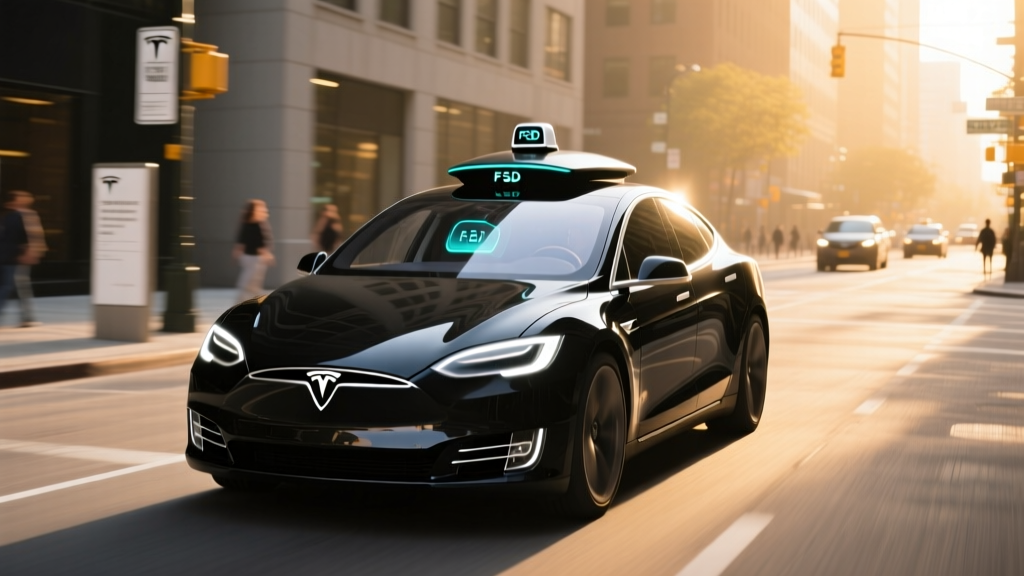
If you own a Tesla or are shopping for one, you've likely encountered the prompt to buy or subscribe to Full Self-Driving (FSD) capability. Despite the name, the Tesla FSD upgrade is not an autonomous driving system. It is an advanced Level 2 driver-assistance suite that extends Tesla's standard Autopilot with features like automated lane changes, traffic-light and stop-sign recognition, and Navigate on Autopilot for highway interchanges. In 2026, FSD (Supervised) also includes Tesla's city-street driving profile, which can handle intersections, turns, and speed-limit adjustments — but always with the driver legally and practically responsible for the vehicle.
Technically, FSD (Supervised) relies entirely on Tesla's vision-only hardware stack. Current Model 3, Model Y, Model S, and Model X vehicles use a suite of eight external cameras (front, side repeaters, side pillars, and rear) processed by Tesla's HW4 computer. Tesla removed ultrasonic sensors (USS) from production starting in late 2022 and radar by 2023, making Tesla Vision the sole input for object detection, depth estimation, and lane-keeping. The neural networks running on HW4 perform real-time 3D scene reconstruction, occupancy-network mapping, and path planning — impressive engineering, but one that still requires an attentive human behind the wheel.
FSD (Supervised) is classified as SAE Level 2 per the Society of Automotive Engineers. This means the system can control steering, acceleration, and braking simultaneously, but the driver must continuously supervise, keep hands on the wheel (or demonstrate attention via the cabin camera), and be prepared to take over instantly. It is not Level 3 (conditional automation), Level 4 (high automation), or Level 5 (full automation). Only geofenced robotaxi services like Waymo operate at Level 4.
Feature Breakdown: Autopilot vs. FSD (Supervised)
Every new Tesla sold in 2026 includes Basic Autopilot at no extra charge. FSD (Supervised) is a paid add-on. Here's exactly what separates the two tiers:
| Feature | Basic Autopilot (Included) | FSD Supervised (Paid) |
|---|---|---|
| Traffic-Aware Cruise Control | ✅ | ✅ |
| Autosteer (lane centering) | ✅ | ✅ |
| Navigate on Autopilot (highway interchanges) | ❌ | ✅ |
| Auto Lane Change | ❌ | ✅ |
| Autopark / Smart Summon | ❌ | ✅ |
| Traffic Light & Stop Sign Control | ❌ | ✅ |
| City Street Driving (FSD Streets) | ❌ | ✅ |
Basic Autopilot handles highway lane-keeping and adaptive cruise well — arguably the most daily-useful ADAS features. FSD (Supervised) adds complexity for city navigation, parking lot maneuvers, and automated on-ramp-to-off-ramp routing. Whether those extras justify the price depends on your driving patterns and tolerance for supervision.
Tesla FSD Upgrade Cost: Purchase vs. Subscription in 2026
Tesla offers two paths to unlock FSD (Supervised). The pricing has fluctuated over the years, but as of the current 2026 model-year structure:
| Option | Price | Transferable? | Break-Even vs. Subscription |
|---|---|---|---|
| One-Time Purchase | $8,000 | Stays with vehicle at sale | ~81 months (6.75 years) |
| Monthly Subscription | $99/month | No — tied to your Tesla account | N/A — cancel anytime |
The math: At $99/month, you'd pay $1,188/year. The $8,000 lump sum breaks even after roughly 81 months of continuous subscription. If you plan to keep your Tesla for seven or more years and use FSD regularly, the purchase makes financial sense. If you're leasing, plan to sell within three to four years, or only want FSD for road trips, the subscription is the clear winner. Tesla occasionally runs promotional FSD transfers to new vehicles for existing owners — check your account for current offers.
Note: FSD pricing and structure are set by Tesla and are separate from any federal EV tax credit. The IRS §30D clean vehicle credit applies to the vehicle purchase itself (up to $7,500, subject to MSRP caps, income limits, and battery-sourcing requirements), but does not specifically cover aftermarket software add-ons like FSD.
Which Tesla Models Include or Support FSD?
FSD (Supervised) is available as an add-on across Tesla's entire 2026 consumer lineup:
- Model 3 (all trims — RWD, Long Range, Performance) — HW4 equipped
- Model Y (Long Range, Performance, and the refreshed Juniper generation) — HW4 equipped
- Model S (Long Range, Plaid) — HW4 equipped
- Model X (Long Range, Plaid) — HW4 equipped
- Cybertruck (AWD, Cyberbeast) — HW4 equipped, FSD rolling out progressively
No Tesla model includes FSD (Supervised) as standard equipment. Every vehicle ships with Basic Autopilot. Older vehicles equipped with HW2.5 or HW3 computers can still run FSD, though Tesla has prioritized neural-network updates and feature rollouts for HW4 hardware. If you're buying a used Tesla, verify the hardware generation — it affects both current capability and future update eligibility.
Real-World Capabilities and Honest Limitations
On well-marked divided highways in clear weather, FSD (Supervised) is genuinely competent. Navigate on Autopilot handles lane changes, on-ramp merges, and off-ramp exits with reasonable smoothness. The system's highway performance has matured considerably since its early beta days.
City-street FSD is where the experience becomes inconsistent. The system can navigate four-way stops, make protected and unprotected left turns, and respond to traffic lights. However, real-world testing reveals recurring edge cases:
- Does not drive autonomously. You are the driver. NHTSA requires your full attention and ability to intervene within seconds.
- Struggles in heavy rain, fog, and snow. Vision-only systems degrade when camera lenses are obscured or road markings are hidden.
- Construction zones. Cone detection and temporary lane rerouting remain inconsistent — expect to take over.
- Unprotected left turns in heavy traffic. The system can be overly conservative or hesitate, requiring driver intervention.
- Faded or missing lane markings. Rural roads and older urban streets with poor paint cause lane-keeping uncertainty.
- Complex multi-lane roundabouts. Navigation can be erratic; manual control recommended.
- Phantom braking. The system occasionally brakes hard for perceived obstacles (shadows, overpasses) that don't exist. This is a known behavior documented in NHTSA complaint databases.
Cold-weather performance deserves specific mention. In sub-30°F conditions, camera lenses can ice over, and the system will issue warnings or disengage. Unlike vehicles with radar redundancy (like GM Super Cruise or Ford BlueCruise), Tesla has no sensor fallback when vision is compromised. Preconditioning the cabin helps warm the hardware, but winter drivers in northern climates should expect more frequent takeovers.
FSD vs. Competing ADAS: How Tesla Stacks Up
Tesla's FSD isn't the only advanced Level 2 system on the market. Here's how it compares to the top alternatives available in 2026:
| System | Brand | SAE Level | Hands-Free? | Sensor Suite | Cost |
|---|---|---|---|---|---|
| FSD (Supervised) | Tesla | Level 2 | No (attention monitored) | 8 cameras (vision only) | $8,000 or $99/mo |
| Super Cruise | GM (Cadillac/Chevy) | Level 2 | Yes (on mapped roads) | Cameras + radar + LiDAR map | Included or ~$2,500 |
| BlueCruise | Ford / Lincoln | Level 2 | Yes (on mapped roads) | Cameras + radar | $2,100 or $75/mo |
| ProPILOT Assist 2.0 | Nissan | Level 2 | Yes (highway, eyes-monitored) | Cameras + radar | Included in select trims |
| Toyota Safety Sense 3.0 | Toyota | Level 2 | No | Cameras + radar | Standard (included) |
The critical differentiator: GM Super Cruise and Ford BlueCruise offer true hands-free driving on pre-mapped divided highways (over 750,000 and 130,000 mapped miles respectively). Tesla FSD covers more road types — including city streets — but never permits hands-off operation. The cabin camera monitors eye gaze, and repeated warnings will disable Autosteer for the remainder of the trip if you look away.
For pure highway commuting on interstates, Super Cruise delivers a more relaxed experience. For drivers who want assistance across diverse road types and don't mind active supervision, FSD offers broader coverage. Neither system is autonomous, and both require a ready driver.
Is the Tesla FSD Upgrade Worth It? A Decision Framework
- You drive 15,000+ miles/year, mostly on highways and suburban arterials
- You frequently take road trips and want automated interchange navigation
- You plan to keep your Tesla 5+ years (purchase) or want flexibility (subscription)
- You enjoy early-access technology and accept iterative software improvements
- You value the potential — however uncertain — of future capability upgrades via OTA updates
- You primarily drive in dense urban areas with complex, unmapped intersections
- You live in a region with heavy snow, fog, or rain for months at a time
- You expect a self-driving car — FSD is not that, and no consumer vehicle currently is
- Basic Autopilot already covers your needs (highway cruise + lane centering)
- You're leasing or plan to sell within 2-3 years — the subscription is more economical
Frequently Asked Questions
Is Tesla FSD actually self-driving?
No. Tesla FSD (Supervised) is an SAE Level 2 driver-assistance system. The driver must remain fully engaged, monitor the road, and be prepared to take control at any moment. The "Supervised" label Tesla added in 2024 was specifically intended to clarify this. True self-driving (Level 4) currently exists only in geofenced robotaxi services like Waymo in select cities.
Can I transfer my FSD purchase to a new Tesla?
FSD purchased outright stays with the vehicle — it transfers to the next owner when you sell or trade in. Tesla has periodically offered limited-time FSD transfer promotions allowing owners to move their license to a new Tesla purchase, but these are promotional, not guaranteed. Subscription-based FSD is tied to your Tesla account and can be activated on any Tesla you own or lease.
Does FSD improve my Tesla's safety rating?
Not directly. The Insurance Institute for Highway Safety (IIHS) and NHTSA evaluate passive safety, crashworthiness, and crash-avoidance systems. FSD features are categorized as convenience/driver-assist, not safety equipment. In fact, NHTSA has investigated Tesla's Autosteer and FSD for crash incidents, and the agency has issued Standing General Orders requiring crash reporting for vehicles with Level 2+ systems.
Will FSD work on my older Tesla with HW3?
Yes, HW3-equipped vehicles can run FSD (Supervised). However, Tesla's most advanced neural networks and newest features are optimized for HW4's higher-resolution camera inputs and faster processing. Tesla has stated HW3 will continue to receive FSD support, but the performance ceiling is lower. If buying used, HW4 is preferable for longevity.
How does FSD handle toll roads and HOV lanes?
Navigate on Autopilot can route through toll plazas and maintain position in HOV lanes when they are clearly marked. However, the system does not automatically pay tolls — you need a transponder or license-plate billing. Toll-booth barrier arms and narrow lanes may require manual control. Always verify the route before the vehicle enters a toll area.