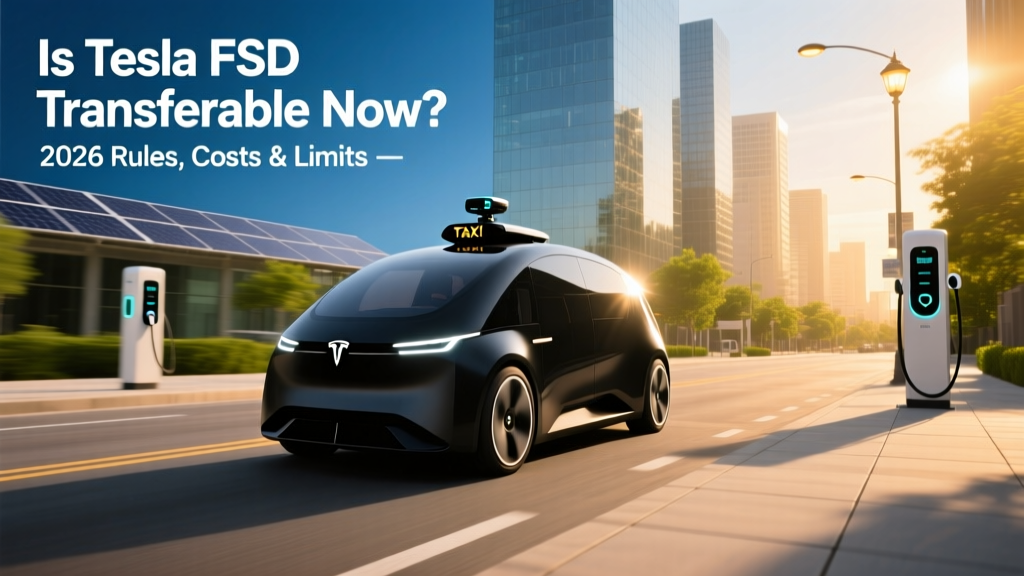
Quick Answer: Is Tesla FSD Transferable Now?
As of early 2026, Tesla's Full Self-Driving (Supervised) capability does not permanently transfer when you sell your vehicle. The FSD license is tied to the original purchaser and the specific VIN at the time of purchase. However, Tesla has periodically run limited-time promotional transfer programs — most recently in late 2025 — that allowed qualifying owners to move an active FSD (Supervised) license to a newly purchased Tesla. These promotions are time-bound, not permanent policy.
If you're weighing whether to buy FSD outright or subscribe monthly, the transfer question is central to the economics. A one-time purchase that stays with the car when you trade it in is worth more at resale than a license that evaporates. Here's exactly what you need to know about how FSD works, what it costs, and where the transfer rules stand today.
SAE Automation Level: Level 2 — Not Self-Driving
Tesla FSD (Supervised) is classified as SAE Level 2 driver assistance. This means the system can simultaneously control steering, acceleration, and braking under certain conditions, but the driver must remain fully engaged, monitor the environment at all times, and be prepared to take over instantly. It is not autonomous driving. Only Level 4 services like Waymo One (operating in Phoenix, San Francisco, and Los Angeles) qualify as true driverless systems. Tesla's naming — "Full Self-Driving" — is widely considered misleading by safety advocates and regulators, including the National Highway Traffic Safety Administration (NHTSA), which has investigated Tesla's Autopilot and FSD systems for crash patterns and driver-monitoring adequacy.
How Tesla FSD (Supervised) Actually Works
Tesla's FSD (Supervised) stack relies on a vision-only architecture — eight cameras providing 360-degree surround view, processed by Tesla's custom HW4 (Hardware 4) computer. Tesla removed ultrasonic sensors (USS) and radar from vehicles built after October 2022, relying entirely on its neural-network-based "Tesla Vision" perception system. This is a significant technical divergence from competitors like Ford BlueCruise (which uses cameras + radar), GM Super Cruise (LiDAR-mapped highways + cameras + radar), and Mercedes-Benz Drive Pilot (Level 3, using LiDAR, radar, cameras, and HD maps).
Core Feature Set
FSD (Supervised) builds on Tesla's standard Autopilot and Enhanced Autopilot features, adding:
- Traffic Light and Stop Sign Control: Detects and responds to traffic signals and stop signs
- Autosteer on City Streets: Navigates intersections, turns, and urban routes (the signature FSD feature)
- Auto Lane Change: Initiates lane changes based on navigation route and surrounding traffic
- Navigate on Autopilot: Highway on-ramp to off-ramp guidance with automatic interchanges
- Smart Summon / Actually Smart Summon: Vehicle navigates parking lots to reach the driver (within limited range)
- Autopark: Parallel and perpendicular parking assist
| Feature | Basic Autopilot (Standard) | Enhanced Autopilot ($6,000) | FSD Supervised ($8,000) |
|---|---|---|---|
| Traffic-Aware Cruise Control | ✅ | ✅ | ✅ |
| Autosteer (highway lanes) | ✅ | ✅ | ✅ |
| Navigate on Autopilot | ❌ | ✅ | ✅ |
| Auto Lane Change | ❌ | ✅ | ✅ |
| Autopark | ❌ | ✅ | ✅ |
| Smart Summon | ❌ | ✅ | ✅ |
| Traffic Light & Stop Sign Control | ❌ | ❌ | ✅ |
| Autosteer on City Streets | ❌ | ❌ | ✅ |
FSD Pricing: One-Time Purchase vs. Monthly Subscription
Tesla currently offers FSD (Supervised) through two pricing models. Understanding the difference is critical when evaluating whether a transfer matters to you.
| Option | Cost | Tied To | Transferable? |
|---|---|---|---|
| One-Time Purchase | $8,000 | Original purchaser + VIN | No (except during limited-time promotions) |
| Monthly Subscription | $99/month | Driver's Tesla account | Cancel anytime; no asset to transfer |
| Enhanced Autopilot (one-time) | $6,000 | Original purchaser + VIN | No |
The $8,000 purchase price was reduced from $12,000 in April 2024, and the subscription dropped from $199/month to $99/month in the same period. These cuts were designed to boost adoption rates, which industry analysts estimated at roughly 10-15% of Tesla owners prior to the price reduction.
Key economic insight: If you plan to keep your Tesla for more than ~6.7 years, the one-time purchase ($8,000) is cheaper than subscribing ($99 × 81 months = $8,019). But if you trade vehicles every 3-4 years, the subscription model avoids the sunk-cost problem entirely — you simply cancel and resubscribe on your next Tesla.
Tesla FSD Transfer Rules: What's Allowed and What Isn't
The transferability of a purchased FSD license is one of the most contentious topics in Tesla ownership. Here's the breakdown:
Standard Policy: No Transfer
Under Tesla's standard terms, a purchased FSD license is non-transferable. When you sell or trade in your Tesla, the FSD license does not move to the buyer (unless Tesla specifically includes it in a certified pre-sale arrangement, which is rare) and does not move to your next vehicle. The $8,000 investment is effectively a sunk cost tied to that specific VIN and your ownership period.
Limited-Time Promotional Transfers
Tesla has occasionally offered FSD transfer promotions to incentivize new vehicle purchases:
- March 2024 promotion: Owners who ordered a new Tesla and took delivery by March 31, 2024, could transfer an existing FSD license from their current vehicle to the new one.
- Late 2025 promotion: A similar window was opened for Q4 2025 deliveries, allowing qualifying owners to migrate FSD to a new purchase.
These promotions are not guaranteed, not recurring on a predictable schedule, and typically require taking delivery within a narrow window. Relying on a future transfer promotion is speculative — Tesla has no obligation to offer them.
What About Selling a Car With FSD?
When you sell a Tesla privately that has an active FSD purchase, the FSD may remain associated with the vehicle for the next owner — but this is not guaranteed and Tesla has changed this policy multiple times. In some cases, Tesla has stripped FSD from vehicles resold through third-party dealers. The safest assumption: do not count on recouping FSD purchase cost in your resale price. Kelley Blue Book and Edmunds generally do not add the full $8,000 to trade-in or private-party values for FSD-equipped vehicles.
Real-World Capabilities and Limitations
FSD (Supervised) has improved substantially through over-the-air software updates, particularly with the shift to an end-to-end neural network architecture (v12.x and later). But it remains a Level 2 system with meaningful limitations that every owner and prospective buyer must understand.
⚠️ What FSD (Supervised) Does NOT Do
- Does not drive autonomously. You must keep your hands on the steering wheel (or apply sufficient torque for the system to detect engagement) and monitor the road at all times.
- Does not handle all weather. Heavy rain, fog, snow, and low-visibility conditions degrade camera-based perception. The system will issue a takeover request or disengage.
- Does not reliably read faded or missing lane markings. Construction zones, rural roads, and poorly maintained infrastructure are common edge cases requiring immediate driver intervention.
- Does not guarantee safe intersection navigation. Unprotected left turns, complex multi-lane roundabouts, and non-standard intersections remain challenging scenarios.
- Does not replace your insurance liability. You are the responsible driver. If the system makes an error and you fail to intervene, you are liable.
Where FSD Performs Well
In controlled testing and daily use, FSD (Supervised) excels at:
- Highway driving: Lane centering, adaptive cruise, and automatic lane changes are smooth and reliable on well-marked divided highways.
- Suburban routes: Low-to-moderate speed residential and commercial streets with clear markings and predictable traffic patterns.
- Stop-and-go traffic: Reduces driver fatigue significantly in congested commuting scenarios.
- Navigation-based routing: The system follows the set navigation route competently, handling most highway interchanges and exits.
Cold-Weather and Edge-Case Reality
Camera-only systems are inherently vulnerable to environmental conditions that radar and LiDAR handle better. In winter driving, accumulated road grime, salt spray, and snow on camera lenses can trigger system disengagement. Owners in northern climates report needing to wipe camera housings more frequently than they would clean a windshield. Tesla's camera heaters help but are not a complete solution in heavy precipitation.
FSD vs. Competing Driver-Assist Systems
Tesla FSD (Supervised) is not the only advanced Level 2 system on the market. Here's how it compares to key competitors in 2026.
| System | Brand | Sensor Suite | Hands-Free? | Cost | Availability |
|---|---|---|---|---|---|
| FSD (Supervised) | Tesla | 8 cameras (vision-only) | No (hands-on torque detection) | $8,000 or $99/mo | All Tesla models (HW4) |
| Super Cruise | GM (Cadillac, Chevy) | Cameras + radar + LiDAR-mapped HD maps | Yes (on 750,000+ mi of mapped roads) | Included or $2,500 add-on depending on trim | Select GM trims |
| BlueCruise | Ford / Lincoln | Cameras + radar | Yes (on 130,000+ mi of divided highways) | $2,100 or $75/mo | Select Ford/Lincoln models |
| Drive Pilot | Mercedes-Benz | LiDAR + radar + cameras + HD maps | Yes (Level 3 — up to 40 mph, specific highways) | $2,500/year subscription | EQS, S-Class (NV, CA only) |
| ProPILOT Assist 2.0 | Nissan | Cameras + radar | Yes (hands-free highway, eyes-off capable) | Included on select trims | Ariya, Rogue, others |
Key differentiator: GM Super Cruise and Ford BlueCruise allow true hands-free driving on pre-mapped divided highways — something Tesla's FSD (Supervised) does not permit, as it requires continuous steering-wheel torque. However, Tesla's system covers a broader range of road types (including city streets), whereas Super Cruise and BlueCruise are limited to their mapped highway networks.
Mercedes-Benz Drive Pilot is the only SAE Level 3 system available to US consumers (currently in Nevada and California), meaning the driver can legally take their eyes off the road under specific conditions (under 40 mph, on mapped divided highways, in clear weather). Mercedes assumes liability when Drive Pilot is engaged within its operational design domain. This is a fundamentally different legal and technical proposition than any Level 2 system.
Should You Buy, Subscribe, or Skip FSD?
Decision Framework
- Buy the $8,000 one-time purchase if: You plan to keep your Tesla 7+ years, you drive frequently in varied conditions where FSD adds daily value, and you accept the risk that the license will not transfer to your next vehicle.
- Subscribe at $99/month if: You trade vehicles every 3-4 years, you want to test FSD before committing, or you only need the feature for specific trips (e.g., long highway commutes). You can cancel and restart anytime.
- Stick with standard Autopilot (free) if: Your driving is primarily highway commuting where Traffic-Aware Cruise Control and basic Autosteer meet your needs, or if you're uncomfortable with the current maturity of city-street autonomous features.
- Consider Enhanced Autopilot ($6,000) if: You want Navigate on Autopilot and Auto Lane Change for highway driving but don't need city-street Autosteer or traffic-light recognition.
Ownership Economics: Does FSD Add Resale Value?
The non-transferability of FSD creates a real economic drag for one-time purchasers. Data from used-vehicle listing platforms suggests that FSD-equipped Teslas command a resale premium of roughly $2,000 to $4,000 — significantly less than the $8,000 purchase price. The premium varies by model, mileage, and market conditions, but buyers in the used market are generally unwilling to pay full price for a software feature that Tesla could modify, restrict, or revoke.
For context, a 2024 Tesla Model 3 Long Range AWD (base MSRP $47,740) with FSD purchased at $8,000 represents a total investment of $55,740. After 3 years and 36,000 miles, typical depreciation might place the vehicle at roughly $30,000-$34,000 private-party value — with perhaps $2,500-$3,500 attributable to the FSD feature. The net FSD cost of ownership over 3 years: approximately $4,500-$5,500, or $125-$153/month — more expensive than the $99/month subscription.
This math strongly favors the subscription model for anyone who doesn't plan to hold the vehicle for 5+ years.
Frequently Asked Questions
Can I transfer my FSD license to a new Tesla I buy in 2026?
Not under standard policy. Tesla occasionally offers limited-time transfer promotions tied to new vehicle delivery deadlines. There is no permanent transfer mechanism. Check Tesla's website or your Tesla account for any active promotions before placing a new order.
If I sell my Tesla privately, does the buyer get FSD?
Sometimes. In many cases, a purchased FSD license remains associated with the VIN and the next owner can use it — but Tesla has, at times, removed FSD from vehicles sold through non-Tesla channels. This is not guaranteed and should not be a primary selling point. Disclose the FSD status to potential buyers transparently.
Is FSD actually self-driving?
No. FSD (Supervised) is SAE Level 2 driver assistance. You must remain alert, keep your hands on the wheel, and be prepared to intervene at any moment. The "Supervised" designation in Tesla's official naming reflects this requirement. True self-driving (Level 4) is currently only available through robotaxi services like Waymo One in select metro areas.
What happens to my FSD subscription if I sell my Tesla?
The $99/month subscription is tied to your Tesla account, not the vehicle. You simply cancel the subscription when you sell. If you buy another Tesla, you can resubscribe immediately. There is no asset to transfer.
Does FSD work in winter and bad weather?
With limitations. Camera-only perception degrades in heavy rain, snow, fog, and when lenses are obscured by road grime or salt. The system will alert you and may disengage. Always be prepared to take full manual control in adverse weather. Radar-equipped competitors (GM Super Cruise, Ford BlueCruise) have an advantage in low-visibility conditions.
Can I try FSD before buying or subscribing?
Tesla has periodically offered free trial periods (typically 30 days) to eligible vehicles equipped with HW3 or HW4. Availability varies and is often tied to promotional campaigns. Check your Tesla app or vehicle software menu for any active trial offers.
What hardware does my Tesla need for FSD?
FSD (Supervised) requires Tesla's HW4 (Hardware 4) computer for the latest software versions. Vehicles built before approximately March 2023 shipped with HW3, which still supports FSD but may not receive all future capability updates. If you're buying a used Tesla, verify the hardware version in the vehicle's Software menu under "Additional Vehicle Information."
How does FSD compare to Waymo or Cruise robotaxis?
Waymo One and Cruise (currently paused in most markets after safety incidents) operate Level 4 autonomous vehicles with no driver required — but only within tightly defined geographic zones in cities like Phoenix, San Francisco, and Los Angeles. Tesla FSD (Supervised) is a Level 2 system that works on virtually any road but requires constant driver supervision. They solve fundamentally different problems: robotaxis replace the driver in limited areas; FSD assists the driver everywhere.
Sources: NHTSA ADAS Overview, Tesla Autopilot & FSD Support, IIHS Advanced Driver Assistance Research.