Tesla's Full Self-Driving (Supervised) package remains one of the most debated driver-assistance systems on the market. With the shift toward a subscription model and continuous over-the-air updates, the Tesla FSD Supervised subscription presents a different value proposition than the legacy one-time purchase. But what exactly are you paying for, what can it actually do on today's roads, and where does it fall short? This guide breaks down the technical reality, the costs, and the practical ownership considerations for 2026.
What Tesla FSD (Supervised) Actually Does
Tesla FSD (Supervised) builds on the base Autopilot system by adding navigated highway driving, automatic lane changes, off-ramp navigation, traffic light and stop sign recognition, and the system's most advanced feature: city-street driving with turn handling. When engaged, the vehicle can manage steering, acceleration, and braking on both highways and urban roads, including navigating intersections and making protected and unprotected turns.
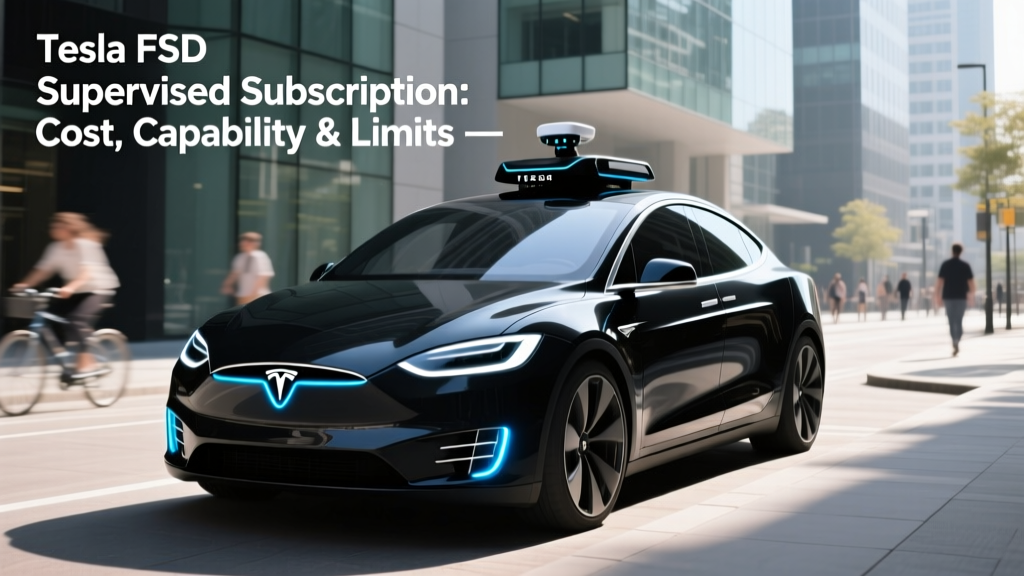
The system operates through Tesla's vision-only architecture. Current Model S, 3, X, and Y vehicles use a suite of eight external cameras (front main, front wide, front narrow, left/right repeaters, left/right pillar, and rear) paired with Tesla's HW4 (also called AI4) onboard computer. Tesla phased out ultrasonic sensors and radar in newer production vehicles, relying entirely on neural-network-driven visual processing to perceive the environment, estimate depth, and classify objects.
| Feature | Description | Requires FSD? |
|---|---|---|
| Traffic-Aware Cruise Control | Maintains set speed and following distance | No (base Autopilot) |
| Autosteer | Center-lane highway steering assist | No (base Autopilot) |
| Auto Lane Change | Initiates and completes highway lane changes | Yes |
| Navigate on Autopilot | Highway on-ramp to off-ramp guidance | Yes |
| Traffic Light & Stop Sign Control | Detects and responds to signals/intersections | Yes |
| City Street Driving | Handles turns, intersections, urban navigation | Yes |
| Smart Summon | Navigates parking lots to driver's location | Yes |
| Autopark | Parallel and perpendicular parking assist | Yes |
SAE Level 2 — Not Self-Driving, and That Matters
SAE Automation Level: 2
Despite the "Full Self-Driving" name, Tesla FSD (Supervised) is classified as an SAE Level 2 driver-assistance system. This means the vehicle can simultaneously control steering and acceleration/braking under certain conditions, but the human driver must remain fully attentive, keep hands on the steering wheel, and be prepared to take over instantly. The "Supervised" designation Tesla added in 2024 makes this explicit: you are the fallback. Only driverless commercial services like Waymo (operating geofenced Level 4 robotaxis) qualify as higher-level automation. FSD does not absolve the driver of responsibility.
Tesla monitors driver engagement through the interior cabin camera, which tracks eye direction and attention. If the system detects inattention — eyes off the road for too long, hands off the wheel — it issues escalating alerts before disengaging. This is a critical distinction from Level 3 systems (like Mercedes-Benz's Drive Pilot, available in limited markets) where the manufacturer assumes liability during operation. With FSD (Supervised), the driver is always legally and practically responsible.
Pricing: Subscription vs. One-Time Purchase in 2026
Tesla restructured FSD pricing to push adoption through its subscription model. As of early 2026, here is how the cost structure breaks down:
| Option | Cost | Notes |
|---|---|---|
| Monthly Subscription | $99/month | Cancel anytime; no long-term commitment |
| One-Time Purchase | $8,000 | Transfers with vehicle if sold; not transferable between cars you own |
| Base Autopilot | Included (no extra cost) | Traffic-aware cruise + Autosteer; standard on all new Teslas |
At $99/month, the subscription breaks even against the $8,000 one-time purchase at approximately 81 months (6.75 years). For owners who plan to keep their Tesla long-term and use FSD daily, the purchase may make financial sense. For those uncertain about the technology's trajectory, who drive primarily on straightforward highways where base Autopilot suffices, or who plan to trade in within 3–4 years, the subscription is the lower-risk option. You can activate it for a road trip month and cancel when you don't need it.
Important caveat: FSD (Supervised) is not currently eligible for the federal §30D clean vehicle tax credit, which applies to the vehicle purchase itself — not software add-ons. The IRS §30D rules govern vehicle MSRP caps, buyer income limits, and battery sourcing requirements, but software subscriptions and one-time software purchases fall outside the credit's scope.
Which Tesla Models and Trims Include FSD Capability?
FSD (Supervised) is available as an add-on — either subscription or purchase — across Tesla's entire current consumer lineup:
- Model 3 (all trims: RWD, Long Range, Performance) — HW4/AI4 on 2024+ production
- Model Y (all trims: Long Range, Performance) — HW4/AI4 on 2024+ production
- Model S (Long Range, Plaid) — HW4/AI4 on refreshed production
- Model X (Long Range, Plaid) — HW4/AI4 on refreshed production
- Cybertruck (AWD, Cyberbeast) — ships with HW4/AI4; FSD availability rolling out
Vehicles built before approximately mid-2023 may have HW3 (AI3) hardware. Tesla has stated that HW3 vehicles will continue to receive FSD updates, but the processing capability is more limited than HW4. If you're buying used, confirm the hardware revision — it affects both current performance and future update compatibility.
Real-World Capabilities: Where FSD Excels
On well-marked divided highways, FSD (Supervised) performs competently. Navigate on Autopilot handles on-ramp merges, lane positioning, and off-ramp exits smoothly in clear conditions. The system's highway lane-change logic has improved substantially — it signals, checks blind spots via camera, and executes changes with reasonable timing.
City-street capability is where Tesla differentiates from competitors, and it has improved markedly through 2025 and into 2026 software versions. The system can navigate four-way stops, handle protected left turns, recognize pedestrian crossings, and manage moderate urban traffic. For daily commutes along familiar, well-maintained routes, many owners report that FSD reduces fatigue significantly.
Smart Summon has also become more practical, allowing the vehicle to navigate a parking lot to the driver's phone location — useful in large lots during rain or when loading groceries, though it remains slow and cautious.
Limitations and Edge Cases: What FSD Cannot Do
Critical Limitations of Tesla FSD (Supervised)
- Weather degradation: Heavy rain, fog, snow, and direct sun glare can impair camera vision. The system may disengage or request immediate takeover in these conditions.
- Lane marking dependency: Faded, missing, or conflicting lane markings (common in construction zones) confuse the system. It may center in the wrong lane or fail to merge.
- Construction zones: Cones, temporary barriers, and shifted lanes are high-risk scenarios. Tesla advises manual driving in active construction areas.
- Unprotected left turns: While improved, these remain a weakness. The system can misjudge oncoming traffic gaps at busy intersections.
- Complex intersections: Multi-lane roundabouts, offset intersections, and non-standard road geometries produce unpredictable behavior.
- No geofencing safety net: Unlike Waymo's Level 4 system that operates only in validated areas, FSD will attempt to drive on any road — including roads it handles poorly.
- Phantom braking: The system occasionally brakes hard for non-existent obstacles, a persistent issue that NHTSA has investigated.
The driver must remain engaged at all times. FSD (Supervised) is not a system you can nap behind, read behind, or zone out behind. Treat it as a capable co-pilot, not a chauffeur.
In cold-weather and winter-driving conditions, camera lenses can accumulate ice, salt spray, or condensation, causing sudden disengagement. Owners in northern climates should budget extra attention for camera maintenance and expect more frequent manual takeovers from November through March.
How FSD Compares to Competing ADAS Systems
| System | Brand | Hands-Free? | City Streets? | Cost |
|---|---|---|---|---|
| FSD (Supervised) | Tesla | No (hands-on wheel) | Yes (all roads) | $99/mo or $8,000 |
| Super Cruise | GM (Cadillac/Chevy/GMC) | Yes (mapped highways) | No | ~$2,200–$2,500 or included on premium trims |
| BlueCruise | Ford/Lincoln | Yes (mapped highways) | No | $75/mo or ~$2,100 one-time (1.2+) |
| Drive Pilot | Mercedes-Benz | Yes (Level 3, limited conditions) | No | ~$2,500 (limited US availability) |
| ProPILOT 2.0 | Nissan | Yes (mapped highways, eyes-off) | No | Included on select trims |
The key tradeoff: Tesla FSD (Supervised) covers the widest variety of roads (including city streets), but requires hands-on engagement at all times. GM's Super Cruise and Ford's BlueCruise offer true hands-free driving on pre-mapped divided highways — roughly 400,000+ miles of US highway for Super Cruise — but cannot handle surface streets, turns, or intersections. If your driving is predominantly highway commuting, Super Cruise or BlueCruise may offer a more relaxing experience. If you want assistance across your entire route, including neighborhood and city driving, FSD (Supervised) is the only consumer system that attempts it.
Mercedes-Benz Drive Pilot is technically a Level 3 system — meaning the manufacturer assumes liability during operation — but it is limited to specific highways, under 40 mph, in clear weather, and is currently available only in Nevada and California on the EQS and S-Class. It represents a fundamentally different legal and technical approach, but with far narrower availability.
Should You Subscribe to FSD (Supervised)?
The decision depends on your driving profile and expectations:
Subscribe if: You have a long, varied commute mixing highway and city driving; you want to evaluate the system before committing $8,000; you take occasional road trips where highway automation reduces fatigue; or you want access to Smart Summon and Autopark features in daily use.
Skip it if: Your driving is primarily short urban trips where you're constantly stopping and starting (base Autopilot's traffic-aware cruise is sufficient); you live in an area with heavy winter weather that will limit camera reliability; you expect "self-driving" and will be frustrated by the supervision requirement; or you're buying a Tesla primarily for the base vehicle and don't plan to use driver assist regularly.
The $99/month subscription removes the financial risk of betting on a rapidly evolving software product. Tesla continues to push updates, and the system's capabilities will change — for better or differently — over the subscription period. That flexibility is the subscription's strongest argument.
Frequently Asked Questions
Can I transfer my FSD subscription to a new Tesla?
The FSD monthly subscription is tied to your Tesla account and the specific vehicle. If you trade in or sell your Tesla, the subscription does not transfer to the new owner, and you'd need to re-subscribe on a new vehicle. A one-time FSD purchase is tied to the vehicle VIN and stays with the car if sold — it does not transfer to a different Tesla you buy.
Does FSD (Supervised) work at night?
Yes. Tesla's camera system operates in low-light and nighttime conditions. However, poorly lit rural roads without reflective lane markings or streetlights reduce system confidence and may trigger more frequent disengagements or takeover requests.
Will Tesla offer a truly driverless (Level 4/5) version of FSD?
Tesla has announced plans for an "Unsupervised" FSD mode, with initial rollout targeted in limited geographies. However, as of early 2026, no consumer Tesla vehicle operates without driver supervision. Any future unsupervised mode would require regulatory approval in each jurisdiction. Tesla's official Autopilot page maintains current feature availability and disclaimers.
How does FSD handle highway toll booths?
FSD (Supervised) can navigate through open-road tolling (E-ZPass, FasTrak, etc.) without issue. For traditional toll plazas with stopping and booth selection, the system may require driver intervention to choose a lane and proceed at low speed. Expect to take over in these scenarios.
Is the FSD subscription tax-deductible or credit-eligible?
No. The federal §30D clean vehicle tax credit applies to the purchase of qualifying new electric vehicles — not to software subscriptions or aftermarket software packages. FSD costs, whether subscription or one-time purchase, are not eligible for any current federal EV tax incentive. Always consult a tax professional for your specific situation.
What happens if FSD disengages while driving?
The system provides audible and visual alerts when it reaches its operational limits and requires driver takeover. In most cases, you have a few seconds to assume control. If the driver does not respond, the system will gradually decelerate and activate hazard lights. This is why continuous driver attention is non-negotiable — you must be ready to intervene at any moment.