What Is a Tesla FSD Strikeout?
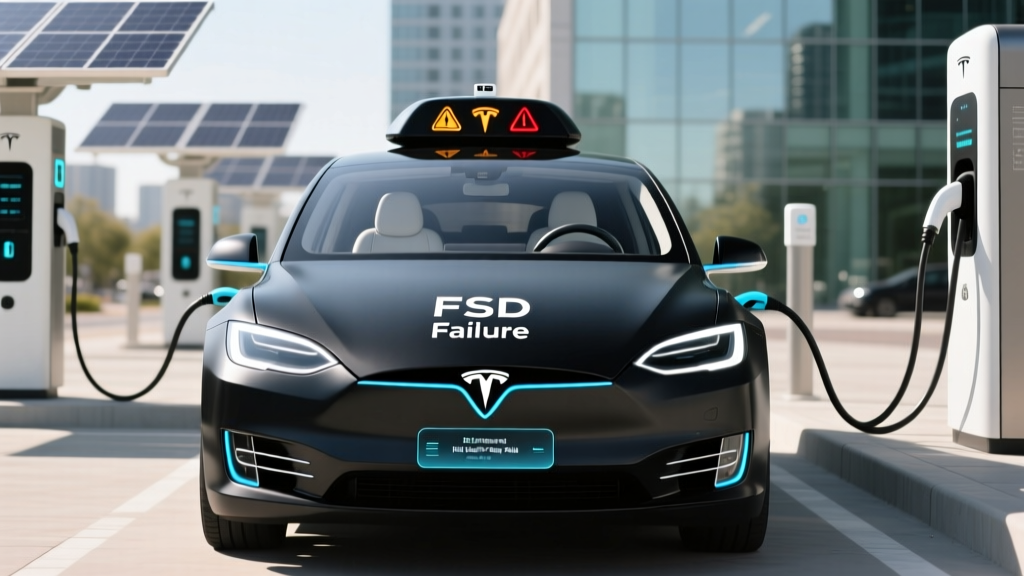
If you've spent any time in Tesla owner forums or EV communities, you've likely encountered the term Tesla FSD strikeout. It's not an official Tesla term, but it has become the shorthand among owners and testers for a very real phenomenon: the moment Tesla's Full Self-Driving (Supervised) system disengages or forces the driver to take over after repeated inattention warnings or a critical edge-case failure.
Understanding what triggers an FSD strikeout — and what the system can and cannot do — is essential before you commit $8,000 to a one-time purchase or $99/month to a subscription. This is not an autonomous driving system. It is an SAE Level 2 driver-assistance feature that requires your constant supervision.
Tesla FSD (Supervised) is classified as SAE Level 2. The vehicle can manage steering, acceleration, and braking under certain conditions, but the driver must remain fully engaged, monitor the road at all times, and be prepared to intervene instantly. This is not self-driving. Only Level 4 systems — like Waymo's robotaxi service operating in geofenced areas — qualify as truly driverless. (Source: NHTSA)
How Tesla FSD (Supervised) Actually Works
Tesla's FSD system relies entirely on a vision-based architecture. Since late 2022, Tesla removed ultrasonic sensors (USS) and radar from its vehicles, betting on a camera-only approach branded as "Tesla Vision." As of the 2025–2026 model years, every new Tesla — Model 3, Model Y, Model S, Model X, and the Cybertruck — ships with the same sensor suite:
- 8 cameras providing 360-degree visibility (front main, front wide, front narrow, left/right repeaters, left/right rear, rear-view)
- HW4 (Hardware 4) computer with dual redundant neural-network processors
- No radar, no ultrasonic sensors, no LiDAR
The system processes real-time video through Tesla's proprietary neural networks to identify lane markings, vehicles, pedestrians, traffic signals, road edges, and obstacles. FSD (Supervised) builds on top of standard Autopilot (which handles basic lane-keeping and adaptive cruise control) by adding capabilities like:
- Navigate on Autopilot (highway on-ramp to off-ramp with automatic lane changes)
- Auto Lane Change (suggests and executes lane changes)
- Autopark (parallel and perpendicular parking)
- Summon and Smart Summon (moves the car in parking lots at low speed)
- Traffic Light and Stop Sign Control
- City street driving with turn execution
| Feature | Environment | Driver Hands Required? | Availability |
|---|---|---|---|
| Traffic-Aware Cruise Control | All roads | Yes — on steering wheel | Standard (Autopilot) |
| Autosteer (Lane Keeping) | Highways, marked roads | Yes | Standard (Autopilot) |
| Navigate on Autopilot | Divided highways | Yes | FSD required |
| Auto Lane Change | Highways | Yes — confirm or auto w/ setting | FSD required |
| City Street Autosteer | Urban/suburban streets | Yes | FSD required |
| Traffic Light/Stop Sign Control | Intersections | Yes — confirm proceed | FSD required |
| Autopark | Parking spaces | No — monitor only | FSD required |
| Smart Summon | Parking lots | No — finger on phone button | FSD or Enhanced Autopilot |
The Strikeout Mechanism: Disengagements, Warnings, and Lockouts
The "strikeout" concept maps to Tesla's escalating inattention and intervention system. Here's how it works in practice:
Inattention Warnings (The Strike Count)
Tesla monitors driver engagement through a cabin-facing camera mounted above the rearview mirror. If the system detects you are not looking at the road — eyes closed, looking at a phone, turned away — it issues escalating alerts:
- Visual chime: A blue steering-wheel icon on the display flashes with an audible prompt to pay attention.
- Repeated warnings: If you continue to look away, the warnings increase in frequency and urgency, and Autosteer may slow the vehicle.
- Autosteer disengagement: After multiple ignored warnings, FSD/Autosteer disengages entirely. You must manually steer and brake.
- Temporary lockout (the "strikeout"): In some software versions, repeated inattention in a single drive session results in a temporary suspension of Autosteer for the remainder of that trip. You must pull over, put the car in Park, and restart to regain access.
Critical Disengagements
Separate from inattention warnings, FSD can also disengage when it encounters an edge case it cannot resolve — a construction zone with conflicting lane markings, an unusual obstacle, degraded road infrastructure, or a scenario where the neural network's confidence drops below a safety threshold. In these cases, the system issues an immediate takeover request with an urgent audible and visual alert. If the driver does not respond quickly enough, the vehicle will initiate a controlled deceleration and, in some cases, activate hazard lights.
These disengagements are what many testers refer to as "strikeouts" in structured testing — particularly in the popular "FSD vs. Reality" YouTube format where drivers count the number of times they must intervene over a set route.
- Does NOT drive autonomously — you are the driver, legally and functionally.
- Does NOT reliably handle construction zones, temporary lane shifts, or unmapped detours.
- Does NOT see well in heavy rain, fog, snow, or direct sun glare into cameras.
- Does NOT guarantee stopping for all pedestrians, cyclists, or unexpected obstacles.
- Does NOT replace your insurance liability — you are responsible for the vehicle's actions.
- Does NOT work on unpaved roads or roads without clear lane markings.
Real-World Limitations: When FSD Struggles Most
Based on extensive real-world testing and owner reporting across the 2024–2026 software releases, FSD (Supervised) exhibits consistent weakness patterns:
Weather Degradation
The camera-only approach has inherent limitations in adverse weather. Heavy rain obscures camera lenses. Snow and slush can coat cameras, particularly the front-facing units. Dense fog reduces the effective range of the vision system. Tesla's software attempts to compensate with image processing, but there is no radar fallback to detect objects through precipitation. Owners in northern climates report significantly more disengagements and phantom-braking events during winter months.
Infrastructure Edge Cases
FSD performs best on well-maintained, clearly marked roads in suburban and highway environments. It struggles with:
- Faded or missing lane markings
- Construction barrels and temporary barriers
- Unprotected left turns across multi-lane traffic
- Roundabouts (improved in recent updates but still inconsistent)
- Narrow rural roads with no shoulder markings
- Complex multi-lane intersections with turn-only lanes
Phantom Braking
One of the most frequently reported issues — and a subject of a NHTSA investigation — is phantom braking: the vehicle applying brakes suddenly and without an apparent obstacle. This occurs most often on highways when shadows, overpasses, or roadside objects are misclassified as obstacles. While Tesla has reduced the frequency through software updates, it remains a documented concern.
Cost Breakdown: FSD Purchase vs. Subscription
Tesla offers FSD (Supervised) through two pricing models. Neither is inexpensive, and the economics depend heavily on how long you plan to own the vehicle and how frequently you'll use the feature.
| Option | Cost | Transferable? | Break-Even vs. Subscription |
|---|---|---|---|
| One-Time Purchase | $8,000 | No — tied to the vehicle | ~81 months (6.75 years) at $99/mo |
| Monthly Subscription | $99/month | N/A — cancel anytime | Immediate flexibility |
| Enhanced Autopilot (EAP) | $6,000 one-time | No | Highway features only, no city streets |
| Basic Autopilot | Included (free) | N/A | TACC + Autosteer only |
Key consideration: The $8,000 one-time purchase is tied to the specific vehicle, not to your Tesla account. If you sell the car, FSD transfers with it (and may add modest resale value, though typically far less than $8,000). The $99/month subscription offers flexibility — you can activate it for a road trip and cancel when you don't need it.
Which Tesla Models and Trims Include FSD?
FSD (Supervised) is not included standard on any Tesla model. It is a paid add-on available across the entire lineup. Basic Autopilot (TACC and Autosteer) comes standard on every new Tesla. Here's the compatibility matrix:
| Model | Hardware | Basic Autopilot | Enhanced Autopilot | FSD (Supervised) |
|---|---|---|---|---|
| Model 3 (2024+ Highland/2026) | HW4 | Standard | $6,000 add-on | $8,000 or $99/mo |
| Model Y (2025+ Juniper/2026) | HW4 | Standard | $6,000 add-on | $8,000 or $99/mo |
| Model S (2026) | HW4 | Standard | $6,000 add-on | $8,000 or $99/mo |
| Model X (2026) | HW4 | Standard | $6,000 add-on | $8,000 or $99/mo |
| Cybertruck (2026) | HW4 | Standard | $6,000 add-on | $8,000 or $99/mo |
Note: Vehicles built before mid-2023 with HW3 (Hardware 3) computers may require a hardware upgrade to run the latest FSD software. Tesla has offered this upgrade to qualifying owners, but availability varies.
Tesla FSD vs. Competing ADAS Systems
Tesla's FSD is the most discussed driver-assist system, but it is not the only option — and depending on your priorities, it may not be the best. Here's how it compares to the leading alternatives:
- Ford BlueCruise: Offers true hands-free driving on pre-mapped divided highways (over 130,000 miles of approved roads). Uses a driver-facing camera for monitoring. More limited in scope than FSD (no city streets), but consistently rated higher for hands-free highway comfort. Available on Mustang Mach-E, F-150 Lightning, and select Ford models. Cost: ~$2,100 one-time or $75/month subscription.
- GM Super Cruise: The longest-running hands-free highway system. Operates on over 750,000 miles of mapped roads in North America. Uses LiDAR-mapped HD maps plus a driver attention camera. Exceptionally smooth on compatible highways but does not handle city streets. Available on Cadillac Lyriq, Chevy Silverado EV, and select GM models. Cost: typically included for 3 years, then ~$25/month.
- Hyundai/Kia Highway Driving Assist 2 (HDA2): Hands-on system with lane-centering and adaptive cruise. Reliable but less ambitious than FSD or Super Cruise. Included standard on many higher trims at no additional cost.
- BMW Highway Assistant (Level 2): Available on iX, i7, and other models. Allows hands-off driving at speeds up to 85 mph on compatible highways with an eye-monitoring system. More permissive than most hands-on systems.
The critical distinction: GM Super Cruise and Ford BlueCruise use hands-off, eyes-on approaches on mapped highways, which many drivers find less fatiguing than Tesla's hands-on-wheel requirement. However, neither system handles city streets or complex surface-road navigation the way FSD attempts to.
Safety Data and Regulatory Context
Tesla publishes quarterly safety reports, and the company's Vehicle Safety Report claims that vehicles with Autopilot engaged record fewer crashes per million miles than the U.S. average. However, this data has been criticized for methodological limitations — notably, it does not isolate FSD-specific performance from basic Autopilot, and it does not account for the types of roads and conditions where Autopilot is typically activated (divided highways in fair weather are inherently safer than urban surface streets).
The NHTSA has opened multiple investigations into Tesla's Autopilot and FSD systems, including probes into crashes involving emergency vehicles and phantom-braking incidents. As of 2026, Tesla's driver-monitoring system has been updated to rely more heavily on the cabin camera, but regulators continue to scrutinize whether the engagement requirements are sufficient.
The Insurance Institute for Highway Safety (IIHS) has consistently rated partial-automation systems — including Tesla's — as requiring improvement in driver monitoring and safeguards against misuse. (Source: IIHS)
Frequently Asked Questions
Is Tesla FSD actually self-driving?
No. Tesla FSD (Supervised) is an SAE Level 2 driver-assistance system. The driver must remain fully engaged, monitor the road continuously, and be prepared to take over at any moment. The "Supervised" label, added by Tesla in 2024, explicitly acknowledges this. Only Level 4 systems like Waymo's robotaxi service operate without a human driver.
What triggers an FSD strikeout or lockout?
A strikeout typically occurs when the cabin camera detects repeated driver inattention — eyes off the road despite multiple warnings. After several ignored alerts, FSD disengages and may lock out Autosteer for the remainder of that drive session. Critical disengagements (where the system encounters an unresolvable edge case) can also force an immediate takeover.
How much does Tesla FSD cost in 2026?
FSD (Supervised) costs $8,000 as a one-time purchase or $99/month as a subscription. Enhanced Autopilot (highway features only) is $6,000 one-time. Basic Autopilot (TACC + lane keeping) is included standard on all new Teslas.
Does FSD work in rain and snow?
FSD operates in light rain, but performance degrades in heavy rain, snow, and fog because the camera-only system has no radar or LiDAR backup. Camera lenses can become obscured by precipitation, road spray, or dirt, reducing system effectiveness. Expect more disengagements in adverse weather.
Can I transfer FSD to a new Tesla?
The one-time $8,000 FSD purchase is tied to the vehicle, not the owner. If you sell the car, FSD stays with it. If you buy a new Tesla, you must purchase FSD again or subscribe. Tesla has occasionally offered limited-time FSD transfer promotions, but these are not standard policy.
How does FSD compare to GM Super Cruise or Ford BlueCruise?
FSD has broader capability (city streets, not just highways) but requires hands on the wheel at all times. Super Cruise and BlueCruise allow hands-free driving on mapped highways and are often rated more comfortable for long highway trips. FSD attempts more but with a higher frequency of edge-case disengagements.
What happens if I ignore FSD takeover requests?
If you fail to respond to a takeover request, the vehicle will escalate warnings (visual, audible, haptic), begin decelerating, activate hazard lights, and eventually come to a controlled stop. In extreme cases, Tesla's system can contact emergency services. Repeated non-responsiveness can result in Autosteer lockout.