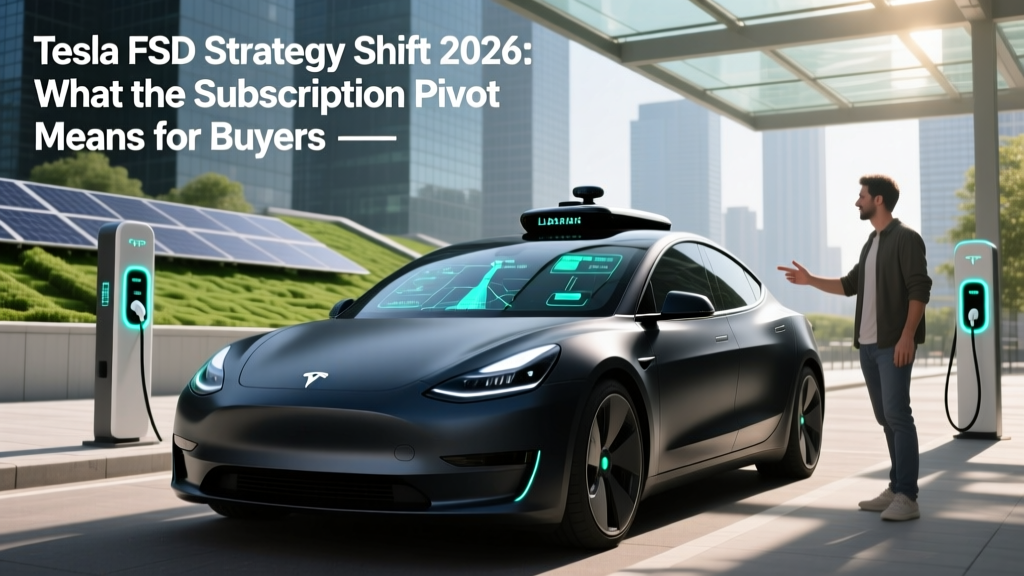
Tesla's approach to Full Self-Driving has undergone a fundamental transformation. What began as a one-time, upfront purchase pitched as an investment in future autonomy has evolved into a subscription-dominant model with shifting pricing, expanding hardware requirements, and a growing emphasis on supervised driver-assist rather than promised robotaxi capability. For buyers evaluating whether to add FSD to a new Model 3, Model Y, Model S, or Model X — or for current owners wondering what their subscription actually delivers — understanding this strategy shift is essential before spending another dollar.
This guide breaks down exactly what Tesla FSD (Supervised) does in 2026, what it does not do, how the pricing and packaging has changed, and how it stacks up against Ford BlueCruise, GM Super Cruise, and other Level 2 systems on the market.
What Tesla FSD (Supervised) Actually Does
Full Self-Driving (Supervised) is Tesla's highest-tier driver-assistance package. It builds on the standard Autopilot system — which provides Traffic-Aware Cruise Control and Autosteer (lane-centering on highways) — with additional capabilities designed for both highway and city driving. As of 2026, FSD (Supervised) includes:
| Feature | What It Does | Environment |
|---|---|---|
| Traffic-Aware Cruise Control | Maintains set speed and following distance | Highway / city |
| Autosteer | Lane-centering on marked roads | Highway primarily |
| Auto Lane Change | Initiates lane changes based on navigation route or driver confirmation | Highway |
| Navigate on Autopilot | Follows navigation route, handles on/off-ramps, interchanges | Highway |
| City Street Steering | Handles intersections, stop signs, traffic lights, turns on surface streets | Urban / suburban |
| Smart Summon | Navigates parking lots to the driver's location at low speed | Parking lots |
| Auto Park | Detects and executes parallel or perpendicular parking maneuvers | Parking |
| Traffic Light & Stop Sign Control | Identifies and responds to traffic signals and stop signs | City streets |
Under the hood, Tesla relies on a vision-only sensor suite. Current-production vehicles (Hardware 4, also called AI4) use a set of high-resolution cameras — typically eight cameras providing 360-degree coverage — paired with Tesla's custom neural-network processing chip. Unlike earlier hardware generations that included radar or ultrasonic sensors, Tesla removed radar from new vehicles starting in 2021 and ultrasonic sensors starting in 2022, committing fully to a camera-and-AI approach it calls Tesla Vision.
This is a deliberate technical bet: Tesla argues that a pure vision system, trained on billions of miles of real-world driving data, can replicate and eventually exceed human perception without the sensor fusion complexity that competitors rely on. Whether that bet pays off at the Level 4 autonomy threshold remains unproven.
The SAE Level Reality: FSD Is Not Self-Driving
Tesla FSD (Supervised) is a Level 2 driver-assistance system under the SAE J3016 standard. This means the system can control steering, acceleration, and braking simultaneously, but the human driver must remain fully engaged — eyes on the road, hands available to take over, and ready to intervene at any moment. Tesla's own branding now includes the word "(Supervised)" to make this explicit. FSD is not autonomous driving. Level 4 systems, which operate without a human driver in defined operational domains, exist only in commercial robotaxi services like Waymo (Alphabet) and Zoox (Amazon) in select cities.
Tesla's naming has drawn scrutiny from the National Highway Traffic Safety Administration (NHTSA) and consumer safety advocates. The term "Full Self-Driving" implies a capability the system does not possess. In response, Tesla appended "(Supervised)" to the product name in late 2023, and the company's own owner's manuals make clear that the driver is responsible for safe operation at all times.
This distinction matters legally and practically. In the event of a crash while FSD is engaged, the driver — not Tesla — bears responsibility. NHTSA's Standing General Order requires Tesla and other ADAS manufacturers to report crashes involving Level 2 systems, and the data consistently shows that these systems require ongoing human oversight to manage edge cases.
The Strategy Shift: From Upfront Purchase to Subscription-First
The most significant business change in Tesla's FSD program is the pricing model. For years, Tesla sold FSD as a one-time purchase — initially $5,000, later $10,000, then $15,000 at its peak — with the promise that the capability would grow over time and early buyers would benefit. That model created a cohort of owners who paid premium prices for features that, in many cases, have not materially advanced beyond what the subscription offers today.
Beginning in 2024 and accelerating into 2026, Tesla has pivoted toward a subscription-dominant strategy. Here is the current pricing landscape:
| Option | Cost | Notes |
|---|---|---|
| Monthly Subscription | $99/month | Cancel anytime; available on most vehicles with HW3 or HW4 |
| One-Time Purchase | $8,000 | Reduced from previous $15,000 peak; available on select models |
| Standard Autopilot | Included (no extra cost) | TACC + Autosteer; comes with every new Tesla |
| FSD Transfer | Limited promotional periods | Tesla has occasionally allowed FSD transfer to a new Tesla purchase; not standard policy |
The strategic logic is clear: a $99/month subscription lowers the barrier to entry, generates recurring revenue, and lets Tesla maintain a direct relationship with the software experience. It also reduces the liability exposure of selling a $15,000 "capability" that may never reach Level 4 autonomy. For the buyer, the subscription model means you pay only for the months you actively use the feature — useful for road-trip seasons or commuting-heavy periods — without a five-figure upfront commitment.
However, this shift has frustrated early adopters who paid $10,000–$15,000 for a perpetual FSD license. The resale value of FSD on used Teslas has been inconsistent; Tesla does not guarantee FSD transfers on private-party sales, and the feature's value at trade-in depends on Tesla's current policy, which has changed multiple times.
Which Models and Trims Include FSD?
FSD (Supervised) is available as an add-on across Tesla's entire consumer lineup, but it is never standard — every vehicle ships with basic Autopilot, and FSD is an optional upgrade.
| Model | Hardware Requirement | FSD Availability | Base MSRP (approx.) |
|---|---|---|---|
| Model 3 (Highland / 2024+ refresh) | HW4 (AI4) | Subscription or purchase | ~$38,990 |
| Model Y (Juniper / 2025+ refresh) | HW4 (AI4) | Subscription or purchase | ~$44,990 |
| Model S | HW4 (AI4) | Subscription or purchase | ~$74,990 |
| Model X | HW4 (AI4) | Subscription or purchase | ~$79,990 |
| Cybertruck | HW4 (AI4) | Subscription or purchase | ~$79,990 |
Vehicles built before mid-2019 with Hardware 2.0 or 2.5 cannot run the current FSD neural-network stack and are not eligible. Owners of HW3 (also called FSD Computer) vehicles can run FSD, though Tesla has indicated that HW4 provides superior processing headroom and camera resolution. If you are buying a used Tesla and FSD capability matters, confirming the hardware generation is essential — check the vehicle's software menu or build date.
Real-World Capabilities and Honest Limitations
In extensive real-world use across highway and city environments, FSD (Supervised) demonstrates genuine competence in structured scenarios and clear fragility in edge cases. Here is an honest assessment based on thousands of miles of supervised driving:
Where FSD performs well:
- Highway driving with clear lane markings: Lane-centering is smooth, lane changes are generally well-timed, and Navigate on Autopilot handles standard on/off-ramps reliably.
- Suburban streets with good signage: Traffic light and stop sign detection works consistently in well-maintained areas. Speed-limit recognition is accurate.
- Predictable traffic flow: Stop-and-go traffic management, following distance, and speed modulation are comfortable and reduce driver fatigue on commutes.
Where FSD struggles — and the driver must intervene:
- Construction zones: Temporary lane shifts, cones, and altered road geometry frequently confuse the vision system. Expect to take over in any active work zone.
- Faded or conflicting lane markings: Roads with old markings visible beneath new ones, or roads with no markings at all, cause erratic steering behavior.
- Heavy rain, fog, and snow: Camera-based systems degrade in low-visibility conditions. Tesla's own manual advises disabling Autosteer in these scenarios. Without radar redundancy, the system has less sensor fallback than competitors.
- Unprotected left turns and complex intersections: City-street FSD can hesitate or make overly conservative decisions at multi-lane intersections with permissive turn signals.
- Emergency vehicles: While Tesla has improved detection of stopped emergency vehicles (a focus of NHTSA investigations), the system has historically struggled with this scenario, and drivers must remain alert to first-responder scenes.
Tesla FSD (Supervised) does not free the driver from the task of driving. You cannot legally or safely look at your phone, close your eyes, sleep, or leave the driver's seat while FSD is active. Tesla monitors driver engagement through a cabin camera that tracks eye gaze. Repeated inattention warnings can result in temporary FSD suspension ("FSD strike" system). Treat FSD as an advanced cruise control and lane-assist system — not a chauffeur.
How Tesla FSD Compares to Competing Level 2 Systems
Tesla is not the only automaker offering sophisticated Level 2 driver-assistance. Here is how FSD (Supervised) compares to the major alternatives available in 2026:
| Feature | Tesla FSD (Supervised) | GM Super Cruise | Ford BlueCruise | Hyundai/Kia HDA2 |
|---|---|---|---|---|
| SAE Level | Level 2 | Level 2 | Level 2 | Level 2 |
| Highway hands-off allowed | No (hands-on, camera monitored) | Yes (on pre-mapped roads, driver monitored by IR camera) | Yes (on pre-mapped roads, driver monitored by camera) | No (hands-on required) |
| City street capability | Yes (surface streets, intersections) | Limited (expanding beyond highways) | Limited (primarily highway) | No |
| Sensor suite | Cameras only (Tesla Vision) | LiDAR-mapped + cameras + radar | Cameras + radar | Cameras + radar |
| Cost | $99/mo or $8,000 | $2,100–$2,500 (included on some trims for limited period) | $2,100 one-time or ~$65/mo subscription | Included on higher trims |
| Driver monitoring | Cabin camera (eye gaze) | IR camera (eye + head tracking) | Camera (eye + head tracking) | Steering-wheel torque sensor |
| Geo-fencing | None (works anywhere) | Pre-mapped roads only (~750,000+ miles in US/Canada) | Pre-mapped roads only (~130,000+ miles) | None |
The critical trade-off is breadth versus reliability. Tesla FSD works on virtually any road — it is not geo-fenced to pre-mapped highways — which gives it the widest operational coverage. But that breadth comes with more frequent edge-case failures that require driver intervention.
GM Super Cruise and Ford BlueCruise take a geo-fenced approach: they only enable hands-off driving on roads that have been pre-mapped with high-definition LiDAR or camera data. Within those zones, both systems are remarkably smooth and confidence-inspiring, allowing true hands-off driving (with eyes-on monitoring). Outside those zones, they revert to basic adaptive cruise and lane-keeping. For drivers whose commutes are primarily on mapped interstates, Super Cruise or BlueCruise can feel more polished than FSD. For drivers who want assistance on surface streets and unfamiliar roads, FSD offers broader coverage.
According to IIHS research, systems with robust driver-monitoring (like Super Cruise's IR camera) tend to keep drivers more engaged and reduce the risk of attention drift — a factor in several high-profile ADAS-related crashes investigated by NHTSA.
Is FSD Worth the Cost in 2026?
The answer depends on your driving profile and expectations:
Subscribe to FSD ($99/month) if:
- You have a long, highway-heavy commute and want fatigue reduction
- You want city-street assist in addition to highway features
- You want to try the system without a large upfront commitment
- You plan to keep the vehicle 2+ years and value the recurring software updates
Skip FSD and use standard Autopilot if:
- Your primary driving is short commutes or city errands where ADAS adds limited value
- You find the hands-on monitoring requirement more distracting than helpful
- You are unwilling to accept the system's edge-case limitations
- You plan to sell the vehicle within 1–2 years (FSD adds uncertain resale value)
Consider Super Cruise or BlueCruise instead if:
- Your commute is on pre-mapped highways and you value true hands-off capability
- You prefer LiDAR-backed redundancy over a vision-only approach
From a pure economics standpoint, the $99/month subscription breaks even against the $8,000 purchase price at roughly 81 months (nearly 7 years). If you keep your Tesla longer than that and use FSD consistently, the one-time purchase is mathematically cheaper. If your usage is seasonal or you plan to upgrade vehicles within 3–4 years, the subscription is the rational choice.
One additional note: Tesla's FSD does not qualify for any federal tax credit. The IRS §30D clean vehicle credit applies to the vehicle purchase itself (subject to MSRP caps of $55,000 for sedans and $80,000 for SUVs/trucks, buyer income limits, and battery-sourcing requirements) — not to software add-ons. FSD is a post-purchase software expense.
Frequently Asked Questions
Is Tesla FSD truly self-driving?
No. Tesla FSD (Supervised) is an SAE Level 2 driver-assistance system. The driver must remain fully engaged — eyes on the road, hands available, ready to intervene. Tesla itself labels the product "(Supervised)" to clarify this. True self-driving (Level 4) currently exists only in limited commercial robotaxi services like Waymo, not in any consumer vehicle.
Can I transfer FSD to a new Tesla if I sell my current one?
Tesla's policy on FSD transfers has changed multiple times. As of 2026, FSD generally does not transfer on private-party used sales. Tesla has occasionally offered limited-time promotions allowing FSD transfer when purchasing a new Tesla. Check Tesla's current policy at the time of purchase — do not assume transferability.
Does FSD work in bad weather?
Tesla's vision-only system degrades in heavy rain, fog, snow, and low-light conditions where camera visibility is reduced. Tesla's owner manual explicitly recommends disabling Autosteer in these conditions. Unlike systems with radar or LiDAR redundancy, Tesla Vision has limited sensor fallback when cameras are obstructed.
What hardware do I need for FSD?
FSD requires at minimum Hardware 3 (FSD Computer), which Tesla began installing in April 2019. However, Hardware 4 (AI4), standard on all current-production vehicles, provides significantly more processing capability and higher-resolution camera input. If purchasing a used Tesla, confirm the hardware generation before expecting FSD compatibility.
How does Tesla monitor driver attention?
Tesla uses an interior cabin camera to monitor driver eye gaze and head position. If the system detects inattention (looking away from the road for extended periods), it issues escalating warnings — visual alerts, audible chimes, and eventually temporary suspension of FSD access (the "strike" system). After multiple strikes in a monitoring period, FSD can be disabled for approximately one week.
Will FSD ever become truly autonomous?
Tesla has predicted full autonomy "next year" since approximately 2016. As of 2026, FSD remains Level 2 with no regulatory approval for driverless operation. Achieving Level 4 requires not just technical capability but regulatory certification, validation across millions of edge-case miles, and liability frameworks that do not yet exist for consumer vehicles. While Tesla's neural-network approach continues to improve, buyers should evaluate FSD on its current Level 2 capabilities — not on future promises.