Every few months, a dashcam clip goes viral showing a Tesla Model Y or Model 3 approaching a stopped school bus with its red lights flashing and stop-arm extended. The question viewers want answered is simple: does Tesla's Full Self-Driving (Supervised) actually stop? The answer is more nuanced than a yes-or-no, and understanding why requires digging into how FSD perceives the world, where it succeeds, where it fails, and what Tesla owners must do to stay safe — and legal — around school buses in 2026.
This article breaks down the technical reality behind the "Tesla FSD school bus test" phenomenon, examines real-world outcomes, and places FSD Supervised alongside competing Level 2 systems like Ford BlueCruise and GM Super Cruise to show how each handles one of the most safety-critical edge cases on American roads.
What the Tesla FSD School Bus Test Actually Measures
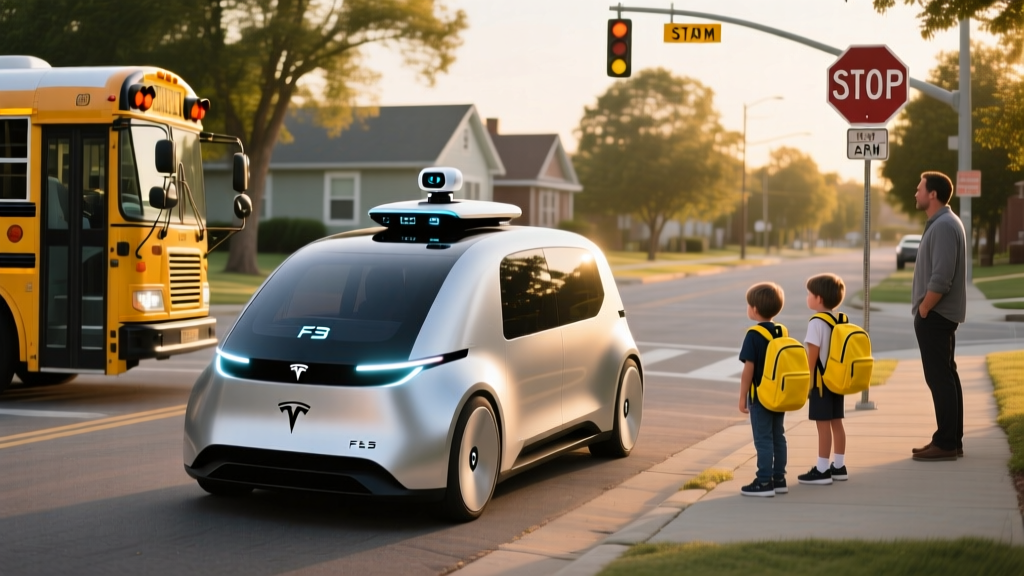
The informal "school bus test" isn't a single standardized evaluation run by NHTSA or the IIHS. It's a crowd-sourced stress test: Tesla owners and EV journalists recording how FSD Supervised reacts when approaching a school bus that has deployed its mechanical stop-arm and flashing red lights. These encounters happen at low speeds (typically 15–35 mph) on residential and two-lane rural roads — environments where FSD's vision-only neural network must identify:
- The school bus body shape and color (yellow/orange)
- Flashing amber then red warning lights
- The extended stop-arm sign
- Children potentially crossing the roadway
- Oncoming traffic behavior (vehicles stopping in both directions on undivided roads)
Federal law requires all drivers to stop for a school bus with its stop-arm deployed, regardless of direction on undivided roads. A Level 2 driver-assist system that fails to recognize this scenario could put a driver — and children — in serious danger, while also exposing the driver to fines that range from $250 to over $1,000 depending on the state.
Tesla FSD (Supervised) is a Level 2 system per the SAE J3016 standard. The driver must remain fully engaged, monitor the environment at all times, and be prepared to take over instantly. FSD does NOT make the vehicle autonomous. The "Supervised" label Tesla added in 2024 reflects this legal and technical reality.
How FSD Supervised Sees a School Bus: Cameras, Neural Nets, and No Radar
Since late 2022, Tesla has operated a pure vision architecture known as "Tesla Vision," having removed ultrasonic sensors and radar from all new vehicles. As of the 2026 model year, every Tesla sold — Model 3, Model Y, Model S, Model X, and Cybertruck — relies exclusively on a camera suite for FSD processing:
| Camera Position | Resolution | Primary Function |
|---|---|---|
| Front main (windshield) | 5 MP | Forward object/traffic detection |
| Front wide-angle | 5 MP | Close-range intersection/cross-traffic |
| Front narrow (telephoto) | 5 MP | Long-range highway perception |
| Left/Right front pillar | 5 MP each | Side/lane-change awareness |
| Left/Right rear fender | 5 MP each | Blind-spot and merge monitoring |
| Rear-view | 5 MP | Reverse and rear approach |
All camera feeds are processed by Tesla's in-house HW4.0 computer, which runs end-to-end neural networks trained on billions of miles of real-world driving data. Rather than relying on hard-coded rules (e.g., "if red octagon shape detected, stop"), FSD uses an occupancy-network approach that builds a 3D voxel map of the world, classifying objects probabilistically.
For a school bus encounter, the neural network must correctly classify the bus as a "school bus" object (not just a large truck), detect the flashing lights as warning signals, recognize the extended stop-arm, and infer the legal requirement to stop. Tesla has specifically trained its networks on school bus scenarios, and the company's quarterly safety reports indicate continuous improvement in this area. But probabilistic classification is not the same as deterministic certainty — and that distinction matters.
Real-World Results: What Dashcam Footage Shows
Aggregated dashcam footage from Tesla owners across YouTube, Reddit's r/TeslaLounge, and EV media outlets paints a mixed but improving picture of FSD's school bus performance from 2023 through early 2026:
Scenarios where FSD typically succeeds:
- Clearly visible school bus stopped in the same lane, lights already flashing at a distance greater than 100 feet
- Multi-lane divided roads where FSD correctly identifies the need to stop in the same direction of travel
- Low-speed residential streets (under 25 mph) with good lighting and clear lane markings
Scenarios where FSD has struggled or failed:
- School bus around a blind curve or crest of a hill — late detection leaves insufficient stopping distance
- Opposing-direction stops on undivided two-lane roads — FSD sometimes does not recognize the obligation to stop when traveling the opposite direction
- Dusk, dawn, or heavy rain where flashing lights are harder for the camera system to distinguish from ambient light sources
- School bus partially obscured by parked cars or foliage, with only the stop-arm visible
- Amber warning lights (pre-stop phase) — FSD may not preemptively slow before red lights and stop-arm deploy
In the most widely shared 2025 test by an EV reviewer on a rural two-lane road, FSD Supervised v13 correctly stopped for a same-direction school bus 8 out of 10 times but only stopped for the opposing-direction bus 3 out of 10 times — requiring driver intervention in the majority of opposing-lane encounters. These results align with the broader pattern: FSD is more reliable for the "obvious" same-lane scenario but less consistent for the nuanced legal requirements that vary by state and road configuration.
FSD Cost, Availability, and Brand Naming in 2026
Tesla's naming convention causes persistent confusion. Here is the precise breakdown for 2026:
| Feature Tier | Capabilities | Cost | Availability |
|---|---|---|---|
| Basic Autopilot | Traffic-aware cruise, lane centering on marked highways | Standard (included) | All 2026 Teslas |
| Enhanced Autopilot (EAP) | Auto lane change, Navigate on Autopilot, Auto Park, Summon | $6,000 one-time | All 2026 Teslas (HW4.0) |
| Full Self-Driving (Supervised) | All EAP features + traffic light/stop sign control, city street autosteer | $8,000 one-time or $99/month subscription | All 2026 Teslas (HW4.0) |
The $99/month FSD subscription is a pragmatic option for buyers who want to test the system before committing $8,000. Tesla has occasionally offered 30-day free trials to new owners. Note that FSD does not transfer to a new vehicle if you sell your Tesla — it's tied to the VIN, not the owner.
| Scenario | Upfront | 5-Year Cost | Break-Even |
|---|---|---|---|
| One-time purchase | $8,000 | $8,000 | ~81 months vs subscription |
| Monthly subscription | $0 | $5,940 | Subscription cheaper until month 81 |
| Included with vehicle (rare promo) | $0 | $0 | N/A |
If you plan to keep your Tesla for more than ~7 years, the one-time purchase is marginally cheaper. For most buyers planning a 3–5 year ownership cycle, the $99/month subscription is the smarter financial play — especially given that FSD's capabilities and reliability are still evolving.
FSD vs. BlueCruise vs. Super Cruise: School Bus Handling Compared
Tesla isn't the only automaker offering advanced Level 2 driver assistance. Ford's BlueCruise and GM's Super Cruise are the other major systems available in 2026. Here's how they compare on the school bus scenario specifically:
| Feature | Tesla FSD (Supervised) | Ford BlueCruise 1.4 | GM Super Cruise |
|---|---|---|---|
| Operational domain | All roads (city + highway) | Pre-mapped divided highways only (~130,000 mi) | Pre-mapped divided highways only (~750,000 mi) |
| School bus encounter likelihood | High (residential/rural roads) | Very low (divided highways) | Very low (divided highways) |
| Sensor suite | 8 cameras (vision only) | Cameras + radar + driver-facing IR | Cameras + radar + LiDAR map + driver-facing IR |
| Hands-free allowed | No (hands on wheel required) | Yes (eyes monitored) | Yes (eyes monitored) |
| Cost | $8,000 / $99/mo | $2,100 one-time + $75/yr after 3 yrs | $2,500 one-time + $25/mo after 3 yrs |
The key insight: BlueCruise and Super Cruise largely avoid the school bus problem by design. They only activate on pre-mapped limited-access highways where school buses almost never stop. Tesla's FSD, by operating on all roads, takes on a much broader set of edge cases — including school bus encounters — that its competitors sidestep entirely. This makes FSD more versatile but also more exposed to failure modes that BlueCruise and Super Cruise never face.
What Tesla Owners Must Do at School Bus Encounters
If you drive a Tesla with FSD (Supervised) enabled, here is the practical protocol for school bus situations:
- Stay alert in school zones and residential areas. FSD's confidence score may be high, but school bus encounters require your independent judgment.
- Watch the FSD visualization. The instrument cluster will show a school bus icon if detected. If the bus appears but FSD does not begin decelerating, intervene immediately.
- Brake preemptively. If you see amber flashing lights (the pre-warning before the stop-arm deploys), tap the brake to disengage autosteer and take manual control before the bus fully stops.
- Know your state's law. On undivided roads, most states require both directions to stop. On divided highways with a physical median, opposing traffic is usually exempt. FSD may not make this distinction correctly.
- Report failures. Use the dashcam save button (or scroll wheel press) to capture any school bus encounter where FSD failed to respond. Submit clips to Tesla via the FSD feedback tool — this data directly trains future neural network versions.
The NHTSA school bus safety page notes that an average of 120 people are killed in school-bus-related crashes annually in the United States. While most fatalities involve pedestrians struck outside the bus rather than collisions with the bus itself, any driver-assist failure in a school bus zone carries outsized consequences.
The Regulatory Landscape: Will FSD Be Required to Pass a School Bus Test?
As of early 2026, no federal regulation requires ADAS systems to pass a standardized school bus stop-arm test. NHTSA has authority under the Federal Motor Vehicle Safety Standards (FMVSS) to regulate vehicle safety systems, but Level 2 driver-assist features fall into a regulatory gray area: the human driver is always the responsible party.
Several states, including Georgia, Illinois, and Virginia, have begun deploying stop-arm cameras on school buses to ticket drivers who pass illegally. These camera systems capture license plates and issue fines automatically. A Tesla driver whose FSD system failed to stop would still receive the citation personally — Tesla bears no legal liability for the actions of its Level 2 system.
Tesla's own Autopilot legal disclosures state clearly: "The driver is responsible for remaining in control of the vehicle at all times." This language protects Tesla legally but places the entire safety burden on the owner.
Verdict: Should You Trust FSD Around School Buses?
No. Not completely. Not in 2026. FSD Supervised has improved meaningfully in school bus detection over the past three software generations, and in straightforward same-lane encounters on well-lit roads, it frequently performs the stop correctly. But the opposing-direction scenario, low-visibility conditions, and partially obscured buses remain unreliable enough that any Tesla owner who disengages their attention in school zones is taking an unacceptable risk.
The "Tesla FSD school bus test" is ultimately a test of the driver, not the software. FSD is a tool that can assist — it is not a replacement for your eyes, your judgment, or your legal obligation to stop.
Does Tesla FSD automatically stop for school buses?
FSD Supervised can detect and stop for school buses in many scenarios, particularly same-direction encounters on well-marked roads. However, it does not do so reliably in all conditions. The driver must remain prepared to brake manually at every school bus encounter.
Is Tesla FSD truly self-driving?
No. Tesla FSD (Supervised) is a Level 2 driver-assist system per the SAE J3016 standard. The driver must keep hands on the steering wheel, monitor the road, and be ready to take over at any moment. Only Level 4 services like Waymo operate without a human driver.
How much does Tesla FSD cost in 2026?
FSD (Supervised) costs $8,000 as a one-time purchase or $99 per month as a subscription. Enhanced Autopilot, which does not include city street driving, costs $6,000 one-time. Basic Autopilot is included standard on all new Teslas.
Can I get a ticket if FSD fails to stop for a school bus?
Yes. You, the driver, are legally responsible for all vehicle actions regardless of whether a driver-assist system is engaged. School bus stop-arm violations carry fines from $250 to over $1,000 depending on your state, plus potential points on your license.
Which Tesla models support FSD in 2026?
All 2026 Tesla models — Model 3, Model Y, Model S, Model X, and Cybertruck — ship with HW4.0 hardware and support FSD (Supervised). Older vehicles with HW3.0 may have limited FSD capability and are not guaranteed to receive all future FSD updates.
How does FSD compare to Ford BlueCruise around school buses?
BlueCruise operates only on pre-mapped divided highways where school bus stops are extremely rare, so it largely avoids this edge case. FSD operates on all roads, giving it broader utility but also more exposure to school bus scenarios where performance is inconsistent.