A recent incident where a Tesla using Full Self-Driving (FSD) reportedly crashed through railroad crossing arms seconds before an approaching train has reignited debate about the boundaries of consumer driver-assistance technology. For the thousands of Tesla owners who rely on FSD daily — and the millions more considering it — this event is a stark reminder that no matter how capable the software appears, it is not a substitute for an attentive human driver.
At AutoEdgeView, we've logged thousands of miles with Tesla's FSD (Supervised), BlueCruise, Super Cruise, and other Level 2 systems. Here's a technical breakdown of what FSD actually does, why railroad crossings remain an edge case, and what every driver-assist user must understand about their legal and safety responsibilities.
What Actually Happened: The Railroad Crossing Incident
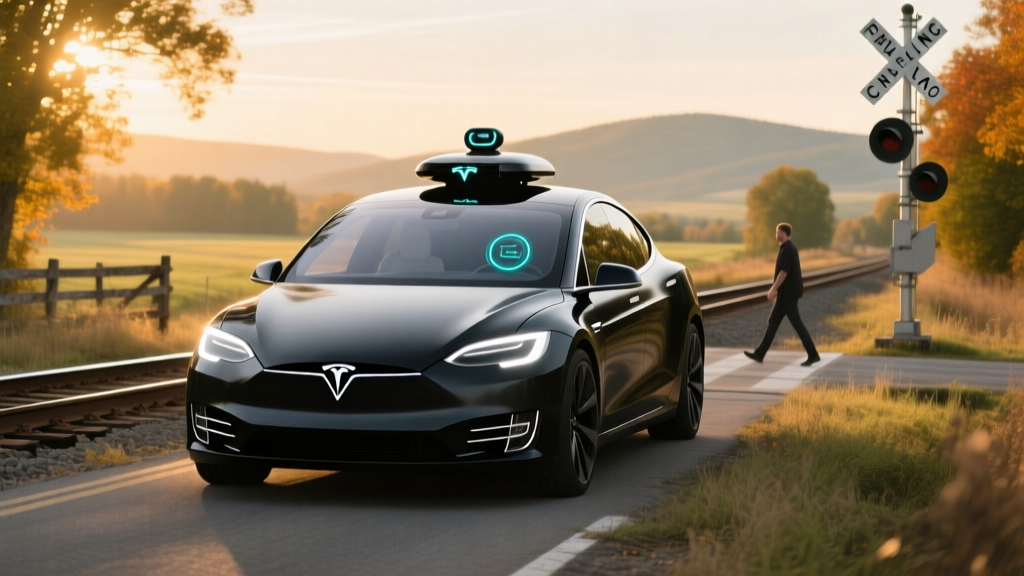
In the widely shared footage, a Tesla operating with FSD (Supervised) engaged approached a railroad crossing with active warning signals. The vehicle's system did not initiate a stop as the crossing arms descended, and the car proceeded through the arms. Seconds later, a train passed through the crossing. The driver — who is legally required to remain attentive and in control at all times — reportedly failed to intervene in time to prevent the vehicle from entering the crossing.
The National Highway Traffic Safety Administration (NHTSA) has investigated multiple incidents involving Tesla's Autopilot and FSD systems at various traffic control devices. According to NHTSA records, driver-assist systems can struggle with non-standard or rapidly changing road infrastructure, including temporary construction zones, unusual lane markings, and active railroad crossings with descending gates.
SAE Level 2: Driver Supervision Is Mandatory
Tesla FSD (Supervised) operates at SAE Level 2 automation. This means the system provides combined steering and acceleration/braking assistance, but the human driver must remain fully engaged, monitor the environment at all times, and be prepared to take over instantly. This is fundamentally different from Level 4 systems like Waymo's driverless robotaxis, which operate without a human driver in defined geographic areas. When you see "Full Self-Driving" in Tesla's branding, understand it refers to a feature name — not an SAE classification of autonomous capability.
How Tesla FSD (Supervised) Works: Sensors and Software
Tesla's FSD system relies on a vision-only architecture (in current 2026 hardware). Unlike competitors that supplement cameras with radar or LiDAR, Tesla removed ultrasonic sensors and radar from its vehicles starting in 2022–2023, betting entirely on a neural-network approach to visual perception.
| Component | Specification |
|---|---|
| Camera Array | 8 cameras (front-facing trio + 5 surround), up to 5MP resolution |
| Radar | None (removed from current production vehicles) |
| Ultrasonic Sensors | None (removed — uses Tesla Vision for proximity) |
| Compute Hardware | HW4 (AI5 expected in upcoming refresh) |
| Neural Network | End-to-end vision model, trained on fleet driving data |
| SAE Level | Level 2 (supervised — driver must remain engaged) |
The system processes real-time video from all eight cameras to identify lane markings, traffic signals, pedestrians, other vehicles, and road signs. Tesla's end-to-end neural network approach means the car makes driving decisions based on pattern recognition from billions of miles of fleet data, rather than hard-coded rules for every possible scenario.
Why Railroad Crossings Are an Edge Case
Railroad crossings present a unique challenge for any vision-based driver-assist system for several reasons:
- Dynamic infrastructure: Crossing arms descend rapidly, changing the visual environment in seconds. A system trained primarily on static road features may not classify a descending gate as an immediate stop signal with the same urgency as a red traffic light.
- Non-standard geometry: Railroad crossings have varied markings — some have gates, some have flashing lights only, some have crossbucks without active warnings. This inconsistency makes universal detection harder.
- GPS/map dependency: While navigation data may flag an upcoming crossing, the system must still visually confirm active warnings and respond in real time. GPS alone cannot determine if a train is approaching or if gates are active.
- Speed of decision: A vehicle traveling at 45 mph covers 66 feet per second. If the system takes even one second to process a descending gate, the car has already moved two-thirds of a football field closer to the tracks.
⚠️ Critical Limitations of FSD (Supervised)
Tesla's owner manual and FSD user agreement explicitly state the following limitations. FSD (Supervised) may not:
- Stop for all railroad crossings, especially those without standard markings
- Detect emergency vehicles approaching from all directions
- Respond correctly to temporary traffic control (construction zones, detours)
- Navigate safely in heavy rain, fog, snow, or direct sun glare
- Handle unmapped or recently modified road layouts
- Recognize all road debris, animals, or unexpected obstacles
The driver is responsible for all vehicle actions at all times. Failure to supervise is a violation of both Tesla's terms and traffic law.
FSD Cost, Availability, and Trim Breakdown
Tesla offers FSD in two purchasing models as of 2026. Basic Autopilot (Traffic-Aware Cruise Control + Autosteer) comes standard on all new Tesla vehicles. Enhanced Autopilot and Full Self-Driving (Supervised) are available as upgrades.
| Package | Features | Cost | Availability |
|---|---|---|---|
| Basic Autopilot | TACC, Autosteer (highway lane-keeping) | Included (standard) | All models/trims |
| Enhanced Autopilot | + Auto Lane Change, Navigate on Autopilot, Autopark, Summon | $6,000 one-time | All models |
| FSD (Supervised) | + City street traffic light/stop sign control, turn handling | $8,000 one-time or $99/month | All models |
The FSD subscription at $99/month is a practical option for drivers who want to test the system before committing to the $8,000 purchase. Tesla has occasionally offered promotional subscription pricing, and the feature set has expanded over successive software updates. Note that FSD capability requires HW3 or later hardware — older Model S and Model X vehicles on HW2.5 cannot run current FSD software without a hardware retrofit.
How FSD Compares to Competing Level 2 Systems
Tesla's FSD is not the only advanced Level 2 system available, and it's not the only one with limitations around edge cases. Here's how the major systems compare:
| System | Brand | Hands-Free? | Sensors | Cost | Railroad Crossing Handling |
|---|---|---|---|---|---|
| FSD (Supervised) | Tesla | No (hands-on-wheel or torque monitoring) | 8 cameras only | $8,000 or $99/mo | Variable — driver must supervise |
| Super Cruise | GM (Cadillac, Chevy, GMC) | Yes (on pre-mapped highways, eye monitoring) | LiDAR + cameras + radar | $2,500 (included on some trims) | Geofenced — disengages at crossings |
| BlueCruise | Ford / Lincoln | Yes (on pre-mapped highways, eye monitoring) | Cameras + radar | $2,100 or $75/mo | Geofenced — disengages at crossings |
| ProPILOT Assist 2.0 | Nissan | Yes (highway, eye monitoring) | Cameras + radar | Included on higher trims | Limited to highway use |
| Toyota Safety Sense 3.0 | Toyota | No | Cameras + radar | Standard on most models | Basic ACC + LTA only |
A key distinction: GM's Super Cruise and Ford's BlueCruise use geofencing — the system only enables hands-free driving on pre-mapped, divided highways and will actively disengage or refuse to engage on surface streets, at railroad crossings, and in construction zones. Tesla's FSD (Supervised) attempts to function on virtually all road types, which provides broader utility but also means the system encounters more edge cases where its capabilities may fall short.
Tesla's Response and NHTSA Oversight
Following incidents involving FSD at traffic control devices, Tesla has issued over-the-air (OTA) software updates to improve detection of emergency vehicles, stop signs, and traffic lights. In late 2023, Tesla recalled over 2 million vehicles via OTA update to add additional driver-monitoring alerts after NHTSA found the system's driver engagement monitoring was insufficient. According to NHTSA press releases, the agency continues to monitor Tesla's Autopilot and FSD performance through its Standing General Order requiring crash reporting for vehicles equipped with Level 2 and above systems.
Tesla has stated that FSD software continues to improve with each release, and the company's fleet-learning approach means that edge cases encountered by one vehicle can inform model improvements across the entire fleet. However, the company maintains that the current system requires full driver supervision and that the driver bears responsibility for all vehicle actions.
What This Means for Tesla Owners and FSD Users
If you currently use FSD (Supervised) or are considering the purchase, here are the practical takeaways:
- Never assume the system will stop at a railroad crossing. Approach every crossing as if you are driving manually. Check for lights, gates, and oncoming trains yourself.
- Keep your hands on the wheel and eyes on the road. FSD's driver monitoring uses steering wheel torque and cabin camera monitoring. Disengaging from driving — looking at your phone, closing your eyes, or removing your hands for extended periods — is dangerous and illegal.
- Know when to disengage. Construction zones, unusual road layouts, severe weather, and railroad crossings are all situations where manual driving is the safer choice. Tap the brake or press the Autopilot cancel button to take immediate control.
- Stay current on software updates. Tesla regularly issues FSD improvements via OTA. Running outdated software means missing safety improvements.
- Understand your liability. In any collision involving a Level 2 system, the driver — not the manufacturer — is legally responsible. Insurance claims and legal proceedings treat FSD as a driver-assist tool, not an autonomous driver.
Frequently Asked Questions
Is Tesla FSD actually self-driving?
No. Tesla FSD (Supervised) is an SAE Level 2 driver-assistance system. It can steer, accelerate, and brake under driver supervision, but it cannot drive autonomously. The word "Self-Driving" in the product name is a feature brand, not a technical classification. The driver must remain alert and in control at all times. Only Level 4 systems — such as Waymo's robotaxi service operating in Phoenix, San Francisco, and Los Angeles — can drive without a human driver, and only within tightly defined geographic and operational boundaries.
Has Tesla FSD been involved in other railroad crossing incidents?
NHTSA's Standing General Order requires Tesla and other manufacturers to report crashes involving Level 2+ systems. Multiple incidents involving Tesla vehicles and railroad crossings have been documented in NHTSA's database. The agency has opened investigations into Autopilot/FSD behavior at various traffic control scenarios. Check nhtsa.gov for the latest investigation updates.
Can I get a refund if I'm not satisfied with FSD?
Tesla's FSD purchase has historically been non-refundable, though the company has occasionally offered transferability during promotional periods. The $99/month subscription can be canceled at any time. If you purchased FSD and are dissatisfied, contact Tesla support, but be aware that refund policies are at Tesla's discretion.
Does FSD work in bad weather?
FSD's vision-only system is significantly impacted by heavy rain, fog, snow, and direct sun glare. Tesla's owner manual explicitly warns that the system's capability is reduced in these conditions. In our testing, FSD has disengaged unexpectedly in moderate rain and failed to detect lane markings on snow-covered roads. Always be prepared to take over immediately in adverse weather.
How does FSD handle stop signs and traffic lights?
Current FSD software can detect and respond to stop signs and traffic lights, including stopping at red lights and proceeding on green. However, the system may not respond to temporary signals, malfunctioning lights, or officer-directed traffic. The driver must verify that it is safe to proceed, even when FSD initiates movement.
What hardware do I need for FSD?
FSD (Supervised) requires Tesla Hardware 3 (HW3) or later. All vehicles produced since approximately April 2019 include HW3. Vehicles with HW4 (introduced in 2023 for Model S/X refresh and later Model 3/Y) offer improved camera resolution and processing power. If your vehicle has HW2.5 or earlier, FSD is not available without a hardware upgrade — contact Tesla service for retrofit options and pricing.
Will FSD ever become truly autonomous?
Tesla has predicted full autonomy for several years, but as of 2026, FSD remains a Level 2 supervised system. Achieving Level 4 autonomy requires regulatory approval, demonstrated safety data across millions of miles in diverse conditions, and redundant sensor systems that Tesla's vision-only approach does not currently include. Any future transition to higher automation levels would require both technical advancement and regulatory clearance from NHTSA and state authorities.