What Tesla FSD Actually Does at Railroad Crossings
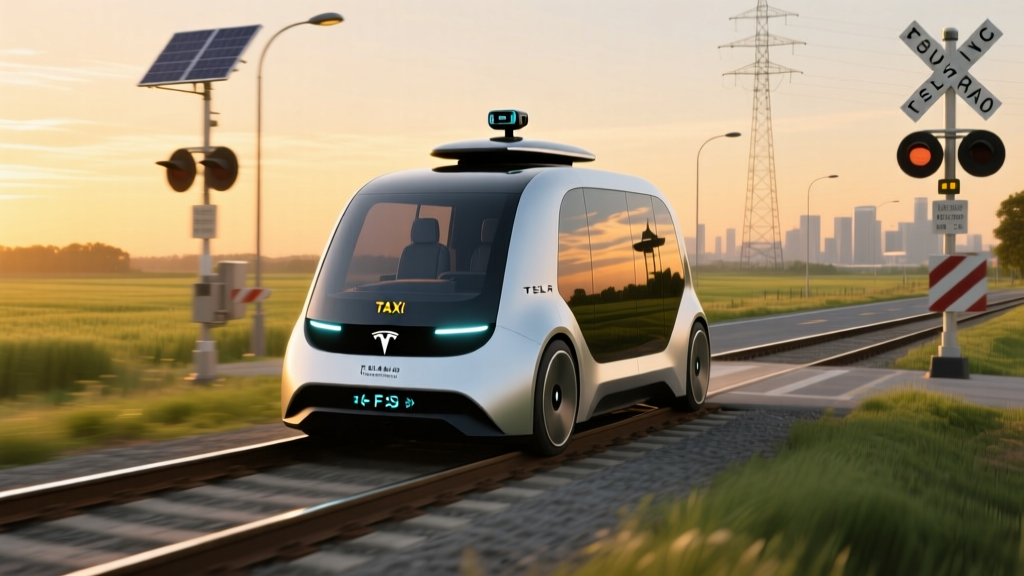
Searches for Tesla FSD railroad crossing behavior spike every time a viral clip shows a Tesla hesitating—or failing to hesitate—at a grade crossing. The reality is more nuanced than any 30-second video. Tesla's Full Self-Driving (Supervised) software, running on the HW4.0 vision-only stack in 2026-model vehicles, processes railroad crossings as part of its general driving policy rather than as a dedicated, hard-coded subroutine.
FSD (Supervised) uses eight surround cameras to build a real-time occupancy-network model of the environment. At a railroad crossing, the system must identify the crossing surface, detect any warning signals (flashing lights, lowered gates), read pavement markings, and decide whether to stop, slow, or proceed. Unlike some legacy ADAS platforms that rely on high-definition map data to pre-identify crossing locations, Tesla's vision-only approach means the car interprets each crossing in real time—every time.
SAE Automation Level: Level 2
Tesla FSD (Supervised) is an SAE Level 2 driver-assistance system. Despite the "Full Self-Driving" branding, the driver must remain fully engaged, monitor the road continuously, and be prepared to take over instantly. Tesla's owner's manual and on-screen alerts reinforce this at every drive. Only Level 4 services like Waymo operate without a human driver in defined geofenced areas.
How the Vision System Interprets Crossing Infrastructure
Tesla's neural network, which runs on the vehicle's dual-computer HW4.0 platform (introduced with the refreshed Model S/X and Cybertruck, now standard across the 2026 lineup), processes camera feeds at high frame rates to identify objects, lane markings, and road surface changes. At a typical grade crossing, the system encounters several distinct challenges:
- Surface discontinuity: Rail tracks create a textured, reflective surface that can confuse depth estimation, particularly in wet or low-sun-angle conditions.
- Warning signals: The network must detect flashing red lights, crossing arms, and audible bells—dynamic elements that change state rapidly.
- Pavement markings: Crossbucks, stop lines, and "RXR" pavement paint must be recognized as regulatory cues.
- Gate position: Determining whether a crossing arm is fully raised, partially lowered, or fully down requires precise spatial reasoning from 2D camera data.
In practice, FSD (Supervised) tends to slow the vehicle when approaching a crossing it identifies, even when no active warning signals are present. This is a conservative policy choice: the system treats the crossing zone as a potential hazard area. However, the degree of deceleration and whether the car comes to a complete stop depends on the specific software version, the visual clarity of the crossing infrastructure, and surrounding traffic behavior.
| Capability | Status | Notes |
|---|---|---|
| Identifies crossing surface | Generally reliable | Performance degrades in heavy rain, snow cover, or faded markings |
| Detects active warning lights | Generally reliable | Vision-based; relies on light being visible to cameras |
| Recognizes lowered crossing gates | Generally reliable | May hesitate or slow excessively at partially lowered gates |
| Stops automatically for active train | Not guaranteed | Driver MUST verify; system may not classify an approaching train correctly at speed |
| Reads passive crossbuck signs | Variable | Recognition depends on sign condition, angle, and lighting |
| Handles uneven track surfaces smoothly | Variable | May brake abruptly or traverse at odd angles on poorly maintained crossings |
The Driver Supervision Requirement: Why You Can't Look Away
Tesla's cabin camera monitors driver attention when FSD (Supervised) is active. If the system detects that your eyes are not on the road, it issues escalating visual and audible warnings before eventually disengaging and locking you out for the remainder of the trip. This monitoring exists precisely because FSD (Supervised) is not capable of handling all scenarios reliably without human oversight.
Critical Limitations at Railroad Crossings
- FSD (Supervised) cannot reliably detect an approaching train. Trains move at high speeds, occupy an unusual visual profile (long, narrow, often at oblique angles), and may not trigger the occupancy network's obstacle classification in time for a safe stop.
- Passive crossings (no gates, no lights) are higher risk. The system may not recognize an unmarked or poorly marked crossing as a hazard zone.
- Sun glare, fog, heavy rain, and nighttime conditions degrade camera performance. Vision-only systems have no radar or lidar backup to confirm obstacles.
- Malfunctioning crossing signals (lights not flashing when a train is approaching) will not be caught by the system.
- The driver is legally and physically responsible for stopping at every railroad crossing as required by law and for verifying that no train is approaching.
Federal law and Tesla's own documentation place the responsibility for safe operation squarely on the driver. The National Highway Traffic Safety Administration (NHTSA) has issued multiple standing general orders and investigations into Level 2 systems and crash incidents at various road features, reinforcing that driver inattention with ADAS engaged is a documented safety risk.
FSD Pricing and Availability Across the 2026 Tesla Lineup
Tesla offers FSD (Supervised) as an add-on across its entire consumer fleet. As of the 2026 model year, the pricing structure is:
| Option | Cost | Notes |
|---|---|---|
| Monthly subscription | $99/month | Cancel anytime; best for occasional use or evaluation |
| One-time purchase | $8,000 | Transfers with the vehicle; does not transfer to a new Tesla you buy |
| Basic Autopilot | Included (standard) | Traffic-aware cruise + lane centering; no city-street capability |
| Enhanced Autopilot | $6,000 | Highway lane changes, auto park, Summon; no city-street FSD |
FSD (Supervised) is available on every 2026 Tesla model: Model 3, Model Y, Model S, Model X, and Cybertruck. Vehicles must be equipped with HW4.0 (sometimes referred to as AI4) hardware, which has been standard on all new-production Teslas since mid-2023. Older HW3.0 vehicles received limited FSD updates but are no longer receiving the latest neural-network architectures as of late 2025.
How FSD Compares to Competing ADAS at Railroad Crossings
Tesla is not the only automaker whose driver-assist system must handle railroad crossings. Here is how the major Level 2 systems compare in their general approach to complex road features like grade crossings:
| System | Automaker | Sensor Suite | Hands-Off? | Monthly Cost |
|---|---|---|---|---|
| FSD (Supervised) | Tesla | 8 cameras (vision-only) | No — hands-on, eyes-on | $99/mo or $8,000 |
| Super Cruise | GM (Cadillac, Chevy, GMC) | Cameras + radar + LiDAR-mapped highways | Yes — eyes-on (on mapped roads) | ~$25/mo after trial |
| BlueCruise | Ford / Lincoln | Cameras + radar | Yes — eyes-on (on approved highways) | $75/mo or $2,100 |
| ProPILOT Assist 2.0 | Nissan | Cameras + radar | Limited hands-off on highways | Included on select trims |
| Toyota Safety Sense 3.0 | Toyota | Cameras + radar | No — hands-on | Included (standard) |
The key distinction is sensor philosophy. GM's Super Cruise supplements cameras with pre-mapped LiDAR data for limited-access highways, giving it a geofenced precision advantage on those roads—but it does not operate on surface streets or at railroad crossings off the highway. Ford's BlueCruise similarly confines its hands-off capability to pre-approved divided highways. Tesla's FSD (Supervised) attempts to handle any road, including rural crossings, but with vision-only hardware that carries inherent limitations in edge-case detection.
None of these systems are designed to independently verify that a railroad crossing is safe to traverse. The driver must do that.
Real-World Behavior: What Owners Actually Report
Owner forums, dashcam compilations, and NHTSA complaint databases paint a consistent picture of FSD behavior at railroad crossings in real-world use:
- Conservative deceleration: FSD (Supervised) typically slows the vehicle when it identifies an upcoming crossing, even on green-lit crossings with no active warnings. This can feel abrupt to following traffic.
- Occasional phantom braking: Shadows cast by crossing gates, reflective track surfaces in wet conditions, or unusual road markings near crossings have triggered unnecessary hard-braking events.
- Hesitation at complex intersections: Crossings adjacent to intersections or with multiple track sets can cause the system to pause or make uncertain steering adjustments.
- Smooth traversal of well-marked crossings: On clear days at well-maintained crossings with visible markings and no active warnings, FSD generally traverses without issue.
The pattern is consistent with a vision-only neural network encountering an environment that differs from standard road surfaces. Tracks are highly reflective, geometrically unusual, and surrounded by signage and infrastructure that can create visual noise for the perception system.
Practical Guidance: How to Drive FSD Through Crossings Safely
If you use FSD (Supervised) daily and your route includes railroad crossings, follow these practices:
- Approach every crossing prepared to take over. Keep your hands near the wheel and your eyes on the crossing infrastructure—lights, gates, and sight lines down the tracks.
- Watch for the system's deceleration pattern. If FSD begins slowing excessively or erratically, tap the accelerator or take the wheel to smooth the approach.
- At passive crossings (no gates or lights), take over completely. The system's ability to identify these as hazard zones is inconsistent.
- In rain, fog, or low-sun conditions, expect degraded performance. These conditions challenge the camera system and increase the likelihood of phantom braking or misidentification.
- Never rely on FSD to detect an approaching train. This is not a capability the system is designed or certified to provide.
According to the Federal Railroad Administration, there are approximately 130,000 public grade crossings in the United States, and a significant portion lack active warning systems. The responsibility for navigating these safely—whether you are driving manually or with ADAS engaged—rests entirely with you.
Does Tesla FSD stop automatically at railroad crossings?
FSD (Supervised) may slow down when it identifies a railroad crossing, but it does not perform a guaranteed automatic stop. The system's response depends on the crossing's visual markings, active warning signals, and the current software version. The driver must always be prepared to stop manually.
Can Tesla FSD detect an oncoming train?
No. Tesla FSD (Supervised) is not designed or certified to detect approaching trains. Trains present a unique visual profile—long, narrow, fast-moving, and often at oblique angles—that the occupancy network may not classify as an obstacle in time. The driver is solely responsible for verifying that no train is approaching before crossing tracks.
Is Tesla FSD self-driving?
No. Tesla FSD (Supervised) is an SAE Level 2 driver-assistance system. The driver must remain fully engaged, monitor the road at all times, and be ready to intervene. Tesla's cabin camera enforces attention monitoring, and the owner's manual explicitly states the driver is responsible for all vehicle actions.
How much does Tesla FSD cost in 2026?
Tesla FSD (Supervised) costs $99 per month as a subscription or $8,000 as a one-time purchase. Basic Autopilot (traffic-aware cruise control and lane centering) is included standard on all new Teslas. Enhanced Autopilot, which adds highway lane changes and auto park, is available for $6,000.
Do other ADAS systems handle railroad crossings better?
No consumer Level 2 system is specifically designed to manage railroad crossings independently. GM Super Cruise and Ford BlueCruise operate primarily on pre-mapped limited-access highways and do not typically encounter grade crossings during hands-off operation. Tesla's FSD attempts broader road coverage, which means it encounters crossings more often—but with vision-only limitations. All systems require the driver to handle crossings safely.