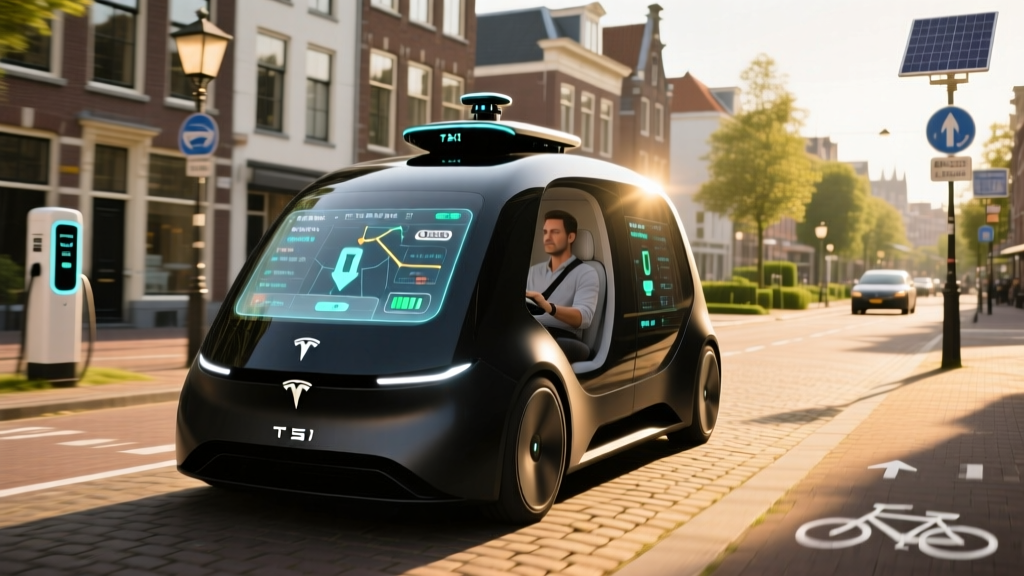
Tesla's Full Self-Driving (Supervised) software has been a lightning rod for debate since its beta launch in the United States. For European buyers — and specifically those in the Netherlands, a key regulatory bellwether within the European Union — the question of whether and how FSD gains approval has practical, legal, and financial implications. As of early 2026, Tesla FSD (Supervised) has received limited regulatory acknowledgment in several EU member states, but the path to full deployment remains constrained by UNECE regulations and the EU's type-approval framework. Here is a precise breakdown of where things stand, what the system actually does, and what Dutch and broader EU drivers need to know before subscribing.
What Tesla FSD (Supervised) Actually Does
Tesla FSD (Supervised) is an advanced driver-assistance system (ADAS) that builds on the company's standard Autopilot package. It uses a vision-only sensor suite — eight cameras providing 360-degree coverage around the vehicle — paired with a neural-network-based perception stack running on Tesla's HW4 (Hardware 4) computer. There is no lidar, no radar (removed from newer production vehicles), and no ultrasonic sensors in current models (Tesla transitioned to a vision-based parking system called High Fidelity Park Assist).
The system's core capabilities include:
- Navigation on Autopilot: Automatic lane changes, on-ramp to off-ramp highway driving, and turn-signal-confirmed exits.
- Auto Lane Change: Suggests and executes lane changes based on navigation route and traffic conditions.
- Autosteer on City Streets: Handles traffic lights, stop signs, crosswalks, and unprotected turns on urban roads.
- Smart Summon: Low-speed autonomous parking-lot navigation to the driver's location.
- Autopark: Parallel and perpendicular parking assistance.
| Feature | Environment | Driver Supervision Required | Availability in EU (as of 2026) |
|---|---|---|---|
| Traffic-Aware Cruise Control | Highway / Urban | Yes | Approved (standard Autopilot) |
| Autosteer (Lane Keeping) | Highway | Yes | Approved (standard Autopilot) |
| Auto Lane Change | Highway | Yes | Approved with FSD package |
| Navigate on Autopilot | Highway (on/off ramps) | Yes | Approved with FSD package |
| City Street Autosteer | Urban / Suburban | Yes | Limited / Pending full UNECE alignment |
| Smart Summon | Parking lots | Yes (phone in hand) | Available (low-speed exemption) |
| Autopark | Parking spaces | Yes | Available |
The SAE Level 2 Reality: This Is Not Self-Driving
Tesla FSD (Supervised) is classified as SAE Level 2 under the SAE J3016 standard. This means the system provides combined longitudinal (acceleration/braking) and lateral (steering) support, but the human driver must remain fully engaged — eyes on the road, hands available to take over at any moment. The driver is legally responsible for all vehicle actions at all times. Only Level 4 systems, such as Waymo's driverless robotaxi service operating in select US cities, qualify as truly autonomous in defined operational domains. Tesla FSD does not meet this threshold.
This distinction matters enormously in the EU regulatory context. European regulators, guided by UNECE (United Nations Economic Commission for Europe) regulations — particularly UN R79 (steering equipment) and UN R157 (Automated Lane Keeping Systems, or ALKS) — impose strict limits on how much lateral and longitudinal control a system can exercise without meeting higher-level safety certification. ALKS, for example, permits hands-off driving at speeds up to 130 km/h on divided highways, but only under narrow conditions and with robust driver-monitoring systems. Tesla's vision-only approach and its broad operational design domain (ODD) have not yet satisfied these specific EU type-approval requirements for anything beyond supervised Level 2 assistance.
Tesla FSD Netherlands Approval: Where Things Stand
The Netherlands, through its vehicle authority RDW (Rijksdienst voor het Wegverkeer), participates in EU-wide type-approval processes and also conducts national assessments for ADAS features. As of 2026, the situation for Tesla FSD in the Netherlands can be summarized as follows:
- Standard Autopilot features (Traffic-Aware Cruise Control, basic Autosteer, Autopark) are fully approved and available on all Tesla vehicles sold in the Netherlands and the broader EU.
- FSD (Supervised) highway features — including Navigate on Autopilot and Auto Lane Change — have received regulatory clearance in several EU markets following Tesla's submission of updated software builds that comply with UN R79 steering-force and lane-change notification requirements. Dutch owners have reported access to these features since late 2024, with progressive rollouts through 2025 and into 2026.
- FSD City Street Autosteer remains the most constrained feature. The EU's regulatory framework requires a more rigorous validation process for urban driving automation, where the system must handle pedestrians, cyclists, complex intersections, and ambiguous road markings. As of early 2026, this feature has not received full EU type-approval and is not active on Dutch roads in the same capacity as in the United States.
The RDW has historically taken a pragmatic but cautious approach, aligning closely with UNECE working groups. Dutch regulators have expressed interest in Tesla's data-driven validation methodology but have not bypassed the established type-approval process to grant special exemptions. The RDW's official position continues to reference EU Regulation 2018/858 and UNECE standards as the governing frameworks.
How Much Does Tesla FSD Cost in the Netherlands?
Tesla's pricing for FSD (Supervised) in Europe has evolved, and Dutch buyers face the same structure as other EU markets:
| Option | Cost | Notes |
|---|---|---|
| One-Time Purchase | €7,500 | Added at vehicle purchase or later via the Tesla app; non-transferable between vehicles |
| Monthly Subscription | €99/month | Cancel anytime; no long-term commitment; available on eligible vehicles with HW3 or HW4 |
| Enhanced Autopilot (EAP) | €3,800 (one-time) | Includes Navigate on Autopilot, Auto Lane Change, Autopark, Summon — but NOT City Street Autosteer |
| Standard Autopilot | Included | Traffic-Aware Cruise Control + basic Autosteer; standard on all new Tesla vehicles |
For Dutch buyers uncertain about whether City Street Autosteer will gain EU approval in the near term, the Enhanced Autopilot (EAP) package at €3,800 represents a pragmatic middle ground — it delivers the highway features that are already approved without paying the FSD premium for capabilities that may not activate on European roads for some time.
Which Tesla Models Include or Support FSD?
FSD (Supervised) is available as a purchase or subscription on all current-production Tesla vehicles equipped with Hardware 3 (HW3) or Hardware 4 (HW4). As of 2026, that includes:
- Tesla Model 3 (Highland refresh, 2024+): HW4 standard on all trims — Rear-Wheel Drive, Long Range AWD, Performance.
- Tesla Model Y (Juniper refresh, 2025+): HW4 standard on Long Range AWD and Performance trims.
- Tesla Model S (2023+ refresh): HW4 standard; available on Long Range and Plaid.
- Tesla Model X (2023+ refresh): HW4 standard; available on Long Range and Plaid.
- Tesla Cybertruck: HW4 standard; FSD available (primarily US market currently).
Vehicles produced before April 2019 with HW2.5 or earlier are not eligible for FSD. Owners of HW3 vehicles can access FSD but may experience slower processing and fewer concurrent neural-network inferences compared to HW4. Tesla has not announced a paid HW3-to-HW4 retrofit program for the European market as of early 2026.
Real-World Limitations: What FSD Cannot Do
Tesla FSD (Supervised) is not a substitute for an attentive driver. The following conditions significantly degrade or disable the system:
- Heavy rain, fog, or snow: Camera occlusion reduces perception confidence; the system will issue a takeover request and may disengage Autosteer entirely.
- Faded or missing lane markings: Common on rural Dutch roads and older infrastructure; the system relies on clear visual lane boundaries and may wander or disengage.
- Construction zones: Temporary barriers, shifted lanes, and orange cones are not always correctly interpreted, particularly in complex multi-phase work zones.
- Unprotected left turns across traffic: Even in the US where City Streets is active, the system sometimes hesitates or misjudges gap distances. This capability is not available in the EU.
- Roundabouts: Ubiquitous in the Netherlands; FSD's handling of multi-lane roundabouts with cyclists and pedestrians is inconsistent. Drivers must be prepared to intervene.
- Glare and low-sun conditions: Direct sunlight into forward-facing cameras can temporarily blind the perception system.
- Tunnel transitions: Sudden light-level changes can cause brief perception drops.
Dutch driving conditions present specific challenges. The Netherlands has dense cycling infrastructure — over 37,000 km of dedicated bike paths — and cyclists frequently share road space with vehicles at intersections and roundabouts. FSD's vision system must reliably detect and predict cyclist behavior, which remains an edge case even in the more permissive US regulatory environment. Additionally, Dutch speed limits (100 km/h on highways during daytime, 130 km/h at night on certain sections) differ from US norms, and the system's speed-adaptation algorithms must account for these specific limits, variable speed zones, and the pervasive use of average-speed camera enforcement (trajectcontrole).
How Tesla FSD Compares to Competing ADAS in Europe
| System | Brand | SAE Level | Highway Hands-Off | City Streets | EU Approval Status | Cost |
|---|---|---|---|---|---|---|
| FSD (Supervised) | Tesla | Level 2 | No (hands-on) | Limited / Pending | Partial (highway features approved) | €7,500 or €99/mo |
| BMW Highway Assistant (with hands-off) | BMW | Level 2+ | Yes (up to 130 km/h, eyes-off on approved highways) | No | Approved under UN R79/R157 | Included in Driving Assistant Professional (~€2,100 option) |
| Mercedes-Benz DRIVE PILOT | Mercedes | Level 3 | Yes (up to 95 km/h, conditional) | No | Approved in Germany; pending broader EU | €5,000–€9,000 depending on market |
| Ford BlueCruise | Ford | Level 2 | Yes (hands-off, eyes-on on approved highways) | No | Approved in select EU markets | Subscription ~€30/mo or included in select trims |
| GM Super Cruise / Ultra Cruise | Cadillac / Chevrolet | Level 2 | Yes (hands-off, eyes-on on mapped roads) | No | Limited EU availability | Included or ~$25/mo subscription (US) |
| Volvo Pilot Assist | Volvo | Level 2 | No (hands-on) | No | Approved | Standard on most trims |
The most notable competitive dynamic in Europe is between Tesla's vision-only, broad-ODD approach and the more constrained but regulatory-approved systems from legacy automakers. Mercedes-Benz's DRIVE PILOT, for example, is the first certified Level 3 system available to consumers in the EU — meaning the driver can legally disengage from the driving task under specific conditions (divided highways, speeds below 95 km/h, good weather). However, DRIVE PILOT's operational design domain is far narrower than Tesla FSD's intended scope, and it costs significantly more. BMW's Highway Assistant has gained UN R157 approval for hands-off, eyes-off driving at up to 130 km/h on approved divided highways, using a combination of cameras, radar, and lidar — a sensor redundancy approach Tesla has explicitly rejected.
For Dutch buyers, the practical question is whether Tesla's broader feature set (once/if fully approved) justifies waiting, versus purchasing a vehicle today with a narrower but fully certified hands-off highway system from BMW or Mercedes.
Regulatory Outlook: What's Next for FSD in the EU and Netherlands
The EU's regulatory trajectory suggests a gradual opening for more advanced ADAS features, but on European terms. Key developments to watch:
- Updated UN R157 (ALKS): The regulation has been progressively expanded to cover higher speeds (from the original 60 km/h to 130 km/h) and lane-change functionality. Tesla would need to certify FSD's lane-change behavior against these specific requirements.
- EU AI Act implications: The European Union's Artificial Intelligence Act classifies certain AI systems used in safety-critical applications as "high-risk," subjecting them to conformity assessments. How this intersects with vehicle type-approval remains an evolving area.
- Data and privacy: Tesla's data-collection practices for FSD training must comply with GDPR. The company has established European data-processing infrastructure, but regulators continue to scrutinize camera-based data collection in public spaces.
- Netherlands-specific leadership: The Dutch government has been proactive in connected and automated driving through initiatives like the Connekt/ITS Corridor programs. However, this enthusiasm has not translated into regulatory shortcuts — RDW continues to require full UNECE compliance.
Tesla's approach of deploying software over-the-air (OTA) means that once regulatory approval is granted for a specific feature, it can be activated on eligible vehicles within days — no dealership visit required. This gives Tesla a significant speed advantage over legacy OEMs once the regulatory gate opens. But that gate remains the binding constraint.
Frequently Asked Questions
Is Tesla FSD legal to use in the Netherlands right now?
Standard Autopilot features (cruise control, lane keeping) and FSD highway features (Navigate on Autopilot, Auto Lane Change) are approved and legal to use. City Street Autosteer is not currently active on Dutch roads due to pending EU type-approval. All features require continuous driver supervision.
Can I buy FSD in the Netherlands and use it in the US?
FSD purchases are region-locked. If you buy FSD in the Netherlands, the features available to you are governed by EU regulatory approvals, not US approvals. Driving your Dutch-registered Tesla in the US would not unlock US-only features like City Street Autosteer, and vice versa.
Does Tesla FSD work on Dutch highways (A-roads)?
Yes — Navigate on Autopilot and Auto Lane Change function on Dutch motorways (A1, A2, A4, A10 ring, etc.) where lane markings are clear and GPS signal is stable. However, the driver must keep hands on or near the steering wheel. The system uses steering-torque detection and cabin-camera monitoring to verify driver attention.
Is the €99/month subscription worth it if City Streets isn't approved?
This depends on your driving profile. If you frequently drive long highway commutes (e.g., Amsterdam–Rotterdam, Utrecht–Eindhoven), Navigate on Autopilot and Auto Lane Change reduce fatigue meaningfully. If most of your driving is urban, the subscription value is lower until City Streets gains approval. Consider Enhanced Autopilot (EAP) at €3,800 one-time as a cost-effective alternative.
How does Tesla's camera-only approach compare to lidar-equipped competitors?
Tesla's vision-only system relies on neural-network depth estimation from camera data, which Tesla argues scales better and avoids sensor-fusion conflicts. Competitors like BMW, Mercedes, and Mobileye use lidar as a redundant depth sensor, which provides reliable range data in low-visibility conditions but adds cost and complexity. The EU's regulatory bodies have generally favored redundant sensor architectures for higher-level automation approvals, which is one factor in Tesla's slower EU certification timeline.
What happens if FSD makes an error — am I liable?
Yes. Because FSD (Supervised) is SAE Level 2, the driver is legally responsible for the vehicle at all times under Dutch traffic law (Wegenverkeerswet 1994). If the system fails to detect an obstacle, misreads a traffic signal, or makes an unsafe lane change, the driver bears liability. This is fundamentally different from Level 3 systems like Mercedes DRIVE PILOT, where the manufacturer accepts liability during approved system operation.
Sources: RDW (Netherlands Vehicle Authority), UNECE Vehicle Regulations, Tesla FSD Official Page. Regulatory status current as of early 2026; verify with RDW before purchasing.