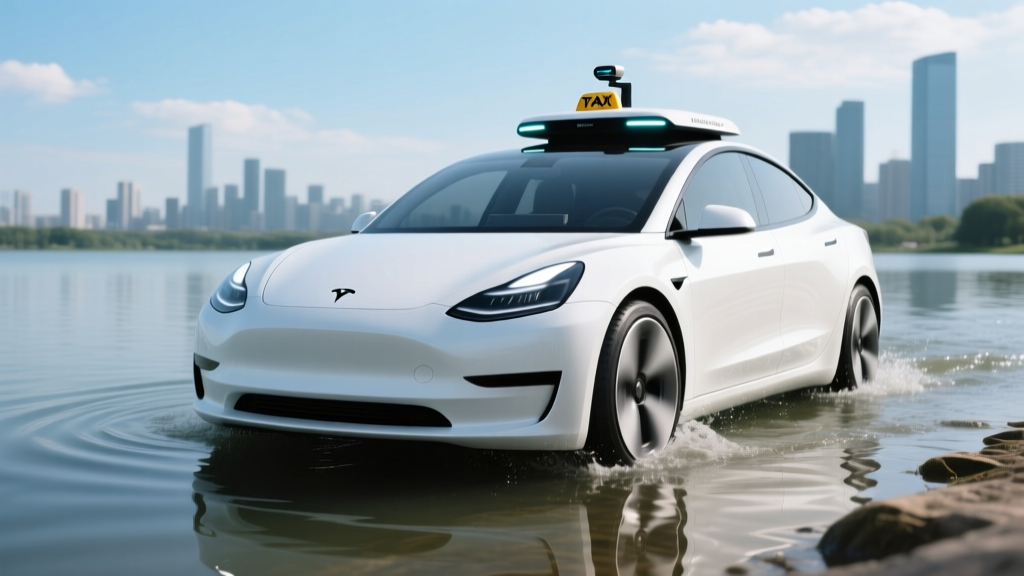
Reports that Tesla's FSD software attempted driving a vehicle into a lake have circulated widely across EV forums and social media, reigniting a critical conversation about the gap between marketing language and real-world capability in advanced driver-assistance systems (ADAS). While the specific incident details vary by source — involving a Tesla navigating toward a body of water due to misidentified road boundaries — the core lesson remains the same: Full Self-Driving (Supervised) is a Level 2 system that demands constant driver oversight, and edge cases involving unusual road geometry, poor lane markings, or reflective surfaces near water remain a persistent challenge for vision-based ADAS platforms.
This article breaks down exactly what Tesla's FSD system does, where it fails, what it costs in 2026, and how it compares to competing Level 2 systems from Ford, GM, and others. If you're a Tesla owner or prospective buyer, understanding these limitations is essential for safe operation.
Tesla's Full Self-Driving (Supervised) is classified as SAE Level 2 by the Society of Automotive Engineers. This means the system can control steering, acceleration, and braking under certain conditions, but the human driver must remain fully engaged, monitor the environment at all times, and be prepared to take over instantly. It is not autonomous. Only Level 4 services like Waymo One operate without a human driver in defined geofenced areas.
What Tesla FSD Actually Does — and How It Works Technically
Tesla's Full Self-Driving (Supervised) software, as of the 2026 model year, relies exclusively on a vision-only architecture — a suite of external cameras (typically eight on current Model 3, Model Y, Model S, and Model X vehicles) processed by Tesla's custom HW4 (Hardware 4) onboard computer. Tesla removed ultrasonic sensors (USS) from new vehicles starting in late 2022 and phased out radar from most models by 2023, making FSD entirely dependent on camera-derived depth estimation, object detection, and neural-network-based scene understanding.
The system is designed to handle:
- Highway lane-keeping and adaptive cruise control (inherited from basic Autopilot)
- Automatic lane changes based on navigation route
- On-ramp to off-ramp highway navigation
- City street driving including traffic light and stop sign recognition
- Interpretation of unprotected turns, crosswalks, and complex intersections
- Parking lot navigation and Smart Summon (low-speed autonomous movement in parking areas, with supervision)
| Attribute | Specification |
|---|---|
| Sensor Suite | 8 external cameras (vision-only); no LiDAR, no radar on most 2024+ models |
| Compute Platform | Tesla HW4 (AI5 expected in next-gen vehicles) |
| SAE Level | Level 2 (driver supervision required at all times) |
| Operational Design Domain | Public roads in the US and select international markets; no geofence restriction |
| Driver Monitoring | Cabin camera attention monitoring; steering wheel torque (legacy models) |
| FSD Version (as of early 2026) | v13.x end-to-end neural network architecture |
The Lake Incident: What Happened and Why It Matters
The incident in which Tesla's FSD software attempted driving a vehicle into a lake — widely shared via dashcam footage and owner reports — highlights a category of failure that vision-based systems are particularly vulnerable to: environmental boundary confusion. In documented cases, the system misidentified a road's edge near a body of water, failed to recognize the transition from paved surface to water, or was confused by reflective surfaces that disrupted depth perception.
Vision-only systems rely on neural networks trained on billions of miles of driving data, but edge cases — roads ending at boat ramps, unpaved shoulders adjacent to water, flooded roadways, or highly reflective lake surfaces at certain sun angles — remain statistically rare enough that training data may be sparse. Unlike LiDAR-equipped systems that can physically measure distance to a surface regardless of its visual properties, a camera-based system must infer whether a surface is drivable based on learned patterns.
- Water and reflective surfaces: FSD may misidentify bodies of water, flooded roads, or highly reflective surfaces as drivable pavement.
- Faded or absent lane markings: Performance degrades significantly on rural roads, construction zones, or roads with non-standard markings.
- Adverse weather: Heavy rain, fog, snow, and direct sun glare can impair camera visibility and system reliability.
- Unmapped or recently modified roads: New construction, temporary detours, or roads not reflected in Tesla's map data can cause erratic behavior.
- Stationary obstacles: Historically, the system has struggled with stationary emergency vehicles and unusual obstacles in the travel lane.
- Driver complacency risk: The system's generally competent behavior on routine drives can lull drivers into reduced vigilance — the exact scenario where edge-case failures become dangerous.
The driver is legally and practically responsible for all vehicle actions at all times. NHTSA has issued standing orders requiring crash reporting for all Level 2+ systems.
Is Tesla FSD Truly Self-Driving? The Level 2 Reality
No. Tesla's Full Self-Driving (Supervised) is not self-driving. The name is a marketing term, and Tesla added the "(Supervised)" qualifier following regulatory scrutiny to clarify that the driver must remain attentive. Under SAE International's J3016 standard, FSD operates at Level 2 — the same automation tier as Ford BlueCruise, GM Super Cruise, and Hyundai's Highway Driving Assist 2.
At Level 2, the system controls lateral (steering) and longitudinal (speed/braking) functions simultaneously, but the driver is the fallback. If the system encounters a scenario it cannot handle — such as a road ending at a lake — there is no automated contingency. The system may issue a warning and disengage, or in worst cases, continue on an incorrect path until the driver intervenes.
This contrasts with Level 4 systems like Waymo One, which operate without any human driver in defined geographic zones and have redundant sensor suites (LiDAR, radar, cameras) and remote-assistance fallbacks. Tesla's approach trades sensor redundancy for scalability, aiming to solve the general driving problem with cameras alone — an approach that has proven capable in routine scenarios but remains controversial for edge cases.
Cost, Availability, and Which Models Include FSD
As of the 2026 model year, Tesla offers FSD (Supervised) through multiple purchase models across its entire consumer lineup. Every new Tesla — Model 3, Model Y, Model S, and Model X — ships with basic Autopilot (adaptive cruise + lane-keeping) as standard. FSD (Supervised) is an add-on available on all trims.
| Option | Cost | Notes |
|---|---|---|
| Basic Autopilot | Included (standard) | Traffic-aware cruise + autosteer; all new Teslas |
| Enhanced Autopilot (EAP) | ~$6,000 one-time | Navigate on Autopilot, auto lane change, Smart Summon, autopark; availability varies by market |
| FSD (Supervised) — Purchase | ~$8,000 one-time | Full city-street capability; price has fluctuated; check Tesla.com for current pricing |
| FSD (Supervised) — Subscription | $99/month | Cancel anytime; transfers to new Tesla if purchased on that vehicle (non-transferable between owners on used vehicles in most cases) |
Prices have shifted multiple times in recent years. Tesla occasionally offers promotional FSD transfers to new vehicles or limited-time subscription pricing. Always verify current pricing directly on Tesla's official support page before purchasing.
How FSD Compares to Competing Level 2 Systems
Tesla's FSD is the most widely deployed Level 2+ system in the US by vehicle count, but it is not the only option — and it is not universally regarded as the safest or most capable. Here's how the major systems compare:
| System | OEM | SAE Level | Sensor Approach | Hands-Free? | Geofenced? |
|---|---|---|---|---|---|
| FSD (Supervised) | Tesla | Level 2 | Vision-only (cameras) | No (supervision required) | No — any public road |
| Super Cruise | GM (Cadillac, Chevy, GMC) | Level 2 | Cameras + radar + LiDAR-mapped roads | Yes (eyes-on via camera) | Yes — 750,000+ mi of mapped roads |
| BlueCruise | Ford / Lincoln | Level 2 | Cameras + radar | Yes (eyes-on via camera) | Yes — Blue Zones (130,000+ mi of divided highways) |
| Highway Driving Assist 2 | Hyundai / Kia / Genesis | Level 2 | Cameras + radar | No (hands-on required) | No — any highway |
| Driving Assist Pro | BMW | Level 2 | Cameras + radar | Yes (eyes-on, up to 85 mph) | Highway-only |
A key distinction: GM's Super Cruise and Ford's BlueCruise use geofencing — they only activate on pre-mapped, divided highways where the system has high confidence in road geometry. Tesla's FSD operates on any public road, which offers broader coverage but exposes it to far more unpredictable scenarios, including the type of road-to-water boundary confusion seen in the lake incident.
Safety Context: NHTSA Investigations and Real-World Data
Tesla's Autopilot and FSD systems have been the subject of multiple NHTSA investigations, including probes into crashes involving stationary emergency vehicles and the adequacy of Tesla's driver-monitoring systems. As of 2026, NHTSA's Standing General Order requires all manufacturers deploying Level 2+ systems to report crashes within 24 hours.
Tesla publishes quarterly safety data in its Vehicle Safety Report, claiming that vehicles with Autopilot engaged record fewer crashes per million miles than the US average. However, these statistics have drawn criticism from safety researchers who note that:
- Autopilot is predominantly used on divided highways — inherently safer driving environments than the urban streets where FSD city driving operates.
- The comparison baseline (all US driving) includes impaired, distracted, and unlicensed drivers, which inflates the apparent advantage.
- Near-miss and disengagement data is not publicly reported in a standardized format across the industry.
For the lake incident specifically, the safety implication is clear: no Level 2 system should be trusted to correctly identify every non-drivable surface, particularly where road geometry is unusual. The driver's responsibility to monitor the road ahead is not optional — it is the system's primary safety mechanism.
Real-World Ownership Considerations for FSD Users
If you own or are considering a Tesla with FSD (Supervised), these practical guidelines can help you use the system more safely:
- Treat every drive as a supervised test. FSD performs well in many scenarios, but its failures can be sudden and without warning. Keep your hands near the wheel and eyes on the road.
- Be extra vigilant near water, construction zones, and rural roads. These environments present edge cases — faded markings, unusual surfaces, temporary barriers — where vision systems are most likely to err.
- Monitor FSD version updates carefully. Tesla pushes over-the-air updates frequently. Read the release notes; test new versions in low-risk driving scenarios before relying on them for complex commutes.
- Understand the disengagement behavior. When FSD encounters a scenario it cannot resolve, it may alert the driver and disengage with limited lead time. You must be prepared to take full control instantly.
- Use the $99/month subscription to evaluate before committing. If you're unsure whether FSD adds value for your typical routes, the monthly subscription lets you test it without the $8,000 upfront commitment.
Frequently Asked Questions
Did Tesla's FSD actually drive a car into a lake?
Multiple owner reports and dashcam videos have documented instances where Tesla's FSD system navigated toward a body of water, misidentifying the road boundary. Whether the vehicle fully entered the water depends on the specific incident and whether the driver intervened in time. In all cases, the driver was responsible for supervising the system and preventing the outcome.
Is Tesla FSD (Supervised) self-driving?
No. Tesla FSD is an SAE Level 2 driver-assistance system. The driver must remain fully engaged, monitor the road, and be ready to take over at any moment. Only Level 4 systems like Waymo One operate without a human driver, and those are limited to specific geofenced service areas.
How much does Tesla FSD cost in 2026?
FSD (Supervised) is available as a one-time purchase (approximately $8,000, though Tesla has adjusted this price multiple times) or as a $99/month subscription. Basic Autopilot is included standard on all new Tesla vehicles. Verify current pricing on Tesla's website.
Which Tesla models support FSD?
All current Tesla models — Model 3, Model Y, Model S, and Model X — support FSD (Supervised) when equipped with HW4 (Hardware 4). Older vehicles with HW3 may require a hardware upgrade to access the latest FSD versions. The upcoming next-generation Tesla platform is expected to feature AI5 hardware.
Why do vision-only systems struggle near water?
Camera-based systems infer drivability from visual patterns learned during neural network training. Reflective water surfaces, boat ramps, flooded roads, and unpaved shoulders near lakes can present visual signatures that don't clearly match "non-drivable" patterns in the training data. LiDAR, which Tesla does not use, physically measures surface distance and is not fooled by visual reflectivity.
How does FSD compare to GM Super Cruise or Ford BlueCruise?
GM Super Cruise and Ford BlueCruise are also Level 2 systems, but they operate only on pre-mapped, divided highways (geofenced). This limits their coverage but increases confidence in road geometry. Tesla FSD operates on any public road — broader coverage, but more exposure to edge cases. Super Cruise and BlueCruise also allow true hands-free driving on approved roads (with eyes-on monitoring), while FSD requires active supervision at all times.
Can I get a refund if FSD doesn't meet my expectations?
Tesla's FSD purchase and subscription terms have historically been non-refundable, though policies can vary. The $99/month subscription model reduces financial risk — you can cancel at any time. Always review Tesla's current terms of service before purchasing.