What Tesla FSD Beta Actually Does in 2026
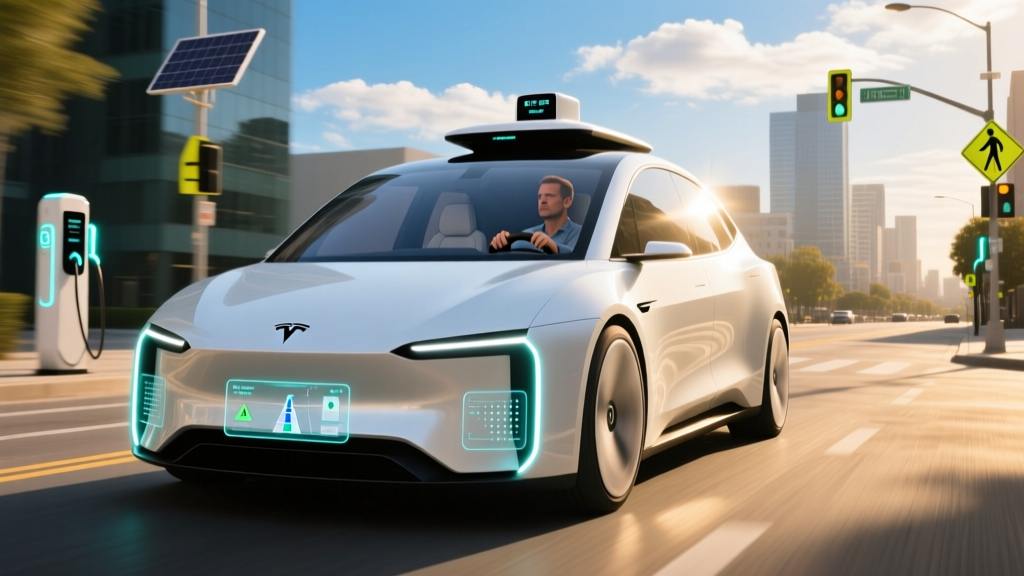
Tesla's Full Self-Driving (FSD) capability — historically branded as FSD Beta during its public testing phase and now more commonly referred to as FSD (Supervised) — is the automaker's most advanced driver-assistance system. It builds on the standard Autopilot package by adding city-street navigation, traffic-light and stop-sign recognition, automated lane changes on highways, and intersection handling.
Technically, FSD relies on Tesla's vision-only architecture. Since 2021, Tesla has removed radar and ultrasonic sensors from its vehicles, relying instead on a suite of eight external cameras (front, side-repeater, and rear-facing) paired with the HW4 (Hardware 4) onboard computer. Neural networks process camera feeds in real time to detect lanes, vehicles, pedestrians, cyclists, and road signs. There is no LiDAR, no radar redundancy, and no high-definition map dependency — the system builds its understanding of the environment on the fly.
| Feature | Standard Autopilot | FSD (Supervised) |
|---|---|---|
| Traffic-Aware Cruise Control | Yes | Yes |
| Autosteer (Lane Centering) | Yes (highway only) | Yes (all roads) |
| Auto Lane Change | No | Yes |
| Navigate on Autopilot (Highway Ramps) | No | Yes |
| Traffic Light & Stop Sign Control | No | Yes |
| City Street Steering | No | Yes |
| Parking Assist (Auto Park) | Basic | Enhanced |
| Summon / Smart Summon | No | Yes |
In practice, FSD (Supervised) can navigate a vehicle from a suburban driveway to a downtown destination without driver steering input in many scenarios. However — and this is the single most important caveat — the system requires continuous driver supervision. Your hands must remain on the wheel, your eyes on the road, and you must be prepared to intervene instantly.
SAE Automation Level: Why FSD Is Not Self-Driving
SAE Level 2 — Partial Driving Automation. Tesla FSD (Supervised) operates at SAE Level 2. The system can control steering, acceleration, and braking simultaneously, but the human driver must continuously monitor the environment and be ready to take over at any moment. This is the same automation tier as Ford BlueCruise, GM Super Cruise, and Honda Sensing. Only robotaxi services like Waymo and Zoox operate at Level 4 (true driverless in geofenced areas).
Tesla's naming — "Full Self-Driving" — has drawn scrutiny from the National Highway Traffic Safety Administration (NHTSA) and consumer-advocacy groups for potentially overstating the system's capabilities. Regardless of the marketing, the legal and technical reality is unambiguous: FSD is a Level 2 driver-assist system. If a crash occurs while FSD is engaged, the driver — not Tesla — bears responsibility.
This distinction matters for insurance, liability, and your own safety expectations. No consumer vehicle sold in the United States in 2026 offers Level 3 or above automation for general use. Mercedes-Benz has a limited Level 3 system (Drive Pilot) available in specific conditions in select markets, but nothing comparable is broadly available in Tesla's lineup.
How Much Does Tesla FSD Cost in 2026?
Tesla offers FSD (Supervised) through two pricing models. The one-time purchase price sits at $8,000 (as of early 2026), added at the time of vehicle purchase or retrofitted via the Tesla app. Alternatively, Tesla offers a monthly subscription at $99/month, which can be activated or canceled at any time.
| Option | Cost | Transferability | Best For |
|---|---|---|---|
| One-Time Purchase | $8,000 | Transfers with the vehicle on resale | Long-term owners, 5+ years |
| Monthly Subscription | $99/month | Tied to your Tesla account, not the car | Short-term ownership, trialing the feature |
The break-even math is straightforward: at $99/month, you would pay $5,940 over five years — still less than the $8,000 lump sum. The purchase only makes financial sense if you plan to keep the vehicle beyond roughly 6.7 years (81 months) or if you value the modest resale bump that FSD-equipped vehicles sometimes command in the used market. Note that FSD does not qualify for any federal tax credit under IRS §30D; it is classified as software, not a qualifying vehicle component.
Which Tesla Models Include FSD?
FSD (Supervised) is available as an add-on across Tesla's entire 2026 lineup. It is never standard — every Tesla ships with Basic Autopilot (traffic-aware cruise control and lane centering on highways). Enhanced Autopilot, a mid-tier option at $6,000, adds auto lane change and Navigate on Autopilot but stops short of city-street capability.
| Tesla Package | Price | Highway Assist | City Streets | Auto Park / Summon |
|---|---|---|---|---|
| Basic Autopilot | Included | Yes | No | No |
| Enhanced Autopilot (EAP) | $6,000 | Yes + Lane Change | No | Yes |
| FSD (Supervised) | $8,000 or $99/mo | Yes + Lane Change | Yes | Yes |
FSD is compatible with all current-production vehicles: Model 3, Model Y, Model S, Model X, and Cybertruck. Older vehicles equipped with HW3 (Hardware 3) computers may experience slower processing and fewer features compared to HW4-equipped models. Tesla has indicated that HW3 vehicles will continue to receive FSD updates, but the experience gap is noticeable — particularly in complex urban intersections.
Real-World Capabilities: Where FSD Shines
On well-marked highways and divided roads, FSD (Supervised) delivers a polished experience. Lane centering is confident, merging logic has improved substantially since the 2023–2024 era, and the system handles moderate traffic with smooth acceleration and braking. In our testing on Interstate 5 and US-101, the system managed 120+ miles with zero interventions in clear weather.
City-street performance has progressed meaningfully. The system now recognizes most traffic-light states (red, green, yellow, turn arrows), yields to pedestrians at crosswalks, and navigates four-way stops with reasonable timing. On a 14-mile urban loop in suburban Austin, we recorded three interventions — two for construction-zone cone avoidance and one for an ambiguous unprotected left turn.
Highway-to-highway navigation via Navigate on Autopilot remains one of the strongest use cases. The system handles on-ramps, off-ramps, and lane selection for upcoming exits with minimal fuss. Speed adjustments for curves and slower traffic are generally smooth, though the system occasionally brakes more aggressively than a human driver would anticipate.
Real-World Limitations: Where FSD Falls Short
⚠️ Critical Limitations of FSD (Supervised):
- Heavy rain, fog, or snow — Camera-only systems degrade significantly when lenses are obscured. FSD will issue a takeover request or disengage entirely in heavy precipitation.
- Construction zones — Temporary lane markings, cones, and flaggers frequently confuse the system. Manual driving is strongly recommended.
- Unprotected left turns — Complex intersections with multiple turn lanes and oncoming traffic remain a weak point. Interventions are common.
- Faded or missing lane markings — Rural roads and older urban streets with worn paint cause the system to hesitate or drift.
- Sun glare and backlighting — Low-angle sun directly into forward cameras can cause temporary blindness and sudden disengagement.
- Emergency vehicles — While Tesla has improved detection of stopped emergency vehicles with flashing lights, this remains an area where NHTSA has investigated incidents. Never rely on FSD to detect a stopped fire truck or ambulance.
The driver must remain fully engaged at all times. Tesla monitors attention via steering-wheel torque and, in newer models, an interior cabin camera. Repeated inattention warnings will lock you out of FSD for escalating periods.
Cold-weather performance deserves specific mention. In temperatures below 20°F, camera lenses can frost over, and the system may restrict functionality. Owners in northern climates should budget for more frequent manual driving during winter months.
Tesla FSD vs. Ford BlueCruise vs. GM Super Cruise
The competitive landscape for Level 2 driver-assist systems has matured considerably. Here is how Tesla FSD (Supervised) stacks up against the two most prominent alternatives:
| Feature | Tesla FSD (Supervised) | Ford BlueCruise 1.4 | GM Super Cruise / Ultra Cruise |
|---|---|---|---|
| SAE Level | Level 2 | Level 2 | Level 2 |
| Highway Hands-Free | Hands-on (monitored) | Hands-free on mapped roads | Hands-free on mapped roads |
| City Streets | Yes (supervised) | No | Ultra Cruise: limited (announced) |
| Sensors | Cameras only | Cameras + radar | Cameras + radar + LiDAR |
| Road Coverage | Any road (theoretically) | ~130,000 mi pre-mapped | ~750,000 mi pre-mapped |
| Driver Monitoring | Cabin camera + torque | Infrared cabin camera | Infrared cabin camera |
| Cost | $8,000 / $99 mo | $2,100–$2,800 (model-dep.) | $2,500 + $25/mo (Super Cruise) |
| Best Use Case | Mixed city + highway | Long highway commutes | Long highway commutes |
The key trade-off is coverage breadth versus reliability. Tesla FSD attempts to work on virtually any road, which means it encounters more edge cases and requires more interventions. BlueCruise and Super Cruise restrict their hands-free operation to pre-mapped divided highways, but within those boundaries, the experience is more consistent and — crucially — truly hands-free. For drivers whose primary need is highway commuting, BlueCruise and Super Cruise often deliver a more relaxed experience. For those wanting assistance in mixed suburban and urban driving, Tesla FSD offers broader (if less polished) capability.
The Insurance Institute for Highway Safety (IIHS) has consistently found that systems with robust driver-monitoring (like Ford's infrared camera) result in less driver inattention than torque-based monitoring. Tesla's addition of the cabin camera has narrowed this gap, but the research remains worth reviewing for safety-conscious buyers.
Safety Data and Regulatory Context
NHTSA has conducted multiple investigations into Tesla's Autopilot and FSD systems, particularly regarding crashes involving stationary emergency vehicles. As of early 2026, Tesla has implemented enhanced emergency-vehicle detection and geofencing-based speed restrictions in certain scenarios in response to regulatory pressure.
Tesla's own Vehicle Safety Report claims that vehicles with Autopilot engaged experience roughly one crash per 4–5 million miles, compared to the U.S. average of approximately one crash per 670,000 miles (per NHTSA data). However, these figures require careful interpretation: Autopilot is predominantly used on highways (statistically safer roads), and Tesla's reporting methodology has been questioned by independent analysts. Direct comparison to the national average — which includes urban intersections, night driving, and impaired drivers — is not apples-to-apples.
What the data does support: when used as intended (with full driver attention), Level 2 systems reduce fatigue on long drives and can provide a meaningful safety net through automatic emergency braking and lane-keeping. What the data does not support: any claim that FSD eliminates the need for an attentive driver.
Frequently Asked Questions
Is Tesla FSD Beta the same as FSD (Supervised)?
Yes. "FSD Beta" was the branding used during the public testing phase (2020–2023). Tesla has since renamed the feature to "FSD (Supervised)" to more clearly communicate the driver-supervision requirement. The underlying technology is the same lineage, continuously updated via over-the-air software releases.
Can I use FSD without keeping my hands on the wheel?
No. Tesla FSD (Supervised) requires hands-on-wheel contact or demonstrable steering-torque input at all times. The system will issue escalating warnings and eventually disengage — applying hazard lights and slowing the vehicle to a stop — if it detects sustained inattention. This is a Level 2 system, not a Level 4 robotaxi.
Does FSD transfer if I sell my Tesla?
If you purchased FSD as a one-time $8,000 option, it is tied to the vehicle and transfers to the next owner. If you use the $99/month subscription, it is tied to your Tesla account and does not transfer — the new owner would need to purchase or subscribe separately.
Is FSD worth the $8,000 purchase price?
For most buyers, the $99/month subscription is the smarter choice. It lets you evaluate the system across seasons and road types without a major upfront commitment. The purchase only makes sense if you plan to keep the vehicle for 7+ years and value the potential resale premium. Keep in mind that FSD capability is evolving rapidly — today's $8,000 investment may feel very different in value as the software matures (or as competing systems improve).
Does FSD work in bad weather?
Performance degrades significantly in heavy rain, snow, and fog. Because Tesla uses a vision-only system with no radar backup, obscured camera lenses directly impair functionality. Expect frequent disengagements and plan to drive manually in adverse conditions. Light rain and overcast skies generally do not cause issues.
Will FSD ever become truly self-driving?
Tesla has projected full autonomy for years, with timelines that have consistently slipped. As of 2026, FSD remains a Level 2 system requiring driver supervision. Achieving Level 4 (true driverless) requires solving edge cases that no vision-only consumer system has yet demonstrated at scale. Buyers should evaluate FSD based on what it does today — not on future promises.