Tesla's Full Self-Driving (Supervised) package is one of the most talked-about — and most misunderstood — driver-assistance systems on the road. Despite years of development and a growing fleet of vehicles running the software, Tesla FSD adoption rates tell a story that doesn't match the hype. Industry analysts and Tesla's own earnings disclosures suggest that fewer than 10-15% of new Tesla buyers are paying for FSD in 2026, with the vast majority sticking with the included Basic Autopilot. This article examines why, with hard numbers on cost, real-world capability, and the SAE Level 2 limitations that every prospective buyer needs to understand before spending thousands.
What Tesla FSD (Supervised) Actually Does
Full Self-Driving (Supervised) is Tesla's premium driver-assistance suite, layered on top of the Basic Autopilot system that comes standard on every new Model 3, Model Y, Model S, and Model X. Here's what each tier includes:
| Feature | Basic Autopilot (Included) | Enhanced Autopilot ($6,000) | FSD Supervised ($8,000 / $99/mo) |
|---|---|---|---|
| Traffic-Aware Cruise Control | ✓ | ✓ | ✓ |
| Autosteer (highway lane-keeping) | ✓ | ✓ | ✓ |
| Auto Lane Change | ✗ | ✓ | ✓ |
| Navigate on Autopilot (on/off-ramp) | ✗ | ✓ | ✓ |
| Autopark | ✗ | ✓ | ✓ |
| Summon / Smart Summon | ✗ | ✓ | ✓ |
| Traffic Light & Stop Sign Control | ✗ | ✗ | ✓ |
| City Street Autosteer | ✗ | ✗ | ✓ |
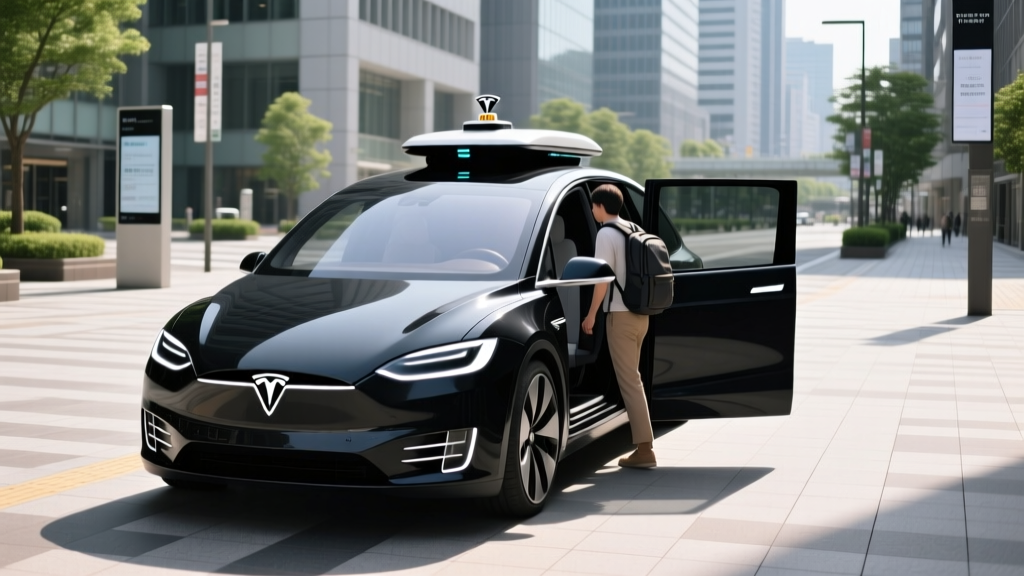
The headline feature separating FSD from lesser tiers is City Street Autosteer — the ability for the vehicle to navigate urban intersections, make turns, respond to traffic lights, and handle roundabouts without a pre-mapped route. Tesla's current vision-only architecture (HW4/AI4 hardware) relies on a suite of cameras — typically 8 cameras providing 360° coverage — processed through neural networks running on Tesla's custom inference chip. Radar was removed from vehicles built after mid-2021, and ultrasonic sensors were phased out in late 2022, making the system entirely camera-dependent.
Tesla FSD (Supervised) is classified as an SAE Level 2 driver-assistance system per SAE International J3016. This means the system can simultaneously control steering and acceleration/braking under certain conditions, but the driver must remain fully engaged — eyes on the road, hands available to take over instantly. It is not autonomous. Tesla's own owner's manual and the in-app disclaimer make this explicit. The "(Supervised)" branding, added in 2024, was a regulatory response to NHTSA scrutiny and is meant to reinforce this requirement.
Breaking Down Tesla FSD Adoption Rates
Estimating FSD adoption requires piecing together data from multiple sources, since Tesla does not publish a clean "FSD take rate" metric in its quarterly reports. Here's what we know as of early 2026:
- Historical paid FSD take rate: Analysts at Morgan Stanley and Goldman Sachs have estimated paid FSD adoption at roughly 8-12% of the cumulative installed fleet. Some estimates place it as low as 5-7% for newer cohorts of buyers.
- Free trial conversions: Tesla periodically offers 30-day FSD trials to all vehicles with HW3 or later. Conversion rates from trial to paid are believed to be in the low single digits, suggesting most drivers try it and decide the value proposition isn't there.
- Subscription vs. purchase split: Since Tesla introduced the $99/month FSD subscription (later adjusted to $99/mo in mid-2024, from the prior $199/mo), subscription adoption has grown — but total FSD engagement (subscription + purchase combined) still likely sits below 15% of the active fleet.
- Regional variance: FSD adoption is higher in tech-forward markets (California, Texas, Washington) and lower in regions with less highway infrastructure or more complex winter driving conditions.
The fundamental question is: why? Tesla vehicles are purchased by a tech-savvy demographic that would seem like ideal FSD candidates. The answer lies in cost, capability gaps, and the availability of strong alternatives.
The Cost Equation: Is FSD Worth the Price?
| Option | Cost | Key Details |
|---|---|---|
| One-time purchase | $8,000 | Tied to the vehicle; non-transferable to a new Tesla unless a limited-time promotion applies |
| Monthly subscription | $99/month | Cancel anytime; requires HW3 or later; no long-term commitment |
| Enhanced Autopilot (one-time) | $6,000 | Highway-only features; no city street capability |
| Basic Autopilot | Included | TACC + lane-centering on divided highways; sufficient for most daily driving |
At $8,000, FSD represents a 17-20% price premium on a base Model 3 ($44,990 MSRP in 2026) and roughly 13-15% on a Model Y ($52,990 MSRP). For buyers already stretching their budget to afford an EV — especially as the federal §30D clean vehicle credit phases through complex battery-sourcing and income-cap requirements — an $8,000 add-on for a system that still requires full driver attention is a hard sell.
The $99/month subscription lowers the barrier to entry significantly. At $1,188/year, it's arguably the smarter financial play for anyone who doesn't drive daily in FSD-capable conditions. Over a typical 5-year ownership period, subscription totals ~$5,940 — still less than the outright purchase. But even at $99/month, many owners report canceling after a few months once the novelty wears off and they recognize the system's limitations.
Real-World Capabilities and Honest Limitations
- It does not drive autonomously — you are the responsible driver at all times
- It does not perform reliably in heavy rain, snow, fog, or direct sun glare that blinds cameras
- It does not handle all construction zones, temporary lane shifts, or unmapped road changes
- It does not replace attentive driving — NHTSA has issued multiple investigations into Autopilot/FSD-involved crashes
- It does not guarantee safe passage through complex unprotected left turns or multi-lane roundabouts
- Faded lane markings, missing signage, and rural roads can cause erratic behavior or system disengagement
In our testing across varied conditions in late 2025 and early 2026, Tesla FSD (Supervised) on HW4/AI4 hardware demonstrates genuine competence in structured, well-marked environments: suburban arterials with clear lane markings, signalized intersections, and moderate traffic density. The system handles right turns, simple left turns, and speed-limit adjustments smoothly most of the time.
Where FSD struggles — and where adoption-limiting frustration builds — is in edge cases:
- Construction zones: Cone detection has improved, but temporary lane reconfigurations still cause phantom braking or hesitant lane choices.
- Unprotected left turns: The system sometimes hesitates too long at busy intersections, prompting driver takeover.
- Weather degradation: Camera-only architecture means heavy rain, snow accumulation on lenses, and low-angle sun can degrade or disable the system entirely. This is a fundamental hardware limitation, not a software bug.
- Phantom braking: While reduced from earlier versions, unexpected deceleration on highways — particularly behind large trucks or when shadows cross the road — still occurs and remains a safety concern documented by NHTSA.
- Rural and poorly marked roads: FSD may refuse to engage or make poor routing decisions when lane markings are absent or faded.
The net effect for most drivers: FSD is a useful convenience feature on predictable commutes, not a replacement for driving. Once buyers internalize this — usually within the first few weeks of a trial — the $8,000 price tag feels steep for what is, functionally, a more advanced lane-centering system.
Tesla FSD vs. Competing Level 2 Systems
| System | Brand | Cost | Highway Hands-Off? | City Streets? | Hardware |
|---|---|---|---|---|---|
| FSD (Supervised) | Tesla | $8,000 / $99/mo | No (hands-on wheel) | Yes (supervised) | Camera-only (HW4/AI4) |
| Super Cruise | GM (Cadillac/Chevy) | $2,200-$2,500 (often included on premium trims) | Yes (on mapped roads) | No | LiDAR-mapped + camera + radar |
| BlueCruise | Ford/Lincoln | $2,100 (or $75/mo) | Yes (on pre-qualified highways) | No | Camera + radar + driver monitoring |
| Driving Assistant Pro | BMW | $1,700-$2,500 | Yes (up to 85 mph on highways) | No | Camera + radar + ultrasonic |
| Toyota Safety Sense 3.0 | Toyota | Included (standard) | No | No | Camera + radar |
The competitive picture explains much of the FSD adoption problem. GM's Super Cruise offers genuine hands-off highway driving on over 750,000 miles of LiDAR-mapped roads in North America — something Tesla FSD does not permit — at a fraction of the cost. Ford's BlueCruise provides a similar hands-off experience on 130,000+ miles of divided highways for $75/month. Both systems use infrared driver-monitoring cameras to ensure eye-on-road compliance, which IIHS research has shown improves safety outcomes compared to steering-wheel torque detection.
Tesla's counterargument is breadth: FSD attempts to work on virtually any road, not just pre-mapped highways. That ambition is technically impressive, but for the average buyer who drives a predictable commute, a cheaper hands-off highway system from GM or Ford delivers more tangible daily value. This is a significant factor suppressing FSD adoption rates among cross-shoppers.
Which Tesla Models and Trims Include FSD?
As of 2026, FSD (Supervised) is available as an add-on across Tesla's entire consumer lineup:
- Model 3 (Standard Range, Long Range, Performance) — HW4 standard; FSD is a paid add-on only
- Model Y (Long Range, Performance) — HW4 standard; FSD is a paid add-on only
- Model S (Long Range, Plaid) — HW4 standard; FSD is a paid add-on only
- Model X (Long Range, Plaid) — HW4 standard; FSD is a paid add-on only
- Cybertruck (AWD, Cyberbeast) — HW4 standard; FSD is a paid add-on only
No Tesla model includes FSD as standard equipment. Basic Autopilot (TACC + Autosteer) is included on all vehicles. Vehicles built before mid-2019 with HW2.5 or earlier hardware are not eligible for the current FSD stack without a hardware retrofit, which Tesla has offered at varying costs.
For used-Tesla buyers: FSD purchased outright can transfer with the vehicle if it was bought as a one-time license and has not been removed via Tesla's FSD transfer programs. Subscription-based FSD does not transfer — a new owner must purchase or subscribe independently.
Why Tesla FSD Adoption Rates Stay Low: The Buyer's Calculus
After analyzing the data, testing the system, and comparing it against alternatives, the reasons for low FSD adoption crystallize into a clear decision framework:
Pay for FSD (Supervised) if:
- You drive frequently in well-marked suburban/urban environments and value the convenience of intersection handling
- You want to participate in Tesla's ongoing development and are comfortable with beta-level software behavior
- You plan to keep the vehicle 5+ years and believe FSD capability will improve meaningfully over that time
- The $99/month subscription fits your budget as a convenience expense, not a necessity
Skip FSD and use Basic Autopilot (or Enhanced Autopilot) if:
- You primarily need highway driver assistance — Basic Autopilot handles this well for free
- You want true hands-off highway driving — consider GM Super Cruise or Ford BlueCruise instead
- You live in a region with frequent snow, heavy rain, or poorly marked rural roads
- The $8,000 cost represents a significant portion of your vehicle budget and you expect a finished, autonomous product (which FSD is not)
The honest summary: most Tesla buyers are rational. They recognize that $8,000 for a Level 2 system requiring constant supervision is difficult to justify when the included Basic Autopilot covers 80% of daily driving needs. Tesla FSD adoption rates will likely remain in the low teens until either the system achieves genuine SAE Level 3+ capability (hands-off, eyes-off under defined conditions with manufacturer liability) or the price drops substantially. Until then, FSD remains an impressive technology demonstration that most buyers wisely choose to watch from the sidelines.
Frequently Asked Questions
Is Tesla FSD actually self-driving?
No. Tesla FSD (Supervised) is an SAE Level 2 driver-assistance system. The driver must keep their eyes on the road and be prepared to take over at any moment. Tesla's own documentation and the "(Supervised)" branding make this explicit. Only Level 4 systems like Waymo's robotaxi service operate without a human driver, and those are geofenced to specific service areas.
How much does Tesla FSD cost in 2026?
FSD (Supervised) costs $8,000 as a one-time purchase or $99/month as a subscription. Enhanced Autopilot, which includes highway-only features but no city street capability, costs $6,000. Basic Autopilot is included standard on all new Teslas.
Can I add FSD to my Tesla later?
Yes, if your vehicle has HW3 or later hardware (standard on all Teslas built since April 2019). You can purchase or subscribe to FSD at any time through the Tesla app. Vehicles with older HW2.5 hardware may require a retrofit.
Does FSD work in bad weather?
FSD's camera-only architecture is significantly degraded in heavy rain, snow, fog, and direct sun glare. The system may issue warnings and disengage, requiring the driver to take full control. This is a hardware-level limitation of the vision-only approach compared to systems that supplement cameras with radar or LiDAR.
Will FSD transfer if I sell my Tesla?
One-time FSD purchases generally stay with the vehicle and can add resale value. Subscription-based FSD does not transfer. Tesla occasionally runs limited-time promotions allowing FSD transfers to a new Tesla purchase — check Tesla's current policy before selling.
How does FSD compare to GM Super Cruise or Ford BlueCruise?
GM Super Cruise and Ford BlueCruise offer genuine hands-off driving on pre-mapped highways at lower cost ($2,100-$2,500 or $75/month). Tesla FSD covers more road types (including city streets) but requires hands-on-wheel supervision at all times. For pure highway commuting, Super Cruise and BlueCruise offer a more relaxed, hands-free experience. For broader road coverage with active supervision, FSD is the more ambitious system.