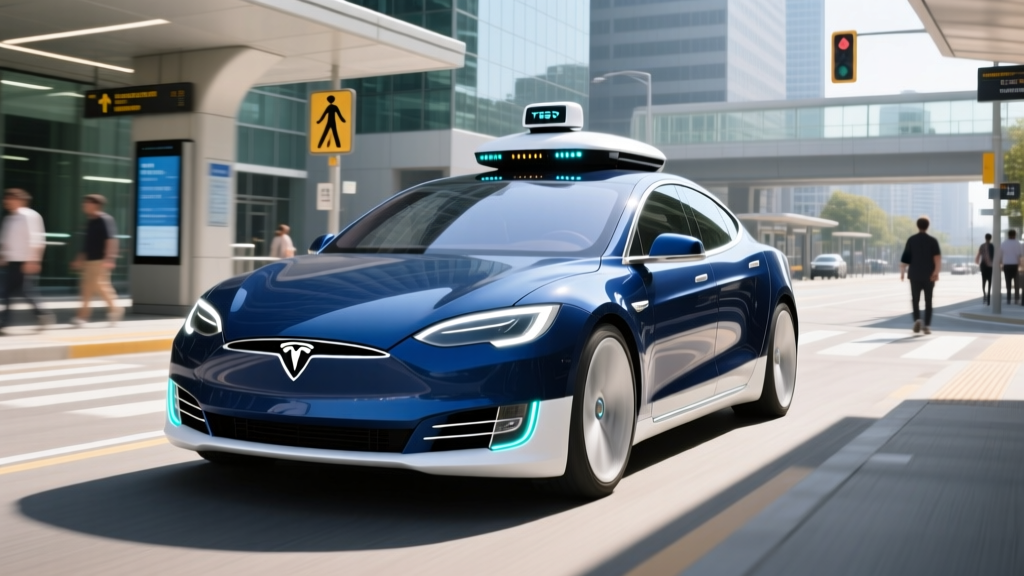
Tesla's Full Self-Driving software has reached version 15 in early 2026, marking the most significant architectural overhaul since Tesla pivoted to an end-to-end neural network approach with FSD v12. But despite the "Full Self-Driving" branding, FSD 15 remains a Level 2 driver-assistance system that requires continuous driver supervision. Here's what the latest version actually does, what it costs, and where it still falls short on real-world roads.
Tesla FSD 15 is classified as SAE Level 2 (partial driving automation). The system can manage steering, acceleration, and braking under certain conditions, but the driver must remain fully engaged, monitor the environment at all times, and be prepared to take over instantly. This is not autonomous driving. Level 4 robotaxi services like Waymo operate without any human driver — FSD 15 does not meet that threshold. Tesla's own marketing materials and the NHTSA's automation framework both confirm this classification.
What FSD 15 Actually Does
FSD 15 (officially "Full Self-Driving Supervised") is Tesla's premium driver-assistance package that extends beyond the base Autopilot system included with every new Tesla. Here's a breakdown of what each tier delivers on 2026-model Teslas:
| Feature | Basic Autopilot | Enhanced Autopilot | FSD 15 (Supervised) |
|---|---|---|---|
| Traffic-Aware Cruise Control | ✅ | ✅ | ✅ |
| Autosteer (lane centering, highways) | ✅ | ✅ | ✅ |
| Auto Lane Change | ❌ | ✅ | ✅ |
| Navigate on Autopilot (on/off-ramps) | ❌ | ✅ | ✅ |
| Autopark | ❌ | ✅ | ✅ |
| Smart Summon | ❌ | ✅ | ✅ |
| City Street Autosteer | ❌ | ❌ | ✅ |
| Traffic Light & Stop Sign Control | ❌ | ❌ | ✅ |
| Turn-by-turn urban navigation | ❌ | ❌ | ✅ |
The headline capability of FSD 15 is City Street Autosteer: the system can navigate surface streets, make turns at intersections, respond to traffic signals, handle roundabouts, and execute lane changes without highway-style lane markings as guides. Version 15 continues Tesla's end-to-end neural network architecture introduced with v12, where a single AI model processes camera inputs and directly outputs driving controls rather than relying on hand-coded rules and heuristics.
How FSD 15 Works: Hardware and Sensors
Tesla's approach to driver assistance is distinct from competitors in one fundamental way: it uses cameras only. There is no lidar, and Tesla removed ultrasonic sensors (USS) and radar from its vehicles starting with 2022–2023 production (a strategy Tesla calls "Tesla Vision").
On 2026-model Teslas equipped with Hardware 4 (HW4), the sensor suite includes:
- 8 cameras providing 360-degree visibility (forward-facing main + narrow, left/right repeaters, left/right pillar, rear-view)
- 12 ultrasonic sensor replacements handled via vision-based occupancy network (no physical USS on newer builds)
- HW4 compute platform with dual AI inference chips, significantly more processing power than HW3
The FSD 15 neural network processes these camera feeds in real time, building a 3D understanding of the environment — vehicles, pedestrians, lane markings, curbs, traffic signals, and road geometry. Tesla's occupancy network identifies objects even when they don't match a known class (e.g., road debris, construction barriers).
This camera-only approach is a philosophical divergence from competitors. GM's Super Cruise and Ford's BlueCruise both supplement cameras with radar and high-definition maps, while Waymo's Level 4 robotaxis rely on lidar, radar, and cameras in combination. Tesla's bet is that a sufficiently advanced vision system, trained on billions of miles of fleet data, can match or exceed sensor-fusion approaches — a claim that remains actively debated in the engineering community.
FSD 15 Pricing: Purchase vs. Subscription
Tesla offers FSD through two pathways in 2026, and the economics differ substantially depending on your ownership horizon:
| Option | Cost | Transferable? | Best For |
|---|---|---|---|
| FSD Purchase (one-time) | $8,000 | No (tied to vehicle) | Long-term owners (4+ years), potential resale value |
| FSD Subscription (monthly) | $99/month | N/A (cancel anytime) | Lease holders, uncertain owners, try-before-commit |
| Enhanced Autopilot | $6,000 one-time | No | Highway-focused drivers who don't need city streets |
Break-even analysis: At $99/month, the subscription matches the $8,000 purchase price after approximately 81 months (6.75 years). If you plan to keep your Tesla less than 5 years, the subscription is the mathematically sound choice. Tesla occasionally offers FSD purchase promotions — in late 2025, a limited-time $6,000 purchase price was offered, which shifted the break-even to ~61 months.
Important note: FSD is not included in the base price of any Tesla model. Base Autopilot (traffic-aware cruise + lane centering on highways) is standard at no extra cost. You must actively purchase or subscribe to FSD to unlock city-street capabilities.
Which Tesla Models Support FSD 15?
FSD 15 is available across Tesla's entire 2026 lineup, though hardware generation affects performance:
- Model 3 (2024+ refresh, HW4): Full FSD 15 capability. Base MSRP from $38,990.
- Model Y (2025+ refresh, HW4): Full FSD 15 capability. Base MSRP from $44,990.
- Model S (2023+, HW4): Full FSD 15 capability. Base MSRP from $74,990.
- Model X (2023+, HW4): Full FSD 15 capability. Base MSRP from $79,990.
- Cybertruck (all builds, HW4): Full FSD 15 capability. Base MSRP from $60,990.
- Older HW3 vehicles: Tesla has stated that HW3 vehicles will continue to receive FSD updates, but HW4's superior compute enables faster inference and potentially smoother behavior. Some complex scenarios may perform better on HW4.
FSD 15 can be transferred between Tesla vehicles in some cases — Tesla has periodically offered FSD transfer promotions, most recently allowing a one-time transfer to a new Tesla purchase through March 2026. Check Tesla's current policy before assuming transferability.
Real-World Capabilities and Limitations
- Drive autonomously — you must pay attention at all times
- Handle all weather conditions — heavy rain, snow, fog, and direct sun glare can degrade camera performance
- Replace driver judgment at complex construction zones or unmapped detours
- Guarantee compliance with all local traffic laws — the driver is legally responsible
- Operate without a licensed, attentive driver in the driver's seat
In real-world use across thousands of miles of testing in diverse environments, FSD 15 shows measurable improvement over prior versions but retains clear edge-case weaknesses:
Where FSD 15 Performs Well
- Suburban surface streets with clear lane markings and moderate traffic — the system handles turns, stop signs, and signal-controlled intersections with growing confidence
- Highway driving remains its strongest domain — lane changes, merges, and exit navigation are smooth and predictable
- Roundabouts — a historical weak point — show significant improvement in v15, with better yield logic and smoother entry/exit trajectories
- Speed adaptation to posted limits and traffic flow is more natural, with fewer abrupt braking events than v13
Where FSD 15 Still Struggles
- Unprotected left turns across multi-lane traffic remain the system's most common intervention trigger — drivers should be especially ready to take over here
- Construction zones with temporary lane shifts, cones, and flaggers require human judgment the system cannot yet reliably replicate
- Low-visibility conditions: Heavy rain on the camera lenses, snow accumulation, or intense sun glare directly into forward cameras can cause the system to issue a "take over immediately" warning or disengage entirely
- Unusual road geometries: Five-way intersections, offset lanes, and poorly marked rural roads can produce uncertain or overly cautious behavior
- Phantom braking: While reduced compared to earlier versions, FSD 15 can still brake unexpectedly when misidentifying shadows, overpasses, or roadside objects as obstacles
Tesla's cabin camera monitors driver attention and will issue escalating warnings (visual, audible, then progressive Autosteer lockouts) if it detects you're not looking at the road. This is a regulatory requirement and a safety necessity — IIHS research consistently shows that over-reliance on Level 2 systems leads to dangerous attention lapses.
FSD 15 vs. Competing Level 2 Systems
Tesla's FSD isn't the only advanced Level 2 system on the market. Here's how it stacks up against the major alternatives available in 2026:
| Attribute | Tesla FSD 15 | GM Super Cruise | Ford BlueCruise 1.4 | Mercedes Drive Pilot |
|---|---|---|---|---|
| SAE Level | Level 2 | Level 2 | Level 2 | Level 3 (limited) |
| City Streets | ✅ | ❌ (mapped highways only) | ❌ (mapped highways only) | ❌ (mapped highways, ≤40 mph) |
| Hands-Off Allowed | No (hands-on wheel or attention monitoring) | Yes (on mapped roads, eyes monitored) | Yes (on mapped roads, eyes monitored) | Yes (eyes off permitted under conditions) |
| Sensor Suite | Cameras only | Cameras + radar + lidar + HD maps | Cameras + radar + HD maps | Cameras + radar + lidar + HD maps |
| Cost | $8,000 or $99/mo | $2,200 + $25/mo after 3 yrs | $2,100 (2-yr) or $75/mo | $2,500/yr subscription |
| Road Coverage | All roads (variable quality) | ~750,000 mi mapped | ~130,000 mi mapped | Limited mapped highways |
The key trade-off: Tesla FSD 15 works on virtually any road but requires constant hands-on or attention-monitored supervision. Super Cruise and BlueCruise only work on pre-mapped divided highways, but on those roads they allow true hands-off driving with eye monitoring — a more relaxed experience within their operational domain. Mercedes Drive Pilot is the only system with Level 3 certification (in Nevada and California), meaning the car assumes legal liability under its narrow operating conditions — but it only works under 40 mph on specific mapped highway segments in good weather.
Safety Data and Regulatory Context
Tesla publishes quarterly safety reports claiming that vehicles with Autopilot engaged record fewer crashes per million miles than the US average. However, these statistics are not directly comparable — Tesla's Autopilot is used predominantly on controlled-access highways (the safest road type), while the national average includes all road types, weather conditions, and driver demographics.
The NHTSA has opened multiple investigations into Tesla's Autopilot and FSD systems, particularly regarding crashes involving stationary emergency vehicles and the adequacy of Tesla's driver-monitoring system. As of early 2026, Tesla uses cabin-camera-based attention monitoring (eye tracking) rather than steering-wheel torque detection alone, which is an improvement — but IIHS has noted that camera-based systems can still be fooled by sunglasses, phone positioning, or deliberate circumvention.
The bottom line for buyers: FSD 15 is a sophisticated driver-assistance tool, not a chauffeur. It can reduce fatigue on long drives and handle tedious stop-and-go traffic, but the legal and safety responsibility remains 100% with you.
Frequently Asked Questions
Is Tesla FSD 15 truly self-driving?
No. FSD 15 is SAE Level 2 — a driver-assistance system that requires an attentive, licensed driver in the seat at all times. The "Full Self-Driving" name is Tesla's branding, not a technical classification. True self-driving (Level 4) is currently only available through robotaxi services like Waymo in limited metro areas.
Can I use FSD 15 on any road?
Technically yes — unlike Super Cruise or BlueCruise which are geofenced to mapped highways, FSD 15 will activate on city streets, rural roads, and highways. However, performance quality varies dramatically. Well-marked suburban arterials and highways produce the best results; unmapped rural roads, complex construction zones, and poorly marked intersections are where driver intervention is most likely.
Does FSD 15 work in rain and snow?
Light rain is generally handled well. Heavy rain, snow, and fog can obscure camera lenses and cause the system to disengage or issue a takeover request. Unlike systems with radar and lidar (which penetrate precipitation better), Tesla's camera-only approach is inherently more weather-sensitive. Keep your camera lenses clean — a dirty front camera can degrade performance even in clear conditions.
Is FSD worth $8,000 or should I subscribe?
If you'll own your Tesla for less than 5 years, the $99/month subscription is the financially rational choice. For long-term owners, the one-time purchase may add some resale value (though FSD transferability is not guaranteed and has historically been limited). Consider subscribing first for 2–3 months to evaluate whether you'll use it regularly before committing to the purchase.
Will FSD 15 get better over time?
Yes — Tesla regularly pushes over-the-air updates that refine FSD behavior. Version 15 is itself an OTA update. However, "better" is subjective and non-linear: some updates improve specific scenarios while temporarily regressing others. There is also no guaranteed timeline for when (or if) FSD will reach a true Level 3 or Level 4 capability, despite years of Tesla predictions to that effect.
Does FSD affect my insurance rates?
It depends on your insurer and state. Tesla offers its own insurance product in many states that uses real-time driving data (including FSD usage) to set premiums, often at competitive rates. Traditional insurers vary — some offer discounts for ADAS-equipped vehicles, while others charge higher premiums reflecting the elevated repair costs of sensor-equipped Teslas. Get quotes before purchasing.