Tesla's Full Self-Driving software — officially branded FSD (Supervised) — has been on a rolling update cycle that keeps owners and prospective buyers asking the same question: when is the next major version arriving, and what will it actually change? As of early 2026, Tesla is shipping the FSD v13.x branch to its fleet, and speculation around FSD v14 has intensified across forums, earnings calls, and Elon Musk's social media posts. Here's what we know, what's confirmed, and what remains aspirational.
What Is Tesla FSD (Supervised) and How Does It Work?
Full Self-Driving (Supervised) is Tesla's most advanced driver-assistance package, layered on top of the standard Autopilot system that ships with every new Tesla. FSD adds capabilities like automated lane changes, navigation-guided on-ramp-to-off-ramp highway driving, traffic-light and stop-sign recognition, and city-street turning — all under continuous driver supervision.
Technically, Tesla's approach is vision-only. Since 2022, Tesla has removed radar and ultrasonic sensors from its vehicles, relying entirely on a suite of external cameras (typically eight) paired with the in-cabin driver-monitoring camera and the HW4 (or newer) onboard computer. Neural networks process the camera feeds in real time to detect lanes, vehicles, pedestrians, signage, and road geometry, then plan a driving path accordingly.
SAE Automation Level: Level 2
Despite the "Full Self-Driving" name, Tesla FSD (Supervised) is classified as SAE Level 2 — the same category as GM Super Cruise, Ford BlueCruise, and Hyundai Highway Driving Assist. The driver must remain attentive, keep hands available, and be prepared to take over instantly. Tesla's in-cabin camera monitors eye gaze and issues escalating warnings if attention lapses. Only Level 4 services like Waymo operate without a human driver in the loop.
When Is FSD 14 Coming Out? The Timeline So Far
Tesla does not publish a public version roadmap the way traditional automakers do with model-year feature sheets. Instead, FSD updates roll out in sub-versions (e.g., v13.2.1, v13.2.6) to internal test fleets first, then to employees, then to a wider Early Access group, and finally to the general FSD subscriber base. Major branch jumps (v12 → v13, v13 → v14) typically represent significant neural-network architecture changes.
Based on the cadence Tesla has established:
- FSD v12 launched broadly in early-to-mid 2024, introducing end-to-end neural network driving that replaced most hard-coded C++ rules with learned behavior.
- FSD v13 began rolling out to the fleet in late 2024 and continued iterating through 2025, adding improved intervention rates, better unpaved-road handling, and enhanced parking.
- FSD v14 has been referenced by Musk in social media posts and earnings calls as the next major architectural leap, with hints pointing toward a mid-to-late 2026 release window — though Tesla's timelines are historically optimistic and subject to delay.
As of this writing, Tesla has not confirmed an exact FSD v14 release date. The company typically announces major versions via an over-the-air update notification rather than a press event. Owners enrolled in FSD (Supervised) will receive it automatically once it clears internal validation gates.
What Will FSD v14 Likely Change?
While Tesla has not published a formal changelog for v14, industry analysts and Tesla's own hints suggest several focus areas:
- Reduced intervention rate: Each major version has targeted a measurable drop in miles-between-disengagement. FSD v13 improved this roughly 2–3x over v12 in internal testing; v14 is expected to continue that trajectory.
- Improved edge-case handling: Construction zones, unprotected left turns across multi-lane traffic, and temporary lane closures remain challenging scenarios. V14 is expected to leverage expanded training data from Tesla's growing fleet.
- Enhanced driver-monitoring integration: Tighter coupling between the cabin camera and driving behavior, potentially allowing longer hands-off periods (though still Level 2).
- Robotaxi-readiness groundwork: Musk has repeatedly stated that FSD improvements are stepping stones toward an unsupervised Level 4 robotaxi service. V14 may include architecture designed for that future mode, even if it remains supervised for consumers.
FSD Cost: Purchase vs. Subscription in 2026
Tesla has periodically adjusted FSD pricing. As of 2026, the structure is:
| Option | Price | Notes |
|---|---|---|
| FSD (Supervised) — One-Time Purchase | $8,000 | Transfers to new Tesla if purchased before cutoff; otherwise vehicle-locked |
| FSD (Supervised) — Monthly Subscription | $99/month | Cancel anytime; no long-term commitment |
| Basic Autopilot | Included (standard) | Traffic-Aware Cruise Control + Autosteer on highways |
| Enhanced Autopilot | $6,000 or discontinued in some markets | Auto lane change, Navigate on Autopilot, Summon, Smart Summon, Auto Park |
For most buyers, the $99/month subscription makes more financial sense unless you plan to keep the vehicle 7+ years. The subscription also lets you pause FSD during months you don't drive much.
Which Tesla Models and Trims Include FSD?
FSD (Supervised) is not standard on any Tesla trim. It is an add-on available for purchase or subscription on every current Tesla model:
| Model | Hardware Required | FSD Available | Starting MSRP (2026) |
|---|---|---|---|
| Model 3 (Highland/Refresh) | HW4 | Yes — add-on | ~$38,990 |
| Model Y (Juniper) | HW4 | Yes — add-on | ~$44,990 |
| Model S | HW4 | Yes — add-on | ~$74,990 |
| Model X | HW4 | Yes — add-on | ~$79,990 |
| Cybertruck | HW4 | Yes — add-on | ~$60,990 |
Vehicles built before mid-2022 with HW3 may require a computer upgrade (which Tesla has offered free to FSD purchasers) to run the latest FSD branches. Confirm your hardware version in the vehicle's Software menu before purchasing.
Real-World Capabilities and Limitations
FSD (Supervised) in its v13.x state is genuinely impressive in many scenarios — but it is not infallible. Here's an honest assessment based on thousands of miles of real-world use:
What FSD does well:
- Highway driving with navigation-guided lane changes and off-ramp exits
- Suburban city streets with clear lane markings and moderate traffic
- Stop-sign and red-light compliance at standard intersections
- Speed-limit adaptation based on detected signage and GPS map data
- Smooth acceleration and braking in most conditions
Where FSD still struggles:
- Construction zones with temporary barriers, shifted lanes, or flaggers
- Unprotected left turns across heavy multi-lane traffic
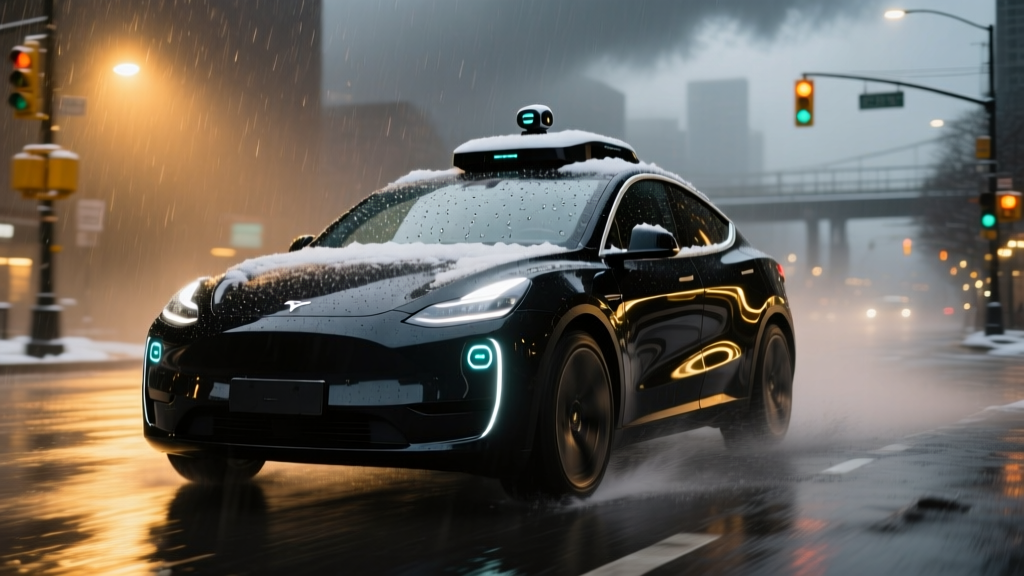
- Heavy rain, fog, or direct sun glare that degrades camera visibility
- Faded or conflicting lane markings in older urban areas
- Unpaved roads or roads without clear edge definition
- Complex multi-lane roundabouts with high traffic volume
⚠️ Critical Limitations — FSD Is NOT Self-Driving
FSD (Supervised) requires your full attention at all times. You are legally and operationally the driver. The system can and will make errors — including phantom braking, misreading a lane merge, or failing to detect a stopped emergency vehicle. NHTSA has investigated multiple Tesla crashes involving Autopilot/FSD, and Tesla's own owner's manual states the driver is responsible for all vehicle actions. Never use FSD while drowsy, distracted, or impaired.
How FSD Compares to Competing Level 2 Systems
| System | Brand | SAE Level | Hands-Free? | Geofenced? | Cost |
|---|---|---|---|---|---|
| FSD (Supervised) | Tesla | Level 2 | No — hands-available, eyes-on | No — works on most roads | $8,000 or $99/mo |
| Super Cruise | GM (Cadillac/Chevy) | Level 2 | Yes — on mapped highways | Yes — ~750,000+ mi of mapped roads | ~$2,500 or included on select trims |
| BlueCruise | Ford/Lincoln | Level 2 | Yes — on mapped highways | Yes — ~130,000+ mi of divided highways | $2,100 or $75/mo |
| Highway Driving Assist 2 | Hyundai/Kia/Genesis | Level 2 | No — hands-on required | No — highway use | Included on higher trims |
| ProPILOT Assist 2.0 | Nissan | Level 2 | Yes — on mapped highways | Yes — limited mapped routes | Included on select trims |
The key differentiator: Tesla's FSD works on virtually any road, including residential streets, while GM Super Cruise and Ford BlueCruise offer true hands-free driving but only on pre-mapped divided highways. If your priority is highway commuting on interstates, Super Cruise and BlueCruise currently provide a more relaxed (and genuinely hands-free) experience. If you want assistance on a wider variety of roads — accepting that you must stay engaged — FSD covers more ground.
Should You Wait for FSD v14 Before Buying or Subscribing?
Decision Framework
Subscribe to FSD now if: You already own a Tesla with HW4, you drive in varied conditions (city + highway), and you want to evaluate whether FSD's current capabilities reduce your driving fatigue on your typical routes. At $99/month, you can cancel anytime if v13.x doesn't meet your needs.
Wait for FSD v14 if: You're considering a new Tesla purchase and FSD is a key factor in your decision, or you've tried v12/v13 and found the intervention rate too high for your comfort. Remember that Tesla's version timelines are aspirational — v14 could arrive mid-2026 or slip into 2027.
Skip FSD entirely if: You primarily drive on well-mapped interstates and can get a GM or Ford with hands-free Super Cruise/BlueCruise for less money. Basic Autopilot (included) handles highway cruising well for most drivers.
Frequently Asked Questions
Is Tesla FSD truly self-driving?
No. Tesla FSD (Supervised) is an SAE Level 2 driver-assistance system. The driver must remain fully attentive and is legally responsible for the vehicle at all times. The "Full Self-Driving" name is a product label, not a technical classification. Only Level 4 systems like Waymo's robotaxi service operate without a human driver.
How much does FSD cost in 2026?
FSD (Supervised) costs $8,000 as a one-time purchase or $99 per month as a subscription. The subscription can be canceled at any time. Basic Autopilot is included standard on every new Tesla.
Will FSD v14 work on older Tesla hardware?
Tesla's latest FSD branches require HW4 (introduced in 2023). Vehicles with HW3 that purchased FSD have been eligible for a free computer upgrade. If your Tesla was built before mid-2022, check your hardware version in Settings → Software before subscribing.
Does FSD work in bad weather?
FSD relies on cameras, so heavy rain, snow, fog, and direct sun glare can degrade performance. Tesla's manual advises drivers to take over in adverse weather conditions. The system will issue warnings and may disengage if camera visibility is compromised.
Can I transfer FSD to a new Tesla?
Tesla has offered limited-time FSD transfer promotions in the past, but the general policy is that FSD is tied to the vehicle on which it was purchased. Subscription-based FSD follows your Tesla account and can be applied to a new Tesla when you take delivery. Always confirm transfer policy with Tesla at the time of purchase, as terms change periodically.
How does FSD's safety record compare to human drivers?
Tesla publishes quarterly safety reports showing miles-per-crash with Autopilot engaged versus the U.S. average. However, these comparisons have been criticized by NHTSA and independent researchers because Tesla's Autopilot is used predominantly on controlled-access highways (a safer driving environment). Direct statistical equivalence is not established. Always treat FSD as an assist, not a replacement for attentive driving.
For the latest official information on Tesla's driver-assistance systems, consult Tesla's Autopilot page and the owner's manual for your specific model year. For safety ratings and crash-test data, reference the Insurance Institute for Highway Safety (IIHS) and NHTSA.