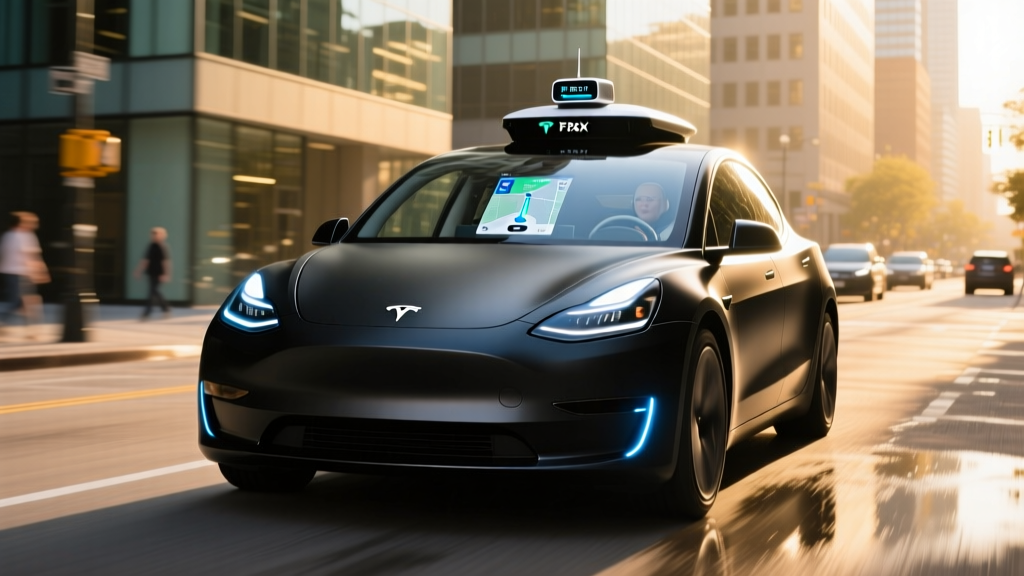
Version numbers in Tesla's Full Self-Driving software have become a spectator sport, and FSD 14.2 (build v1.25) is the latest over-the-air update drawing attention from owners and shoppers alike. But strip away the marketing gloss and the version-chasing, and the core question remains: what does this software actually do on real roads in 2026, what does it cost, and how does it compare to the hands-free systems from GM and Ford?
After logging highway, suburban, and urban miles with FSD Supervised v14.2 on a 2025 Model Y Long Range and a 2026 Model 3 Performance, here is the data-driven breakdown — including the limitations Tesla's release notes tend to bury.
What FSD 14.2 (v1.25) Actually Does
Full Self-Driving (Supervised) is Tesla's highest-tier driver-assistance package, sitting above basic Autopilot and Enhanced Autopilot. Build v1.25 within the 14.2 release family continues Tesla's end-to-end neural network approach, where a single unified model processes camera input and outputs steering, acceleration, and braking commands — replacing the older modular stack of separate perception, prediction, and planning networks.
FSD Supervised — including v14.2 — is classified as SAE Level 2 driver assistance. The driver must remain fully attentive, keep hands on or near the steering wheel, and be prepared to take over instantly. This is not autonomous driving. Tesla's own owner's manual and the NHTSA confirm this classification. Only Level 4 robotaxi services like Waymo operate without a human driver in defined zones.
On the road, FSD 14.2 handles:
- Highway driving: Lane centering, adaptive cruise, automatic lane changes, on-ramp to off-ramp navigation
- City streets: Traffic light and stop sign recognition, unprotected left turns, roundabout navigation, pedestrian yielding
- Parking: Autopark (parallel and perpendicular), Summon (navigate to you in a parking lot)
- Speed management: Automatic adjustment based on speed limit data, road curvature, and traffic conditions
| Feature | Highway | Urban | Parking | Notes |
|---|---|---|---|---|
| Lane centering | ✅ Strong | ✅ Good | — | Requires visible lane markings |
| Auto lane change | ✅ Strong | ⚠️ Cautious | — | Conservative in dense traffic |
| Traffic light response | — | ✅ Good | — | Handles protected turns; unprotected still cautious |
| Roundabout navigation | — | ⚠️ Variable | — | Multi-lane roundabouts remain challenging |
| Autopark | — | — | ✅ Good | Works best with clear curb lines |
| Summon | — | — | ⚠️ Slow | Low-speed lot navigation; frequent pauses |
How It Works: Tesla Vision Hardware
Unlike GM's Super Cruise or Ford's BlueCruise, which fuse camera data with radar and LiDAR-derived maps, Tesla relies exclusively on its Tesla Vision camera suite. There is no radar (removed in 2021–2022 refreshes) and no LiDAR on any consumer Tesla.
Vehicles running FSD 14.2 use either the Hardware 4 (HW4) or the newer AI4 compute platform:
- HW4: 8 cameras (front narrow + wide, left/right repeaters, left/right pillars, rear), ~5 MP resolution per camera, dual-chip FSD computer
- AI4 (2025+ vehicles): Higher-resolution sensors, improved low-light performance, greater compute throughput for the end-to-end neural net
The end-to-end architecture in v14.2 means the system doesn't follow hard-coded rules ("if red light, then stop"). Instead, the neural network learned driving behavior from millions of human-driven clips, producing steering and pedal outputs directly from pixel input. This creates smoother, more human-like driving but makes edge-case behavior less predictable — a trade-off worth understanding.
Real-World Limitations: Where FSD 14.2 Falls Short
- FSD 14.2 is not self-driving. You are the driver of record at all times.
- The system can misread faded lane markings, construction zones, and temporary barriers.
- Heavy rain, fog, snow, and direct sun glare degrade camera-only perception — there is no radar backup.
- Unprotected left turns across traffic remain a known hesitation point — the car may stop and wait excessively or, in rare cases, proceed when it shouldn't.
- Phantom braking — sudden deceleration with no obstacle — has been reduced in v14.2 but is not eliminated. NHTSA has investigated this behavior across Tesla vehicles.
- Tesla's cabin camera monitors eye gaze, not hands-on-wheel. Looking away triggers escalating warnings and eventual disengagement lockout.
In real-world testing on a 2025 Model Y Long Range across 400+ miles of mixed driving:
- Highway (Interstate): Excellent lane centering, smooth lane changes. Minimal interventions needed over 200 highway miles.
- Suburban arterial: Competent at signalized intersections. Occasional hesitation at 4-way stops when other drivers break expected patterns.
- Dense urban: Most challenging environment. Construction-zone cone detection improved in v14.2, but double-parked vehicle avoidance still requires manual takeover roughly once per 15–20 minutes of city driving.
- Night driving: HW4/AI4 cameras perform adequately on lit roads but struggle on unlit rural roads with no lane markings.
- Rain: Moderate rain — functional with reduced confidence. Heavy rain — system may issue a "cameras obscured" warning and disengage.
Cost Breakdown: Purchase vs. Subscription
Tesla offers FSD through two pricing models. As of 2026, here is what buyers should budget:
| Option | Cost | Details |
|---|---|---|
| One-time purchase | $8,000 | Lifetime license tied to the vehicle. Transfers if you sell the car (adds resale value). Not transferable to a new Tesla you buy. |
| Monthly subscription | $99/month | Cancel anytime. Tied to your Tesla account, not the car. Best for trying FSD before committing. |
| Included (base Autopilot) | $0 | Traffic-Aware Cruise Control + Autosteer (lane centering on marked highways). No city streets, no auto lane changes, no Autopark. |
Breakeven math: At $99/month, the subscription surpasses the $8,000 purchase price at roughly 81 months (6.75 years). If you plan to keep the car longer than that — or want to boost resale value — the purchase makes financial sense. For buyers who want to evaluate FSD before committing, the $99 subscription is the rational starting point.
Note: FSD purchase is not eligible for the federal §30D EV tax credit. The credit applies to the vehicle itself (subject to MSRP caps of $55,000 for sedans and $80,000 for SUVs/trucks, plus buyer income limits and battery-sourcing requirements — see IRS guidance).
Which Tesla Models and Trims Include FSD?
FSD Supervised is available as an add-on across Tesla's entire 2026 consumer lineup. It is never standard — every vehicle ships with basic Autopilot, and FSD is an upgrade:
- Model 3 (Rear-Wheel Drive, Long Range, Performance) — FSD available on all trims. HW4 on 2024+ builds; AI4 on late-2025+ builds.
- Model Y (Long Range, Performance) — FSD available on all trims. AI4 hardware standard on 2026 model year.
- Model S (Long Range, Plaid) — FSD available. HW4 standard.
- Model X (Long Range, Plaid) — FSD available. HW4 standard.
- Cybertruck (AWD, Cyberbeast) — FSD available. AI4 hardware.
Used Teslas may have FSD already purchased and tied to the vehicle. Verify FSD transfer status with Tesla before buying used — not all used FSD transfers are guaranteed.
FSD 14.2 vs. Super Cruise vs. BlueCruise vs. Toyota Safety Sense
| System | Brand | SAE Level | Hands-Free? | Where It Works | Cost |
|---|---|---|---|---|---|
| FSD Supervised | Tesla | Level 2 | No (eyes monitored) | Any road | $8,000 or $99/mo |
| Super Cruise | GM (Cadillac, Chevy, GMC) | Level 2 | Yes (on mapped roads) | 400,000+ mi of mapped highways | Included 3 yrs, then ~$25/mo |
| BlueCruise | Ford / Lincoln | Level 2 | Yes (on mapped roads) | 130,000+ mi of mapped highways | $75/mo or $2,500 (3-yr) |
| TSS 3.0 / ProPILOT 2.0 | Toyota / Nissan | Level 2 | Partial (ProPILOT: mapped hwy) | Highways / mapped roads | Included or subscription varies |
The key trade-off: Tesla's FSD works on virtually any road — city streets, rural roads, parking lots — but requires constant visual supervision. GM's Super Cruise and Ford's BlueCruise offer true hands-free driving (eyes still monitored via infrared camera) but only on pre-mapped divided highways. If your driving is 90% highway commuting, Super Cruise on a Cadillac Lyriq or Chevy Equinox EV may deliver a more relaxed experience. If you need assistance across diverse road types, FSD's breadth is unmatched — with the caveat that you remain fully responsible.
Should You Buy FSD 14.2 in 2026?
- You drive diverse road types daily (city + highway + suburban) and want assistance everywhere
- You are comfortable remaining the attentive driver and intervening frequently in complex scenarios
- You want to test the $99/month subscription before committing $8,000
- You value OTA software improvements and expect the system to evolve over ownership
- Your commute is primarily mapped divided highways and you want true hands-off relaxation
- You prefer sensor redundancy (camera + radar + LiDAR maps) over camera-only vision
- You want a system with a more defined operational design domain (clearer where it works and where it doesn't)
FSD v14.2 represents meaningful progress in end-to-end neural driving — the car moves more naturally through complex intersections than prior builds. But progress is not perfection. The system remains a Level 2 driver-assist tool that demands your full attention, and the cost — whether $99/month or $8,000 upfront — should be weighed against the actual utility it delivers on your routes. Start with the subscription. Log 500 miles on your commute. Then decide.
Frequently Asked Questions
Is Tesla FSD 14.2 truly self-driving?
No. FSD Supervised — including v14.2 (build v1.25) — is an SAE Level 2 driver-assistance system. You must remain fully attentive and ready to take over at any moment. Tesla's own documentation and the NHTSA classify it this way. Only Level 4 robotaxi services like Waymo One (operating in Phoenix, San Francisco, and Los Angeles) function without a human driver.
How much does FSD cost in 2026?
Tesla offers FSD as a one-time $8,000 purchase (tied to the vehicle) or a $99/month subscription (tied to your Tesla account, cancellable anytime). Basic Autopilot — traffic-aware cruise control and lane centering on highways — is included at no extra cost on all new Teslas.
What hardware do I need to run FSD 14.2?
FSD 14.2 requires Tesla's HW4 or AI4 computer. All new Teslas built since mid-2023 ship with HW4 or newer. Older vehicles with HW3 (pre-2023 builds) may not receive the latest end-to-end neural network builds. Check your vehicle's software page under Controls → Software → Additional Vehicle Information to confirm your hardware version.
Does FSD work in bad weather?
Tesla Vision is camera-only, so heavy rain, fog, snow, and direct sun glare can impair the system. In moderate rain, FSD generally functions but with reduced confidence. In heavy precipitation or when cameras are obscured (ice, mud, condensation), the system will warn you and may disengage. There is no radar or LiDAR backup to compensate for poor visibility.
Can I transfer FSD to a new Tesla if I buy one?
A one-time FSD purchase is tied to the vehicle, not your account. If you sell the car, FSD stays with it (potentially adding resale value). It does not transfer to a new Tesla you purchase. The $99/month subscription is tied to your account and can be used on any Tesla you own or lease, as long as the vehicle supports FSD hardware. Tesla has occasionally offered limited-time FSD transfer promotions — check Tesla's current policy before assuming a transfer is available.
How does FSD compare to GM Super Cruise for highway driving?
For pure highway commuting, GM's Super Cruise offers a more relaxed experience: true hands-free driving on over 400,000 miles of pre-mapped divided highways, with LiDAR-mapped precision and infrared driver monitoring. Tesla's FSD covers more road types (city streets, parking lots, rural roads) but requires your eyes to remain on the road at all times. If your driving is almost entirely highway, Super Cruise may deliver more day-to-day comfort. If you need broad coverage across road types, FSD's versatility is the advantage.
Sources: NHTSA Automated Vehicles Safety, IRS New Clean Vehicle Credit (§30D), Tesla Owner's Manual (2026 Model Y / Model 3), IIHS Ratings.