What Tesla FSD 14.2.2 Actually Does
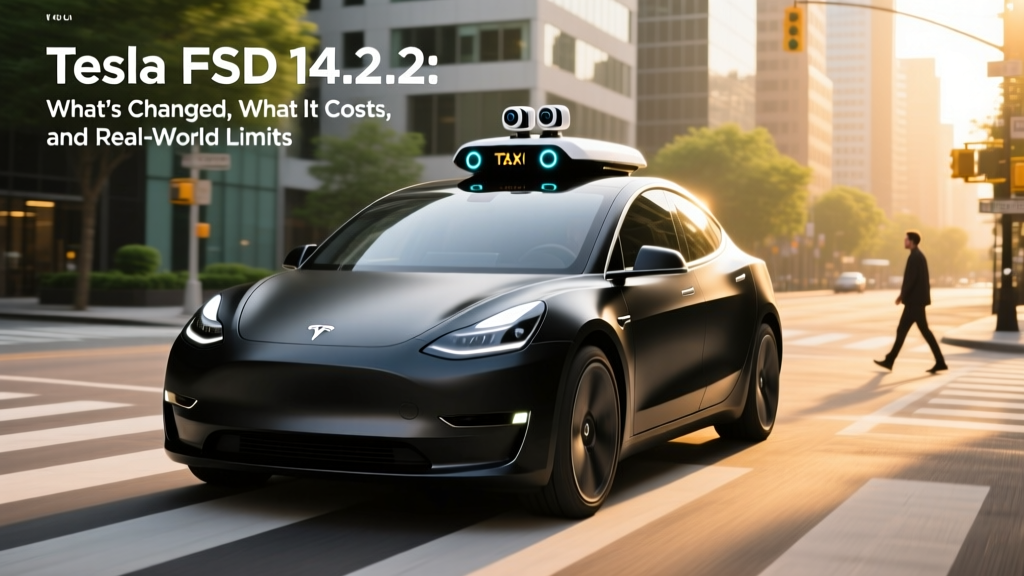
Tesla's Full Self-Driving (Supervised) software, version 14.2.2, represents the latest iterative update to Tesla's vision-only driver-assistance stack. Despite the "Full Self-Driving" name, FSD remains a Level 2 advanced driver-assistance system (ADAS) under the SAE J3016 framework — meaning the driver must remain fully attentive, keep hands available to take over, and is legally responsible for the vehicle at all times.
FSD (Supervised) builds on Tesla's base Autopilot by adding capabilities beyond highway lane-keeping. On compatible Tesla vehicles running the 14.2.2 firmware, the system can:
- Navigate on-ramps to off-ramps on divided highways, including automatic lane changes and speed adjustments for merging traffic
- Execute turns at intersections guided by navigation (city street routing)
- Recognize and respond to traffic lights and stop signs
- Perform lane changes on surface streets when prompted or when the system determines it is necessary for the navigation route
- Execute Smart Summon (in supported environments) to bring the vehicle to the driver in parking lots at low speed
Under the hood, FSD 14.2.2 relies entirely on Tesla's camera-only "Tesla Vision" hardware suite — eight cameras providing 360-degree coverage around the vehicle (front-facing main and wide-angle, repeaters on front fenders, rear-view). Tesla removed ultrasonic sensors and radar from vehicles produced after late 2022, meaning all distance estimation, object detection, and lane identification is performed by neural networks processing camera imagery in real time on the HW4 (AI4) computer.
Tesla FSD (Supervised), including version 14.2.2, is classified as SAE Level 2 automation. This means the system can control steering and acceleration simultaneously, but the human driver must continuously supervise, remain ready to intervene instantly, and bears full legal responsibility. Only Level 4 systems like Waymo's driverless ride-hail service operate without a human driver in defined zones. No consumer vehicle sold in the US is Level 3 or above for general use.
FSD 14.2.2: What Changed From Prior Versions
Version 14.2.2 is part of Tesla's ongoing end-to-end neural network architecture that was introduced with the FSD v12 branch and refined through the v13 and v14 series. Rather than relying on hard-coded rules (e.g., "stop 10 feet before a stop line"), the system processes camera inputs through a single integrated neural network that maps pixels directly to driving actions — steering angle, acceleration, braking.
Key refinements in the 14.2.x branch include:
- Smoother intersection handling: Reduced hesitation at unprotected left turns and improved gap-selection in moderate traffic
- Better construction-zone navigation: Improved cone and barrier recognition with more natural path-planning through temporary lane shifts
- Refined speed profiles: More human-like speed modulation on residential streets and curves, reducing the abrupt braking events common in earlier builds
- Enhanced Smart Summon: More reliable low-speed parking-lot navigation with better pedestrian prediction
These are incremental improvements, not step-change breakthroughs. Drivers upgrading from v13.x will notice refinement rather than entirely new capabilities.
Real-World Capabilities and Limitations
Testing FSD 14.2.2 across varied conditions reveals a system that is genuinely useful on well-marked highways and simple suburban routes, but still demands active supervision — particularly in edge cases that a human driver handles intuitively.
- Heavy rain, fog, or snow: Camera-only vision degrades significantly when lenses are obscured; the system will issue a takeover request and may disable itself
- Faded or missing lane markings: Rural roads, construction zones without clear temporary markings, and unmapped roads cause erratic path-planning
- Complex multi-lane roundabouts: The system often hesitates or selects incorrect exit lanes
- Emergency vehicles: While Tesla has improved detection of parked emergency vehicles with flashing lights, the system does not reliably perform legal "move over" maneuvers
- Unprotected left turns in heavy traffic: Gap judgment has improved but still requires the driver to be prepared to take over immediately
- Railroad crossings and speed bumps at speed: The system may not slow adequately for grade crossings or large speed humps
In real-world use on a 40-mile mixed commute (suburban surface streets and a limited-access highway), FSD 14.2.2 handled approximately 85–90% of the route without requiring intervention on a clear day. The remaining 10–15% of interventions typically occurred at complex intersections, during lane merges where the system hesitated, or when a pedestrian near the curb caused overly conservative braking.
Cold-weather performance deserves specific mention: because Tesla Vision relies on cameras, any frost, road-salt spray, or condensation on the lens surfaces will trigger system degradation or disengagement. Owners in northern climates should expect reduced FSD availability during winter months compared to systems that supplement cameras with radar.
Cost: Purchase, Subscription, and What's Included
Tesla offers FSD (Supervised) through two pricing models, and the base Autopilot system is included on all new Tesla vehicles at no additional charge. Here is the breakdown as of early 2026:
| Feature Tier | Cost | What's Included |
|---|---|---|
| Basic Autopilot | Included (all vehicles) | Traffic-Aware Cruise Control, Autosteer (lane-centering on highways) |
| Enhanced Autopilot (EAP) | $6,000 one-time | Navigate on Autopilot (highway), Auto Lane Change, Autopark, Summon |
| FSD (Supervised) — Purchase | $8,000 one-time | All EAP features + Traffic Light & Stop Sign Control, city street autosteer, Smart Summon |
| FSD (Supervised) — Subscription | $99/month | Same features as one-time purchase; cancel anytime |
The subscription option makes financial sense for most buyers. At $99/month ($1,188/year), it takes roughly 6.7 years of continuous subscription to equal the $8,000 one-time cost — and the subscription can be paused or cancelled if you sell the vehicle or simply don't use the feature frequently. The one-time purchase is only transferable if Tesla explicitly allows it during a trade-in promotion; it generally does not increase resale value dollar-for-dollar.
Note: FSD is not eligible for the §30D federal EV tax credit. The credit applies to the vehicle's base MSRP and qualifying battery components, not to software add-ons or subscriptions. See IRS guidance on clean vehicle credits for current eligibility rules.
Which Tesla Models and Trims Support FSD 14.2.2
FSD (Supervised) is available across Tesla's current US lineup, but hardware compatibility matters. Vehicles must be equipped with the HW4 (also called AI4) computer to run the latest FSD builds. All vehicles currently in production ship with HW4, but older vehicles with HW3 require a hardware retrofit (offered by Tesla for a fee) to access newer software branches.
| Model | HW4 Standard | FSD Available | Notes |
|---|---|---|---|
| Model 3 (Highland / 2024+) | ✓ | ✓ | All trims |
| Model Y (Juniper / 2025+) | ✓ | ✓ | All trims |
| Model S (2023+ refresh) | ✓ | ✓ | All trims |
| Model X (2023+ refresh) | ✓ | ✓ | All trims |
| Cybertruck | ✓ | ✓ | All trims; FSD rollout slightly delayed vs sedan/SUV fleet |
If you own a 2019–2022 Tesla with HW3, check your vehicle's software screen (Controls → Software) for the hardware designation. Tesla has periodically offered HW4 retrofit programs; contact your local service center for current availability and pricing.
How FSD 14.2.2 Compares to Competing ADAS Systems
Tesla's FSD is not the only advanced driver-assist system on the market. Several competitors offer comparable or, in specific scenarios, superior experiences — particularly on highways. Here is how the major systems stack up:
| System | Brand | SAE Level | Key Strength | Key Limitation |
|---|---|---|---|---|
| FSD (Supervised) | Tesla | Level 2 | Broadest surface-street coverage; no geofencing | Camera-only; degrades in bad weather |
| Super Cruise | GM (Cadillac, Chevy, GMC) | Level 2 | LiDAR-mapped highways; allows hands-off with eye monitoring | Limited to ~750,000 miles of pre-mapped roads; no city streets |
| BlueCruise | Ford / Lincoln | Level 2 | Hands-free on 130,000+ miles of divided highway | No surface-street autonomy; geofenced |
| ProPILOT Assist 2.0 | Nissan | Level 2 | Hands-off highway with navigation-linked lane changes | Limited to highways; no city routing |
| Toyota Safety Sense (TSS 3.0) | Toyota | Level 2 | Included standard on most trims; reliable lane-keeping | Hands-on only; no automated lane changes or navigation routing |
The key trade-off is breadth versus polish. Tesla's FSD attempts to work everywhere — any road, any city — which means it encounters more edge cases and delivers a less consistent experience. GM's Super Cruise and Ford's BlueCruise are geofenced to mapped divided highways but deliver a smoother, more confidence-inspiring hands-free experience within those boundaries. If your commute is primarily highway, Super Cruise or BlueCruise may feel more refined. If you want a system that attempts to assist on surface streets and in city traffic, Tesla's FSD remains the only consumer option.
Safety Context: Supervision Requirements and Data
Tesla requires drivers using FSD (Supervised) to keep their hands on the steering wheel or be prepared to take over immediately. The system monitors driver attention via the interior cabin camera and will issue escalating warnings — visual chimes, then audible alerts, then system disengagement — if it detects inattention.
Tesla publishes quarterly safety reports claiming that vehicles with Autopilot engaged record fewer crashes per million miles than the US average. However, these reports have been criticized by safety researchers because they do not control for variables like road type (Autopilot is used primarily on limited-access highways, which are inherently safer than surface streets), driver demographics, or vehicle age. The National Highway Traffic Safety Administration (NHTSA) has opened and closed several investigations into Tesla's Autopilot and FSD systems, including incidents involving emergency vehicles.
For the safest use of FSD 14.2.2:
- Treat it as an advanced cruise control, not a chauffeur — eyes on the road at all times
- Pre-position your hands on the wheel in complex environments (intersections, construction zones, school zones)
- Disable FSD proactively in adverse weather rather than waiting for a system disengagement alert
- Review Tesla's in-app FSD safety score, which tracks hard braking, aggressive steering, and forced disengagements — use it as feedback on where your routes challenge the system
Frequently Asked Questions
Is Tesla FSD 14.2.2 truly self-driving?
No. FSD (Supervised) is an SAE Level 2 driver-assist system. The driver must remain fully engaged, supervise the system at all times, and is legally responsible for the vehicle's operation. The "Full Self-Driving" name has been the subject of regulatory scrutiny and consumer lawsuits. Only Level 4 systems like Waymo operate without a human driver, and those are limited to specific geofenced service areas in select cities.
Can I try FSD before committing to the $8,000 purchase or $99/month subscription?
Tesla periodically offers free trial periods (typically 30 days) for vehicles equipped with the necessary hardware that have not previously had FSD activated. Check your Tesla app or vehicle software screen for current trial availability. The $99/month subscription also offers a low-commitment way to evaluate the system before deciding on a one-time purchase.
Does FSD 14.2.2 work in all US states?
FSD (Supervised) is available in all 50 US states. However, real-world performance varies significantly by region — well-maintained suburban and highway environments with clear lane markings yield the best results, while rural roads, unmapped areas, and regions with heavy precipitation will see more frequent disengagements.
Will FSD improve over time with over-the-air updates?
Yes. Tesla continuously deploys software updates that refine the neural network, improve object recognition, and expand capabilities. However, the pace and magnitude of improvements are unpredictable, and Tesla has historically missed its own timelines for achieving higher levels of autonomy. Purchase FSD for what it does today, not for promised future capabilities.
Does FSD transfer if I sell my Tesla?
The one-time FSD purchase is generally tied to the vehicle, not the owner. If you sell the car privately, the FSD capability transfers to the new owner. If you trade it in to Tesla, the FSD purchase is typically not refunded, though Tesla occasionally runs promotional transfer programs. The $99/month subscription does not transfer — the new owner would need to purchase their own subscription or one-time license.
Sources: NHTSA Automated Vehicles Safety, IRS Clean Vehicle Credits, IIHS Vehicle Ratings