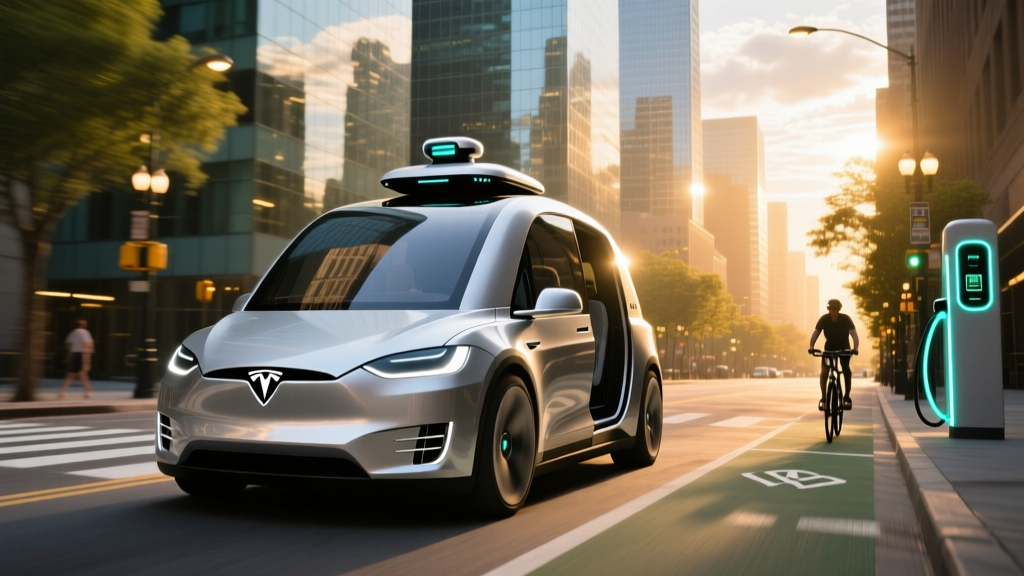
Tesla's Full Self-Driving (Supervised) software continues its iterative evolution, and the 14.2.2.5 release has drawn attention from owners tracking every build change. For current Tesla drivers and prospective buyers weighing whether to subscribe, understanding what this specific update actually changes — versus what Tesla's marketing implies — is essential. This guide breaks down the technical architecture, real-world behavior, cost structure, and the critical supervision requirements that define FSD in 2026.
What Tesla FSD (Supervised) Actually Does in Build 14.2.2.5
Full Self-Driving (Supervised) is Tesla's highest-tier driver-assistance package. It extends beyond basic Autopilot (which handles lane centering and adaptive cruise control) by adding navigated on-ramp-to-off-ramp highway driving, city-street traffic light and stop sign recognition, automatic lane changes, and parking assistance. Build 14.2.2.5 continues Tesla's end-to-end neural network approach, where a single model processes camera inputs and outputs driving controls rather than relying on hand-coded rules for each scenario.
Technically, FSD relies on Tesla's vision-only hardware suite. Current Model 3, Model Y, Model S, and Model X vehicles use a camera array (typically eight exterior cameras providing 360-degree coverage) paired with Tesla's HW4 (also called AI4) compute platform. Earlier vehicles equipped with HW3 may receive FSD updates but can face processing limitations compared to the newer silicon. Tesla removed ultrasonic sensors and radar from new production vehicles beginning in 2022–2023, making Tesla Vision the sole perception system.
Despite the "Full Self-Driving" name, Tesla FSD (Supervised) is classified as SAE Level 2 driver assistance. This means the system provides combined longitudinal and lateral control, but the human driver must remain fully engaged, monitor the environment at all times, and be prepared to take over instantly. It is not autonomous. Tesla's own owner's manual and the NHTSA's automated vehicle framework confirm this classification. True driverless operation (SAE Level 4) is currently limited to geofenced robotaxi services like Waymo in select cities.
Key Changes and Improvements in FSD 14.2.2.5
Tesla's release notes for point releases are notoriously sparse, often listing only "general improvements to FSD (Supervised)" without specifics. However, community testing and telemetry from FSD tracking accounts indicate several areas of focus in the 14.2.x branch:
- Smoother end-to-end control: Reduced oscillation during lane changes and more natural steering inputs on curved roads, particularly on highways with worn lane markings.
- Improved unprotected left turns: Better gap selection and creep behavior at intersections without dedicated turn signals, a historically challenging scenario for vision-only systems.
- Enhanced construction zone handling: More reliable cone and barrel detection with improved path planning through temporary lane shifts.
- Reduced phantom braking events: Fewer instances of unexpected deceleration on clear highways, though these events have not been fully eliminated.
- Better pedestrian and cyclist prediction: More conservative behavior near crosswalks and bike lanes in dense urban environments.
These are incremental refinements, not fundamental capability leaps. Drivers upgrading from 14.1.x builds should expect a polished version of the same core feature set rather than entirely new driving scenarios.
Real-World Capabilities and Where FSD Excels
In favorable conditions — dry weather, well-marked roads, moderate traffic — FSD 14.2.2.5 performs impressively for a Level 2 system. Highway driving remains its strongest use case. Merging, maintaining speed, navigating interchanges, and handling lane reductions are executed with a competence that reduces driver fatigue on long trips. City driving has improved substantially since Tesla's transition to the end-to-end neural network architecture, with the system handling multi-lane urban boulevards, timed traffic lights, and four-way stops with increasing reliability.
| Driving Scenario | Performance | Supervision Needed |
|---|---|---|
| Highway (well-marked, dry) | Excellent | Low — periodic monitoring |
| Highway (construction zones) | Good | Moderate — watch for lane shift errors |
| City streets (marked lanes, signals) | Good | Moderate — verify turn decisions |
| Unprotected left turns | Improved | High — be ready to take over |
| Rain / fog / snow | Reduced | High — camera occlusion risk |
| Unmarked rural roads | Poor | Very high — system may disengage |
| Parking lots / garages | Moderate | High — low-speed but unpredictable |
Limitations and Edge Cases: What FSD Cannot Do
- Not self-driving: You are the driver. NHTSA requires your hands on the wheel (or torque applied) and eyes on the road at all times. Disengagements are frequent and unpredictable.
- Vision-only vulnerability: Camera occlusion from heavy rain, snow, fog, direct sun glare, or dirty lenses can cause sudden degradation or disengagement with minimal warning.
- Phantom braking: The system may brake unexpectedly for shadows, roadside objects, or perceived obstacles that do not exist. This remains a documented concern in NHTSA complaint databases.
- No geographic fence: Unlike Ford BlueCruise or GM Super Cruise, FSD does not restrict operation to pre-mapped roads. It will attempt to drive anywhere, which means capability varies wildly by location.
- Emergency vehicles: Response to stopped emergency vehicles with flashing lights has improved but is not guaranteed. You must remain prepared to take over.
- Traffic light nuances: Right-on-red, flashing yellow, and temporary signals may not be correctly interpreted in all cases.
The absence of radar or lidar means Tesla's system cannot independently verify camera detections through a secondary sensor modality. Competing Level 2 systems from Ford, GM, and Mercedes-Benz use different sensor fusion approaches, and some restrict operation to validated highway segments — trading flexibility for predictability.
FSD Pricing: Subscription vs. One-Time Purchase in 2026
Tesla offers two ways to access Full Self-Driving (Supervised). The pricing structure has shifted over the years, and as of 2026 the options are:
| Option | Cost | Notes |
|---|---|---|
| Monthly Subscription | $99/month | Cancel anytime; no long-term commitment |
| One-Time Purchase | $8,000 | Transfers with vehicle if sold; non-refundable |
| Basic Autopilot | Included (free) | Lane centering + adaptive cruise only; no FSD features |
| Enhanced Autopilot | Discontinued | Previously $6,000; no longer offered as a separate tier |
For most buyers, the $99/month subscription is the financially rational choice. At $8,000 upfront, you would need to use FSD continuously for over 6.5 years just to break even on the subscription cost — and that assumes Tesla never reduces the subscription price or changes the feature set. The subscription also lets you pause FSD during months when you drive less or rely on other vehicles.
FSD eligibility requires a Tesla with HW3 or newer hardware. All current-production Model 3, Model Y, Model S, and Model X vehicles include the necessary hardware. The Cybertruck also supports FSD. The Tesla Roadster (announced, not yet in production) is expected to include FSD capability. Older vehicles with HW2 or earlier cannot run current FSD builds.
How FSD Compares to Competing Level 2 Systems
Tesla FSD is not the only advanced Level 2 driver-assist system available. Comparing it against major competitors reveals different design philosophies:
| System | Brand | Operational Domain | Hands-Free? | Cost |
|---|---|---|---|---|
| FSD (Supervised) | Tesla | Any road (no geofence) | No — torque monitoring | $99/mo or $8,000 |
| BlueCruise | Ford | Pre-mapped divided highways (~130,000 mi) | Yes — eye monitoring via camera | $75/mo or $2,100 (varies by model) |
| Super Cruise | GM (Cadillac/Chevy) | Pre-mapped highways (~750,000 mi) | Yes — eye monitoring via camera | ~$25/mo or included on select trims |
| Drive Pilot | Mercedes-Benz | Specific highways, under 40 mph, clear weather | Yes — SAE Level 3 (limited) | $2,500/year subscription (S-Class/EQS) |
| Toyota Safety Sense 3.0 | Toyota | Any road (lane centering + ACC) | No — hands-on required | Included (standard) |
The key trade-off is flexibility versus predictability. Tesla FSD attempts to drive anywhere, which maximizes utility but means encountering edge cases more frequently. Ford BlueCruise and GM Super Cruise restrict operation to validated highway segments, which limits where you can use them but provides a more consistent and reliable experience within those zones. Mercedes-Benz Drive Pilot represents the only SAE Level 3 system available to US consumers, meaning the driver can legally look away under very specific conditions — but those conditions are extremely narrow (low speed, specific highways, good weather, clear lane markings).
Safety Context: NHTSA Oversight and Standing Orders
All vehicles equipped with Level 2 and above driver-assist systems are subject to NHTSA's Standing General Order, which requires manufacturers to report crashes involving automated driving features. Tesla has reported numerous FSD-involved incidents through this mechanism. The NHTSA's AV safety data portal provides public access to these reports.
Tesla's own Vehicle Safety Report, published quarterly, claims that vehicles using Autopilot technology experience fewer crashes per million miles than those without. However, these reports have faced scrutiny because they do not isolate FSD from basic Autopilot, do not account for the types of roads driven (highway vs. city), and rely on Tesla's own airbag-deployment-based crash definition. Independent validation from IIHS and other bodies has not consistently replicated Tesla's claimed safety advantage for partial automation systems.
The responsible approach: treat FSD as a fatigue-reduction tool, not a replacement for attentive driving. Keep your hands on the wheel, scan the road ahead, and be prepared to disengage at any moment.
Frequently Asked Questions
Is Tesla FSD 14.2.2.5 actually self-driving?
No. Tesla FSD (Supervised) is an SAE Level 2 driver-assistance system. The driver must remain engaged, monitor the road, and be prepared to take over at any time. The "Full Self-Driving" name is a product label, not a description of the system's automation level. Only geofenced robotaxi services like Waymo currently operate at SAE Level 4 (true driverless in defined areas).
How do I get FSD 14.2.2.5 on my Tesla?
FSD updates are delivered over-the-air (OTA). If you have an active FSD subscription or have purchased FSD, your vehicle will receive the update automatically when Tesla pushes it to your hardware configuration. You can check your current build version under Controls > Software in the vehicle's touchscreen. Not all vehicles receive updates simultaneously — Tesla staggers rollouts.
Does FSD work in bad weather?
Performance degrades significantly in heavy rain, snow, fog, or conditions that obscure the cameras. Tesla Vision relies entirely on camera input, and occluded lenses can cause the system to reduce speed, limit functionality, or disengage entirely. Tesla's owner manual explicitly warns against using Autopilot or FSD in conditions with poor visibility. Always clean your cameras before driving.
Can I use FSD on any road?
Yes — unlike Ford BlueCruise or GM Super Cruise, Tesla FSD does not geofence its operation. It will attempt to drive on any road where GPS and camera data are available. However, capability varies enormously by road type. Well-marked highways and urban streets with clear signals perform best. Unmarked rural roads, private driveways, and complex multi-leg intersections may exceed the system's current capability.
Is the $99/month FSD subscription worth it?
For most drivers, the subscription is more cost-effective than the $8,000 one-time purchase. You can subscribe for a road trip, cancel when you no longer need it, and avoid committing to a feature whose long-term value depends on Tesla's future software development. If you drive a Tesla daily on highways and value the reduced fatigue, the subscription pays for itself in comfort. If you primarily drive in dense city traffic or on rural roads, the system's limitations may not justify the monthly cost.
What hardware does my Tesla need to run FSD?
FSD requires Tesla HW3 (also called FSD Computer) or the newer HW4/AI4 platform. All vehicles produced from approximately April 2019 onward include HW3 or newer. If you own an older vehicle with HW2 or HW2.5, you cannot run current FSD builds without a hardware retrofit (which Tesla has offered in limited cases for customers who pre-purchased FSD). Check your hardware version under Controls > Software > Additional Vehicle Information.
Does FSD transfer if I sell my Tesla?
A one-time FSD purchase is tied to the vehicle, not the owner. If you sell the car, the FSD capability transfers to the new owner. However, Tesla has occasionally offered FSD transfer promotions that allow you to move a purchased FSD license to a new Tesla you buy — these promotions are time-limited and not always available. Subscription-based FSD does not transfer; the new owner would need to start their own subscription.