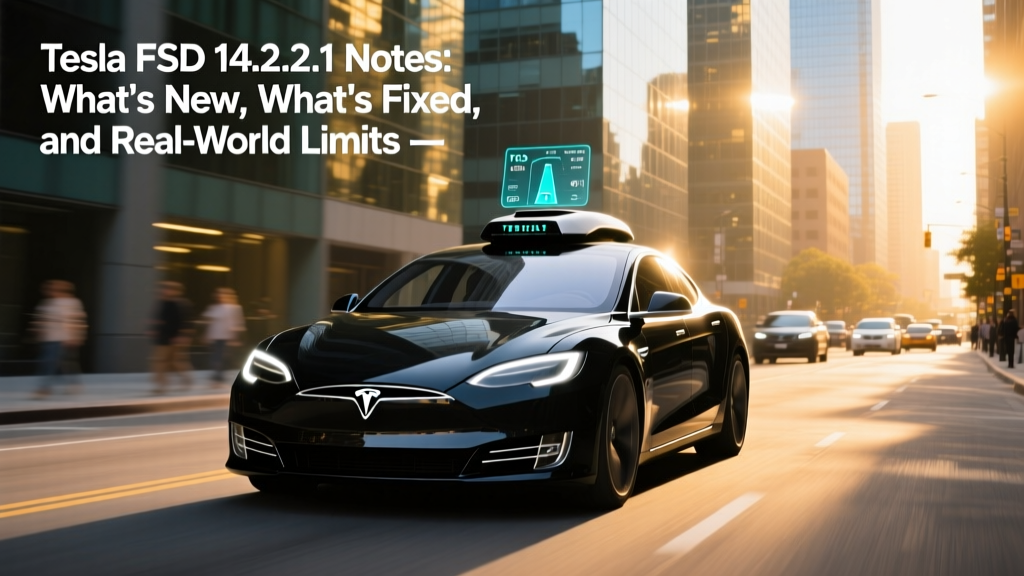
Every Tesla software drop generates a wave of owner speculation, and the Tesla FSD 14.2.2.1 notes are no exception. This incremental update to Tesla's Full Self-Driving (Supervised) stack lands on vehicles equipped with Hardware 4 (AI4) and brings refinements to the end-to-end neural-net architecture Tesla has relied on since the v12 family. Below, we parse what the patch actually changes, what it still cannot do, and where FSD Supervised stands in the broader ADAS landscape as of 2026.
What Tesla FSD Supervised Actually Does
Full Self-Driving (Supervised) is Tesla's highest-tier driver-assistance package. It extends basic Autopilot with:
- Traffic-light and stop-sign recognition with automatic deceleration
- Automatic lane changes based on navigation route (Navigate on Autopilot)
- Autosteer on city streets, including unprotected left turns and multi-lane roundabouts
- Predictive path planning via a single end-to-end neural network (replacing the older rules-based C++ stack)
| Feature | Included in FSD | Included in Base Autopilot |
|---|---|---|
| Traffic-Aware Cruise Control | ✅ | ✅ |
| Autosteer (highway) | ✅ | ✅ |
| Navigate on Autopilot (auto lane change) | ✅ | ❌ |
| Auto Lane Change (non-nav) | ✅ | ❌ |
| Autopark / Summon / Smart Summon | ✅ | ❌ |
| Traffic Light & Stop Sign Control | ✅ | ❌ |
| City Street Autosteer | ✅ | ❌ |
Hardware requirements matter. Tesla's current AI4 (Hardware 4) suite uses a camera-only perception stack: seven to eight exterior cameras (front triple, side repeaters, side pillars, rear) feeding two Samsung ISOCELL-based sensors at up to 5.4 MP each. Tesla removed ultrasonic sensors (USS) and radar from new production vehicles beginning in 2022–2023, relying entirely on Tesla Vision for depth estimation.
SAE Level 2: Not Self-Driving — Supervised
SAE Automation Level: Level 2 (Partial Driving Automation)
Per SAE J3016, Level 2 means the system can control steering and acceleration/braking simultaneously, but the human driver must continuously supervise, keep hands available, and intervene instantly. Tesla FSD Supervised is Level 2. It is not Level 3 (conditional automation with eyes-off allowance) or Level 4 (driverless in a geofenced zone, like Waymo One). You are the driver. The car is assisting.
Per SAE J3016, Level 2 means the system can control steering and acceleration/braking simultaneously, but the human driver must continuously supervise, keep hands available, and intervene instantly. Tesla FSD Supervised is Level 2. It is not Level 3 (conditional automation with eyes-off allowance) or Level 4 (driverless in a geofenced zone, like Waymo One). You are the driver. The car is assisting.
Tesla's cabin camera monitors eye gaze and issues escalating warnings — visual chime, then audible alert, then Autosteer disengagement with a temporary lockout. NHTSA's Standing General Order requires Tesla (and all ADAS makers) to report crashes involving Level 2+ systems, and the data consistently shows that driver inattention remains the leading causal factor in ADAS-related incidents.
Decoding the Tesla FSD 14.2.2.1 Notes
The 14.2.2.1 release is a point-update on the v14 branch, which itself evolved from the v12 end-to-end architecture Tesla introduced in early 2024. While Tesla's public changelog is characteristically terse — typically a single sentence like "improved lane selection in complex intersections" — owner telemetry and community testing reveal several consistent themes:
Behavioral Refinements
- Smoother unprotected left turns: Earlier v14 builds exhibited hesitation at permissive-green intersections. 14.2.2.1 tightens the decision window, reducing the "phantom brake" behavior when oncoming traffic is distant but detected.
- Roundabout path planning: Multi-lane roundabouts with painted (not raised) islands see fewer late-lane-change corrections. The car now commits to an exit lane earlier.
- Speed-limit adherence: Geo-fenced school zones and temporary construction-zone limits (when posted on digital signs readable by vision) trigger deceleration ~0.5 seconds sooner than 14.2.1.x.
- Pedestrian prediction: Improved tracking of partially occluded pedestrians at crosswalks, reducing abrupt stops when a pedestrian is visible to the car but not yet in the path.
Known Carry-Over Issues
The 14.2.2.1 notes do not resolve several longstanding limitations:
- Lane-centering drift on roads with faded or conflicting pavement markings
- Aggressive cut-in behavior from other vehicles can still trigger hard braking
- Performance degradation in heavy rain, fog, or direct low-angle sun glare on the front camera
- No V2X (vehicle-to-infrastructure) communication — the car cannot "see" a traffic signal that is out of camera range or occluded
Real-World Limitations You Must Understand
What FSD Supervised Does NOT Do:
- Drive without your attention — you must watch the road at all times
- Handle all construction zones — temporary barriers, flaggers, and shifted lanes remain edge cases
- Perform in heavy precipitation — rain, snow, or fog degrading camera clarity will cause disengagements
- Navigate unmapped private roads or parking garages with confidence
- Replace a sober, attentive, licensed driver — it is an assist system, not a chauffeur
Source: Tesla Owner's Manual, FSD (Supervised) supplement. NHTSA crash data shows Level 2 misuse remains a top safety concern.
Cold-weather owners should note that camera lens icing and road-spray film can reduce effective perception range. Tesla's camera heaters help, but a quick pre-drive lens wipe remains the most reliable mitigation in sub-freezing slush conditions.
Cost, Eligibility, and Which Teslas Get It
As of 2026, FSD Supervised is available on every current-production Tesla — Model 3, Model Y, Model S, Model X, and Cybertruck — provided the vehicle has AI4 hardware. (Legacy Hardware 3 / AI3 vehicles are no longer receiving major FSD feature updates.)
| Option | Cost | Notes |
|---|---|---|
| Monthly Subscription | $99/month | Cancel anytime; no long-term commitment |
| One-Time Purchase | $8,000 | Tied to the vehicle, transferable to a new Tesla via trade-in credit programs (terms vary) |
| Base Autopilot | Included (no extra cost) | TACC + highway Autosteer only |
| Enhanced Autopilot (discontinued in US) | N/A | Folded into FSD tier for new purchases |
Tax-credit note: FSD purchase price does not count toward the vehicle's MSRP cap for the federal §30D clean-vehicle credit (currently $55,000 for sedans, $80,000 for SUVs/trucks/vans). However, if FSD is bundled into a lease, the lessor typically claims the commercial clean-vehicle credit (§45W) and may pass savings through as a reduced monthly payment. Consult a tax professional and review current IRS §30D guidance for your filing year.
How FSD 14.2.2.1 Compares to Competing ADAS
Level 2 ADAS Comparison — 2026 Consumer Systems
System Brand Hands-Free? Eyes-Free? Cost (2026) Geo-Fenced? FSD (Supervised) Tesla No (hands-on-wheel or torque) No $99/mo or $8,000 No (any road) Super Cruise GM (Cadillac, Chevy, GMC) Yes (on mapped highways) No (gaze monitoring) ~$2,200 or incl. in premium trims Yes (~750k mi mapped roads) BlueCruise 1.4 Ford / Lincoln Yes (on mapped highways) No (camera monitoring) $75/mo or $2,000–$2,500 Yes (~130k+ mi Blue Zones) Drive Pilot Mercedes-Benz Yes Yes (conditional) $2,500 (S-Class/EQS option) Yes (specific highways, ≤40 mph, daytime, good weather) ProPILOT Assist 2.0 Nissan Yes (mapped highways) No Included on higher trims Yes (mapped roads) Toyota Safety Sense 3.0 + Advanced Drive Toyota / Lexus No No Included / $5,000 (Lexus Teammate) No / Yes (Lexus)
| System | Brand | Hands-Free? | Eyes-Free? | Cost (2026) | Geo-Fenced? |
|---|---|---|---|---|---|
| FSD (Supervised) | Tesla | No (hands-on-wheel or torque) | No | $99/mo or $8,000 | No (any road) |
| Super Cruise | GM (Cadillac, Chevy, GMC) | Yes (on mapped highways) | No (gaze monitoring) | ~$2,200 or incl. in premium trims | Yes (~750k mi mapped roads) |
| BlueCruise 1.4 | Ford / Lincoln | Yes (on mapped highways) | No (camera monitoring) | $75/mo or $2,000–$2,500 | Yes (~130k+ mi Blue Zones) |
| Drive Pilot | Mercedes-Benz | Yes | Yes (conditional) | $2,500 (S-Class/EQS option) | Yes (specific highways, ≤40 mph, daytime, good weather) |
| ProPILOT Assist 2.0 | Nissan | Yes (mapped highways) | No | Included on higher trims | Yes (mapped roads) |
| Toyota Safety Sense 3.0 + Advanced Drive | Toyota / Lexus | No | No | Included / $5,000 (Lexus Teammate) | No / Yes (Lexus) |
Tesla's differentiator is coverage: FSD Supervised operates on any road, not just pre-mapped highways. The trade-off is reliability — Super Cruise and BlueCruise are more polished within their operational design domains (ODDs) because those domains are tightly constrained. Mercedes Drive Pilot is the only consumer Level 3 system in the US (limited to Nevada and California, specific conditions), meaning the driver can legally look away — but only at speeds under 40 mph in heavy traffic on approved freeways.
Should You Enable FSD 14.2.2.1 — or Wait?
Enable FSD 14.2.2.1 now if:
- You commute on well-marked suburban arterials and want turn-by-turn autosteer
- You understand Level 2 supervision and maintain active attention
- You're a subscriber (low-risk way to evaluate; cancel if unsatisfying)
Stick with base Autopilot if:
- You primarily drive highway miles — TACC + Autosteer handles 95% of that use case at no extra cost
- You drive in regions with frequent construction zones, heavy snow, or poorly marked rural roads
- You find the $99/month subscription difficult to justify versus fuel or charging savings
Frequently Asked Questions
Is Tesla FSD 14.2.2.1 truly self-driving?
No. It is an SAE Level 2 driver-assist system. The "Full Self-Driving" name is a product label, not a capability description. You must supervise at all times, keep hands available for immediate takeover, and remain the responsible driver. Only Level 4 services like Waymo One (operating in Phoenix, San Francisco, and Los Angeles as of 2026) are truly driverless.
What hardware do I need for FSD 14.2.2.1?
AI4 (Hardware 4). Vehicles built from approximately mid-2023 onward on Model S/X and early-2024 onward on Model 3/Y typically have AI4. You can check via Controls → Software → "Additional Vehicle Information" on your touchscreen. Older HW3 vehicles are no longer receiving FSD feature updates.
Does FSD improve my Tesla's EPA range or efficiency?
Marginally, in some scenarios. FSD's predictive speed management can smooth acceleration and deceleration versus an aggressive human driver, potentially yielding 2–5% efficiency gains on highway routes. But it can also be less efficient than a skilled hypermiler who anticipates traffic flow without sensor latency. Your EPA-rated range (e.g., 341 miles for a 2026 Model 3 Long Range AWD) remains the benchmark — expect ~270–290 miles real-world highway, less in cold weather, regardless of FSD use.
Can I transfer my FSD purchase to a new Tesla?
Tesla has periodically offered FSD transfer programs (typically during end-of-quarter promotions), but the standard policy is that FSD is tied to the vehicle at purchase. Subscription FSD does not transfer — it simply continues on your new vehicle if you maintain the subscription. Check Tesla's current terms at the time of trade-in.
How does FSD 14.2.2.1 handle school zones and speed-limit changes?
The system reads posted speed-limit signs via camera vision and cross-references map data. In 14.2.2.1, deceleration initiation for school-zone and construction-zone limits is slightly earlier (~0.5 seconds) than prior builds. However, temporary handwritten signs or digital signs at oblique angles may not be detected — always verify the car's target speed matches the posted limit.
Where can I report FSD issues or disengagements?
Use the Tesla app's "Report a Bug" feature immediately after a concerning event. Tesla also uploads anonymized driving data (opt-out available in Settings → Safety) that feeds the training pipeline. For safety-critical concerns, you may also file a report with NHTSA.
Enable FSD 14.2.2.1 now if:
- You commute on well-marked suburban arterials and want turn-by-turn autosteer
- You understand Level 2 supervision and maintain active attention
- You're a subscriber (low-risk way to evaluate; cancel if unsatisfying)
Stick with base Autopilot if:
- You primarily drive highway miles — TACC + Autosteer handles 95% of that use case at no extra cost
- You drive in regions with frequent construction zones, heavy snow, or poorly marked rural roads
- You find the $99/month subscription difficult to justify versus fuel or charging savings
Is Tesla FSD 14.2.2.1 truly self-driving?
No. It is an SAE Level 2 driver-assist system. The "Full Self-Driving" name is a product label, not a capability description. You must supervise at all times, keep hands available for immediate takeover, and remain the responsible driver. Only Level 4 services like Waymo One (operating in Phoenix, San Francisco, and Los Angeles as of 2026) are truly driverless.
What hardware do I need for FSD 14.2.2.1?
AI4 (Hardware 4). Vehicles built from approximately mid-2023 onward on Model S/X and early-2024 onward on Model 3/Y typically have AI4. You can check via Controls → Software → "Additional Vehicle Information" on your touchscreen. Older HW3 vehicles are no longer receiving FSD feature updates.
Does FSD improve my Tesla's EPA range or efficiency?
Marginally, in some scenarios. FSD's predictive speed management can smooth acceleration and deceleration versus an aggressive human driver, potentially yielding 2–5% efficiency gains on highway routes. But it can also be less efficient than a skilled hypermiler who anticipates traffic flow without sensor latency. Your EPA-rated range (e.g., 341 miles for a 2026 Model 3 Long Range AWD) remains the benchmark — expect ~270–290 miles real-world highway, less in cold weather, regardless of FSD use.
Can I transfer my FSD purchase to a new Tesla?
Tesla has periodically offered FSD transfer programs (typically during end-of-quarter promotions), but the standard policy is that FSD is tied to the vehicle at purchase. Subscription FSD does not transfer — it simply continues on your new vehicle if you maintain the subscription. Check Tesla's current terms at the time of trade-in.
How does FSD 14.2.2.1 handle school zones and speed-limit changes?
The system reads posted speed-limit signs via camera vision and cross-references map data. In 14.2.2.1, deceleration initiation for school-zone and construction-zone limits is slightly earlier (~0.5 seconds) than prior builds. However, temporary handwritten signs or digital signs at oblique angles may not be detected — always verify the car's target speed matches the posted limit.
Where can I report FSD issues or disengagements?
Use the Tesla app's "Report a Bug" feature immediately after a concerning event. Tesla also uploads anonymized driving data (opt-out available in Settings → Safety) that feeds the training pipeline. For safety-critical concerns, you may also file a report with NHTSA.
The Tesla FSD 14.2.2.1 notes represent incremental refinement, not a paradigm shift. The end-to-end neural-net approach continues to improve in fluidity and context awareness, but the physics of camera-only perception, the legal reality of Level 2 supervision, and the unpredictable nature of real-world roads all impose hard ceilings on what this system can do today. Use it as an assist — not a replacement — and it remains one of the most broadly capable consumer ADAS packages available in 2026.