What Tesla FSD 14.1.4 (Supervised) Actually Is
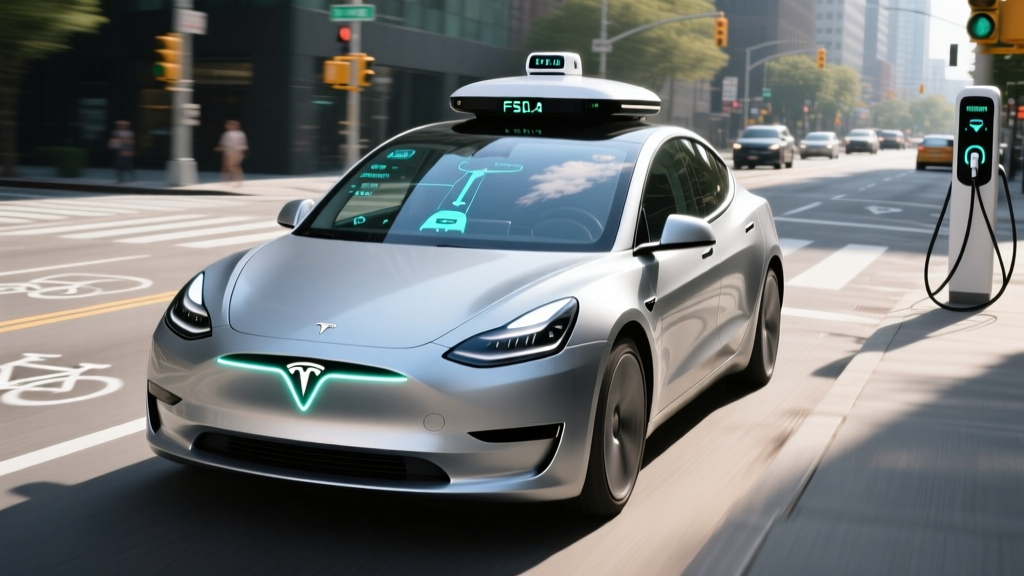
Full Self-Driving (Supervised) version 14.1.4 is Tesla's most current over-the-air iteration of its advanced driver-assistance stack, pushed to eligible vehicles through the 2026 model-year update cycle. Despite the name, FSD remains an SAE Level 2 system — meaning the driver must continuously supervise the vehicle, keep hands available for immediate takeover, and accept full legal responsibility for every driving decision the car makes.
FSD 14.1.4 provides combined longitudinal and lateral control (steering, acceleration, braking) under driver supervision. It does not remove the driver from the loop. Tesla's own documentation and the NHTSA's automation framework classify this as Level 2 — the same tier as GM Super Cruise and Ford BlueCruise. True driverless operation (Level 4) currently exists only in geofenced robotaxi services like Waymo.
Tesla's FSD stack differs fundamentally from competitors in one respect: it relies exclusively on a vision-only sensor suite. There is no LiDAR, and Tesla removed radar from new vehicles starting in 2021 and ultrasonic sensors starting in 2022. Everything FSD 14.1.4 perceives — lane markings, traffic signals, pedestrians, other vehicles — is processed through a network of external cameras feeding Tesla's custom neural networks running on the Hardware 4 (HW4) computer.
How FSD 14.1.4 Works: Sensors, Compute, and the Vision-Only Bet
Understanding what FSD 14.1.4 can and cannot do requires understanding its hardware foundation:
| Component | Specification | Role |
|---|---|---|
| External cameras | 8 cameras (front, front-side ×2, rear-side ×2, rear, cabin-facing) | 360° visual perception; object detection, lane reading, traffic signal recognition |
| Compute platform | Hardware 4 (HW4) — dual neural-net processors, ~500 TOPS combined | Real-time inference for path planning, object classification, occupancy networks |
| Radar | None (removed from production) | N/A — Tesla relies solely on vision |
| Ultrasonic sensors | None (removed from production) | N/A — Tesla Vision handles proximity estimation |
| GPS / IMU | Standard navigation-grade | Localization, route planning, map-matching |
| Driver monitoring | Cabin camera (HW4 vehicles) | Attention detection; triggers warnings if driver looks away |
FSD 14.1.4 uses what Tesla calls an "end-to-end neural network" architecture, first introduced with the v12 branch and refined through subsequent updates. Rather than modular code stacks (one module for lane detection, another for path planning, another for control), the system processes camera input through a unified neural network trained on billions of miles of real-world driving video. The practical result: smoother lane changes, more natural speed modulation, and better handling of ambiguous scenarios like unprotected left turns — but also less predictability when the system encounters situations underrepresented in its training data.
Real-World Capabilities: Where FSD 14.1.4 Performs Well
In controlled testing across suburban and highway environments, FSD 14.1.4 demonstrates meaningful competence in several scenarios:
- Divided highway driving: Maintains lane centering with minimal oscillation, handles gentle curves at speed, and executes lane changes with reasonable gap judgment when turn signals are engaged.
- Stoplight and stop-sign management: Detects and responds to traffic signals and stop signs, coming to a complete stop and proceeding when clear — though driver confirmation is often required at complex intersections.
- Speed adaptation: Adjusts to posted speed limits and slows for curves, construction zones, and slower lead vehicles with generally smooth deceleration profiles.
- Roundabout navigation: Handles single-lane roundabouts adequately in many cases, though multi-lane roundabouts with heavy traffic remain inconsistent.
- Parking: The updated park-assist module handles perpendicular and parallel spots with reasonable accuracy, leveraging Tesla Vision for curb and line detection.
The end-to-end architecture in 14.1.4 has noticeably improved the system's behavior at unprotected left turns and in navigating temporary lane shifts in construction zones — two areas where earlier FSD versions frequently required intervention.
Real-World Limitations: Where You Must Stay Engaged
- Heavy rain, fog, and snow: Camera-only perception degrades significantly in precipitation, fog, and low-visibility conditions. The system will issue a takeover request and may disable FSD entirely. Unlike radar-equipped competitors, there is no redundant sensor to fall back on.
- Faded or missing lane markings: Rural roads, construction zones with conflicting old/new markings, and poorly maintained urban streets can cause erratic lane positioning or disengagement.
- Sun glare and backlighting: Direct low-angle sunlight into cameras can temporarily blind the system, particularly at dawn and dusk on east-west roads.
- Complex intersections: Multi-turn lanes, unusual signal phasing, and intersections with pedestrian scrambles may cause hesitation or incorrect path selection.
- Emergency vehicles: While FSD 14.1.4 attempts to detect and yield to emergency vehicles, response is inconsistent — always verify and take over when you hear sirens.
- Phantom braking: Sudden, unexplained deceleration on highways remains a documented issue, reported to NHTSA's complaint database by numerous Tesla owners. Stay prepared to apply throttle immediately.
- Narrow roads with oncoming traffic: The system may not adequately judge passing distance on undivided two-lane roads, especially with parked cars reducing effective width.
The absence of radar and LiDAR means FSD 14.1.4 has no independent depth-sensing redundancy. Distance estimation to lead vehicles is inferred entirely from camera data and neural-net training. In most normal conditions this works adequately, but in edge cases — a stopped white truck against a bright sky, for instance — the system's confidence can drop or, worse, remain incorrectly high.
Cost: Subscription, Purchase, and What's Included
Tesla offers FSD through two pricing models, and the choice depends heavily on how long you plan to keep the vehicle:
| Option | Cost | Transferability | Best For |
|---|---|---|---|
| Monthly subscription | $99/month | Not transferable; tied to your Tesla account | Short-term ownership, trying before committing, seasonal use |
| One-time purchase | $8,000 (current pricing) | Transfers with vehicle on resale; occasionally transferable to new Tesla purchase during promotional windows | Long-term owners (5+ years), high-mileage drivers |
| Basic Autopilot | Included with all new Teslas | N/A | Drivers who want lane-keeping and adaptive cruise without FSD |
| Enhanced Autopilot | Discontinued as separate tier (folded into FSD subscription options) | N/A | N/A |
At $99/month, the subscription breaks even against the $8,000 purchase at roughly 81 months (6.75 years), not accounting for the time value of money. If you plan to keep your Tesla for fewer than five years, the subscription is almost certainly the better financial choice — particularly since FSD's resale value contribution is debatable and Tesla occasionally runs transfer promotions.
Important note: FSD is not eligible for any federal tax credit. The IRS §30D credit applies only to the vehicle itself (subject to MSRP caps of $55,000 for sedans / $80,000 for SUVs and trucks, buyer income limits, and battery sourcing requirements). Software subscriptions and one-time software purchases do not qualify.
Which Tesla Models and Trims Include FSD?
FSD (Supervised) is available as an add-on across Tesla's entire current production lineup, but it is not included standard on any trim. You must purchase or subscribe separately:
| Model | Hardware Requirement | FSD Availability | Notes |
|---|---|---|---|
| Model 3 (Highland / 2024+) | HW4 standard | Subscription or purchase | All trims eligible |
| Model Y (Juniper / 2025+) | HW4 standard | Subscription or purchase | All trims eligible |
| Model S (2024+) | HW4 standard | Subscription or purchase | All trims eligible |
| Model X (2024+) | HW4 standard | Subscription or purchase | All trims eligible |
| Cybertruck | HW4 standard | Subscription or purchase | Rolling FSD availability; some features may lag sedan/SUV parity |
| Older vehicles (HW3) | Hardware 3 | Limited — HW3 support uncertain for future updates | Tesla has offered HW4 upgrades to some HW3 owners; check eligibility |
If you own an older Tesla with Hardware 3, be aware that Tesla's development focus has shifted entirely to HW4. While HW3 vehicles may continue receiving basic Autopilot updates, FSD 14.1.4 and future versions are optimized for — and may eventually require — HW4's higher compute throughput and improved camera resolution.
FSD 14.1.4 vs. Competing Level 2 Systems
Tesla's vision-only approach is a philosophical bet that camera data plus neural networks can match or exceed sensor-fusion systems. Here's how FSD 14.1.4 compares to the major alternatives available in 2026:
| Feature | Tesla FSD (Supervised) 14.1.4 | GM Super Cruise | Ford BlueCruise | Mercedes Drive Pilot |
|---|---|---|---|---|
| SAE Level | Level 2 | Level 2 | Level 2 | Level 3 (limited) |
| Sensor suite | Cameras only (8) | Cameras + LiDAR + radar + HD maps | Cameras + radar | Cameras + LiDAR + radar + HD maps |
| Hands-off allowed | Yes (with attention monitoring) | Yes (on pre-mapped highways) | Yes (on pre-mapped highways, BlueCruise 1.0+) | Yes (under 40 mph, approved roads) |
| Eyes-off allowed | No | No | No | Yes (Level 3 — driver can look away) |
| Geographic scope | Any road (nominally) | ~750,000+ miles of pre-mapped divided highways | ~130,000+ miles of pre-mapped divided highways | Select approved highways in Germany, Nevada, California |
| Cost | $99/mo or $8,000 | $2,100–$2,500 one-time (or included on select trims); $25/mo after initial period on some models | $2,100 one-time or $75/mo subscription | $2,500/year subscription (S-Class) or included in EQS packages |
| Weather robustness | Degrades in rain/fog/snow | LiDAR provides redundancy; system may still disable in severe weather | Moderate — radar helps but cameras still primary | Robust — LiDAR + radar redundancy, but restricted to approved conditions |
The key trade-off: Tesla FSD works on virtually any road, while Super Cruise and BlueCruise are restricted to pre-mapped divided highways. If your commute is mostly freeway, GM and Ford's systems offer more predictable, confidence-inspiring behavior with LiDAR or radar redundancy. If you want a system that at least attempts to handle surface streets, neighborhood driving, and parking, FSD is currently the only consumer option that tries.
Mercedes-Benz Drive Pilot represents a genuine step beyond FSD in automation level — it is SAE Level 3, meaning the manufacturer accepts liability when the system is engaged under its operational design domain. But that domain is extremely narrow (low-speed highway congestion, specific approved roads, good weather), making it a different use case entirely.
Safety Context: What the Data Shows
Tesla publishes quarterly safety reports claiming lower crash rates per million miles for vehicles with Autopilot/FSD engaged versus those without. However, these reports have significant methodological limitations: they do not control for road type (highway driving, where Autopilot is primarily used, is inherently safer than urban driving), driver demographics, or vehicle age. Independent verification remains limited.
The NHTSA has opened multiple investigations into Tesla's Autopilot and FSD systems, including inquiries into crashes involving stationary emergency vehicles and the adequacy of Tesla's driver-monitoring system. As of 2026, several investigations remain open. The IIHS has consistently rated Tesla's driver-monitoring as less robust than GM's Super Cruise and Ford's BlueCruise, citing Tesla's reliance on steering-wheel torque detection (on older vehicles) and the cabin camera's permissiveness.
For FSD 14.1.4 specifically, Tesla's cabin-facing camera on HW4 vehicles provides improved attention monitoring compared to earlier steering-torque-only systems. But the fundamental requirement remains unchanged: you are the driver. Every mile driven on FSD is a mile for which you bear full legal and moral responsibility.
Frequently Asked Questions
Is Tesla FSD 14.1.4 truly self-driving?
No. FSD 14.1.4 is an SAE Level 2 driver-assistance system. The "Full Self-Driving" name is a product label, not a technical classification. You must remain attentive, keep your hands available, and be prepared to take over at any moment. Tesla's own user interface displays "FSD (Supervised)" to reinforce this requirement.
Can I use FSD 14.1.4 on any road?
Technically, yes — FSD does not require pre-mapped highways the way Super Cruise and BlueCruise do. However, performance varies enormously by road type. It works best on well-marked divided highways and degrades on narrow rural roads, in construction zones with conflicting markings, and in poor weather.
Does FSD 14.1.4 work in rain and snow?
Performance degrades significantly in heavy rain, snow, and fog. Because the system is vision-only with no radar or LiDAR backup, precipitation on camera lenses and reduced visibility directly impair perception. Expect frequent disengagement requests and plan to drive manually in adverse weather.
Will FSD get better over time via OTA updates?
Tesla regularly pushes over-the-air updates that improve FSD behavior. However, past promises of full autonomy "next year" have consistently been delayed. Buy FSD for what it does today — competent Level 2 highway and surface-street assistance — not for what it might become.
Do I need Hardware 4 for FSD 14.1.4?
Yes, for current and future FSD versions. Tesla's development has shifted to HW4, and older HW3 vehicles may not receive the latest FSD updates or may receive degraded versions. If you're buying a used Tesla and want FSD, verify the hardware version before purchasing.
How does FSD's $99/month subscription compare to competitors?
GM Super Cruise costs roughly $2,100–$2,500 upfront (or is included on higher trims like the Cadillac CT5-V Blackwing and Escalade). Ford BlueCruise is $2,100 one-time or $75/month. FSD's $99/month is the most expensive monthly option, but it's also the only system that doesn't restrict you to pre-mapped highways.
The Bottom Line on FSD 14.1.4
FSD 14.1.4 represents the current state of Tesla's ambitious vision-only bet: a system that handles a wider variety of roads than any competitor, with impressively smooth behavior in its comfort zone, but with real limitations in adverse weather, complex intersections, and edge cases that a camera-only architecture cannot fully resolve. At $99/month, it's a reasonable add-on for Tesla owners who understand its Level 2 nature and commit to active supervision. The $8,000 one-time purchase only makes financial sense for long-term owners who drive high annual miles and value the system's convenience enough to absorb the cost — and the uncertainty of what Tesla's FSD roadmap will actually deliver.