If you've spent any time on EV forums or Tesla owner groups, you've likely seen the phrase "free FSD" floating around. Some owners claim they received Full Self-Driving capability at no cost; others insist it's a myth. The reality sits somewhere in between, wrapped in Tesla's evolving pricing strategy and a web of marketing terms that can confuse even seasoned EV buyers.
This guide cuts through the noise. We'll explain what Tesla's Full Self-Driving (Supervised) actually does in 2026, what "free FSD" really means, what you'll pay if you don't get it free, and — critically — what this system cannot do. Because despite the aspirational name, FSD remains a Level 2 driver-assistance system that demands your full attention behind the wheel.
What Tesla Full Self-Driving (Supervised) Actually Does
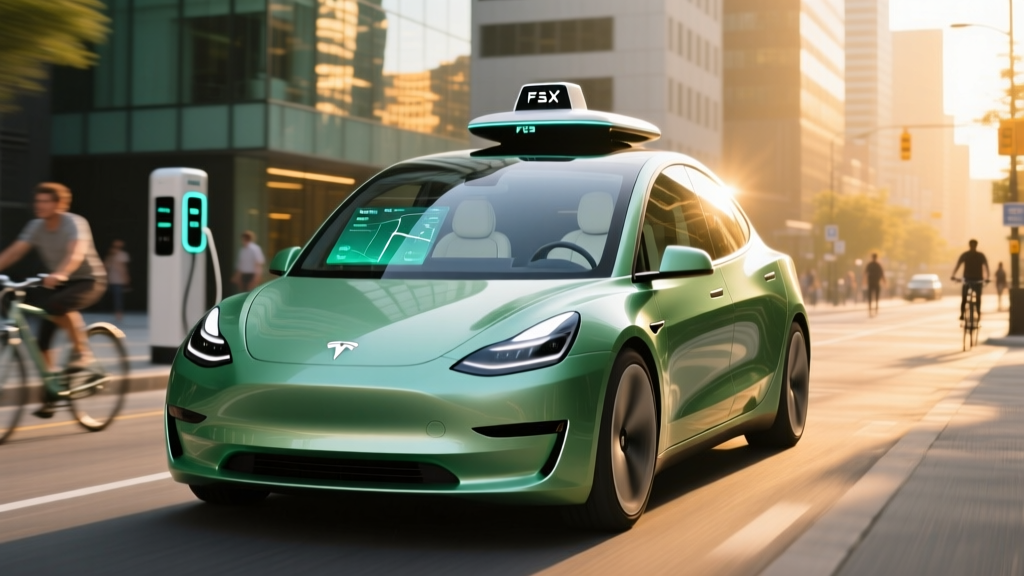
Tesla's Full Self-Driving, officially branded as FSD (Supervised), is the automaker's most advanced driver-assistance package. It builds on top of Tesla's standard Autopilot system and adds several capabilities:
- Navigate on Autopilot: Automatic highway on-ramp to off-ramp driving, including lane changes and interchange navigation based on your set destination.
- Auto Lane Change: The system initiates lane changes when it determines a faster lane is available or when your route requires it.
- Autosteer on City Streets: The vehicle can navigate traffic lights, stop signs, and turn through intersections on surface streets — a feature Tesla spent years developing and refining.
- Smart Summon: The car navigates a parking lot to come to you or drive to a designated pickup spot at low speeds.
- Autopark: Automatic parallel and perpendicular parking with minimal driver input.
- Traffic Light and Stop Sign Control: The vehicle recognizes and responds to traffic signals, stopping and proceeding as appropriate.
Despite the "Full Self-Driving" name, Tesla's FSD (Supervised) is classified as SAE Level 2 automation by both Tesla and independent bodies. This means the system provides combined steering and acceleration/braking assistance, but the driver must remain fully engaged, monitor the environment at all times, and be prepared to take over instantly. It is not autonomous. The vehicle cannot drive itself without a vigilant human behind the wheel. Only Level 4 systems like Waymo's robotaxi service operate without a human driver — and those are geofenced to specific mapped areas.
How FSD Works: The Hardware Behind the System
Tesla's FSD relies on a vision-only sensor suite, meaning it uses cameras rather than lidar or radar for environmental perception. As of 2026, vehicles shipping with Tesla's Hardware 4.0 (HW4) include:
- 8 cameras providing 360-degree visibility (front-facing main and narrow, left/right front pillar, left/right rear fender, rear-view)
- 12 ultrasonic sensors (on earlier builds; Tesla has removed these on some newer HW4 vehicles, relying purely on Tesla Vision)
- A custom FSD Computer with dual neural network processors capable of up to 2,300 frames per second of video processing
The system uses end-to-end neural networks — particularly in the v12.x and v13.x software generations — where a single AI model processes camera input and outputs driving decisions, rather than relying on hand-coded rules for every scenario. This approach has improved fluidity in complex urban environments but introduces unpredictability that Tesla acknowledges requires driver supervision.
Notably, Tesla removed radar from its sensor suite starting in 2021 and ultrasonic sensors from new production starting in late 2022, betting entirely on its camera-based Tesla Vision approach. Competitors like Ford's BlueCruise and GM's Super Cruise still incorporate radar alongside cameras, and Waymo's Level 4 robotaxis use lidar, radar, and cameras together.
The "Free FSD" Question: Trials, Transfers, and Promotions
So, is free FSD real? Here's what actually happens in practice:
Free Trials
Tesla periodically offers 30-day free trials of FSD (Supervised) to eligible vehicles. These are typically extended to:
- New Tesla deliveries during promotional periods
- Existing owners who haven't previously purchased or subscribed to FSD
- Vehicles equipped with HW3 or HW4 hardware
During the trial, you get full access to all FSD features. When the 30 days expire, the system reverts to standard Autopilot unless you purchase or subscribe. Tesla has run these promotions inconsistently — sometimes tied to end-of-quarter delivery pushes, sometimes as broad invitations through the Tesla app.
Used Vehicle FSD Transfers
This is where "free FSD" gets most tangible. If you buy a used Tesla that already has FSD purchased (the one-time buy, not a lapsed subscription), the FSD license stays with the vehicle. You effectively get FSD at no additional cost because it's baked into the used car's price. Tesla's own used inventory on its website often labels FSD-equipped vehicles, and third-party listings on sites like Autotrader may note it.
However, Tesla has occasionally run FSD transfer promotions where owners who trade in or sell their FSD-equipped vehicle can transfer the license to a new Tesla purchase. These are limited-time, targeted offers — not a permanent program.
Complimentary FSD with Specific Purchases
At various points, Tesla has bundled FSD at no extra cost with certain configurations — for example, including FSD with Cybertruck deliveries in early production phases or as a limited-time incentive on specific trim levels. These are promotional, not permanent, and availability shifts quarter to quarter.
FSD Pricing in 2026: Purchase vs. Subscription
If you don't receive FSD through a trial, transfer, or promotion, here's what you'll pay as of early 2026:
| Option | Cost | Notes |
|---|---|---|
| One-Time Purchase | $8,000 | Permanent license tied to the vehicle; transfers with resale |
| Monthly Subscription | $99/month | Cancel anytime; does not transfer to a new vehicle |
| Free Trial | $0 (30 days) | Promotional; reverts to basic Autopilot after expiration |
Note: Tesla has adjusted FSD pricing multiple times. The one-time purchase was previously $15,000 before being reduced. Always verify current pricing on Tesla's configurator or in your Tesla app before committing.
The subscription model makes sense for drivers who want to test FSD on a road trip or evaluate it seasonally without committing $8,000. The one-time purchase is more cost-effective if you plan to keep the vehicle for more than ~6.7 years (the breakeven point at $99/month). Plus, the purchased license adds residual value when you sell the car.
Which Tesla Models Include FSD Capability?
FSD (Supervised) is available as an add-on across Tesla's entire current lineup, but it is never standard equipment. Every new Tesla ships with basic Autopilot (Traffic-Aware Cruise Control and Autosteer on marked highways) at no extra cost. FSD must be purchased or subscribed to separately.
| Brand | Feature Name | SAE Level | Pricing Model | Hands-Free? |
|---|---|---|---|---|
| Tesla | FSD (Supervised) | Level 2 | $8,000 or $99/mo | No — steering wheel monitoring required |
| Tesla | Autopilot (standard) | Level 2 | Included | No — steering wheel torque monitoring |
| Ford | BlueCruise | Level 2 | $2,100 or $75/mo | Yes, on pre-mapped highways (eyes monitored via camera) |
| GM (Cadillac/Chevy) | Super Cruise | Level 2 | $2,200 + $25/mo after trial | Yes, on pre-mapped highways (eyes monitored via camera) |
| Hyundai/Genesis | Highway Driving Assist 2 | Level 2 | Included on higher trims | No — hands-on required |
A key distinction: Ford's BlueCruise and GM's Super Cruise allow true hands-free driving on pre-mapped divided highways (over 750,000 miles of compatible roads in North America as of 2026, per GM and Ford), but they monitor driver attention via an infrared camera aimed at your eyes. Tesla's FSD does not allow hands-free operation — it monitors steering wheel torque to confirm driver engagement, though Tesla has been testing an interior camera-based attention monitor in newer vehicles.
Real-World Capabilities and Limitations
After extensive real-world testing across highway, suburban, and urban environments, here's what FSD (Supervised) handles well — and where it still falls short.
Where FSD Excels
- Highway cruising: Lane centering is smooth, speed management in traffic is natural, and Navigate on Autopilot handles most interchanges confidently.
- Stop-and-go traffic: The system manages congestion well, maintaining appropriate following distance without excessive braking.
- Simple intersections: Well-marked suburban intersections with clear lane lines and standard signal phasing are handled competently.
- Parking assistance: Autopark reliably handles perpendicular and parallel spots in most conditions.
Where FSD Struggles
- Construction zones: Temporary lane markings, shifted lanes, and barrel-lined corridors frequently confuse the system. Expect to take over.
- Heavy rain, fog, or snow: Camera-only perception degrades significantly in low-visibility weather. The system may disengage or make poor decisions. Tesla's owner manual explicitly warns about this.
- Complex intersections: Multi-lane roundabouts, unprotected left turns with heavy cross-traffic, and non-standard signal configurations remain challenging.
- Faded or missing lane markings: Rural roads and older urban streets with worn paint can cause erratic steering behavior.
- Emergency vehicles: While FSD attempts to yield to stopped emergency vehicles, it does not consistently recognize all scenarios. The driver must remain alert to sirens and flashing lights.
- Phantom braking: The system occasionally brakes hard for perceived obstacles that don't exist — a known issue documented in NHTSA complaints and ongoing investigations.
FSD is not a substitute for an attentive driver. It is an assistance tool that can reduce fatigue on long drives but introduces its own failure modes that require constant human oversight.
Cold-Weather and Seasonal Considerations
Camera lenses can become obscured by ice, road salt spray, or heavy condensation, causing FSD to disable itself. In winter testing, we've found that keeping a microfiber cloth accessible for quick camera wipe-downs is essential. The front-facing main camera, mounted behind the windshield, benefits from the defroster but can still be affected by interior fogging or exterior salt buildup.
Safety Record and Regulatory Context
Tesla's Autopilot and FSD systems have been the subject of multiple NHTSA investigations, including probes into crashes involving stationary emergency vehicles and the adequacy of Tesla's driver-monitoring approach. As of early 2026, NHTSA has not issued a blanket recall of FSD but has required software updates addressing specific scenarios.
Tesla publishes quarterly safety data in its Vehicle Safety Report. In recent reports, Tesla claims vehicles driving with Autopilot engaged recorded approximately one crash per 4–5 million miles, compared to the US average of roughly one crash per 670,000 miles (per NHTSA data). However, independent researchers have noted that these comparisons are imperfect — Tesla's data mixes highway and city driving differently than the national average, and the definition of "crash" and "engaged" can vary.
The Insurance Institute for Highway Safety (IIHS) has consistently emphasized that partial automation systems like FSD do not earn bonus credit in their safety ratings and that driver monitoring robustness varies significantly between manufacturers.
Should You Pay for FSD or Wait?
- You drive more than 15,000 miles/year, mostly on highways and in suburban areas
- You plan to keep your Tesla for 7+ years (breakeven vs. subscription)
- You want FSD to transfer with the vehicle at resale, potentially boosting trade-in value
- You enjoy being an early adopter of iterative software improvements
- You want to evaluate FSD before committing thousands of dollars
- You only need advanced features seasonally (e.g., summer road trips)
- You plan to sell or trade your Tesla within 3–5 years
- Your driving is mostly city commuting where FSD's city-street capability still requires heavy supervision
- You're uncomfortable with the system's current limitations and prefer to wait for further maturation
- You value the $8,000 more invested elsewhere (home charging setup, solar, savings)
If you're shopping for a used Tesla and find one with FSD already purchased, that vehicle effectively gives you "free FSD" — the license is already paid for and embedded in the car. Just verify in the Tesla app or vehicle settings that FSD shows as active before finalizing the purchase.
Frequently Asked Questions
Can I get FSD for free on a new Tesla?
Not as a permanent feature. Tesla occasionally offers 30-day free trials to new owners, but these expire and revert to basic Autopilot. The only way to get FSD at no additional ongoing cost is through a one-time $8,000 purchase, a $99/month subscription, or by buying a used Tesla that already has FSD purchased and tied to the vehicle.
Is Tesla FSD really self-driving?
No. Tesla's FSD (Supervised) is an SAE Level 2 driver-assistance system. The driver must remain fully attentive, keep hands on or near the steering wheel, and be prepared to take over at any moment. The "Full Self-Driving" name is aspirational branding, not a description of current capability. Truly driverless (Level 4) systems like Waymo operate only in geofenced urban areas with extensive mapping and sensor suites including lidar.
Does FSD transfer if I sell my Tesla?
If you purchased FSD as a one-time license ($8,000), it stays with the vehicle and transfers to the next owner. This can increase resale value. If you're on the $99/month subscription, it does not transfer — the new owner would need their own subscription or purchase.
How does FSD compare to Ford BlueCruise or GM Super Cruise?
FSD offers broader geographic coverage (it works on virtually any road, not just pre-mapped highways) and includes city-street capabilities. However, BlueCruise and Super Cruise allow genuine hands-free driving on compatible highways with robust eye-tracking driver monitoring, which many drivers find more comfortable for long highway stretches. FSD requires steering wheel engagement at all times. For pure highway use, BlueCruise and Super Cruise are more polished; for mixed city/highway driving, FSD covers more scenarios but requires more vigilance.
Will FSD ever become truly autonomous?
Tesla has been predicting full autonomy for years, with timelines that have consistently slipped. As of 2026, FSD remains Level 2. Achieving Level 4 or 5 autonomy requires solving edge cases that current vision-only, neural-network approaches have not yet demonstrated they can handle reliably at scale. Regulatory approval for driverless consumer vehicles also remains an unresolved hurdle. Treat any promised timeline with skepticism.
Does using FSD affect my insurance?
It can. Some insurers view FSD-equipped vehicles as higher-value (more expensive to repair), which can raise premiums. Tesla offers its own insurance product in many states that uses real-time driving data, including FSD engagement, to calculate premiums — sometimes resulting in lower rates for safe drivers. Check with your insurer before purchasing FSD to understand any premium impact.