If you've ever been in a fender bender or a more serious accident in a Tesla, you might assume the repair process mirrors that of a conventional car. It doesn't. The Tesla collision repair process is deeply intertwined with the vehicle's Advanced Driver Assistance Systems (ADAS) — specifically, the suite of cameras, sensors, and neural-net software powering Autopilot and Full Self-Driving (FSD) Supervised. A bent fender isn't just sheet metal; it can misalign a camera critical to lane-keeping, automatic emergency braking, and adaptive cruise control.
This guide breaks down exactly what happens when a Tesla needs body or structural repair in 2026, how ADAS calibration fits into the workflow, and what Tesla owners should expect in terms of cost, timelines, and safety validation before getting back behind the wheel.
Why Tesla Repairs Are Fundamentally Different
Every Tesla sold since 2022 uses the company's HW4 (Hardware 4) computer vision platform — or the updated HW5 suite introduced on refreshed Model S/X and the Cybertruck. These systems rely on a network of up to 8 external cameras (front main, front narrow, front wide, left/right forward-pillar, left/right rear-fender, and rear) providing 360-degree visibility. Earlier vehicles also carried a forward-facing radar, but Tesla has fully transitioned to Tesla Vision — a camera-only approach with no radar or ultrasonic sensor backup on current-production vehicles.
This architecture means that even minor body damage near a camera housing can compromise the entire ADAS stack. A cracked windshield, for instance, sits directly in front of the front-facing camera triplet mounted behind the rearview mirror. A dented rear quarter panel could shift the rear-fender camera's angle by fractions of a degree — enough to throw off blind-spot monitoring and lane-change assist calculations at highway speed.
| Sensor | Location | Function | Collision Sensitivity |
|---|---|---|---|
| Front main camera | Behind windshield, top-center | Forward object detection, AEB, lane-keeping | Windshield replacement requires recalibration |
| Front narrow camera | Same housing as main | Long-range detection (highway) | Windshield replacement requires recalibration |
| Front wide camera | Same housing as main | Intersection/cross-traffic awareness | Windshield replacement requires recalibration |
| Pillar cameras (L/R) | A-pillar area | Blind-spot, lane-change assist | A-pillar or fender damage may shift alignment |
| Rear fender cameras (L/R) | Rear quarter panel area | Rear cross-traffic, lane-change | Quarter-panel damage directly impacts angle |
| Rear camera | Tailgate/trunk lid | Rearview, reverse, parking | Rear-end collisions require recalibration |
What Tesla Autopilot and FSD Supervised Actually Do
Before diving into repairs, it's worth clarifying exactly what Tesla's driver-assist features do — and don't do — because this directly affects why calibration is so critical.
SAE Level 2 — Driver Supervision Required. Both Autopilot and Full Self-Driving (FSD) Supervised are classified as SAE Level 2 driver-assistance systems by the National Highway Traffic Safety Administration (NHTSA) and SAE International. This means the system can simultaneously control steering, acceleration, and braking under certain conditions — but the driver must remain fully engaged, hands on the wheel (or providing steering-torque input), eyes on the road, and ready to take over instantly. Tesla's FSD is not self-driving. It is not Level 3, Level 4, or Level 5. The driver is legally responsible for the vehicle at all times.
Tesla Autopilot (standard on all new Teslas) includes:
- Traffic-Aware Cruise Control (TACC) — matches speed to vehicles ahead
- Autosteer — lane-centering on clearly marked roads
- Automatic Emergency Braking (AEB)
- Forward and Side Collision Warning
- Lane Departure Avoidance
FSD (Supervised) adds:
- Navigation on Autopilot — highway on/off-ramp and lane-change suggestions
- Auto Lane Change
- Autopark and Summon
- Traffic Light and Stop Sign Control
- City street driving assistance (with driver confirmation at intersections)
All of these features depend on precise camera alignment. A camera shifted even 0.5 degrees after a collision can cause Autosteer to drift within the lane, misjudge following distance, or fail to detect a vehicle in an adjacent lane. This is why the Tesla collision repair process mandates post-repair ADAS calibration as a non-negotiable step.
The Tesla Collision Repair Process: Step by Step
Tesla operates a network of Tesla-approved body shops — a mix of Tesla-owned service centers and certified third-party collision repair facilities. As of 2026, there are over 400 approved body shops across the United States. Here's what the process looks like:
Step 1: Damage Assessment and Estimate
After a collision, the vehicle is towed or driven to a Tesla-approved body shop. Technicians perform a visual inspection and pull diagnostic codes via Tesla's proprietary Toolkit software (accessible only to authorized repair facilities). The estimate covers structural repair, panel replacement, paint, and — critically — an ADAS calibration line item. For minor cosmetic damage away from camera zones, calibration may not be required. For anything involving glass, pillars, quarter panels, or the front fascia, it is.
Step 2: Structural and Body Repair
Teslas use a mix of aluminum, ultra-high-strength steel, and (in the Cybertruck) stainless steel exoskeleton panels. Aluminum repair requires specific tools, training, and a clean-room environment to avoid galvanic corrosion — not every body shop is equipped for this. Tesla's official body repair program mandates that approved shops complete Tesla-specific training and maintain the correct equipment.
Step 3: ADAS Camera Recalibration
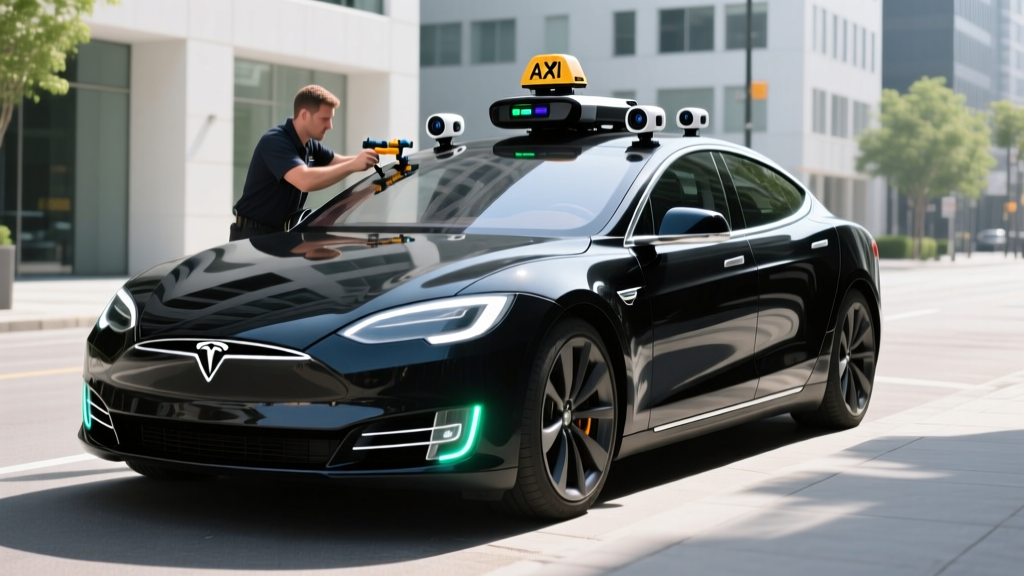
This is where Tesla repairs diverge most sharply from conventional vehicles. After any repair that could affect camera positioning, the shop runs a calibration routine. The process involves:
- Static calibration: The vehicle is positioned in a controlled environment with specific calibration targets (checkerboard patterns at precise distances). Tesla's diagnostic software measures each camera's actual field of view against the expected baseline and adjusts the software interpretation accordingly.
- Dynamic calibration: After static calibration, the vehicle is driven on roads with clear lane markings. The system collects real-world data to fine-tune its spatial understanding. Tesla's software typically requires 20–40 miles of varied driving to complete this phase.
If a camera housing was physically damaged and replaced, the new camera module must also be paired to the vehicle's HW4/HW5 computer — a process that only Tesla's diagnostic tools can perform.
Step 4: Validation and Quality Check
Before returning the vehicle, the shop verifies that all ADAS features function correctly: AEB triggers at the correct distance, Autosteer centers the vehicle, blind-spot warnings activate appropriately, and no diagnostic trouble codes remain. Tesla's service documentation requires a post-calibration test drive with logged data to confirm system health.
How Much Does Tesla Collision Repair Cost?
Costs vary widely depending on damage severity, but ADAS calibration adds a meaningful line item that conventional car repairs don't carry. Here's a general breakdown based on industry data and owner reports from 2025–2026:
| Repair Type | Typical Cost Range | ADAS Calibration Required? |
|---|---|---|
| Minor bumper scuff (no camera zone) | $800 – $2,500 | Usually no |
| Windshield replacement | $1,200 – $2,200 | Yes — front camera recalibration |
| Rear quarter-panel repair | $2,500 – $6,000 | Yes — rear-fender camera recalibration |
| Front-end collision (fascia, hood, fenders) | $5,000 – $15,000+ | Yes — multiple cameras + potential HW computer check |
| ADAS calibration only (post-repair) | $300 – $700 | N/A — this is the calibration line item |
| Camera module replacement (single) | $250 – $600 (part) + labor + pairing | Yes |
Insurance typically covers ADAS calibration as part of the collision claim, but owners should verify that their adjuster understands this requirement. Some insurers unfamiliar with EV-specific repair workflows may initially push back on calibration charges. Providing documentation from the Tesla-approved shop usually resolves this.
Limitations and Edge Cases in Tesla's Vision-Only System
What Tesla Vision Cannot Do (Even After Perfect Calibration):
- Heavy rain, fog, or snow can obscure camera lenses, causing Autopilot to disengage or reduce functionality. Unlike radar-based systems (used by competitors like Mercedes-Benz and BMW), camera-only systems have no redundant sensing modality in low-visibility conditions.
- Direct sun glare into the front cameras can temporarily blind the system, particularly at sunrise/sunset angles.
- Faded or absent lane markings reduce Autosteer confidence and may cause the system to disengage without warning on poorly maintained roads.
- Construction zones with shifted lanes, temporary barriers, or conflicting markings remain a significant edge case. The driver must be prepared to take over immediately.
- Camera contamination — mud, ice, or bug splatter on camera housings degrades performance. Tesla's software will display a "Camera visibility reduced" warning, but owners should proactively keep lenses clean.
The driver is always the final safety layer. No amount of calibration eliminates these physical limitations of a camera-only approach.
How Tesla's ADAS Repair Compares to Competitors
Tesla isn't the only automaker dealing with post-collision sensor calibration, but its camera-only architecture creates a unique repair profile. Here's how it stacks up against other major ADAS platforms:
| System | Sensors | Calibration After Collision | Self-Driving Level |
|---|---|---|---|
| Tesla Autopilot / FSD Supervised | 8 cameras (no radar on current models) | Static + dynamic; requires Tesla diagnostic tools | SAE Level 2 |
| Ford BlueCruise | Cameras + radar + ultrasonic | Static + dynamic; radar alignment also required | SAE Level 2 (hands-free on approved highways) |
| GM Super Cruise | Cameras + radar + LiDAR-mapped routes | Camera + radar calibration; LiDAR map is cloud-based | SAE Level 2 (hands-free on mapped roads) |
| Mercedes-Benz Drive Pilot | Cameras + radar + LiDAR + rear camera | Multi-sensor calibration; LiDAR units are expensive to replace | SAE Level 3 (conditional, limited markets) |
| BMW Highway Assistant | Cameras + radar + ultrasonic | Camera + radar calibration at authorized dealer | SAE Level 2 |
The key takeaway: Tesla's camera-only approach simplifies the sensor hardware (no radar units or LiDAR modules to replace after a collision) but makes precise camera alignment absolutely critical. With radar-equipped competitors, you're calibrating more sensor types but each individual sensor may be less sensitive to small angular shifts. Tesla's system demands tighter tolerances on camera positioning because the entire perception stack depends on those cameras alone.
Tesla Autopilot and FSD: Pricing and Availability
| Feature | Cost | Availability |
|---|---|---|
| Basic Autopilot (TACC + Autosteer) | Included (standard) | All new Tesla vehicles |
| Enhanced Autopilot | $6,000 one-time purchase | Model S, Model X, Model 3, Model Y (varies by market) |
| FSD (Supervised) — Purchase | $8,000 one-time purchase | All new Tesla vehicles |
| FSD (Supervised) — Subscription | $99/month | All Tesla vehicles with HW3 or later |
Note: Tesla has adjusted FSD pricing multiple times. The figures above reflect the most recent pricing as of early 2026. Enhanced Autopilot has been phased out in some markets, with FSD Supervised becoming the primary upgrade option. Always verify current pricing on Tesla's official support page.
Importantly, if your Tesla requires camera replacement after a collision, the ADAS software features you've purchased (Enhanced Autopilot or FSD) remain tied to the vehicle's VIN and hardware — they are not lost during repair. However, the repair shop must ensure the replacement camera is properly paired with the vehicle's computer, or FSD functionality may be restricted until pairing is complete.
Tips for Tesla Owners Navigating a Collision Repair
- Use a Tesla-approved body shop. Independent shops without Tesla certification may lack the diagnostic tools required for camera pairing and calibration. This can leave your Autopilot and FSD features non-functional — or worse, miscalibrated in ways that compromise safety.
- Document everything. Photograph the damage, the repair estimate, and any post-repair calibration reports. This protects you if an insurance dispute arises over calibration charges.
- Verify ADAS function before accepting the vehicle. During the post-repair test drive, activate Autosteer on a marked road, test AEB in a safe environment (or confirm the diagnostic report shows it passed), and check blind-spot warnings. If anything feels off, request a re-calibration.
- Keep cameras clean. Post-repair, make a habit of wiping camera lenses (located at the windshield header, A-pillars, rear fenders, and tailgate) during your regular car wash. Contaminated lenses degrade the system Tesla Vision relies on entirely.
- Check for software updates. Tesla frequently pushes over-the-air updates that may include calibration refinements. After a repair, ensure your vehicle is running the latest software version.
Frequently Asked Questions
Does every Tesla collision require ADAS calibration?
No. If the damage is purely cosmetic and doesn't affect any camera housing, mounting point, or windshield, calibration is typically unnecessary. Examples include a minor door ding or a scratch on the rear bumper below the camera. However, any repair involving the windshield, A-pillars, quarter panels, front fascia, or tailgate will likely trigger a calibration requirement.
Can I drive my Tesla with a cracked windshield before repair?
You can drive the vehicle manually, but Tesla Vision's front cameras are mounted directly behind the windshield. A crack in the camera's field of view can distort the image, potentially causing Autopilot to malfunction or disengage. Tesla's owner manual recommends disabling Autosteer if camera visibility is compromised and scheduling repair promptly.
How long does ADAS calibration take?
Static calibration in the shop typically takes 30–60 minutes. Dynamic calibration requires a 20–40 mile drive, which the shop usually performs as part of the post-repair quality check. Total turnaround for a repair that includes calibration is often 3–7 business days, depending on parts availability and shop workload.
Will my insurance cover Tesla ADAS calibration costs?
In most cases, yes — calibration is a necessary part of restoring the vehicle to pre-accident condition, which is the standard insurance obligation. However, some adjusters unfamiliar with EV repair may question the charge. Having the Tesla-approved shop provide documentation explaining the calibration requirement usually resolves this quickly.
Is Tesla's FSD actually self-driving?
No. FSD (Supervised) is an SAE Level 2 system. The driver must remain attentive, keep hands on the wheel (or provide steering-torque confirmation), and be prepared to take over at any moment. Only Level 4 systems — such as Waymo's driverless robotaxi service operating in defined urban zones — qualify as truly autonomous without a human driver in the loop. Tesla has not achieved Level 3, 4, or 5 certification from any regulatory body.
For more on Tesla's safety data and ADAS capabilities, see the IIHS Tesla ratings page and Tesla's quarterly Vehicle Safety Report.