The Tesla Train Collision Problem: What Keeps Happening
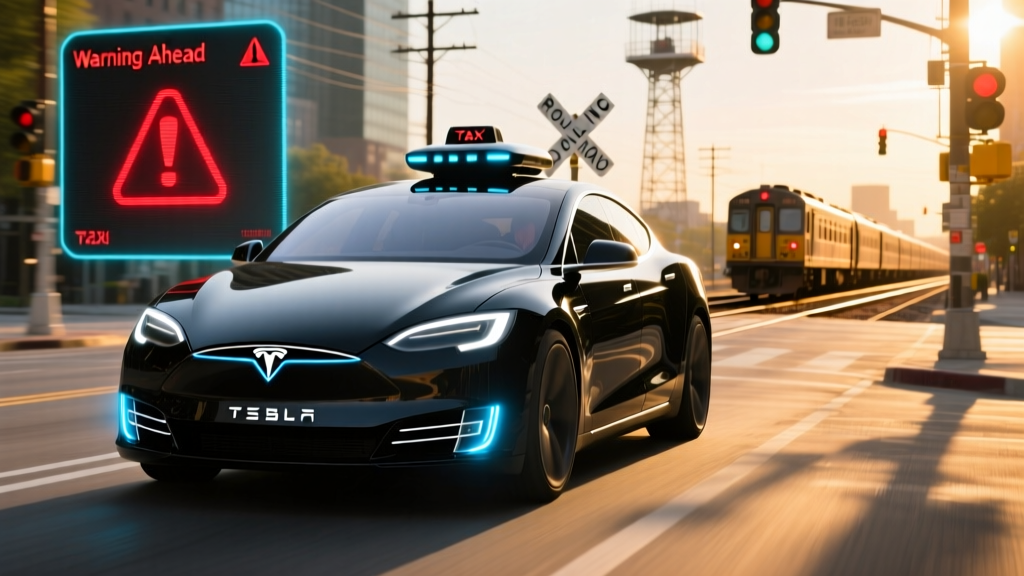
Since 2016, multiple incidents have involved Tesla vehicles on Autopilot or Full Self-Driving (FSD) colliding with trains at grade-level railroad crossings. These events are not anomalies — they expose a fundamental gap in how Level 2 driver-assistance systems perceive and respond to rail traffic. Unlike stopped cars or highway barriers, trains present a unique detection challenge: they are narrow relative to their length, move on fixed tracks that don't appear in HD maps as traffic lanes, and can approach at speeds exceeding 60 mph with enormous mass that no passenger vehicle can survive.
As of 2026, no consumer ADAS system — Tesla's included — is designed to detect or stop for trains at railroad crossings. The National Highway Traffic Safety Administration (NHTSA) has investigated multiple Autopilot-related incidents, and the National Transportation Safety Board (NTSB) has repeatedly flagged railroad crossings as an edge case that current vision-based systems handle poorly. Understanding why requires looking at the sensor architecture, the SAE automation level, and the legal reality that the driver remains responsible.
How Tesla Autopilot and FSD Actually Work (Sensor Architecture)
Tesla's current driver-assistance stack, branded Autopilot (standard) and FSD Supervised (paid upgrade), relies on a pure-vision architecture. Since 2022, Tesla has removed radar and ultrasonic sensors from all new vehicles, depending entirely on a suite of 8 cameras (front-facing, side-forward, side-rear, and rear-view) feeding into a neural network running on the Hardware 4.0 (HW4) computer.
Both Autopilot and FSD Supervised are classified as SAE Level 2 driver-assistance systems. This means the vehicle can control steering, acceleration, and braking under certain conditions, but the human driver must remain fully engaged, monitor the environment at all times, and be prepared to take over instantly. The driver is legally responsible for all vehicle actions. This is not "self-driving" — that designation begins at SAE Level 4, which currently applies only to geofenced robotaxi services like Waymo and Zoox.
The vision system is trained on billions of miles of driving data to recognize lane markings, vehicles, pedestrians, cyclists, and static obstacles. However, railroad crossings introduce elements the system was not primarily optimized for:
- Trains are geometrically unusual: A locomotive is narrow (roughly 10 feet wide) but can be hundreds of feet long, moving perpendicular to the vehicle's path. The neural network may not classify it as an "obstacle" until it's already partially in the vehicle's path.
- Crossing infrastructure is inconsistent: Some crossings have gates, flashing lights, and bells; others are passive (crossbucks only, no active warnings). Autopilot does not integrate with railroad crossing signal infrastructure.
- Track geometry confuses path prediction: The system may interpret railroad tracks as road markings or fail to predict that a train will occupy the vehicle's planned path.
- Speed differential is extreme: A freight train moving at 50 mph covers 73 feet per second and requires over a mile to stop. By the time a vision system confirms a train is approaching, the time window for evasive action may have closed.
Tesla Autopilot vs. FSD Supervised: Naming, Trims, and Cost
Tesla's driver-assistance offerings have distinct names, capabilities, and pricing. Confusion between "Autopilot" and "FSD" is common — and consequential when discussing incidents.
| Feature | Autopilot (Standard) | FSD Supervised |
|---|---|---|
| Included on | All new Tesla vehicles | All models (paid add-on) |
| SAE Level | Level 2 | Level 2 |
| Highway steering + lane keep | Yes | Yes |
| Traffic-aware cruise control | Yes | Yes |
| Auto lane change | No (driver-initiated) | Yes (with confirmation) |
| Traffic light / stop sign recognition | Display only | Active stop-and-go |
| Railroad crossing detection | No | No |
| City street navigation | No | Yes (FSD Supervised) |
| One-time purchase price (2026) | Included | $8,000 |
| Monthly subscription | N/A | $99/month |
Neither system includes specific railroad crossing detection or automatic stopping at grade crossings. FSD Supervised may slow the vehicle when approaching a crossing it identifies, but it does not reliably stop for approaching trains or verify that tracks are clear before proceeding.
Real-World Limitations: Where ADAS Fails at Railroad Crossings
- Detect approaching trains reliably, especially at oblique angles or in low-light conditions
- Automatically stop the vehicle when crossing gates are down or lights are flashing
- Integrate with railroad crossing signal infrastructure (no V2I communication)
- Recognize all passive crossings (unmarked or crossbuck-only) in HD maps
- Override driver input if the driver commands the vehicle forward across tracks
The limitations extend beyond Tesla. Every consumer ADAS system on the market — Ford BlueCruise, GM Super Cruise, Toyota Safety Sense, Honda Sensing, Hyundai/Kia Highway Driving Assist — operates at SAE Level 2 and shares similar blind spots at railroad crossings. The key differences lie in how aggressively each system monitors driver engagement:
| System | Brand | Driver Monitoring | Railroad Crossing Handling |
|---|---|---|---|
| Autopilot / FSD Supervised | Tesla | Torque-based steering + camera (cabin) | No active detection; driver responsible |
| BlueCruise | Ford | Driver-facing camera (eyes-on) | No active detection; hands-free zones only |
| Super Cruise | GM (Cadillac/Chev/GMC) | Driver-facing camera (eyes-on) | Disengages at mapped crossings on some routes |
| Toyota Safety Sense 3.0 | Toyota | Steering torque + alerts | No active detection; driver responsible |
| ProPILOT Assist 2.0 | Nissan | Driver-facing camera | No active detection; driver responsible |
GM's Super Cruise is notable for occasionally disengaging at known railroad crossings along its mapped highway network, forcing the driver to take manual control. This is a more conservative approach than Tesla's, which generally maintains Autopilot engagement through crossings unless the driver intervenes.
Why Vision-Only Systems Struggle with Trains Specifically
Tesla's decision to remove radar (starting with the Model 3/Y in 2021 and extending to all models by 2023) was controversial in the ADAS engineering community. Radar provides direct distance and velocity measurement of objects, which is particularly useful for detecting large metallic objects like trains — even in rain, fog, or darkness where cameras may struggle.
With vision-only, the system must:
- Classify the object correctly: A train must be identified as an obstacle, not background scenery. Side-on views of a locomotive at a crossing may not trigger the same "stop" response as a vehicle directly ahead.
- Estimate distance and speed from 2D images: Without radar or lidar, depth perception relies on stereo vision algorithms and learned priors. A train approaching from the side at 50+ mph may not register as an imminent collision threat until it's very close.
- Handle edge-case lighting: Nighttime, dusk, fog, and direct sun glare can degrade camera performance. Railroad crossings often lack the consistent lighting of highway environments.
- Manage occlusion: Vegetation, buildings, parked vehicles, and crossing gate infrastructure can partially block the camera's view of an approaching train until the last seconds.
Competitors using radar (Ford BlueCruise, GM Super Cruise) or lidar (some Mercedes Drive Pilot configurations in Germany) have additional sensor modalities that could theoretically detect a large metallic train earlier — but even these systems are not explicitly programmed to stop for trains. The responsibility remains with the driver across all platforms.
Safety Context: NHTSA Investigations and the Supervision Requirement
NHTSA has opened and closed multiple investigations into Autopilot-related crashes, including incidents at emergency vehicle scenes and railroad crossings. In 2023, NHTSA issued a standing general order requiring automakers to report all crashes involving Level 2 and higher ADAS systems. Tesla reports the highest volume of incidents, partly because it has the largest deployed fleet of vehicles with always-on telemetric reporting.
The NTSB has been more critical, issuing safety recommendations after investigations into specific Autopilot crashes. In multiple railroad-crossing incidents involving Teslas, the NTSB found that the driver was over-reliant on Autopilot and failed to monitor the driving environment — a pattern consistent with "automation complacency," where the human operator's attention degrades during long periods of competent system performance.
Tesla's in-cabin camera (present in all vehicles since late 2020) monitors driver attention, but enforcement varies. In FSD Supervised mode, the system will issue warnings and eventually disengage if the driver's eyes are not detected on the road. However, "looking at the road" and "actively processing that a train is approaching" are very different cognitive states. The system cannot verify comprehension, only gaze direction.
What This Means for Tesla Owners: Practical Guidance
If you own or are considering a Tesla (or any vehicle with Level 2 ADAS), here is the actionable framework for railroad crossings:
| Scenario | Recommended Action |
|---|---|
| Approaching any railroad crossing on Autopilot | Disengage Autopilot (tap brake or pull paddle); take manual control before the crossing |
| Approaching crossing with active gates/lights | Stop completely; do not rely on FSD to recognize and stop |
| Passive crossing (no gates, no lights) | Slow down, look both ways, cross manually — Autopilot may not even recognize the crossing |
| FSD Supervised navigating city streets near tracks | Stay alert; FSD may route across tracks without confirming they're clear |
| Nighttime or low-visibility crossing | Always manual — camera performance degrades in these conditions |
The fundamental rule: every railroad crossing is a manual-driving event. No consumer ADAS system in 2026 is rated or designed to handle train detection. The cost of a misjudgment is catastrophic — a loaded freight train can weigh 200 times more than a passenger vehicle, and no Tesla model's safety cell is engineered to survive a direct lateral impact with a locomotive.
Frequently Asked Questions
Does Tesla FSD stop for trains at railroad crossings?
No. FSD Supervised does not include reliable train detection. It may slow the vehicle at some crossings it identifies, but it cannot be depended on to stop for an approaching train. The driver must remain fully responsible for verifying that tracks are clear.
Why can't Tesla's cameras see a train coming?
Cameras can technically see trains, but the neural network must classify the object correctly, estimate its speed and distance from 2D images, and do so in time to stop. Trains are geometrically unusual (narrow but very long), approach from angles the system isn't optimized for, and may be partially occluded. Without radar or lidar providing independent distance/velocity data, the vision system has less margin for error.
Is Tesla Autopilot self-driving?
No. Autopilot and FSD Supervised are both SAE Level 2 driver-assistance systems. The driver must remain engaged, monitor the road, and be prepared to take over at any moment. True self-driving (SAE Level 4) currently exists only in geofenced robotaxi services like Waymo.
Does GM Super Cruise or Ford BlueCruise handle train crossings better?
Somewhat. GM's Super Cruise has been known to disengage at certain mapped railroad crossings, forcing the driver to take manual control — a more conservative approach. However, no Level 2 system actively detects approaching trains. All systems require driver responsibility at crossings.
How much does Tesla FSD cost in 2026?
FSD Supervised costs $8,000 as a one-time purchase or $99/month as a subscription. It is available on all current Tesla models (Model 3, Model Y, Model S, Model X, and Cybertruck). Standard Autopilot is included at no additional cost on all new Tesla vehicles.
Has NHTSA taken action on Tesla Autopilot and railroad crossings?
NHTSA has investigated multiple Autopilot-related crashes, including some at railroad crossings, and requires all automakers to report ADAS-related crashes under a standing general order. The NTSB has issued safety recommendations regarding automation complacency and the need for more robust driver engagement monitoring, though no specific regulation mandating train detection in consumer ADAS has been enacted as of 2026.