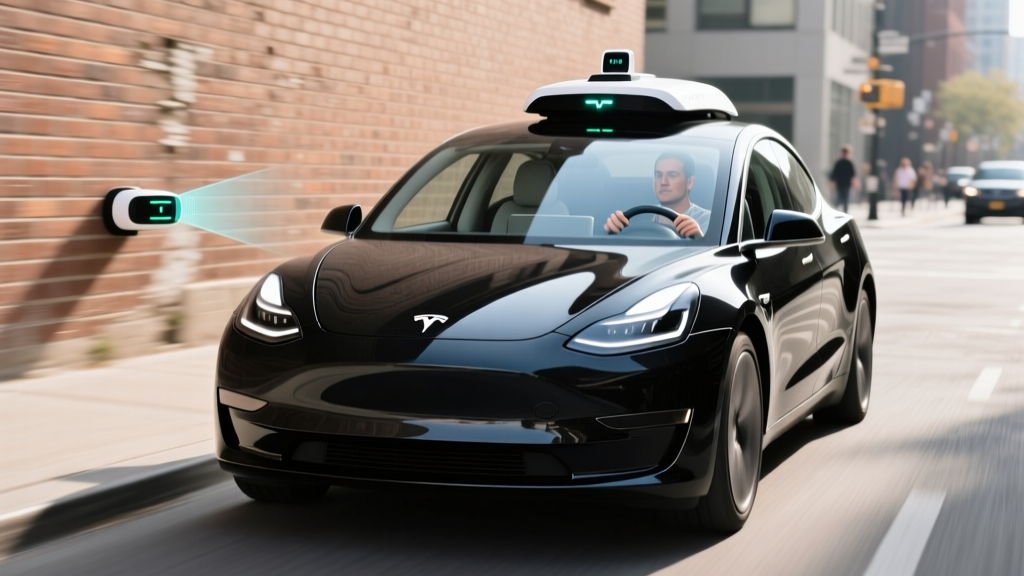
A viral video circulating across social media shows a Tesla Model Y driving toward a large mural of a brick wall painted directly onto a flat concrete barrier. The vehicle, operating with Tesla Autopilot engaged, does not brake. It strikes the painted surface at speed. This scenario — known colloquially as the "Tesla Autopilot painted brick wall test" — has become a lightning rod for debates about camera-based advanced driver-assistance systems (ADAS) and their real-world limitations.
The test is not an official NHTSA evaluation. It is an informal demonstration, but it highlights a genuine engineering challenge that every vision-based ADAS must confront: distinguishing a two-dimensional painted illusion from a three-dimensional physical obstacle. Understanding what this test reveals — and what it does not — is essential for anyone driving a Tesla or considering a vehicle equipped with Tesla Autopilot or Full Self-Driving (Supervised).
How Tesla's Vision-Only ADAS Actually Works
Since 2022, Tesla has relied exclusively on a camera-only sensor suite branded as "Tesla Vision." The current hardware (HW4/AI4, standard on 2025–2026 Model 3, Model Y, Model S, and Model X) uses up to eight exterior cameras providing 360-degree coverage. Earlier HW3 vehicles used a similar camera count but with lower-resolution sensors.
Tesla removed radar from new vehicles starting in mid-2021 and ultrasonic sensors starting in late 2022. The system now depends entirely on neural-network-driven image processing to perform object detection, depth estimation, lane tracking, and path planning.
| Sensor Type | Tesla Vision (2025–2026) | Competing ADAS (e.g., GM Super Cruise, Ford BlueCruise) |
|---|---|---|
| Cameras | 8 exterior (up to 5 MP) | 5–8 exterior cameras |
| Radar | None (removed 2021+) | 1–5 radar units (front + corner) |
| LiDAR | None | None (consumer); present in Waymo/Zoox L4 |
| Ultrasonic | None (removed 2022+) | 6–12 sensors (parking assist) |
| HD Maps | Not used | Used by Super Cruise / BlueCruise on mapped highways |
The depth-perception task — figuring out how far away an object is — is handled entirely by machine-learning models trained on billions of frames of driving data. In most scenarios, this works remarkably well. But the painted brick wall test exploits a specific edge case: a flat surface with texture and shadow cues that mimic a protruding object.
What the Painted Brick Wall Test Exposes
In the test scenario, a realistic brick-wall pattern is painted onto a flat concrete jersey barrier or wall surface. To a human driver, the illusion is immediately obvious — you can see the surrounding context, the lack of shadow beneath the "bricks," and the flatness of the surface at an angle. But a camera-based neural network processing a forward-facing image may interpret the painted depth cues (shadows, perspective lines, texture gradients) as a genuine three-dimensional obstacle — or, conversely, may fail to classify the flat wall as an obstacle at all if the pattern confuses its object-detection model.
The core issue is monocular depth ambiguity. Without radar or LiDAR providing an independent distance measurement, the system must infer depth from visual features alone. A trompe-l'oeil painting is specifically designed to defeat that inference.
This is not unique to Tesla. Any purely vision-based system — including the camera components of Mobileye SuperVision or Honda Sensing — can theoretically be fooled by adversarial visual inputs. However, systems that fuse camera data with radar or LiDAR have a physical backstop: the radar will report whether an object is actually protruding into the vehicle's path, regardless of what the camera sees.
SAE Automation Level: What Tesla Autopilot and FSD Actually Are
Both Tesla Autopilot and Full Self-Driving (Supervised) are classified as SAE Level 2 systems per the SAE J3016 standard. This means the driver must remain fully engaged, monitor the road at all times, and be prepared to take over instantly. The system provides combined steering and acceleration/braking assistance, but the human is the driver. Only Level 4 services like Waymo One operate without a human driver — and only in geofenced areas.
This distinction matters enormously in the context of the painted brick wall test. Because Tesla Autopilot and FSD Supervised are Level 2 systems, the driver is expected to notice the painted wall, recognize it as either a real obstacle or an illusion, and intervene. The system's failure to handle the edge case is a limitation — but under Level 2, the driver's failure to supervise is equally a factor.
Tesla's owner manuals state explicitly that Autopilot and FSD "may not detect all objects" and that the driver must "remain alert and be prepared to take action at any time." This legal and operational framework places the responsibility for handling edge cases squarely on the human.
Autopilot vs. FSD Supervised: Feature Breakdown and Cost
Tesla offers two tiers of driver-assistance software. Understanding the difference is critical before evaluating what the painted brick wall test applies to.
| Feature | Basic Autopilot (Standard) | Enhanced Autopilot (EAP) | FSD Supervised |
|---|---|---|---|
| Traffic-Aware Cruise Control | ✓ | ✓ | ✓ |
| Autosteer (lane centering) | ✓ (highway only) | ✓ | ✓ |
| Auto Lane Change | ✗ | ✓ | ✓ |
| Navigate on Autopilot (highway ramps) | ✗ | ✓ | ✓ |
| Autopark | ✗ | ✓ | ✓ |
| Summon / Smart Summon | ✗ | ✓ | ✓ |
| Traffic Light & Stop Sign Control | ✗ | ✗ | ✓ |
| City Street Autosteer | ✗ | ✗ | ✓ |
| SAE Level | Level 2 | Level 2 | Level 2 |
| Software Tier | One-Time Purchase (2025–2026) | Monthly Subscription | Included Standard? |
|---|---|---|---|
| Basic Autopilot | N/A | N/A | Yes — all new Teslas |
| Enhanced Autopilot (EAP) | $6,000 | Not available as subscription | No |
| FSD Supervised | $8,000 | $99/month | No |
The painted brick wall test is most relevant to scenarios where Autosteer is engaged — which applies to all three tiers. However, it is particularly relevant to FSD Supervised, which operates on city streets where murals, construction barriers with painted surfaces, and other visual anomalies are far more common than on divided highways.
Real-World Limitations Beyond the Painted Wall
The painted brick wall is one dramatic edge case, but Tesla Vision has documented limitations across several categories that every owner should understand:
- Stationary objects at speed: NHTSA has investigated numerous incidents where Teslas on Autopilot struck stationary emergency vehicles, construction barriers, and parked cars. The system has historically struggled to classify unexpected stationary objects, particularly at highway speeds above 45 mph.
- Low-light and adverse weather: Heavy rain, fog, snow, and direct sun glare can degrade camera performance. Tesla's owner manual warns that Autopilot "may not function properly" in these conditions.
- Faded or missing lane markings: Construction zones, rural roads, and recently repaved surfaces without fresh striping can cause Autosteer to disengage or make incorrect steering decisions.
- Phantom braking: Tesla Vision has been widely reported to initiate unexpected hard braking on clear roads — often triggered by shadows, overpasses, or roadside objects the system briefly classifies as obstacles. NHTSA opened an investigation into this behavior in 2022 and continued monitoring through 2025.
- High-contrast visual anomalies: Billboards, murals, reflective building facades, and painted road surfaces can create false positives or false negatives in object detection.
The NHTSA's Standing General Order requires automakers to report crashes involving Level 2+ systems. Tesla's reported incident numbers are high partly because of the large fleet size and the aggressive deployment of its ADAS features, but the data underscores that these systems are not infallible.
How Competing ADAS Systems Handle the Same Scenario
A camera-plus-radar fusion system — such as those used by GM Super Cruise, Ford BlueCruise, Hyundai/Kia Highway Driving Assist 2, and Mercedes-Benz Drive Pilot (Level 3, limited availability) — has an inherent advantage in the painted-wall scenario. The forward-facing radar measures the physical distance to objects using radio waves. A flat painted wall will return a radar signature consistent with a flat surface at a fixed distance, not a protruding obstacle. The system can cross-reference the camera's classification with the radar's physical measurement.
| System | Sensor Fusion | HD Maps | Operational Domain | Cost |
|---|---|---|---|---|
| Tesla Autopilot / FSD | Camera only | No | All roads (FSD) | $0–$8,000 / $99/mo |
| GM Super Cruise | Camera + radar + LiDAR (vehicle) | Yes (320,000+ mi mapped) | Mapped highways only | $2,500 + $25/mo after trial |
| Ford BlueCruise | Camera + radar | Yes (130,000+ mi mapped) | Mapped highways only | $2,100 or $75/mo |
| Hyundai HDA2 | Camera + radar | No | Highway only | Included on select trims |
| Mercedes Drive Pilot | Camera + radar + LiDAR + HD maps | Yes | Limited highways, <40 mph (Level 3) | $2,500/yr (CA/NV) |
Systems like Super Cruise and BlueCruise restrict their operation to pre-mapped divided highways, which dramatically reduces the likelihood of encountering a painted mural on a jersey barrier. Tesla's decision to allow Autosteer and FSD on any road increases the system's versatility but also its exposure to unpredictable visual environments.
What Tesla Owners Should Do Right Now
If you drive a Tesla with Autopilot or FSD Supervised, the painted brick wall test is a useful reminder of practical safety habits:
- Never trust the system with stationary objects: Approach construction zones, barriers, and stopped traffic with your foot hovering over the brake. Tesla Vision's weakest performance envelope is stationary-object detection at speed.
- Watch for visual anomalies: Murals, billboards at road level, painted construction barriers, and reflective surfaces are all potential confusion points. If you see one ahead, prepare to take over.
- Maintain following distance: The system's reaction time to unexpected obstacles is not instantaneous. A 3-second following minimum gives you time to intervene.
- Keep cameras clean: Dirt, water spots, and ice on camera lenses degrade performance. Tesla's camera-cleaning wipers (on 2025+ models) help, but manual cleaning is still necessary.
- Report incidents: If Autopilot or FSD behaves unexpectedly, submit a report via the Tesla app. Dashcam footage of edge cases like the painted wall scenario contributes to fleet learning and future OTA improvements.
Frequently Asked Questions
Did Tesla Autopilot actually fail the painted brick wall test?
In the widely shared video, a Tesla operating on Autopilot did not brake for a painted brick wall on a flat barrier and struck the surface. This is consistent with known limitations of camera-only depth perception. However, the test is informal and not a standardized evaluation. Results may vary by software version, approach speed, lighting conditions, and the specific painting's visual characteristics.
Is Tesla Autopilot or FSD self-driving?
No. Both are SAE Level 2 driver-assistance systems. The driver must remain fully attentive, keep hands on or near the wheel (Tesla monitors via steering torque and cabin camera), and be prepared to take over at any moment. The "Full Self-Driving" name is a product label, not a technical classification.
Would radar have prevented the painted wall collision?
Very likely, yes. A forward-facing radar would detect that the surface is flat and at a fixed distance, rather than a protruding three-dimensional object. This is why most competing ADAS systems retain radar as a redundant sensor. Tesla's decision to remove radar was a deliberate bet that neural-network vision processing would eventually match or exceed sensor-fusion performance — a bet that remains debated in the engineering community.
Has Tesla addressed this limitation in software updates?
Tesla continuously improves Tesla Vision via over-the-air (OTA) updates. FSD v12 and v13 (2024–2025) moved to an end-to-end neural network architecture that improved general object detection and reduced phantom braking. However, fundamental physics limits remain: a camera cannot measure physical depth the way radar or LiDAR can. Software improvements reduce but do not eliminate the risk of visual illusions.
How does Tesla's safety record on Autopilot compare to manual driving?
Tesla publishes quarterly safety data showing lower crash rates per million miles with Autopilot engaged versus the U.S. average. However, this data has been criticized for not accounting for the fact that Autopilot is primarily used on divided highways — the safest driving environment. The IIHS has noted that driver-assistance systems can create complacency, leading to worse outcomes when the system encounters an edge case the driver isn't prepared for.
What does FSD Supervised cost in 2025–2026?
FSD Supervised costs $8,000 as a one-time purchase or $99 per month as a subscription on all current Tesla models (Model 3, Model Y, Model S, Model X). Basic Autopilot is included standard on every new Tesla. Enhanced Autopilot (EAP) costs $6,000 one-time. None of these features change the SAE Level 2 classification or the driver's legal responsibility.