What Is Tesla Autopilot and What Does It Actually Do?
Every new Tesla sold in the United States — Model 3, Model Y, Model S, and Model X — ships with Basic Autopilot at no additional charge. This is Tesla's baseline Level 2 driver-assistance suite, bundling two core functions:
- Traffic-Aware Cruise Control (TACC): Uses forward-facing cameras and neural-net processing to match the speed of the car ahead, maintaining a driver-selected following distance down to a complete stop.
- Autosteer: Keeps the vehicle centered in a clearly marked lane using the same vision-based system, providing continuous steering input on highways and divided roads.
Since 2022, Tesla has relied exclusively on its Tesla Vision camera-only architecture — eight surround cameras (front, left/right forward, left/right rear, and rear) feeding images to the onboard Hardware 4 (AI5) computer. Radar and ultrasonic sensors were removed from production starting in 2021–2022. This differs from competitors like Ford BlueCruise or GM Super Cruise, which supplement cameras with radar and, in GM's case, LiDAR.
Basic Autopilot, Enhanced Autopilot, and Full Self-Driving (Supervised) are all classified as SAE Level 2 per the SAE J3016 standard. This means the system can control steering and acceleration simultaneously, but the human driver must remain fully engaged — eyes on the road, hands available to take over instantly. Tesla is not a self-driving car. No consumer Tesla system qualifies as Level 3, 4, or 5. Only purpose-built robotaxi services like Waymo One operate at Level 4 in geofenced areas.
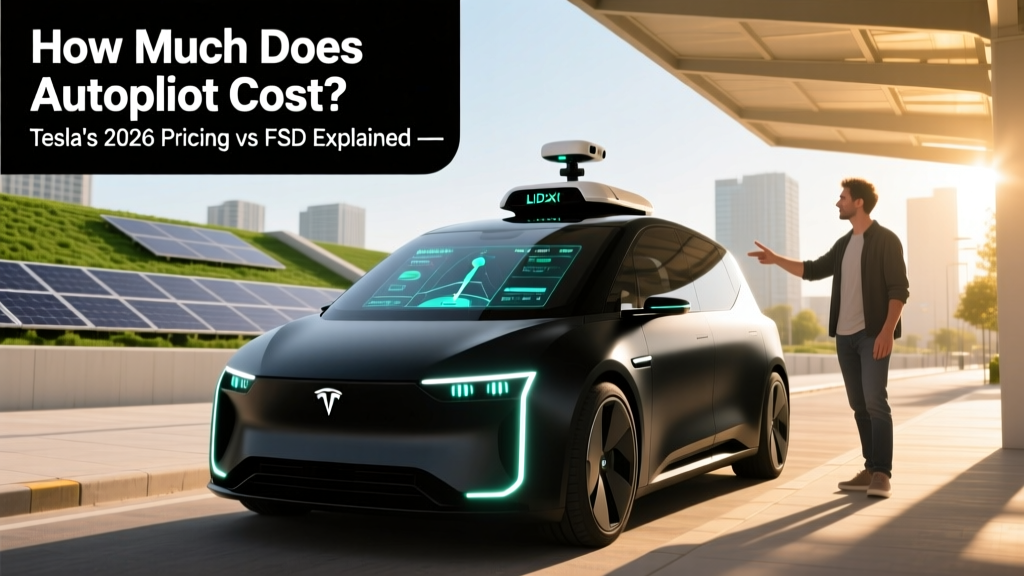
How Much Does Autopilot Cost? The Full Pricing Breakdown
Tesla offers three tiers of driver-assistance technology. Basic Autopilot is standard; the two paid tiers can be purchased outright or, in the case of FSD, subscribed to monthly. Here is the current 2026 pricing structure:
| Tier | One-Time Purchase | Monthly Subscription | Included Standard? |
|---|---|---|---|
| Basic Autopilot | $0 | N/A | Yes — all new Teslas |
| Enhanced Autopilot (EAP) | $6,000 | Not available | No |
| Full Self-Driving (Supervised) | $8,000 | $99/month | No |
Key pricing notes for 2026:
- Basic Autopilot is non-negotiable and free. You cannot opt out of it, and it cannot be removed. It activates automatically when you pull the cruise control stalk twice (or tap the Autopilot icon on the touchscreen in newer Model 3/Y refresh vehicles with stalkless steering columns).
- Enhanced Autopilot is purchase-only. Tesla discontinued the EAP subscription option in late 2023. If you want EAP features, you pay $6,000 upfront, either at vehicle purchase or added later through the Tesla app.
- FSD (Supervised) offers flexibility. The $8,000 outright purchase is a one-time, lifetime license tied to the vehicle. The $99/month subscription can be canceled at any time and does not require a long-term commitment. Tesla occasionally offers promotional subscription rates (e.g., $99/month for the first 6 months), but the standard rate has held at $99 since mid-2024.
- FSD transfers: Tesla has periodically offered limited-time FSD transfer promotions (allowing owners to move an FSD purchase to a new Tesla). As of early 2026, no active transfer promotion is in effect — verify on Tesla's support page before assuming transferability.
What You Get at Each Tier: Feature Comparison
| Feature | Basic Autopilot | Enhanced Autopilot | FSD (Supervised) |
|---|---|---|---|
| Traffic-Aware Cruise Control | ✅ | ✅ | ✅ |
| Autosteer (lane centering) | ✅ | ✅ | ✅ |
| Navigate on Autopilot (auto lane changes, off-ramps) | ❌ | ✅ | ✅ |
| Auto Lane Change (with confirmation) | ❌ | ✅ | ✅ |
| Autopark (parallel & perpendicular) | ❌ | ✅ | ✅ |
| Smart Summon | ❌ | ✅ | ✅ |
| Traffic Light & Stop Sign Control | ❌ | ❌ | ✅ |
| City Street Autosteer (FSD city driving) | ❌ | ❌ | ✅ |
| Driver monitoring | Torque sensing | Torque sensing | Cabin camera |
The most consequential upgrade from Basic to FSD is city-street Autosteer. While Basic Autopilot and EAP function primarily on highways and divided roads with clear lane markings, FSD (Supervised) attempts to navigate surface streets, handle unprotected left turns, respond to traffic signals, and manage multi-way stop intersections. In practice, this capability varies enormously by geography and road complexity — more on that below.
Which Tesla Models Include Autopilot, and What Are the Requirements?
Basic Autopilot is included on every new Tesla sold in 2026, regardless of trim:
- Model 3 (Standard Range, Long Range, Performance) — all trims, starting at $38,990 MSRP
- Model Y (Long Range, Performance) — all trims, starting at $44,990 MSRP
- Model S (Long Range, Plaid) — all trims, starting at $74,990 MSRP
- Model X (Long Range, Plaid) — all trims, starting at $79,990 MSRP
- Cybertruck (AWD, Cyberbeast) — all trims, starting at $79,990 MSRP
Enhanced Autopilot and FSD can be added to any of the above models at the time of purchase or retroactively via the Tesla app, provided the vehicle has Hardware 3 (HW3) or later. All Teslas built after April 2019 have HW3; vehicles built from mid-2023 onward use the upgraded Hardware 4 (also called AI5), which offers higher-resolution camera processing and improved neural-net inference speed. If you are buying a used Tesla, verify the hardware generation — HW3 vehicles can run FSD, but HW4 delivers noticeably smoother performance in complex scenarios.
Real-World Limitations: Where Autopilot and FSD Fall Short
Tesla's Autopilot and FSD (Supervised) do not make the vehicle autonomous. The National Highway Traffic Safety Administration (NHTSA) has investigated multiple incidents involving Autopilot-engaged vehicles and stationary emergency vehicles. The driver is legally and physically responsible for the vehicle at all times. Specific limitations include:
- Faded or missing lane markings: Autosteer may disengage abruptly or drift. Construction zones with shifted lanes are a common failure mode.
- Heavy rain, fog, snow, or direct sun glare: Camera-only Tesla Vision degrades in low-visibility conditions. The system will display a "Camera visibility reduced" warning and may limit or disable Autosteer entirely.
- Complex intersections: FSD city driving struggles with unprotected left turns across heavy traffic, multi-lane roundabouts, and non-standard intersections (e.g., five-way stops, offset cross streets).
- Phantom braking: Tesla Vision has a documented tendency to apply unexpected deceleration on highways, particularly when overpasses or shadows cross the road ahead. NHTSA opened an investigation into this behavior in 2022; reports continue as of 2026.
- Emergency vehicles: Despite software updates aimed at improving detection, Teslas on Autopilot have been involved in collisions with parked fire trucks and police cars. Never rely on the system to detect stationary emergency vehicles.
In real-world highway driving, Basic Autopilot performs reliably on well-marked interstates with moderate traffic. On a 400-mile road trip across I-80 in clear conditions, Autosteer typically handles 85–90% of highway miles without intervention. The remaining 10–15% usually involves construction zones, lane merges, or exits where the system requests driver takeover with a visual and audible alert.
FSD (Supervised) on city streets is far less consistent. In our experience across suburban and urban environments, FSD requires driver intervention roughly once every 5–15 miles on surface streets — sometimes to correct an overly cautious stop, sometimes to prevent an unsafe lane choice, and occasionally to avoid a misidentified obstacle. It is a convenience feature, not a replacement for attentive driving.
Tesla Autopilot vs. Competing Systems: How Does the Cost Compare?
| System | Brand | SAE Level | Cost | Hands-Free? |
|---|---|---|---|---|
| Autopilot / FSD | Tesla | Level 2 | Free–$8,000 / $99/mo | No (torque or camera monitoring) |
| BlueCruise | Ford | Level 2 | $2,100 (3 yr) or $75/mo | Yes (on pre-mapped highways, eyes monitored) |
| Super Cruise | GM (Cadillac/Chevy) | Level 2 | Included on select trims, $25/mo after trial | Yes (on 750,000+ mi mapped roads, LiDAR + camera) |
| ProPILOT Assist 2.0 | Nissan | Level 2 | Included on SV/SL trims | Yes (eyes-on monitoring, mapped highways) |
| Toyota Safety Sense 3.0 | Toyota | Level 2 | Standard on all trims | No (hands-on required) |
The most significant differentiator between Tesla Autopilot and systems like Ford BlueCruise or GM Super Cruise is the hands-free capability on mapped highways. Both BlueCruise and Super Cruise allow the driver to remove their hands from the wheel on pre-mapped divided highways, while monitoring driver attention via infrared eye-tracking cameras. Tesla's Autopilot and FSD require continuous steering-wheel torque (or, for FSD, cabin-camera eye monitoring) and do not permit true hands-free operation.
However, Tesla's FSD has a broader operational design domain (ODD) in theory — it attempts to drive on any road, not just pre-mapped highways. Whether that broader ODD is a benefit or a liability depends on your tolerance for edge-case interventions. On a mapped interstate, Super Cruise is arguably smoother and more predictable. On a rural two-lane road, only Tesla's system will attempt to steer at all.
Is Autopilot or FSD Worth the Cost? A Practical Decision Framework
Stick with free Basic Autopilot if:
- You primarily drive on well-marked highways and want adaptive cruise + lane centering.
- You are skeptical of subscription costs and do not need automated lane changes.
- You view driver-assistance as a convenience, not a primary purchase reason.
Consider Enhanced Autopilot ($6,000) if:
- You take frequent long highway trips and want Navigate on Autopilot to handle on/off-ramps and lane changes automatically.
- You value Autopark and Smart Summon for tight parking situations.
- You do not need city-street driving assistance and want to avoid the $99/month FSD subscription.
Consider FSD ($8,000 or $99/month) if:
- You want to evaluate city-street automated driving and are comfortable with frequent interventions.
- You prefer the subscription model — at $99/month, you can trial FSD for a few months and cancel if it does not meet expectations (9 months of subscription equals the cost gap between EAP and FSD outright).
- You anticipate Tesla expanding FSD capabilities meaningfully during your ownership period, though this is speculative.
From a pure cost-per-use standpoint, if you commute 40 highway miles daily and rely on Autosteer for 80% of that distance, Basic Autopilot delivers substantial value at zero cost. The jump to EAP or FSD is harder to justify on economics alone — it is a technology-enthusiast purchase, not a fuel-savings calculation.
Frequently Asked Questions
Is Tesla Autopilot free?
Yes. Basic Autopilot — which includes Traffic-Aware Cruise Control and Autosteer — is included at no additional cost on every new Tesla. You do not need to purchase anything extra to get adaptive cruise control and lane-centering on highways.
Is Tesla Autopilot self-driving?
No. All Tesla driver-assistance systems, including Full Self-Driving (Supervised), are SAE Level 2 — meaning the driver must remain fully attentive and ready to take over at any moment. The "Full Self-Driving" name is a product label, not a description of capability. Tesla's owner's manual and the Tesla Autopilot page explicitly state that the driver is responsible for the vehicle at all times.
Can I add FSD to my Tesla after purchase?
Yes. If your Tesla has Hardware 3 or later (all vehicles built after April 2019), you can purchase FSD outright ($8,000) or subscribe ($99/month) at any time through the Tesla app. The software is delivered via an over-the-air update, typically within a few hours of purchase.
Does FSD transfer if I sell my Tesla?
FSD purchased outright is tied to the vehicle, not the owner. If you sell your Tesla privately, the FSD license stays with the car (which may increase resale value). If you trade it in to Tesla, the FSD license does not transfer to your new vehicle unless Tesla is running an active transfer promotion. Subscription-based FSD does not transfer — you must re-subscribe on the new vehicle.
How does Tesla's camera-only approach compare to LiDAR-based systems?
Tesla removed radar and ultrasonic sensors in favor of a pure camera (Tesla Vision) approach. Competitors like GM Super Cruise and Nissan ProPILOT 2.0 use LiDAR or radar to supplement cameras, providing redundancy in low-visibility conditions. In practice, Tesla Vision performs well in clear weather but is more susceptible to degradation in heavy rain, fog, snow, and direct sun glare. Camera-only is a cost-saving and simplicity decision by Tesla, and it remains a subject of debate among safety researchers at IIHS.
What happens if I stop paying the FSD subscription?
If you cancel the $99/month FSD subscription, your Tesla reverts to Basic Autopilot functionality at the end of the billing cycle. You lose access to Navigate on Autopilot, Auto Lane Change, Autopark, Smart Summon, Traffic Light and Stop Sign Control, and city-street Autosteer. You can resubscribe at any time without penalty.
Does using Autopilot affect my insurance premium?
It depends on your insurer and state. Some insurers offer discounts for vehicles equipped with ADAS features; others have raised premiums on Teslas due to higher repair costs and claim frequency. Tesla offers its own insurance product in many states that uses real-time driving data (including Autopilot usage) to calculate premiums. Check with your provider for specifics.