What Tesla Autopark Actually Does
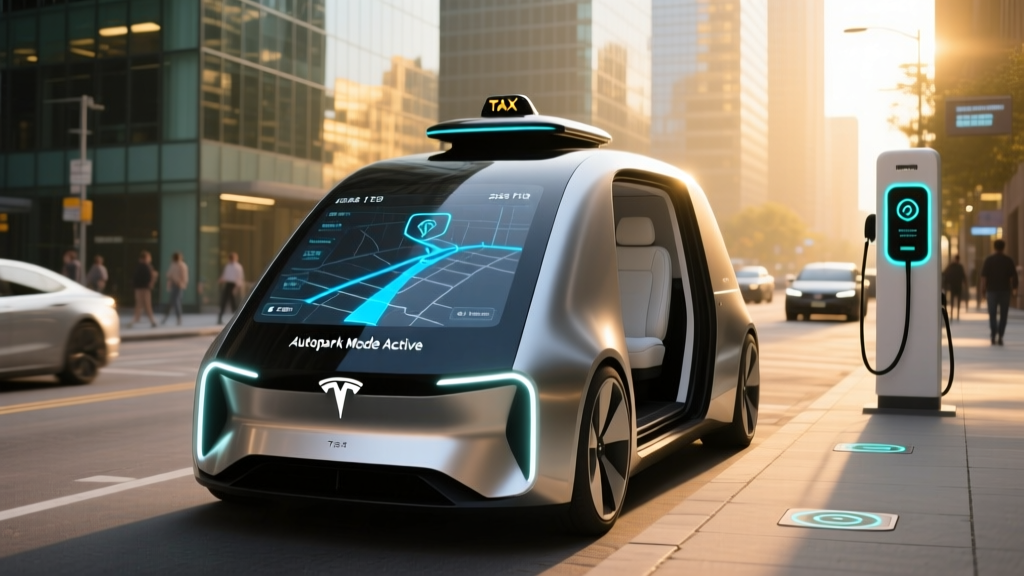
Tesla Autopark is a semi-automated parking assist feature embedded within Tesla's Autopilot and Full Self-Driving (FSD) software stacks. When activated at low speeds (typically under 15 mph), the system scans for detected parking spaces — parallel or perpendicular — and, upon driver confirmation, takes over steering, acceleration, braking, and gear selection to maneuver the vehicle into the spot.
The feature is designed for low-speed, structured environments: parking lots, driveways, and curb-side parallel spaces. The driver remains responsible for monitoring the surroundings, verifying clearance, and intervening at any point by tapping the brake or taking the steering wheel.
Tesla Autopark operates under SAE Level 2 automation. This means the system can control steering and acceleration simultaneously, but the driver must remain fully engaged, monitor the environment, and be prepared to take over instantly. It is not a self-driving or autonomous parking system. The vehicle cannot operate without a licensed, attentive driver in the seat.
How Autopark Works: Sensors, Vision, and Software
Since late 2022, Tesla has relied exclusively on its Tesla Vision camera-only architecture, having removed ultrasonic sensors (USS) and radar from all new production vehicles. Autopark now depends on:
- 8 surround cameras (front narrow/wide, left/right repeaters, left/right rear pillars, rear) providing 360° coverage
- Neural network–based occupancy mapping that replaces the ultrasonic distance readings previously used to detect curbs, poles, and nearby objects
- Real-time SLAM (Simultaneous Localization and Mapping) to track vehicle position relative to parking-space boundaries
- HW4 (AI4) computer in 2023+ vehicles, offering higher-resolution camera processing and faster inference than HW3
When you drive slowly past a row of parked cars or open spaces, the system identifies potential parking spots and displays a "P" icon on the touchscreen. Shifting into reverse triggers the Autopark prompt. Once confirmed, the vehicle executes the maneuver — including multi-point turns for tight parallel spots — while the driver monitors progress on the 3D visualization render.
| Parameter | Specification |
|---|---|
| Sensor suite | 8 cameras (Tesla Vision, no USS/radar) |
| Compute platform | HW4 (AI4) — 2023+ vehicles; HW3 legacy |
| Supported maneuvers | Parallel parking, perpendicular parking |
| Max activation speed | ~15 mph (24 km/h) |
| Min. parallel space required | ~6 ft longer than vehicle length (varies by model) |
| Min. perpendicular space required | ~2 ft wider than vehicle width |
| Multi-point turns | Yes (3-point and 5-point supported) |
| Driver supervision | Mandatory — brake or steering input cancels maneuver |
Which Tesla Models Include Autopark — and at What Cost?
Autopark is not available as a standalone feature. It requires the Full Self-Driving (FSD) capability package, which Tesla sells either as a one-time purchase or a monthly subscription. Basic Autopilot (standard on all Teslas) includes Traffic-Aware Cruise Control and Autosteer on highways, but not Autopark, Summon, or Smart Summon.
| Option | Cost | Includes Autopark? |
|---|---|---|
| Basic Autopilot (standard) | $0 (included) | No |
| FSD one-time purchase | $8,000 | Yes |
| FSD monthly subscription | $99/month | Yes |
All current-production Tesla models — Model 3, Model Y, Model S, Model X, and Cybertruck — are hardware-compatible with Autopark, provided they have HW4 or later. Vehicles built before mid-2023 with HW3 retain Autopark functionality but may experience slower processing and slightly less precise space detection.
One cost nuance: Tesla periodically adjusts FSD pricing. The $8,000 purchase price and $99/month subscription are current as of early 2026, but Tesla has historically run promotional price reductions. Check Tesla's configurator at time of order for the live number.
Real-World Performance: Where Autopark Succeeds and Struggles
In controlled testing — well-lit parking lots with clearly painted lines, flat surfaces, and standard-width spaces — Autopark performs competently. Perpendicular parking in open-air lots is its strongest use case: the system identifies the space, centers the vehicle, and completes the maneuver in one or two smooth motions.
Parallel parking, the more complex task, works well when the detected space is at least 6 feet longer than the vehicle. Multi-point corrections are handled smoothly, and the steering inputs are generally more precise than an average driver's.
- No ultrasonic sensors: Tesla Vision relies on visual detection. Small obstacles (thin bollards, low curbs, trailer hitches, shopping-cart wheels) may not register reliably at close range.
- Poor lighting: Nighttime parking in poorly lit lots or garages reduces camera accuracy. Faded or absent parking lines degrade space detection.
- Weather degradation: Heavy rain, snow, or fog obscuring cameras can cause the system to abort or refuse to engage.
- Tight spaces: Spaces less than ~2 ft wider (perpendicular) or ~6 ft longer (parallel) than the vehicle may not be detected or may result in door-opening difficulty.
- Angled/irregular spaces: Non-standard geometries (diagonal, wedge-shaped, or spaces on slopes) are not reliably supported.
- Moving pedestrians/carts: While the system monitors for dynamic obstacles, reaction latency in dense pedestrian environments requires driver readiness to cancel immediately.
The transition from ultrasonic sensors to Tesla Vision remains the most debated aspect of Autopark's real-world reliability. Ultrasonic sensors provided hard distance measurements to objects regardless of lighting or paint lines. Tesla Vision infers distances from camera data using neural networks — impressive in most conditions, but subject to edge-case failures that ultrasonics would have caught. Owners in regions with heavy snowfall or frequent rain report more Autopark aborts than those in dry, sunny climates.
Tesla Autopark vs. Competing Parking Assist Systems
Automated parking assist is not unique to Tesla. Several OEMs offer comparable features, though their sensor strategies, pricing models, and capabilities differ meaningfully.
| Brand / Feature Name | Sensor Suite | Parallel | Perpendicular | Remote Park | Cost |
|---|---|---|---|---|---|
| Tesla Autopark (FSD) | Cameras only (Tesla Vision) | Yes | Yes | Summon / Smart Summon | $8,000 or $99/mo |
| BMW Parking Assistant Plus | Cameras + ultrasonic + surround view | Yes | Yes | Remote Parking (select models) | ~$1,100 one-time (package) |
| Mercedes PARKTRONIC w/ Active Parking Assist | Cameras + ultrasonic | Yes | Yes | Remote Parking Assist (EQS/EQE) | Included in Premium packages (~$2,000+) |
| Hyundai Remote Smart Parking Assist (RSPA) | Ultrasonic + cameras | Yes | Yes | Yes (key fob) | Included on Limited/Calligraphy trims |
| Ford Active Park Assist Plus | Ultrasonic + cameras | Yes | Yes | No | Included on mid/high trims |
The critical difference: Tesla's camera-only approach is the outlier. BMW, Mercedes, Hyundai, and Ford all retain ultrasonic sensors as a redundant close-range object-detection layer. This gives those systems a measurable advantage in detecting thin posts, low curbs, and objects in darkness — precisely the edge cases where Tesla Vision can struggle.
On the flip side, Tesla's FSD subscription model ($99/month) means you can try Autopark without an $8,000 commitment, and the same subscription unlocks highway Autosteer, Auto Lane Change, and Smart Summon. Competing systems are typically bundled into trim packages with no subscription flexibility.
Summon and Smart Summon: Autopark's Companion Features
While Autopark handles parking while you're in the driver's seat, Tesla's Summon and Smart Summon extend the concept to remote operation via the Tesla mobile app.
- Summon: Moves the vehicle forward or backward in a straight line (up to ~39 feet) — useful for extracting from tight garage spaces where opening doors is impossible.
- Smart Summon: Navigates the vehicle through a parking lot to your phone's GPS location, avoiding obstacles and pedestrians. Range is limited to approximately 213 feet (65 meters) from your phone.
Both features also require FSD and operate under SAE Level 2 — your thumb must remain on the phone screen, and releasing it stops the vehicle immediately. In practice, Smart Summon's reliability varies significantly with lot complexity, pedestrian density, and lighting conditions. It's a useful feature for specific scenarios (rainy-day pickup, narrow garage), but it is not a replacement for walking to your car.
Safety Context: What Autopark Does NOT Do
Understanding the boundaries of Autopark is essential for safe use. Per NHTSA guidance on automated driving systems, Level 2 features require continuous driver supervision. Specifically:
- Autopark does not eliminate the need to check mirrors and blind spots. Camera blind zones exist, particularly at the vehicle's lower corners.
- Autopark does not guarantee obstacle avoidance. Thin objects, low-reflectivity surfaces, and fast-approaching pedestrians may not trigger a stop in time.
- Autopark does not work in all spaces. If the system cannot detect clear boundaries, it will not engage — and forcing the feature in marginal conditions is a driver error.
- You are legally liable. In every US jurisdiction, the driver is responsible for the vehicle's movements during Level 2 operation. A parking-lot collision during Autopark is the driver's fault, not Tesla's.
Tesla's owner's manual makes this explicit: the driver must remain in the driver's seat, monitor the surroundings, and be prepared to cancel the maneuver by tapping the brake pedal or touching the steering wheel. There is no scenario in which you should exit the vehicle while Autopark is executing (that capability is reserved for Summon, which operates under different constraints).
Frequently Asked Questions
Is Tesla Autopark truly self-driving?
No. Autopark is an SAE Level 2 driver-assistance feature. The driver must remain seated, attentive, and ready to intervene at any moment. The system controls steering, braking, and gear selection during the parking maneuver, but full legal and operational responsibility rests with the driver.
How much does Tesla Autopark cost in 2026?
Autopark requires Tesla's Full Self-Driving (FSD) package, priced at $8,000 as a one-time purchase or $99/month as a subscription. Basic Autopilot, which is standard on all Teslas, does not include Autopark.
Does Autopark work on all Tesla models?
Yes — Model 3, Model Y, Model S, Model X, and Cybertruck all support Autopark, provided the vehicle has the FSD software package activated. Vehicles with HW4 (AI4) offer better processing speed and detection accuracy than older HW3 units.
Why does Autopark sometimes fail to find a parking space?
Tesla Vision requires visible parking lines or clear spatial boundaries to detect a space. Faded paint, unpaved lots, snow-covered surfaces, and poorly lit garages can all prevent detection. The absence of ultrasonic sensors (removed since late 2022) means the system cannot fall back on proximity sensing alone.
Can I use Autopark in a parking garage?
Yes, if lighting is adequate and parking lines are visible. Low-ceiling, dimly lit garages with worn markings reduce reliability. Always remain prepared to cancel the maneuver and park manually.
How does Tesla Autopark compare to BMW or Hyundai parking assist?
BMW and Hyundai systems retain ultrasonic sensors, giving them an edge in detecting small obstacles and operating in low-light conditions. Tesla's advantage is the subscription pricing model and integration with Summon/Smart Summon. For pure parking reliability in varied conditions, ultrasonic-equipped systems currently hold a practical edge.
Sources: Tesla Autopilot & FSD official page; NHTSA Automated Vehicles Safety; IIHS Advanced Driver Assistance research.