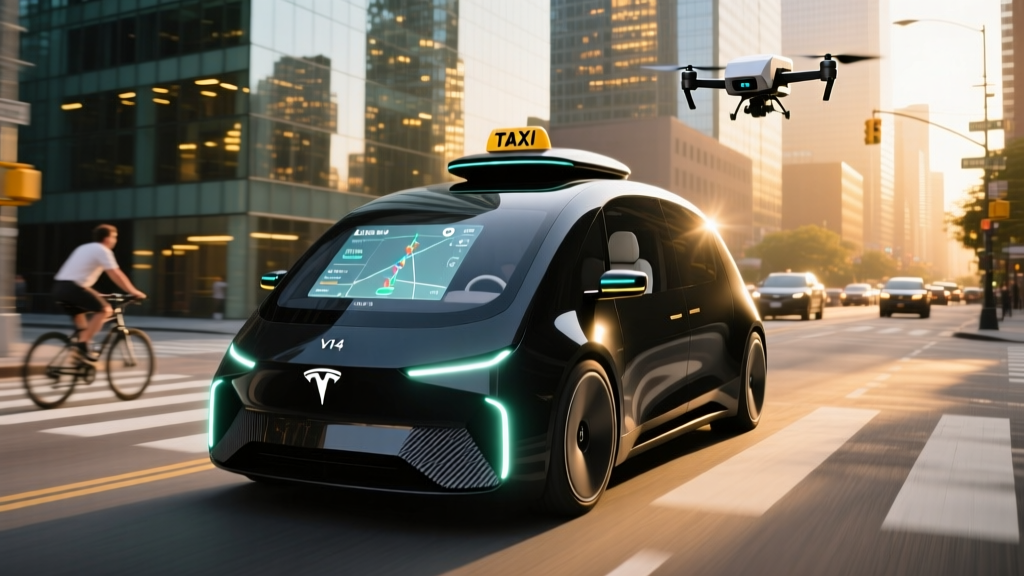
Tesla's push into driverless mobility has shifted from boardroom promise to pavement reality — but the gap between marketing headlines and operational truth remains wide. As of mid-2026, the Tesla autonomous ride hailing expansion centers on a limited, closely monitored pilot program in Austin, Texas, using modified Model Y vehicles with safety operators. The purpose-built Cybercab, unveiled in late 2024, remains in pre-production, with volume manufacturing targeted for 2027.
For EV shoppers and tech watchers trying to separate signal from noise, this article breaks down exactly where Tesla's robotaxi ambitions stand today — the technology, the regulatory hurdles, the safety record, and how it compares to Waymo's commercially live Level 4 service. We deal in data, not timelines.
SAE Automation Levels: Where Tesla Actually Sits
The single most important distinction in autonomous driving is the SAE level. Consumer confusion here is rampant, and it directly affects how you interpret every headline about Tesla's robotaxi plans.
| Level | Name | Driver Required? | Example |
|---|---|---|---|
| Level 0 | No Automation | Full control | Basic cruise control |
| Level 1 | Driver Assistance | Hands on wheel | Lane-keep or adaptive cruise |
| Level 2 | Partial Automation | Hands on, eyes on, full supervision | Tesla Autopilot, FSD (Supervised), BlueCruise, Super Cruise |
| Level 3 | Conditional Automation | Eyes off in specific conditions; must take over on request | Mercedes DRIVE PILOT (limited markets) |
| Level 4 | High Automation | No driver needed within geofence | Waymo One, Zoox (commercial service areas) |
| Level 5 | Full Automation | No driver, no geofence, all conditions | Does not exist commercially |
Where Tesla stands today: Tesla's Full Self-Driving (Supervised) software, available to consumer vehicle owners, is a Level 2 system. The driver must remain attentive, keep hands available, and bear full legal responsibility. Tesla's robotaxi pilot in Austin uses vehicles with remote monitoring and safety operators — it is not yet a publicly accessible, driverless Level 4 commercial service in the way Waymo One operates in Phoenix and San Francisco.
This distinction matters because regulatory approval, insurance liability, and public safety standards differ fundamentally between Level 2 (driver responsible) and Level 4 (operator responsible). Tesla's path to a scalable Level 4 robotaxi network requires regulatory certifications that go well beyond software capability.
Service Availability: Where Can You Actually Ride?
As of mid-2026, the landscape for autonomous ride-hailing services in the U.S. looks like this:
| Service | City/Region | Status | SAE Level | Public Access |
|---|---|---|---|---|
| Waymo One | Phoenix, AZ (metro-wide) | Commercial — fully operational | Level 4 | Open to public via app |
| Waymo One | San Francisco, CA | Commercial — fully operational | Level 4 | Open to public via app |
| Waymo One | Los Angeles, CA (select zones) | Commercial — expanding | Level 4 | Open to public via app |
| Waymo One | Austin, TX (limited) | Commercial — early access | Level 4 | Waitlist / limited |
| Tesla Robotaxi Pilot | Austin, TX (geofenced corridor) | Pilot — safety operators present | Level 2+ (transitional) | Invite-only / employees |
| Zoox | Las Vegas, NV; Foster City, CA | Testing / limited rides | Level 4 | Invite-only |
| Cruise (GM) | Phoenix, AZ (relaunch) | Phased relaunch w/ safety drivers | Level 4 (target) | Limited / safety driver |
Key takeaway: Waymo is the only service offering commercially available, fully driverless Level 4 rides to the general public at scale in the U.S. Tesla's Austin pilot is an internal testing program, not a ride-hailing service you can summon via an app today. Tesla has announced plans to open a limited ride-hailing service to the public, but no firm date for general availability has been confirmed.
Tesla's Technology Stack: Camera-Only vs. Multi-Sensor
The architectural philosophy behind Tesla's autonomy system diverges sharply from every other robotaxi competitor. Understanding this difference is critical for evaluating both capability and risk.
Tesla Vision (Camera-Only)
- Sensors: 8 surround cameras (front, side-forward, side-rear, rear) providing 360° visibility up to ~250 meters
- No lidar: Tesla removed ultrasonic sensors (USS) and radar from production vehicles starting in 2022–2023, relying exclusively on vision
- Compute: Hardware 4 (HW4) — dual custom FSD chips, ~300+ TOPS combined processing power
- AI approach: End-to-end neural networks trained on billions of miles of fleet driving data; occupancy networks for 3D spatial understanding
- HD maps: Tesla does not use pre-mapped HD routes; the system navigates dynamically using real-time perception
Waymo (Multi-Sensor Fusion)
- Sensors: Custom 5th-gen lidar (roof-mounted + perimeter), radar units, cameras, external audio sensors
- Compute: Custom Waymo Driver platform with redundant compute paths
- AI approach: Sensor fusion combining lidar point clouds, radar returns, and camera imagery; deep learning for prediction and planning
- HD maps: Waymo relies on centimeter-precision HD maps of every operational zone, updated continuously
- Geofencing: Strictly bounded operational design domains (ODDs) — the vehicle will not operate outside mapped/validated areas
What this means practically: Tesla's vision-only approach is lower-cost and more scalable in theory — cameras are cheap, and the system doesn't require pre-mapping every street. But it places enormous burden on neural network generalization, particularly in edge cases involving poor lighting, heavy rain, construction zones, or unusual road geometries. Waymo's lidar-and-maps approach is more expensive per vehicle (~$100,000+ in sensor hardware) but provides redundant depth perception and operates within tightly validated zones where edge cases have been extensively cataloged.
For a robotaxi service where there is no human driver to intervene, sensor redundancy is not optional from a regulatory standpoint. The National Highway Traffic Safety Administration (NHTSA) has increasingly scrutinized driverless operations, and state regulators (particularly California's DMV and Public Utilities Commission) require demonstrated safety cases that typically include sensor redundancy.
Safety Record: What the Data Actually Shows
Safety is the make-or-break metric for any robotaxi service. Here's what we know from publicly reported data:
| Metric | Waymo One | Tesla FSD (Supervised) |
|---|---|---|
| Cumulative driverless miles | 30+ million fully autonomous miles (as of late 2025 reporting) | N/A — no public driverless commercial service |
| FSD supervised fleet miles | N/A | 3+ billion cumulative supervised miles (Tesla earnings reports) |
| Police-reported crash rate vs. human baseline | ~57% fewer police-reported crashes per million miles vs. human drivers in comparable urban environments (Waymo published data, 2024) | Tesla claims lower crash rates with FSD engaged; independent verification is limited due to reporting methodology differences |
| NHTSA Standing General Order incidents | Reported per federal requirements; specific counts available via NHTSA AV reporting | Reported per SG0; Autopilot/FSD-involved incidents tracked separately |
| Disengagement rate (human intervention) | Not applicable in driverless service (no driver to intervene); remote assistance rate not publicly broken out per ride | Varies widely by driver and route; Tesla does not publish standardized disengagement data comparable to CA DMV format |
Context matters enormously here. Waymo's crash-rate comparison uses urban driving in Phoenix and San Francisco — environments with specific traffic densities, weather patterns, and road designs. Tesla's FSD data is collected across all U.S. roads, weather conditions, and driver behaviors, making direct comparison statistically imprecise.
For Tesla's robotaxi pilot specifically, safety data has not been published in a format comparable to Waymo's public reports. The Austin pilot operates with safety operators, meaning it is not yet generating driverless safety data. Until Tesla opens a commercial driverless service and reports miles-driven and incident data through standard regulatory channels (NHTSA Standing General Order), independent safety assessment remains limited.
Pricing: Robotaxi vs. Uber/Lyft
Where robotaxi services are commercially live, pricing is competitive with traditional rideshare — and in some cases, cheaper.
| Service | Base Fare | Per-Mile Rate | Typical 5-Mile Ride | Surge Pricing? |
|---|---|---|---|---|
| Waymo One (Phoenix) | ~$5.00 | ~$1.25/mi | ~$11–$14 | Limited / none currently |
| Waymo One (San Francisco) | ~$5.50 | ~$1.50/mi | ~$13–$16 | Limited / none currently |
| UberX (Phoenix avg.) | ~$3.50 | ~$1.50/mi | ~$11–$18 | Yes — can 1.5–3x |
| Lyft (Phoenix avg.) | ~$3.00 | ~$1.40/mi | ~$10–$17 | Yes — variable |
| Tesla Robotaxi (projected) | TBD — Elon Musk has cited target of ~$0.20/mi operating cost | TBD | TBD | TBD |
Tesla has repeatedly stated that the long-term economics of a robotaxi network would allow rides priced significantly below Uber/Lyft, citing the elimination of driver compensation (which accounts for ~60–70% of a rideshare fare). Musk has referenced a target cost of roughly $0.20 per mile for the vehicle operator, which could translate to consumer fares well under current rideshare rates.
However, these projections assume: (1) fully driverless Level 4 operation at scale, (2) vehicle durability of 1 million+ miles (the Cybercab's design target), (3) low remote-assistance staffing ratios, and (4) regulatory approval across multiple jurisdictions. None of these conditions have been met at commercial scale yet. Until Tesla publishes actual consumer pricing for a live service, all figures remain speculative.
Regulatory Landscape: Who Approves Robotaxi Operations?
Autonomous vehicle deployment in the U.S. is governed by a patchwork of state and federal regulations. There is no single federal license for robotaxi operation.
- Federal (NHTSA): Sets vehicle safety standards (FMVSS). NHTSA does not "approve" autonomous driving software, but it has authority to investigate defects, issue recalls, and require incident reporting through the Standing General Order. Tesla's FSD system has been subject to multiple NHTSA investigations regarding crash response and driver monitoring.
- California (DMV + CPUC): Requires separate permits for testing (DMV) and commercial deployment (California Public Utilities Commission). Waymo holds both. Tesla does not currently hold a California commercial robotaxi deployment permit. California's regulatory process is among the most stringent in the nation.
- Arizona: Among the most permissive regulatory environments. No specific state permit required for testing or deployment, which is why Waymo launched commercially in Phoenix first. Tesla's Austin pilot operates under Texas law.
- Texas: Passed AV legislation (HB 3026, 2023) allowing autonomous vehicles on public roads with specific insurance and registration requirements. Local municipalities can impose additional operational rules.
- Nevada: Has AV testing and deployment frameworks; Zoox operates under Nevada permits in Las Vegas.
For Tesla specifically: Any expansion of a commercial driverless ride-hailing service beyond the Austin pilot will require state-by-state regulatory engagement. California — the largest U.S. auto market — will be a critical test. Given prior NHTSA scrutiny of Tesla's driver-monitoring systems and Autopilot crash investigations, Tesla faces a higher evidentiary bar than a company like Waymo, which has operated under regulatory permits since 2018.
Current Limitations: What Tesla's Robotaxi Cannot Do
- Weather: Camera-only systems degrade in heavy rain, fog, snow, and direct sun glare. Tesla's Austin pilot operates in a climate with relatively mild weather; expansion to cities with frequent precipitation (Seattle, Chicago, Boston) presents significant technical challenges.
- Geofencing: The Austin pilot operates within a restricted corridor. Tesla's FSD system is not geofenced in consumer use, but the robotaxi pilot's operational design domain (ODD) is tightly bounded — it cannot handle arbitrary point-to-point routing across a metro area.
- Construction zones: Temporary lane shifts, missing lane markings, and flagger-directed traffic remain difficult edge cases for vision-only systems.
- Night driving: Reduced camera fidelity in low-light conditions, particularly on unlit rural roads, limits reliability.
- Complex intersections: Unprotected left turns across multiple lanes of traffic, roundabouts with irregular geometry, and non-standard intersections require high-confidence prediction that current systems do not consistently achieve without human oversight.
- No driverless commercial service: As of mid-2026, Tesla does not operate a publicly accessible, fully driverless (no safety operator, no remote teleoperator) ride-hailing service anywhere in the U.S.
- Cybercab production: The purpose-built Tesla Cybercab (2-door, no steering wheel, no pedals) was announced for 2026–2027 production. Until it is in volume production and certified to FMVSS standards (or receives an exemption), the robotaxi fleet relies on modified Model Y vehicles with standard driver controls.
The Cybercab: Announced Specs and Production Timeline
Tesla's Cybercab is the vehicle designed from the ground up for autonomous ride-hailing — no steering wheel, no pedals, two seats, and a target price under $30,000. Here's what's been announced:
| Spec | Announced / Estimated |
|---|---|
| Seating | 2 passengers |
| Steering wheel / pedals | None (requires FMVSS exemption or regulatory update) |
| Estimated range | ~250 miles (EPA est., preliminary) |
| Battery | ~50 kWh usable (estimated, LFP chemistry likely for cost) |
| Charging | Wireless inductive charging pad (no plug); DC fast charge capability TBD |
| Target MSRP | Under $30,000 (announced target) |
| Operating cost target | ~$0.20/mile (Tesla estimate) |
| Production start | Targeted 2026–2027 (unverified at scale) |
| Volume target | 2–4 million units/year (long-term, Musk estimate) |
Important caveat: All Cybercab specifications are preliminary and subject to change. The vehicle has not received FMVSS certification for road use without a steering wheel. Tesla would need to petition NHTSA for an exemption — a process that is neither guaranteed nor rapid. The production timeline has shifted multiple times since the initial announcement.
How Tesla's Expansion Compares to Waymo's Playbook
Waymo's expansion strategy offers a useful benchmark for evaluating Tesla's likely path:
- Waymo took 7+ years from its first fully driverless ride (2015, Austin) to commercial service at meaningful scale (Phoenix, 2022–2023). Each city expansion required months of mapping, testing, regulatory negotiation, and phased public access.
- Waymo's per-city cost is high: HD mapping, local fleet operations, remote assistance infrastructure, and regulatory compliance represent significant per-market investment.
- Waymo's fleet size is limited: Estimated ~1,000–1,500 vehicles across all operational cities as of early 2026, constraining ride availability and wait times.
Tesla's proposed advantage is scale: millions of Tesla vehicles already on U.S. roads, generating training data and potentially convertible to robotaxi use via software update. But converting a consumer Level 2 system to a commercially certified Level 4 robotaxi is not a software-only problem — it requires regulatory approval, insurance frameworks, fleet maintenance infrastructure, and demonstrated safety performance in each operational domain.
The most likely near-term scenario for Tesla's autonomous ride hailing expansion is a gradual, city-by-city rollout beginning with geofenced corridors in favorable regulatory environments (Texas, Arizona), with safety monitoring, before any attempt at broad metro-area coverage. This mirrors Waymo's approach but starts from a later position and with a different technology foundation.
Frequently Asked Questions
Where can I use Tesla's robotaxi service right now?
You cannot. As of mid-2026, Tesla operates a closed pilot program in Austin, Texas, with safety operators and invite-only participants. There is no public app, no public ride-hailing service, and no city where you can summon a driverless Tesla. Waymo One is the only commercially available, fully driverless robotaxi service in the U.S., operating in Phoenix, San Francisco, and expanding in Los Angeles.
How much does a robotaxi ride cost vs. Uber or Lyft?
Where Waymo One is live, a typical 5-mile ride costs approximately $11–$16, comparable to or slightly below UberX/Lyft in the same market — with the advantage of no surge pricing. Tesla has not published consumer pricing because no public service exists yet. Tesla's long-term target is dramatically lower per-mile costs, but this depends on achieving fully driverless operation at scale.
How safe are robotaxis — is there real data?
Waymo has published data showing approximately 57% fewer police-reported crashes per million miles compared to human drivers in comparable urban environments, based on 30+ million fully autonomous miles. Tesla's FSD (Supervised) has accumulated billions of supervised miles, but because a human driver is always present and responsible, the safety comparison is fundamentally different. Tesla's robotaxi pilot has not published independent safety data in a comparable format. All safety data should be interpreted in context — urban vs. highway, weather conditions, and reporting methodology all affect the numbers.
What are the current limitations of Tesla's autonomous driving?
Tesla's FSD (Supervised) is a Level 2 driver-assist system — the driver must remain fully attentive. The robotaxi pilot operates within a restricted geofence in Austin with safety operators. Camera-only perception degrades in heavy rain, fog, snow, and low-light conditions. Construction zones, non-standard intersections, and complex urban scenarios remain challenging. The Cybercab vehicle needed for scalable driverless service is not yet in production.
Is Tesla's FSD truly self-driving?
No. Tesla Full Self-Driving (Supervised) is an SAE Level 2 driver-assistance system. The driver must keep their eyes on the road, remain prepared to take over at any moment, and bears full legal responsibility for the vehicle's operation. Tesla's own documentation and the system's naming ("Supervised") reflect this. Only Level 4 services like Waymo One operate without a human driver — and only within specific geofenced areas under regulatory permits.
When will Tesla's robotaxi service be available to the public?
Tesla has not confirmed a specific date for public robotaxi service availability. The Austin pilot is ongoing, and the Cybercab production timeline targets 2026–2027. Regulatory approval for driverless commercial operation in each state is required and is not guaranteed on any particular timeline. Based on Waymo's precedent, expect a multi-year, city-by-city rollout rather than a sudden nationwide launch.
Sources: NHTSA Automated Vehicle Safety, EPA Green Vehicles, Tesla investor relations and earnings reports, Waymo safety publications. All pricing and availability data reflects conditions as of mid-2026 and is subject to change. Tax credit and regulatory information should be verified with current IRS and state agency guidance.