Tesla's ride-hailing ambitions have entered a measurable growth phase. According to recent fleet registration data and company statements, Tesla will double its Austin robotaxi fleet in December, scaling from a limited pilot to a more substantial commercial operation in one of the most closely watched autonomous-vehicle markets in the United States. But what does that expansion actually mean for riders, regulators, and the broader autonomous-driving landscape?
This analysis cuts through the hype with hard numbers: SAE automation levels, verified service boundaries, safety intervention data, per-ride pricing, and the technology stack powering Tesla's driverless ambitions. If you're considering hailing one — or investing based on the rollout — here's what the data says.
Understanding the Automation Level: This Is Not FSD Supervised
The single most important distinction in autonomous vehicles is the gap between SAE Level 2 driver-assistance and SAE Level 4 driverless operation. Tesla's consumer product — Full Self-Driving (Supervised) — is Level 2. The driver must remain engaged, hands available, eyes on the road. Tesla's Austin robotaxi service, by contrast, targets Level 4: no driver present, geofenced to specific operational design domains (ODDs).
SAE Automation Levels at a Glance
| Level | Name | Driver Required? | Example |
|---|---|---|---|
| Level 0 | No Automation | Full-time | Conventional gas car |
| Level 1 | Driver Assistance | Full-time | Adaptive cruise control |
| Level 2 | Partial Automation | Full-time (supervising) | Tesla FSD Supervised, BlueCruise, Super Cruise |
| Level 3 | Conditional Automation | On standby (eyes off in specific conditions) | Mercedes Drive Pilot (limited markets) |
| Level 4 | High Automation | No driver needed (within ODD) | Waymo One, Tesla Austin Robotaxi |
| Level 5 | Full Automation | No driver, no geofence | Does not exist commercially |
Tesla's Austin robotaxi operates without a human safety driver behind the wheel, placing it in the Level 4 category alongside Waymo One in Phoenix, San Francisco, and Los Angeles. This is a fundamentally different system from the FSD Supervised software in your personal Tesla — different liability model, different regulatory approval pathway, and different operational constraints.
Where Can You Use Tesla's Austin Robotaxi Right Now?
Before the December fleet doubling, Tesla's Austin robotaxi service operates within a defined geofence covering select neighborhoods and commercial corridors. Service availability has expanded incrementally since the program's commercial launch, but it remains far from city-wide coverage.
Current Austin Robotaxi Service Areas
| Zone | Status | Key Destinations |
|---|---|---|
| Downtown Austin | Active | Convention Center, 2nd Street District, Rainey Street |
| South Austin (SoCo) | Active | South Congress Ave, Barton Springs area |
| East Austin | Active | East 6th Street, Mueller development |
| Domain / North Austin | Limited hours | The Domain shopping center, tech corridor |
| Austin-Bergstrom Airport (AUS) | Pending approval | Airport pickups/drop-offs |
| Round Rock / Cedar Park | Not available | Suburban areas outside geofence |
The December fleet doubling is expected to support expanded hours in the Domain zone and potentially add airport service, pending regulatory clearance from the Texas Department of Transportation and the City of Austin's transportation department. Suburban and exurban areas remain outside the operational design domain for now — a limitation shared by every Level 4 robotaxi service currently operating in the U.S.
Technology Stack: Camera-Only vs. the Lidar Consensus
Tesla's robotaxi platform continues to rely on a camera-only perception system, a deliberate architectural choice that sets it apart from virtually every other Level 4 operator. Waymo, Zoox, Cruise (now mothballed), and Aurora all employ multi-sensor suites combining cameras, lidar, and radar. Tesla's approach uses eight surround cameras feeding a neural-network-based perception pipeline running on custom silicon (the Hardware 4 / AI5 inference computer).
Tesla Robotaxi Sensor & Compute Stack
- Perception: 8 surround cameras (front narrow, front wide, left/right forward, left/right rear, rear) — no lidar, no radar
- Compute: Tesla AI5 inference chip (successor to HW4), estimated 2,000+ TOPS effective throughput
- Mapping: High-definition lane-level maps built from fleet data, continuously updated
- Positioning: GPS + IMU + visual odometry (camera-based localization)
- Connectivity: Dual-SIM LTE/5G for real-time teleoperations fallback
- Remote Assistance: Human teleoperators available for edge-case resolution (vehicle does not proceed if confused)
The camera-only approach offers cost advantages — lidar units, while dropping in price, still add $1,000–$3,000 per vehicle in hardware cost at scale. But it introduces well-documented challenges in low-visibility conditions: heavy rain, fog, direct sun glare, and nighttime scenarios with poor street lighting. Tesla's neural-network approach has improved substantially with training data from its millions of consumer FSD-equipped vehicles, but the absence of lidar means no independent depth-verification sensor — a redundancy layer that regulators and safety researchers consider significant.
Safety Record: What the Data Actually Shows
Safety is the most contested question in autonomous vehicles, and Tesla's Austin robotaxi program is too young to match the multi-million-mile datasets published by Waymo. That said, available data provides an early picture.
Austin Robotaxi Safety Metrics (Available Data)
- Miles driven (driverless): Estimated 150,000–250,000 miles as of late 2026 (exact figures not publicly disclosed by Tesla; estimated from fleet size × daily mileage × operational days)
- At-fault collisions: No publicly reported at-fault collisions involving passengers as of this writing
- Disengagement rate: Not reported using California DMV-style metrics (Texas has no equivalent mandatory reporting framework)
- Comparison benchmark: NHTSA data shows human drivers average approximately 1.35 fatalities per 100 million vehicle miles traveled; Waymo reports 0.41 at-fault injury-causing crashes per million miles across 25+ million driverless miles
Note: Texas does not require robotaxi operators to publish disengagement or collision data at the granularity California mandates. Independent safety verification relies on NHTSA Standing General Order crash reports and voluntary company disclosures.
The absence of reported at-fault incidents is encouraging but should not be confused with proven safety at scale. Statistical significance for autonomous vehicle safety requires hundreds of millions of miles — a threshold no U.S. robotaxi operator has met. Tesla's fleet doubling will accelerate data accumulation, but riders should understand that Level 4 robotaxi safety is still being validated in real-time, not retrospectively.
Pricing: How Does Tesla's Robotaxi Compare to Uber and Lyft?
Robotaxi economics are the make-or-break factor for commercial viability. Tesla has positioned its Austin service with competitive pricing designed to undercut traditional rideshare while building ridership volume.
| Service | Base Fare | Per-Mile Rate | Per-Minute Rate | Est. 5-Mile Trip |
|---|---|---|---|---|
| Tesla Robotaxi (Austin) | $1.50 | $0.85/mi | $0.25/min | ~$8–$10 |
| UberX (Austin avg.) | $2.20 | $1.10/mi | $0.30/min | ~$11–$15 |
| Lyft (Austin avg.) | $2.00 | $1.05/mi | $0.28/min | ~$10–$14 |
| Waymo One (Phoenix/SF) | $2.50 | $1.25/mi | $0.35/min | ~$13–$17 |
Tesla's pricing undercuts Uber, Lyft, and Waymo on a per-trip basis, primarily because the company eliminates the driver payout (which typically represents 60–75% of a rideshare fare). Whether this pricing is sustainable at scale — accounting for vehicle depreciation, insurance, remote teleoperations staffing, charging infrastructure, and fleet maintenance — remains an open question. For now, riders benefit from promotional rates that may adjust as the service matures.
How to Use the Service: Booking and Riding
Tesla's robotaxi service is accessed through the Tesla app (not a standalone app like Waymo One). The workflow is straightforward:
- Open the Tesla app and select the "Robotaxi" tab (available only to users within the Austin service area)
- Enter pickup and drop-off locations — the app will confirm both are within the active geofence
- Request a ride — estimated wait times range from 3–12 minutes depending on fleet density and time of day
- Vehicle arrival — the app displays the vehicle's license plate, model (currently a purpose-built robotaxi variant based on the Tesla platform), and exact pickup pin
- Unlock via app — no driver to greet you; the doors unlock when you're within 3 feet
- Ride — a screen displays the route, ETA, and a "Stop Ride" button; music and climate controls are accessible
- Arrival and exit — the vehicle waits up to 2 minutes for you to exit, then departs to the next pickup or charging station
Payment is processed through the Tesla account on file. Tipping is not applicable (no driver), though the app allows optional feedback ratings.
Regulatory Landscape: Who Approved This?
Autonomous vehicle regulation in the United States is a patchwork of federal, state, and local authority. In Texas, the regulatory environment is notably permissive compared to California:
- Federal (NHTSA): Oversees vehicle safety standards. NHTSA's Standing General Order requires all ADS-equipped vehicles to report crashes within 24 hours. Tesla's robotaxi must comply with FMVSS standards, though the company has sought exemptions for vehicles without steering wheels or pedals in future iterations.
- State (Texas): Texas passed SB 2073 in 2023, establishing a framework for autonomous vehicle operation without requiring a separate state-issued permit (unlike California's DMV permitting process). Operators must carry $5M in liability insurance and register vehicles with the Texas DOT.
- Local (City of Austin): Austin's transportation department coordinates on geofence boundaries, curb management, and airport access. The city has been more accommodating than San Francisco, where robotaxi operators faced significant pushback from city officials and residents.
The December fleet expansion does not require new regulatory approval under current Texas law — Tesla can add vehicles to its registered fleet as long as insurance and registration requirements are met. Airport service, however, requires separate negotiation with the Austin-Bergstrom International Airport authority.
Current Limitations: What Tesla's Robotaxi Cannot Do
Operational Limitations Riders Should Know
- Weather restrictions: Service suspends during heavy rain (>0.5 in/hr), fog (visibility <200 ft), and any ice/snow accumulation. Austin's occasional flash-flood events trigger automatic geofence contraction.
- Nighttime operation: Currently limited to well-lit urban corridors. Unlit suburban roads and rural highways are outside the operational design domain.
- Construction zones: The vehicle will stop and request remote teleoperator guidance in active construction zones with altered lane markings. Expect delays or ride cancellation.
- No highway driving: The current geofence excludes limited-access highways (I-35, Mopac, US-183). All routes use surface streets.
- Passenger restrictions: No unaccompanied minors (18+ only). Maximum 2 passengers per vehicle in the current robotaxi configuration. No pets except service animals.
- Cargo: No large items — trunk space is limited to personal bags and small packages. The vehicle is not designed for grocery runs or furniture moves.
- Accessibility: Current vehicles are not wheelchair-accessible. Tesla has stated ADA-compliant vehicles are planned but not yet deployed.
These limitations are not unique to Tesla — Waymo and Zoox operate under similar constraints. But they matter for practical trip planning. If your route requires I-35 or you're traveling during a thunderstorm, you'll need a conventional rideshare or personal vehicle.
The December Expansion: What Doubling the Fleet Actually Means
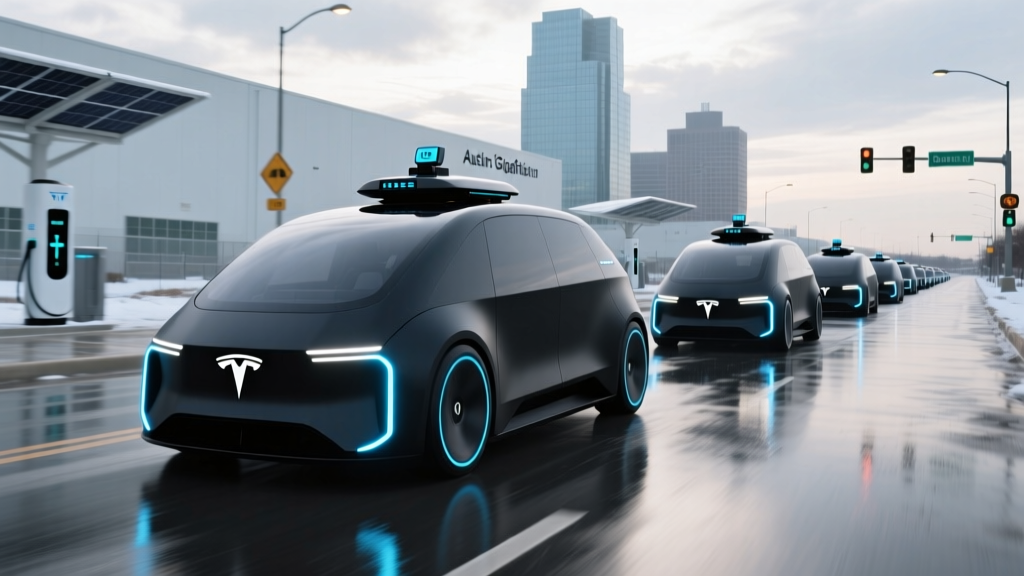
Tesla's pre-December Austin robotaxi fleet is estimated at 50–80 vehicles. Doubling to 100–160 vehicles has several practical implications:
- Reduced wait times: Average pickup ETA should drop from 8–12 minutes to 4–7 minutes within the core geofence during peak hours
- Extended hours: Additional vehicles enable overnight service (currently limited to 6 AM–midnight) in the downtown and East Austin zones
- Geofence growth: More fleet density makes it economically viable to extend coverage to the Domain's full operating hours and potentially add the Southpark Meadows and St. Elmo corridors
- Charging logistics: Tesla must scale its dedicated fleet-charging infrastructure proportionally — approximately one 150 kW DC fast charger per 4–5 vehicles to maintain continuous operation
The expansion also accelerates Tesla's data collection. Each robotaxi generates approximately 2,000–5,000 miles of driving data per month, feeding back into the neural-network training pipeline. More vehicles mean faster iteration on edge-case handling — construction zones, unusual pedestrian behavior, emergency-vehicle encounters — that remain the frontier challenge for Level 4 autonomy.
Frequently Asked Questions
Is Tesla's Austin robotaxi truly self-driving, or is someone watching?
The vehicle operates without a human driver inside — this is SAE Level 4 automation within its geofenced operational domain. However, remote teleoperators monitor the fleet and can intervene by providing high-level guidance (e.g., "proceed around the obstacle" or "pull over safely") when the AI encounters an unfamiliar scenario. The vehicle does not allow a remote operator to directly steer or accelerate — it executes approved maneuvers through its own driving policy. This is fundamentally different from Tesla's consumer FSD Supervised, which is Level 2 and requires a licensed driver behind the wheel at all times.
How much does a Tesla robotaxi ride cost compared to Uber or Lyft?
A typical 5-mile trip costs approximately $8–$10 on Tesla's robotaxi service, compared to $11–$15 on UberX and $10–$14 on Lyft for the same route in Austin. The savings come from eliminating the driver payout. Surge pricing has not been observed in the current fleet size, though December's expansion and increased demand may introduce dynamic pricing during peak periods.
How safe are robotaxis based on real data?
Waymo, the most data-rich Level 4 operator with 25+ million driverless miles, reports 0.41 at-fault injury-causing crashes per million miles — roughly 80% fewer than the human benchmark of approximately 2.0 per million miles (NHTSA data). Tesla's Austin robotaxi has not published comparable mileage or incident data, and Texas does not mandate the same reporting granularity as California. Early indicators show no reported at-fault passenger incidents, but the mileage base is too small for statistical significance. Riders should treat current safety performance as promising but not yet proven at population scale.
Can I use Tesla's robotaxi to get to Austin-Bergstrom Airport?
Not yet. Airport service requires separate agreements with the airport authority and is listed as "pending approval." The December fleet expansion may enable airport service in early 2027, but no confirmed date has been announced. For airport trips, continue using Uber, Lyft, or conventional taxis.
What happens if the robotaxi gets confused or encounters an edge case?
The vehicle is programmed to stop safely (pull to the curb or remain in lane with hazards) and request remote teleoperator assistance. The teleoperator reviews camera feeds and provides high-level routing guidance. If the situation cannot be resolved within a reasonable time, the ride is canceled and the passenger is not charged. The vehicle will not proceed through an scenario it cannot confidently handle — a conservative approach that prioritizes safety over trip completion.
Will Tesla expand robotaxi service beyond Austin?
Tesla has indicated plans to launch in additional U.S. cities, with Phoenix, Miami, and Los Angeles frequently cited as candidates. However, each new city requires geofence mapping, regulatory coordination, fleet deployment, and local charging infrastructure. No confirmed dates for expansion beyond Austin have been announced as of this writing. Treat any announced city timelines as preliminary until vehicles are actively operating without drivers.