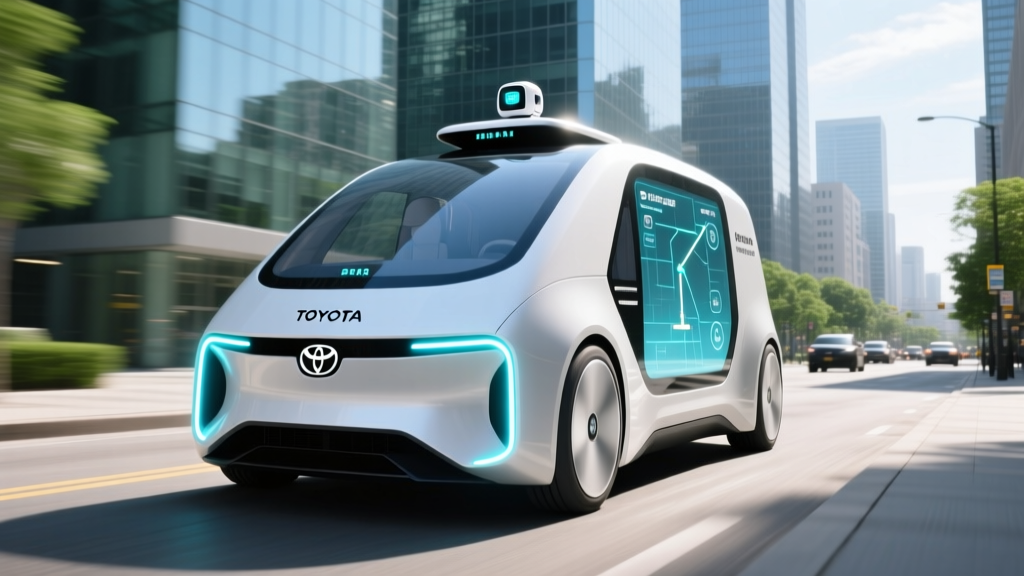
When shoppers search for a "self-driving Toyota," they are usually imagining a car that handles the entire trip without human intervention — a true robotaxi experience. The reality in 2026 is more nuanced. Toyota's advanced driver-assistance suite, branded Teammate (formerly Toyota Advanced Drive/ADS), is a sophisticated system that can manage certain highway scenarios hands-off under specific conditions. But it is not a Level 4 driverless robotaxi like Waymo's fleet. Understanding that distinction is the single most important thing to know before buying or riding.
This guide unpacks exactly what Toyota's autonomy tech can and cannot do today, where it operates, what it costs, and how its safety record stacks up against dedicated robotaxi services.
SAE Automation Levels: Where Toyota Teammate Actually Sits
The Society of Automotive Engineers defines six levels of driving automation, from zero (no assistance) to five (full self-driving everywhere). The confusion in marketing usually happens between Level 2 and Level 4.
| Level | Name | Who Drives? | Example Systems |
|---|---|---|---|
| Level 0 | No Automation | Human 100% | Basic cruise control |
| Level 1 | Driver Assistance | Human, with minor help | Adaptive cruise OR lane centering |
| Level 2 | Partial Automation | Human must supervise | Tesla Autopilot, GM Super Cruise, Toyota Teammate (highway) |
| Level 3 | Conditional Automation | System drives in limited ODD; human must take over on request | Mercedes Drive Pilot (limited markets), Honda Legend (Japan only) |
| Level 4 | High Automation | No human needed within geofence | Waymo One, Cruise (pre-suspension), Zoox |
| Level 5 | Full Automation | No human needed anywhere | Does not exist commercially |
This is a critical distinction. A Level 2 or conditional Level 3 system is driver-assist: you remain legally responsible for the vehicle. A Level 4 robotaxi like Waymo has no steering wheel and no driver — the company bears liability within its service area.
Where Can You Use Toyota's Self-Driving Tech Right Now?
Toyota's Teammate system is available as a hardware/software package on specific 2025-2026 model-year vehicles, primarily the Lexus LS 500h and Lexus RX with the Advanced Drive trim, and certain Toyota Mirai and bZ4X trims in Japan. U.S. availability is limited to models equipped with the optional Advanced Drive package, which carries a premium of approximately $5,000-$8,000 over base trims.
| Feature | Toyota Teammate (Personal Vehicle) | WTRIPS / Woven City (Japan) | Waymo One (U.S. Robotaxi) |
|---|---|---|---|
| Type | Consumer vehicle ADAS | Limited pilot / internal test | Commercial robotaxi service |
| SAE Level | 2 (Level 3 in narrow ODD) | Level 4 (closed campus) | Level 4 (geofenced urban) |
| U.S. Availability | Nationwide (vehicle purchase) | Not available | Phoenix, SF, LA, Austin (expanding) |
| Public Booking | N/A (you own the car) | No | Yes, via Waymo app |
| Driver Required | Yes | No (campus only) | No |
In Japan, Toyota's Woven City test campus near Mt. Fuji hosts Level 4 prototype shuttles, but these are not available to the general public. Toyota subsidiary Woven by Toyota continues developing autonomy software, with a stated goal of deploying Level 4 robotaxis via partners — not a standalone Toyota ride-hail app.
How Much Does It Cost vs. Uber, Lyft, and Waymo?
Because Toyota does not run a consumer robotaxi service, the cost question splits into two scenarios: owning a Teammate-equipped vehicle, and riding in an actual robotaxi.
| Option | Cost Structure | Typical Per-Mile / Monthly Cost |
|---|---|---|
| Toyota/Lexus with Teammate | $5,000-$8,000 package + vehicle MSRP ($55,000-$90,000) | Ownership: ~$0.55-$0.75/mile (fuel, insurance, depreciation) |
| Uber / Lyft (standard) | Per-ride fare | $1.50-$2.50/mile (varies by city, surge pricing) |
| Waymo One (Phoenix, SF, LA) | Per-ride fare | $1.00-$2.00/mile (competitive with Uber, often cheaper off-peak) |
| Waymo (Austin) | Per-ride fare | $0.90-$1.80/mile (introductory market pricing) |
For a consumer, the Teammate package adds meaningful cost to a vehicle purchase without eliminating the need to drive. A robotaxi service like Waymo, by contrast, charges per ride with no ownership burden — but is only available in four U.S. metro areas as of early 2026.
Safety Record: What the Data Actually Shows
Toyota's Teammate system has not been involved in high-profile autonomous incidents comparable to Cruise's 2023 pedestrian-dragging event in San Francisco. However, comprehensive public safety data specific to Teammate is limited because Toyota reports incidents under general ADAS categories to NHTSA Standing General Order (SGO) filings, not as a separate product line.
- Waymo: Over 30 million fully driverless miles completed across Phoenix, San Francisco, Los Angeles, and Austin. Published safety reports show human-injury crash rates approximately 85% lower than human benchmarks in comparable geographies (per Waymo's 2024 insurance-claims study with Swiss Re).
- Cruise: Suspended operations in October 2023 after a pedestrian was struck and dragged in San Francisco. Resumed limited testing in Phoenix and Dallas in 2025 with safety drivers; no commercial driverless service as of 2026.
- Toyota Teammate: No published aggregate mileage or intervention-rate data specific to Teammate. NHTSA SGO reports list Toyota/Lexus ADAS incidents alongside conventional systems; no pattern of Teammate-specific failures has emerged.
- Tesla FSD (Supervised): Level 2 system with ~3+ billion cumulative miles. NHTSA has opened multiple investigations into FSD-related crashes; Tesla reports one crash per ~4-5 million FSD miles vs. ~670,000 for U.S. average (methodology debated by safety researchers).
The honest assessment: Toyota's approach is conservative. Teammate's ODD is narrow, its deployment is limited to premium models, and the company has prioritized low-speed, low-risk scenarios over aggressive expansion. This results in fewer headline-grabbing incidents but also less public data to evaluate.
Technology Stack: Lidar, Cameras, and HD Maps
Toyota Teammate uses a multi-sensor fusion approach — distinctly different from Tesla's camera-only philosophy and closer to Waymo's stack, though at a different scale.
| Component | Toyota Teammate | Waymo (6th-gen) | Tesla FSD (Supervised) |
|---|---|---|---|
| Primary Sensors | Cameras + millimeter-wave radar + lidar (select models) | Cameras + lidar + radar (custom 6th-gen suite) | Cameras only (8 cameras, no lidar/radar as of HW4) |
| Lidar | Yes (front-facing, short/mid-range) | Yes (360° custom lidar, ~500m range) | No |
| HD Maps | Yes (required for Level 3 ODD) | Yes (centimeter-precision, constantly updated) | No (vision-only, no pre-mapped routes) |
| Compute | Proprietary Toyota/Woven SoC | Custom Waymo compute platform | Tesla HW4 (dual FSD chips, ~300 TOPS) |
| Geofencing | Yes (mapped divided highways, low-speed ODD) | Yes (urban service areas, ~700+ sq mi combined) | No (operates on any road) |
The reliance on HD maps and geofencing means Teammate's Level 3 mode only activates on pre-mapped highway segments — typically congested traffic below ~37 mph (60 km/h) on divided expressways. Once you exit the mapped corridor or exceed the speed threshold, the system downgrades to Level 2 and requires hands-on-wheel supervision.
Regulatory Landscape: Who Approves Autonomous Operations?
In the United States, autonomous vehicle regulation is split between federal and state authority:
- Federal (NHTSA): Sets vehicle safety standards (FMVSS). Does not currently "approve" ADAS or autonomous systems pre-market but investigates post-incident. Standing General Order requires crash reporting for Level 2+ systems.
- State DMVs/Agencies: California DMV issues autonomous vehicle testing and deployment permits. Arizona (where Waymo launched) has minimal permitting requirements. Texas allows testing with registration. Each state sets its own rules for whether a human driver must be present.
- Insurance & Liability: For Level 2/3 systems like Teammate, the vehicle owner/driver carries liability. For Level 4 robotaxis, the operating company (Waymo, Zoox) carries commercial liability insurance — typically $5M-$10M per incident.
Toyota's Teammate, as a consumer ADAS product, does not require special state permits. The driver remains responsible for the vehicle at all times, even when Teammate's Level 3 mode is active in its narrow ODD. This is a fundamentally different legal framework from a Waymo ride, where no human driver exists.
Current Limitations: What Self-Driving Toyota Cannot Do
Teammate's real-world constraints are substantial and worth understanding before purchase:
- Weather: Heavy rain, snow, fog, and direct sun glare can disable or degrade sensor performance. System will issue a takeover request.
- Geofence boundaries: Level 3 mode only activates on pre-mapped divided highways. Surface streets, rural roads, and unmapped construction zones default to Level 2.
- Speed limits: Level 3 "eyes-off" mode typically limited to ~37 mph (60 km/h) traffic-jam scenarios. Above that threshold, hands-on-wheel is required.
- Construction zones: Lane shifts, temporary barriers, and flaggers frequently trigger takeover requests even in mapped areas.
- Night driving: Reduced camera performance in low-light conditions can narrow the ODD further.
- No point-to-point autonomy: Teammate cannot navigate from your driveway to a destination without continuous driver supervision. It is an assist system, not a chauffeur.
- Edge cases: Emergency vehicles, erratic human drivers, debris in the roadway, and unusual road geometries (tight roundabouts, unprotected left turns) remain beyond the system's reliable capability.
These limitations are not unique to Toyota — they apply to every production Level 2/3 system on the market. The difference is that Toyota is transparent about them in owner's manuals, while some competitors market their systems with language that implies broader capability than exists.
Toyota vs. Waymo: Which "Self-Driving" Experience Is Right for You?
The choice between a Teammate-equipped Toyota/Lexus and using a Waymo robotaxi is not really apples-to-apples. One is a personal vehicle with driver-assist features; the other is an on-demand transportation service. Here is a practical decision framework:
Choose a Teammate-equipped Toyota/Lexus if:
- You want a personal luxury vehicle with the best available highway driving assistance for daily commutes
- You live outside the four U.S. cities where Waymo operates
- You prefer ownership and want a system that reduces fatigue on long highway trips
- You understand you remain the driver and accept that responsibility
Choose Waymo (or another Level 4 robotaxi) if:
- You live in Phoenix, San Francisco, Los Angeles, or Austin and want point-to-point rides without driving
- You want to eliminate car ownership costs (insurance, maintenance, depreciation, parking)
- You need transportation while impaired, fatigued, or unable to drive
- You want a true driverless experience with no human supervision required
Frequently Asked Questions
Is Toyota Teammate truly self-driving or just driver-assist?
It is driver-assist. Teammate's Level 3 mode (eyes-off in low-speed highway traffic on mapped roads) is the most autonomous Toyota offers consumers, but it operates within a very narrow ODD. Outside that ODD — which is most real-world driving — it functions as a Level 2 system requiring active driver supervision. It is not a robotaxi.
Can I buy a Toyota that drives itself without any human input?
No. As of 2026, no Toyota or Lexus sold to consumers in the U.S. can drive itself without a human driver present and responsible. Toyota's Woven by Toyota subsidiary is developing Level 4 technology, but it is not available for consumer purchase or ride-hailing.
How does Toyota's approach compare to Tesla's FSD?
Toyota uses a multi-sensor stack (cameras, radar, lidar) with HD maps and strict geofencing. Tesla uses cameras only, no maps, and claims broad capability but remains Level 2 (driver must supervise). Toyota's approach is more conservative and transparent about limitations; Tesla's covers more scenarios but with more frequent edge-case failures and ongoing NHTSA scrutiny.
When will Toyota offer a real robotaxi service?
Toyota has not announced a specific date for a consumer-facing Level 4 robotaxi service. Woven by Toyota continues testing, and the company has partnered with various mobility providers globally. Realistic timelines for broad U.S. deployment remain uncertain — likely late 2020s at the earliest, and initially limited to specific geofenced urban areas.
Does the Teammate package qualify for any federal tax credits?
The Teammate/Advanced Drive package itself does not qualify for separate incentives. However, if the underlying vehicle is an EV (such as the bZ4X in Japan or future U.S. EV models), the vehicle may qualify for the §30D federal clean vehicle credit — up to $7,500, subject to MSRP caps ($55,000 for sedans, $80,000 for SUVs/trucks), buyer income limits ($150K single / $300K joint AGI), and battery sourcing requirements. Always verify current-year eligibility with a tax professional before purchasing.
What happens if Teammate encounters a situation it cannot handle?
The system issues escalating alerts — visual, audible, and haptic (seat vibration) — requesting the driver to take over. If the driver does not respond within a few seconds, Teammate will activate hazard lights, gradually decelerate, and bring the vehicle to a controlled stop in the current lane or on the shoulder if available. This is standard behavior for Level 2/3 systems.
The bottom line: "self-driving Toyota" is a marketing-adjacent phrase that does not describe a currently available product. Toyota Teammate is a capable, conservative driver-assist system for highway use — not a replacement for a human driver, and not a competitor to Waymo's Level 4 robotaxi service. Buyers should evaluate it as a premium ADAS feature, not as autonomy.