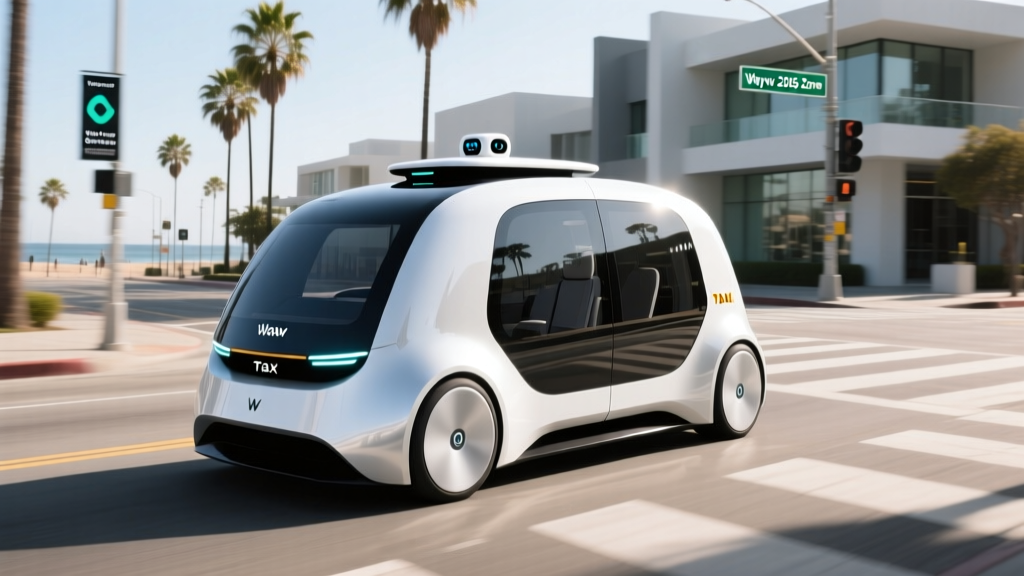
If you've walked along Santa Monica's Ocean Avenue or waited for a ride near the Third Street Promenade recently, you may have spotted a Jaguar I-PACE with a prominent roof-mounted sensor array and no one in the driver's seat. That's a Waymo One robotaxi — and yes, you can hail one. But the reality of calling a self-driving taxi in Santa Monica involves geofencing nuances, pricing structures, and safety trade-offs that differ meaningfully from a standard Uber or Lyft ride.
This guide breaks down exactly where autonomous ride-hail services operate in the Santa Monica and greater Los Angeles area as of early 2026, what they cost, how their safety records compare to human drivers, and where the technology still falls short.
Is a Robotaxi Truly Self-Driving? Understanding SAE Levels
Before calling a ride, it's critical to understand what "self-driving" actually means in this context. Consumer vehicles with features like Tesla's FSD (Supervised), GM's Super Cruise, or Ford's BlueCruise are SAE Level 2 systems — they require a human driver to remain attentive and ready to take over at any moment. Marketing language aside, these are driver-assist systems, not autonomous vehicles.
Robotaxis like Waymo operate at SAE Level 4, which means the vehicle handles all driving tasks within a defined operational design domain (ODD) — a specific geographic area, under specific conditions — with no human driver present. If the system encounters a scenario it can't handle, it executes a minimal-risk maneuver (typically pulling over safely) rather than handing control to a passenger.
| Level | Who Drives | Example |
|---|---|---|
| Level 2 | Human (system assists) | Tesla Autopilot, GM Super Cruise, Ford BlueCruise |
| Level 3 | System (human on standby) | Mercedes DRIVE PILOT (limited highway, select states) |
| Level 4 | System (no human needed, geofenced) | Waymo One, Zoox (limited areas) |
| Level 5 | System (all conditions, everywhere) | Does not yet exist in production |
Source: SAE International J3016
Where Can You Use Self-Driving Taxis in Santa Monica Right Now?
As of early 2026, Waymo One is the only commercially available robotaxi service operating in the Santa Monica and greater Los Angeles area. Waymo launched its LA service in mid-2024 and has progressively expanded its operational geofence since then.
| Service | LA Status (2026) | Santa Monica Coverage | Hours |
|---|---|---|---|
| Waymo One | Live — expanded LA geofence | Yes — most of Santa Monica proper, including downtown, Mid-City, and Ocean Avenue corridor | 24/7 |
| Zoox (Amazon) | Testing only — no public ride-hail in LA | N/A | N/A |
| Cruise (GM) | Suspended / limited re-entry testing | No | N/A |
The Waymo One LA geofence covers roughly 80+ square miles as of 2026, stretching from Santa Monica eastward through West LA, Beverly Hills, Hollywood, Downtown LA, and parts of the Mid-Wilshire and Koreatown corridors. However, geofence boundaries are not always intuitive — a pickup on one side of a street may be available while the other side is outside the zone. The Waymo app shows the precise service boundary in real time.
Notably, the Santa Monica Pier, Third Street Promenade, and most residential areas south of Montana Avenue fall within the service zone. Pickups at LAX are available, which connects well for Santa Monica-bound travelers.
How to Hail a Waymo Robotaxi and What It Costs
Using Waymo One is straightforward: download the Waymo One app (iOS/Android), create an account, and request a ride just as you would with Uber or Lyft. The app shows an estimated wait time (typically 3–8 minutes in the Santa Monica area based on vehicle density), a fare estimate before you confirm, and real-time vehicle tracking as your car approaches.
The vehicles in LA are Jaguar I-PACE electric SUVs equipped with Waymo's 5th-generation Driver sensor suite. You unlock the car via the app (it verifies your identity and confirms you're the rider), and the trip begins automatically once you're buckled in.
| Route | Waymo One (est.) | UberX (est.) | Lyft Standard (est.) |
|---|---|---|---|
| Santa Monica Pier → Venice Beach (3 mi) | $9–$13 | $10–$15 | $10–$14 |
| Santa Monica → LAX (15 mi) | $28–$38 | $25–$40 | $24–$38 |
| Santa Monica → Downtown LA (18 mi) | $32–$45 | $30–$50 | $28–$48 |
| Santa Monica → Century City (8 mi) | $16–$22 | $15–$24 | $14–$22 |
Estimates based on typical non-surge pricing, early 2026. Actual fares vary by demand, time of day, and route. Waymo pricing does not include tipping (no driver to tip). Sources: Waymo One app, Uber/Lyft fare estimators.
Key pricing takeaway: Waymo fares are generally competitive with UberX and Lyft Standard — often within $1–$3 of a comparable rideshare trip. The absence of a tip expectation (no human driver) effectively makes Waymo cheaper on many trips when you factor in the customary 15–20% rideshare tip. However, Waymo does not yet offer shared/pool rides, so solo travelers comparing against Uber Pool or Lyft Shared may find those options less expensive.
Safety Record: What the Data Actually Shows
This is where most coverage falls short — either breathlessly hyping robotaxis as infallible or sensationalizing every incident. The truth, as always, lives in the data.
- Autonomous miles driven: Over 30 million fully driverless miles across all markets (Phoenix, San Francisco, LA, Austin) as of late 2025. Source: Waymo Safety Report
- Injury-causing crash rate: Waymo's autonomous vehicles were involved in injury-causing crashes at a rate approximately 85% lower than human benchmark drivers in comparable urban environments, per Waymo's peer-reviewed analysis using NHTSA crash data.
- Contact rate (any physical contact): Approximately 6.1 per million autonomous miles — compared to a human benchmark of roughly 15–20 per million miles in similar urban driving.
- Notable incidents in LA: A small number of minor low-speed collisions have been reported (typical: sideswipe or rear-end by a human driver). No fatal incidents involving a Waymo vehicle in autonomous mode in LA.
Independent researchers at the Insurance Institute for Highway Safety (IIHS) and several university transportation labs have begun publishing analyses of robotaxi safety data. The early consensus: Level 4 robotaxis in geofenced urban areas demonstrate lower crash rates than human drivers in comparable conditions, particularly for angle and intersection collisions. However, robotaxis show higher rates of certain edge-case behaviors — abrupt stops for phantom obstacles, overly conservative merging, and occasional confusion at complex multi-lane construction zones.
California's DMV requires annual disengagement reports from all autonomous vehicle testers, providing a public record of how often human safety operators (where present) had to take over. Waymo's fully driverless operations don't have a human to intervene, so the relevant metric shifts to "minimal-risk maneuver" frequency — how often the car pulls itself over because it can't proceed confidently.
Under the Hood: Waymo's Sensor and Technology Stack
Waymo's approach differs fundamentally from Tesla's camera-centric strategy. The Jaguar I-PACE robotaxis operating in Santa Monica use Waymo's 5th-generation Driver system, which relies on sensor redundancy across three modalities:
| Sensor Type | Count (Jaguar I-PACE) | Function |
|---|---|---|
| LiDAR | 5 units (1 primary roof-mounted, 4 peripheral) | 360° 3D point-cloud mapping up to 500m; works in darkness and most weather |
| Cameras | 29 cameras | High-res visual perception — traffic light state, sign reading, lane markings, object classification |
| Radars | 6 units | Velocity detection of moving objects, penetration through fog/rain |
| Audio detection | External microphones | Emergency vehicle siren detection and localization |
The system also relies on HD mapping — Waymo pre-maps every street in its geofence at centimeter-level precision before launching service. The car constantly compares live sensor data against this map, providing an additional layer of redundancy. This is why Waymo can't simply "turn on" service in a new neighborhood without first completing the mapping and validation process.
Compared to Tesla's vision-only FSD approach (which uses 8 cameras and no LiDAR), Waymo's sensor-fusion stack is significantly more expensive per vehicle — estimated at $100,000–$150,000 in sensor hardware alone — but provides redundancy that's considered essential for Level 4 operations where no human is available to take over.
Current Limitations: Where Robotaxis Still Struggle
Despite impressive capabilities, Waymo robotaxis in Santa Monica face real operational constraints that riders should understand before booking:
- Heavy rain / flooding: While light rain is handled well, Waymo may suspend service or limit the geofence during heavy downpours. LiDAR performance degrades in dense precipitation, and flooded streets present classification challenges.
- Construction zones: Major road construction with shifted lanes, temporary barriers, or flaggers can cause the vehicle to stop and request remote guidance. Expect longer trip times in active construction corridors.
- Geofence edges: If your destination falls outside the service area, the app will not let you book the ride. The boundary can shift — what was available last week may be temporarily restricted.
- No highway driving (limited): Waymo's LA operations primarily cover surface streets. Freeway segments are included on specific corridors (e.g., portions of the I-10 and I-405), but the system avoids complex multi-level freeway interchanges where possible.
- Pickup/dropoff precision: The car will pull to a safe curb location near your pin, but may not stop at the exact spot you'd prefer (e.g., it won't pull into a private driveway or a busy bus stop).
- No stops mid-trip: You can't ask the car to stop at a store or wait for you. Once the ride begins, it proceeds to the destination.
- Passenger capacity: Currently limited to 1–3 riders per vehicle (front passenger seat is blocked off for sensor/compute equipment).
- Accessibility: Waymo has begun deploying wheelchair-accessible vehicles in select markets, but availability in LA remains limited. Check the app for WAV options.
Regulatory Landscape: Who Approves Robotaxi Operations in LA?
Robotaxi operations in California involve overlapping regulatory authority at the state and local levels:
- California DMV: Issues autonomous vehicle testing and deployment permits. Waymo holds a Driverless Testing Permit and a Deployment Permit, both required for commercial driverless operations.
- California Public Utilities Commission (CPUC): Regulates robotaxis as "passenger carriers" under the state's ride-hail framework. The CPUC approved Waymo's commercial passenger service permit, which governs fare collection, insurance requirements, and accessibility obligations.
- City of Santa Monica / LA Metro: Local jurisdictions control curb management, pickup/dropoff zones, and can impose additional operating restrictions. Santa Monica has generally permitted Waymo operations under existing ride-hail rules, though the city council has debated dedicated robotaxi pickup zones in high-traffic areas like the Pier and Promenade.
- NHTSA (federal): Sets vehicle safety standards (FMVSS) but does not currently have a specific regulatory framework for Level 4 operations. NHTSA has issued standing general orders requiring crash reporting from automated driving systems.
The regulatory environment remains fluid. California's framework is among the most permissive in the US for robotaxi deployment, but political pressure following incidents in San Francisco (primarily involving Cruise, not Waymo) has led to increased scrutiny and periodic hearings at the CPUC.
Robotaxi vs. Rideshare: Which Should You Choose in Santa Monica?
For most trips within Santa Monica and greater West LA, the choice between Waymo and a traditional rideshare comes down to priorities:
- You want a consistent, predictable fare with no surge pricing
- You prefer not to interact with a driver (privacy, quiet ride)
- You're traveling solo or as a couple (1–3 passengers)
- Your trip is within the geofence and doesn't require mid-trip stops
- You want to experience autonomous driving technology firsthand
- You need a larger vehicle (XL, SUV options for 4+ passengers)
- Your destination is outside the Waymo geofence
- You need a mid-trip stop or multi-destination trip
- You're traveling during heavy rain or extreme weather
- You need a wheelchair-accessible vehicle (broader WAV availability)
- You want to use a shared/pool option for a lower fare
Frequently Asked Questions
Can I hail a self-driving taxi from Santa Monica Pier right now?
Yes — the Santa Monica Pier falls within Waymo One's LA geofence as of 2026. Open the Waymo One app, set your pickup near the Pier entrance (the car will find a safe curb spot), and confirm your destination. Wait times typically run 3–8 minutes in the area.
How much does a Waymo ride from Santa Monica to LAX cost?
Expect $28–$38 for a standard trip from central Santa Monica to LAX, comparable to or slightly below UberX pricing. The advantage is no surge pricing during peak travel times and no tip expectation. The trip typically takes 25–40 minutes depending on traffic.
Is Waymo safer than a human Uber driver?
Based on available data, Waymo's injury-causing crash rate is approximately 85% lower than human benchmarks in comparable urban driving, per Waymo's analysis of NHTSA data. However, robotaxis exhibit different failure modes — they may stop unexpectedly or take overly conservative routes. For low-speed urban trips in good weather, the data favors Waymo. For complex highway driving or severe weather, human drivers may still have an edge in adaptability.
Does Waymo operate at night in Santa Monica?
Yes, Waymo One in LA operates 24/7, including late-night and early-morning hours. The LiDAR and radar sensor suite does not depend on visible light, so nighttime driving performance is comparable to daytime. In fact, Waymo's safety data shows a relative advantage over human drivers at night, when human fatigue and impairment are elevated risk factors.
Can I bring luggage or a child car seat in a Waymo robotaxi?
The Jaguar I-PACE has a standard SUV trunk, so typical carry-on luggage and a few checked bags fit fine. However, Waymo does not provide child car seats, and California law requires appropriate restraints for children under 8 (or under 4'9"). You can bring your own car seat and install it, but the process must be completed before the ride begins — the car won't wait indefinitely.
What happens if the Waymo car gets confused or can't complete my trip?
Waymo's system has a remote-assistance capability. If the vehicle encounters a scenario it can't navigate (e.g., a complex construction zone), it will pull over safely and connect with a remote operations specialist who can provide guidance or reroute the vehicle. In rare cases where the trip can't be completed, you'll be notified and the fare may be adjusted. The car will never simply stop in a travel lane.
Will self-driving taxis replace Uber and Lyft in Santa Monica?
Not in the near term. Robotaxis currently lack the vehicle variety (XL, luxury, shared), geographic coverage, and edge-case flexibility of human-driven rideshare. Waymo is scaling gradually, and industry analysts project robotaxis will capture a meaningful share of urban ride-hail trips by the late 2020s — but human drivers will remain necessary for suburban, highway, and complex-routing trips for years to come.