Are There Self-Driving Taxis in Miami Beach Right Now?
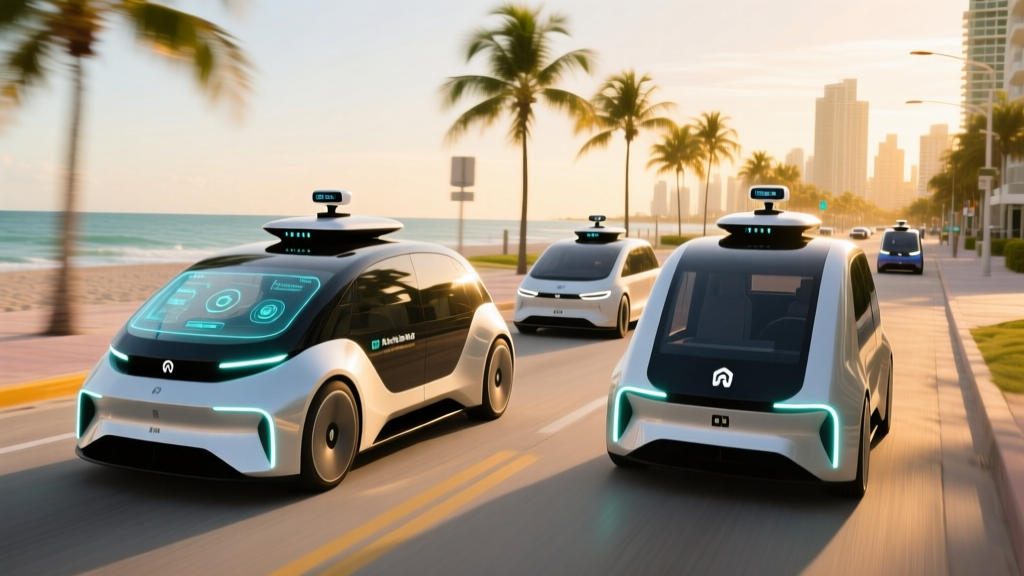
If you've searched for self driving taxis miami beach hoping to hail a driverless ride along Ocean Drive, the short answer in early 2026 is: not yet as a fully open, commercial robotaxi service. Miami-Dade County is not among the handful of U.S. cities where Level 4 driverless robotaxis operate daily for paying passengers. However, Miami is on the expansion radar for several operators, and testing activity has been building.
This guide breaks down exactly where robotaxis do operate today, what Miami Beach visitors and residents can realistically expect, how the technology and regulatory landscape is evolving in Florida, and what you need to know before assuming any vehicle on the road is truly driverless.
SAE Automation Levels: What "Self-Driving" Actually Means
| SAE Level | Name | Who Drives? | Examples |
|---|---|---|---|
| Level 0 | No Automation | Human always | Basic cruise control |
| Level 1 | Driver Assistance | Human + one system | Adaptive cruise OR lane-keep |
| Level 2 | Partial Automation | Human supervises | Tesla Autopilot, FSD (Supervised), GM Super Cruise, Ford BlueCruise |
| Level 3 | Conditional Automation | System drives in limited conditions; human on standby | Mercedes DRIVE PILOT (approved in NV, CA) |
| Level 4 | High Automation | No human driver needed within geofence | Waymo One, Zoox (limited areas) |
| Level 5 | Full Automation | No human needed anywhere | Does not exist commercially |
Key distinction: Consumer features like Tesla FSD (Supervised) and GM Super Cruise are Level 2 — the driver must remain attentive and is legally responsible. Robotaxis like Waymo One are Level 4 — no driver is present, and the company assumes operational responsibility within its approved service area. Never conflate the two. (Source: SAE International J3016)
Where Robotaxis Actually Operate in 2026
As of early 2026, commercial Level 4 robotaxi service available to the general public is confined to a small number of U.S. metro areas. Here is the current landscape:
| Operator | City/Region | Service Type | Hours | Vehicle |
|---|---|---|---|---|
| Waymo One | Phoenix metro (Chandler, Tempe, Mesa, Scottsdale) | Commercial, open to public | 24/7 | Jaguar I-PACE (5th-gen sensor suite) |
| Waymo One | San Francisco (most neighborhoods) | Commercial, open to public | 24/7 | Jaguar I-PACE |
| Waymo One | Los Angeles (downtown, Hollywood, Santa Monica, LAX) | Commercial, open to public | 24/7 | Jaguar I-PACE, Hyundai Ioniq 5 (6th-gen rollout) |
| Waymo One | Austin (limited zones, expanding) | Commercial, limited | Select hours | Jaguar I-PACE |
| Zoox | Foster City, CA / Las Vegas (test corridor) | Limited pilot, invite-only | Daytime | Zoox purpose-built carriage |
| Cruise | Operations suspended; gradual restart Phoenix/Dallas | Limited testing with safety driver | Daytime only | Chevrolet Bolt EV / Origin (announced) |
Miami and Miami Beach are not on this list. Waymo has indicated Florida is a future target market, and the company has conducted mapping and limited testing in the state, but no public commercial service has launched in Miami-Dade as of this writing. (Source: Waymo One service areas)
Miami Beach and Florida: The Regulatory Picture
Florida is actually one of the most permissive states for autonomous vehicle testing and deployment. Under Florida Statute § 316.85 (updated in 2023 and further clarified in 2024), autonomous vehicles may operate on public roads without a human driver present, provided the operator meets insurance and reporting requirements. There is no state-level ban on driverless robotaxis.
However, deployment requires more than state permission:
- Local coordination: Miami-Dade County and the City of Miami Beach must coordinate on geofencing, curb management, and emergency-response protocols.
- Insurance and liability: Florida requires a minimum of $1 million in liability coverage for autonomous vehicle operators.
- Federal oversight: The National Highway Traffic Safety Administration (NHTSA) mandates crash reporting for all Level 4 and above systems through its Standing General Order. (Source: NHTSA AV Safety)
- Infrastructure readiness: Dense urban environments with heavy pedestrian traffic, frequent construction zones, and seasonal flooding (common in Miami Beach) present technical challenges that operators must validate before launch.
Miami's tropical climate — heavy rain, intense sun glare, and occasional tropical storms — adds sensor challenges that operators must solve before deploying driverless service reliably.
How Robotaxis Work: The Technology Stack
Understanding why Miami Beach isn't live yet requires understanding what's under the hood (and on the roof) of a Level 4 robotaxi.
Waymo 5th-Gen (Current Fleet) Sensor Suite
| Sensor Type | Count | Function |
|---|---|---|
| LiDAR (custom, roof-mounted) | 5 | 360° 3D point cloud; object detection to ~500m |
| Cameras (high-resolution) | 29 | Traffic-light state, sign reading, pedestrian intent |
| Radar (imaging) | 6 | Velocity detection, adverse-weather redundancy |
| Audio detection | External mics | Siren detection for emergency-vehicle yielding |
| GPS/IMU/HD maps | — | Centimeter-level localization within pre-mapped geofence |
LiDAR vs. camera-only debate: Waymo, Zoox, and most robotaxi operators rely on LiDAR as a core sensor for depth perception and redundancy. Tesla's FSD (Supervised) uses a camera-only approach — but remember, FSD is Level 2 driver-assist, not a Level 4 robotaxi system. The camera-only approach is lighter and cheaper but requires the human driver as a fallback, which is precisely why it cannot be deployed as a driverless taxi.
Geofencing is essential: Level 4 robotaxis operate within precisely mapped zones. The vehicle's HD map includes lane geometry, traffic-signal positions, speed limits, and construction-zone patterns. If the vehicle exits the geofence or encounters unmapped changes, it will execute a minimal-risk maneuver (safe pullover) rather than proceed blindly.
Pricing: Robotaxis vs. Uber and Lyft
For the markets where robotaxis are live, here is how Waymo One pricing compares to conventional rideshare in early 2026:
| Route Example | Waymo One | UberX | Lyft |
|---|---|---|---|
| 5-mile city trip (Phoenix) | $11–$16 | $10–$18 | $9–$17 |
| 10-mile trip (SF, SOMA to Marina) | $18–$28 | $16–$30 | $15–$28 |
| Airport run (LAX to Santa Monica, ~8 mi) | $22–$32 | $20–$35 | $18–$33 |
| Surge pricing? | No dynamic surge | Yes, 1.5x–3x common | Yes, similar |
| Tipping | Not expected (no driver) | Expected ($2–$5) | Expected ($2–$5) |
Key takeaway: Robotaxi pricing is currently comparable to UberX and Lyft, not dramatically cheaper. The long-term economic thesis is that removing the driver (who earns ~65–75% of a rideshare fare) should lower costs — but Waymo has not yet passed those savings to consumers at scale. In markets where Waymo competes directly, prices are competitive but not disruptive. Expect similar pricing if and when service reaches Miami.
Safety Data: What the Numbers Actually Show
Safety is the most contested question in autonomous vehicles. Here is what the verified data tells us as of 2026:
Waymo Safety Record (Verified Data)
- Total autonomous miles driven: Over 40 million fully driverless miles as of late 2025 (Source: Waymo Safety Report)
- Injury-causing crash rate: ~85% lower than human benchmarks in Waymo's operating cities, per Waymo's peer-reviewed study published with the Swiss Re reinsurance group
- Property-damage crash rate: ~57% lower than human benchmarks
- Contact incidents: The vast majority of minor contacts occur at low speed (<10 mph) in parking lots or during unprotected left turns — scenarios where human drivers also have elevated incident rates
The Cruise suspension context: In October 2023, a Cruise robotaxi in San Francisco dragged a pedestrian who had been thrown into its path by a human-driven vehicle. The incident, combined with Cruise's failure to fully disclose the drag element to regulators, led the California DMV to suspend Cruise's deployment permit. Cruise subsequently paused all nationwide operations, laid off staff, and began a phased restart in Phoenix and Dallas in 2025–2026 with safety drivers before attempting driverless service again. (Source: NHTSA)
This incident underscores a critical point: Level 4 robotaxis are generally safer than human drivers in routine scenarios, but edge cases — especially those involving multiple actors and unpredictable pedestrian behavior — remain challenging. Miami Beach, with its dense nightlife pedestrian traffic on Ocean Drive, would represent exactly this type of complex environment.
Current Limitations: Why Miami Beach Is a Hard Problem
Technical and Operational Constraints
- Heavy rain and standing water: Miami Beach receives ~60 inches of rain annually and experiences frequent street flooding, especially during king tides. LiDAR performance degrades in heavy precipitation, and flooded road surfaces can confuse lane-detection systems.
- Dense, unpredictable pedestrian zones: Ocean Drive and the South Beach entertainment district have extremely high pedestrian density, jaywalking, and intoxicated foot traffic — particularly at night. Validating safe operation here requires extensive scenario testing.
- Construction and detours: Miami Beach undergoes near-constant road and utility work. Geofenced HD maps require frequent updates; unmapped detours force the vehicle to pull over safely rather than navigate blindly.
- Hurricane and tropical storm protocols: No current robotaxi operates in severe weather. Evacuation scenarios, downed power lines, and debris-covered roads are well beyond current Level 4 capability.
- Airport and port access: Miami International Airport and PortMiami have their own access regulations. Robotaxi drop-off at these facilities requires separate agreements.
- No multi-modal integration yet: Robotaxis currently cannot coordinate with Miami-Dade Transit (Metromover, Metrorail) for seamless trip planning.
These limitations aren't unique to Miami — they apply to any dense, weather-challenged coastal city. But they explain why operators have prioritized drier, more grid-structured cities (Phoenix, Austin) before tackling South Florida.
What Miami Beach Visitors Can Do Now
While you wait for Level 4 robotaxi service to arrive, here are your current options for tech-forward transportation in Miami Beach:
- Uber and Lyft: Fully available throughout Miami Beach, including Uber Comfort and Lyft Lux for premium EV options. Some drivers use Tesla Model Y, Model 3, or Ford Mustang Mach-E vehicles — you may get an EV ride, but a human is always driving.
- Tesla FSD (Supervised) rentals: Some Turo hosts in Miami offer Tesla vehicles with FSD (Supervised) enabled. Remember: this is Level 2 — you must remain attentive, hands near the wheel, and you are legally the driver.
- Waymo One in other cities: If you're traveling to Phoenix, San Francisco, or Los Angeles before or after Miami, you can use Waymo One there. Download the Waymo app, create an account, and request a ride like any rideshare.
⚠️ Critical Reminder
If you see a Tesla, Mercedes, or any consumer vehicle driving itself on Miami Beach roads in 2026, it is not a robotaxi. It is a Level 2 or Level 3 driver-assist system with a human driver who is legally required to supervise. No Level 4 driverless commercial service is currently authorized to pick up passengers in Miami-Dade County.
Frequently Asked Questions
Where can I use a robotaxi service right now?
As of early 2026, Waymo One is commercially available to the public in Phoenix (metro-wide), San Francisco (most neighborhoods), Los Angeles (downtown to LAX corridor), and Austin (limited zones). Zoox operates invite-only pilots in Foster City, CA, and Las Vegas. Cruise is gradually restarting with safety drivers in Phoenix and Dallas. No robotaxi service is available in Miami or Miami Beach.
How much does a robotaxi cost compared to Uber or Lyft?
Waymo One pricing is comparable to UberX and Lyft — typically $11–$16 for a 5-mile city trip, $18–$28 for a 10-mile trip. The key advantage is no surge pricing and no tipping. Robotaxis are not yet significantly cheaper than rideshare, but they offer price predictability during peak demand periods.
How safe are robotaxis — is there real data?
Waymo's verified data (over 40 million driverless miles) shows an ~85% reduction in injury-causing crashes and ~57% reduction in property-damage crashes compared to human benchmarks in the same cities. However, the Cruise pedestrian-drag incident in San Francisco demonstrates that edge cases remain a serious concern. Both NHTSA and state regulators require crash reporting for all Level 4 operations.
What are the current limitations of robotaxis?
Level 4 robotaxis cannot operate outside their geofenced service area, struggle in heavy rain, snow, and standing water, cannot handle unmapped construction detours, do not operate during severe weather events, and may pause or pull over when encountering complex scenarios like aggressive pedestrian behavior or emergency situations. Miami Beach's combination of tropical weather, dense nightlife pedestrian zones, and frequent flooding makes it a particularly challenging deployment environment.
Is Tesla FSD the same as a robotaxi?
No. Tesla Full Self-Driving (Supervised) is a SAE Level 2 driver-assistance system. The human driver must remain fully attentive, keep hands near the steering wheel, and is legally responsible for the vehicle at all times. A robotaxi like Waymo One is SAE Level 4 — there is no human driver in the vehicle, and the operating company assumes responsibility. Tesla has announced a future robotaxi concept, but it is not commercially available or approved for driverless operation anywhere.
When will self-driving taxis come to Miami Beach?
There is no confirmed launch date for any robotaxi service in Miami-Dade County. Waymo has identified Florida as a future market and has conducted mapping activity in the state, but commercial deployment requires local coordination, weather validation, and regulatory agreements that have not yet been finalized. Realistically, a limited geofenced launch in parts of Miami (not necessarily Miami Beach specifically) could occur in 2027 or later, but this is speculative.