Is There a Self-Driving Taxi in Miami Right Now?
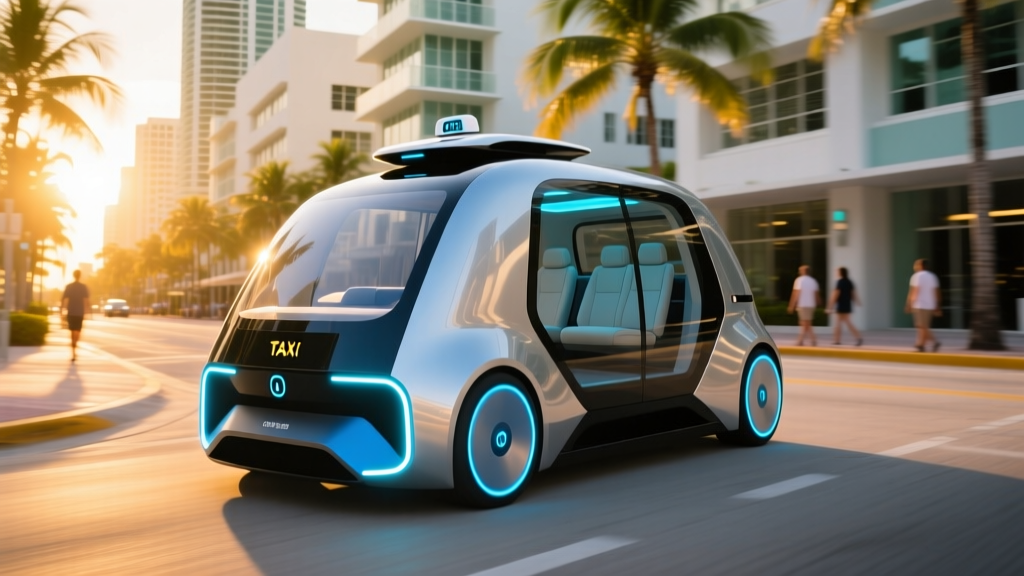
If you've searched for a self-driving taxi in Miami hoping to hail a driverless ride from South Beach to Brickell, the honest 2026 answer is: not yet for the general public on open roads. Miami-Dade County is, however, one of the most active robotaxi testing grounds in the United States, with Waymo and Cruise (under its relaunched supervised-testing program) holding permits to operate test vehicles on public streets. Fully commercial, fare-charging, driverless robotaxi service — the kind where no human sits behind the wheel — remains limited to a handful of U.S. metros as of early 2026.
This guide maps exactly where robotaxis operate today, what Miami's status is, how pricing compares to Uber and Lyft, what the safety data actually shows, and when Miami riders might realistically hail a driverless car.
Is This Truly Self-Driving or Driver-Assist?
Robotaxis from Waymo, Zoox, and the relaunched Cruise testing program operate at SAE Level 4 — meaning the vehicle handles all driving tasks without a human driver, but only within a defined Operational Design Domain (geofenced area, fair weather, mapped roads). There is no human behind the wheel to take over.
This is fundamentally different from SAE Level 2 systems like Tesla Autopilot, FSD (Supervised), Ford BlueCruise, or GM Super Cruise, which require an attentive human driver at all times. Consumer Level 2 vehicles are not robotaxis and cannot operate without a licensed driver present.
Where Robotaxis Actually Operate in 2026
Commercial, fare-charging robotaxi service is live in only a few U.S. cities. Here is the current landscape:
| Company | Live Commercial Cities | Testing / Permitted | SAE Level |
|---|---|---|---|
| Waymo (Alphabet) | Phoenix, San Francisco, Los Angeles | Austin, Miami, Atlanta | Level 4 |
| Zoox (Amazon) | Las Vegas (limited), Foster City, CA | Seattle, San Francisco | Level 4 |
| Cruise (GM) | None (commercial service suspended since late 2023) | Phoenix, Dallas, Houston (supervised testing) | Level 4 (testing) |
| Motional (Hyundai/Aptiv) | None (paused commercial ops) | Las Vegas | Level 4 (testing) |
Sources: NHTSA AV reporting, company press releases. Status as of Q1 2026 — always verify before travel.
Miami's Robotaxi Status: Testing, Not Rides
Miami-Dade County approved autonomous vehicle testing on public roads, and Waymo has been spotted running its 5th-generation Jaguar I-PACE fleet through neighborhoods like Wynwood, the Design District, and parts of downtown. However, these are mapping and validation runs, not commercial rides you can book through an app.
Florida is one of the most permissive states for AV regulation. Florida Statute 316.86 allows fully driverless operation on public roads without a human safety operator, provided the vehicle meets federal motor-vehicle safety standards and the operator maintains minimum insurance. This legal framework positions Miami well for eventual commercial launch — but a commercial rollout date has not been announced by any operator as of early 2026.
If you see a Waymo vehicle in Miami, it likely has a safety driver or is on a restricted mapping route. You cannot currently hail it.
How Robotaxi Pricing Compares to Uber and Lyft
In cities where commercial robotaxi service is live (Phoenix, San Francisco, Los Angeles), pricing is broadly competitive with UberX and Lyft — sometimes cheaper during promotional periods, sometimes slightly more expensive during peak demand.
| Service | Base Fare (typical) | Per-Mile Rate | Per-Minute Rate | Surge Pricing? |
|---|---|---|---|---|
| Waymo One | $3.00–$5.00 | $1.10–$1.50 | $0.30–$0.45 | Rare; more consistent pricing |
| UberX | $2.50–$4.00 | $1.00–$1.75 | $0.20–$0.40 | Yes, frequent in peak hours |
| Lyft | $2.50–$4.00 | $1.00–$1.60 | $0.20–$0.35 | Yes, frequent in peak hours |
A typical 5-mile trip in Phoenix on Waymo One costs roughly $12–$18 before tip (tipping is not applicable — there's no driver). The same trip on UberX during non-surge hours runs $10–$16. During surge events, Waymo's pricing tends to remain more stable since fleet supply is algorithmically managed rather than dependent on independent driver availability.
For Miami riders: until commercial service launches, expect pricing in line with Phoenix/SF rates — approximately $12–$20 for a typical midtown-to-Brickell trip.
How Safe Are Robotaxis? The Real Data
Robotaxi safety is the most scrutinized question in the AV industry. Here's what the verified data shows:
Robotaxi Safety by the Numbers
- Waymo has logged over 40 million fully driverless miles across Phoenix, SF, and LA as of late 2025, per Waymo's published safety reports.
- Waymo's insurance-claim rate for injury-causing crashes is approximately 85% lower than the human-driver benchmark for comparable urban driving, according to a Swiss Re reinsurance analysis published in 2024.
- Cruise suspended all driverless operations nationwide in October 2023 after a San Francisco incident in which a pedestrian was struck by a human-driven vehicle and then dragged under a Cruise robotaxi. Cruise has since resumed supervised testing (with safety drivers) in select cities under new operational protocols.
- The NHTSA Standing General Order requires all AV operators to report crashes involving ADS-equipped vehicles. As of 2025, over 2,400 ADS-related crash reports have been filed nationally — the vast majority minor, low-speed contacts, but the dataset includes serious incidents.
- Human-driver baseline: U.S. traffic fatalities in 2024 were approximately 1.35 per 100 million vehicle miles traveled (NHTSA FARS). Robotaxis have not yet accumulated enough driverless miles to produce a statistically equivalent fatality rate — the sample size is still too small for a definitive per-mile fatality comparison.
The data suggests that Level 4 robotaxis in their operational domains are performing at or better than attentive human drivers for the specific metrics tracked (injury claims, police-reported crashes). However, the operational domain is narrow — good weather, mapped roads, moderate speeds — and the total driverless miles driven are a fraction of the ~3.2 trillion miles Americans drive annually.
The Technology Stack: What Makes a Robotaxi Drive Itself
Robotaxis rely on a fundamentally different technology approach than consumer Level 2 driver-assist systems. Here's what's under the hood:
Waymo 5th-Generation Sensor Suite (Jaguar I-PACE)
- LiDAR: 5 roof-mounted LiDAR units providing 360° point-cloud mapping out to 300+ meters. LiDAR is the primary depth sensor and works in darkness.
- Cameras: 29 cameras covering 360° visibility, used for object classification, traffic-light state detection, and lane-reading.
- Radar: 6 radar units for velocity detection and operation in rain/fog where LiDAR and cameras degrade.
- Audio sensors: External microphones to detect emergency-vehicle sirens.
- Compute: Custom "Waymo Driver" hardware processing over 1 billion sensor data points per second.
Zoox Purpose-Built Vehicle
- Bidirectional (no steering wheel, no "front" or "back") — designed from the ground up as a robotaxi.
- Redundant steering, braking, and compute systems — if one system fails, the backup takes over.
- Similar LiDAR + camera + radar fusion, with 4-corner sensor pods.
Geofencing
All current Level 4 robotaxis operate within a geofenced Operational Design Domain (ODD) — a high-definition mapped area where the system has been validated. If a passenger requests a destination outside the ODD, the ride is declined. The ODD also defines speed limits, road types, and weather conditions under which the system will operate.
By contrast, Tesla's FSD (Supervised) uses a camera-only approach (no LiDAR, no radar on current vehicles) and operates without a geofence — but it remains a Level 2 system requiring constant driver supervision. These are fundamentally different engineering philosophies with different safety trade-offs.
Current Limitations: What Robotaxis Cannot Do
Understanding what robotaxis cannot do is as important as understanding their capabilities:
Operational Limitations
- Weather: Heavy rain, fog, snow, and flooding degrade LiDAR and camera performance. Robotaxis will pull over or decline rides in severe conditions. Miami's summer thunderstorms could regularly trigger service interruptions.
- Geofence boundaries: You can only travel within the mapped ODD. A trip from downtown Miami to the Keys or to Fort Lauderdale would not be possible if those areas aren't mapped and validated.
- Construction zones: Unexpected lane closures, temporary signage, and flaggers can confuse the system. Robotaxis may take conservative routes or stop and wait for remote-assistance guidance.
- Unprotected left turns: These remain one of the most challenging maneuvers. Robotaxis handle them but sometimes with excessive caution, causing delays.
- Pickup/dropoff precision: Robotaxis pull to the curb at designated spots but cannot navigate parking garages, driveways, or private property. You walk to the car, not the other way around.
- No highway driving (most services): Waymo's Phoenix service includes some freeway segments, but most urban robotaxi ODDs are limited to surface streets at speeds under 45 mph.
- Passenger assistance: No driver means no help with luggage, wheelchair loading, child seats, or medical emergencies. Zoox's vehicle has no trunk — only a small interior cargo shelf.
The Regulatory Landscape: Who Approves Robotaxis
Robotaxi deployment in the U.S. involves a patchwork of federal and state authority:
- Federal (NHTSA): Sets vehicle safety standards (FMVSS). NHTSA can grant exemptions for vehicles without steering wheels or mirrors (Zoox has received such exemptions). NHTSA also mandates crash reporting via the Standing General Order.
- State level: States control licensing of AV operations. California's CPUC and DMV jointly regulate commercial robotaxi service. Arizona has minimal regulatory barriers, which is why Waymo launched commercially in Phoenix first. Florida permits driverless operation with insurance requirements but does not have a specific commercial-robotaxi licensing framework like California's CPUC process.
- Local/municipal: Cities and counties control road access, curb management, and can impose operating restrictions. Miami-Dade's cooperation with AV testers is a positive signal but does not guarantee a specific launch timeline.
The absence of a unified federal AV deployment law means each operator must navigate state-by-state approval — a significant bottleneck for rapid expansion.
When Will Miami Get a Commercial Robotaxi?
Based on current operator trajectories, Miami is likely a 2027–2028 candidate for commercial Waymo service, assuming:
- Waymo completes its Miami mapping and validation phase (currently underway).
- The company scales its fleet production — Waymo's partnership with Hyundai/Genesis for next-gen vehicles is still ramping.
- Florida's regulatory framework remains permissive (it currently is, under both parties).
Miami's flat terrain, wide grid streets, and year-round warm weather make it an attractive robotaxi market — but the density of pedestrians in South Beach, frequent construction, and aggressive local driving culture present validation challenges that take time to address.
Frequently Asked Questions
Where can I use a robotaxi service right now?
Commercial, fare-charging, driverless robotaxis are available to the public in Phoenix (Waymo One), San Francisco (Waymo One), Los Angeles (Waymo One), and limited areas of Las Vegas (Zoox). Miami does not yet have commercial robotaxi service — only testing vehicles are on the road.
How much does a robotaxi cost vs. Uber or Lyft?
In cities where Waymo One operates, a typical 5-mile ride costs $12–$18, comparable to UberX during non-surge hours ($10–$16). Waymo pricing is generally more stable since it doesn't use traditional surge pricing, but availability is limited to the geofenced area.
How safe are robotaxis based on real data?
Waymo has logged over 40 million driverless miles with an injury-claim rate approximately 85% lower than the human-driver benchmark (per Swiss Re analysis). However, total driverless miles are a tiny fraction of U.S. annual VMT, and the operational domain is restricted. Cruise suspended operations in 2023 after a serious incident and has not resumed commercial service.
What are the current limitations of robotaxis?
Robotaxis cannot operate in severe weather, outside their geofenced area, or on most highways. They cannot assist with luggage, child seats, or wheelchairs. Construction zones and complex intersections may cause delays or route refusals. Miami's summer thunderstorms could be a regular service disruptor.
Is a Tesla with FSD the same as a robotaxi?
No. Tesla's Full Self-Driving (Supervised) is an SAE Level 2 driver-assist system that requires a licensed, attentive human driver at all times. Waymo, Zoox, and Cruise testing vehicles operate at SAE Level 4 — fully driverless within their operational domain, with no human behind the wheel. These are fundamentally different systems with different regulatory classifications.
Can I call a robotaxi in Miami today?
No. As of early 2026, no company offers commercial, app-bookable robotaxi rides in Miami. Waymo has testing vehicles on Miami roads, but they are not available for public rides. Check the Waymo One app for service-area updates, as expansion announcements are made periodically.