Las Vegas has quietly become one of the most active robotaxi proving grounds in the United States. Between Waymo's expanding commercial service and Motional's Ioniq 5-based fleet, visitors and residents now have genuine options for hailing a vehicle with no one in the driver's seat. But availability is nuanced, geofencing is strict, and the experience differs sharply from a standard Uber or Lyft ride. Here's exactly what you need to know before booking a self driving taxi Las Vegas in 2026.
Is This Truly Self-Driving or Driver-Assist?
The robotaxis operating in Las Vegas are SAE Level 4 vehicles — meaning they drive themselves entirely within a defined operational domain (specific geofenced areas, specific conditions) with no human driver present and no expectation of human intervention. This is fundamentally different from the Level 2 driver-assist systems found in consumer vehicles.
SAE Automation Levels: What Matters Here
| Level | Definition | Example |
|---|---|---|
| Level 2 | Driver-assist: car steers/accelerates, driver must monitor at all times | Tesla Autopilot/FSD Supervised, GM Super Cruise, Ford BlueCruise |
| Level 3 | Conditional automation: car drives in limited scenarios, driver must take over on request | Mercedes Drive Pilot (limited markets, <40 mph) |
| Level 4 | High automation: fully driverless within a defined operational design domain (geofence, weather, speed) | Waymo One, Motional robotaxi, Zoox |
| Level 5 | Full automation: any road, any condition, no geofence — does not exist commercially today | None |
Source: SAE International J3016
If you've used Tesla's Full Self-Driving (Supervised), you've experienced Level 2. The car handles steering and speed, but you are legally and practically the driver. Robotaxis in Las Vegas are Level 4: the vehicle handles all driving tasks within its service area, and there is no steering wheel intervention required from you. The distinction matters for safety expectations, regulatory oversight, and liability.
Where Can I Use a Robotaxi in Las Vegas Right Now?
As of early 2026, two primary operators run driverless robotaxi services in the Las Vegas metro area, each with distinct coverage zones and access methods.
| Operator | Vehicle | Service Area | Access | Hours |
|---|---|---|---|---|
| Waymo One | Jaguar I-PACE (custom-equipped, 5th-gen sensor suite) | Las Vegas Strip corridor, downtown Las Vegas, parts of Henderson — approximately 50+ sq mi geofence | Waymo app (open to public, no waitlist) | 24/7 |
| Motional | Hyundai Ioniq 5 (robotaxi variant, Level 4 equipped) | Select Strip and downtown zones — more limited geofence than Waymo | Uber app (Motional rides appear as a ride option) or Lyft | Limited hours, typically 10 AM – 11 PM |
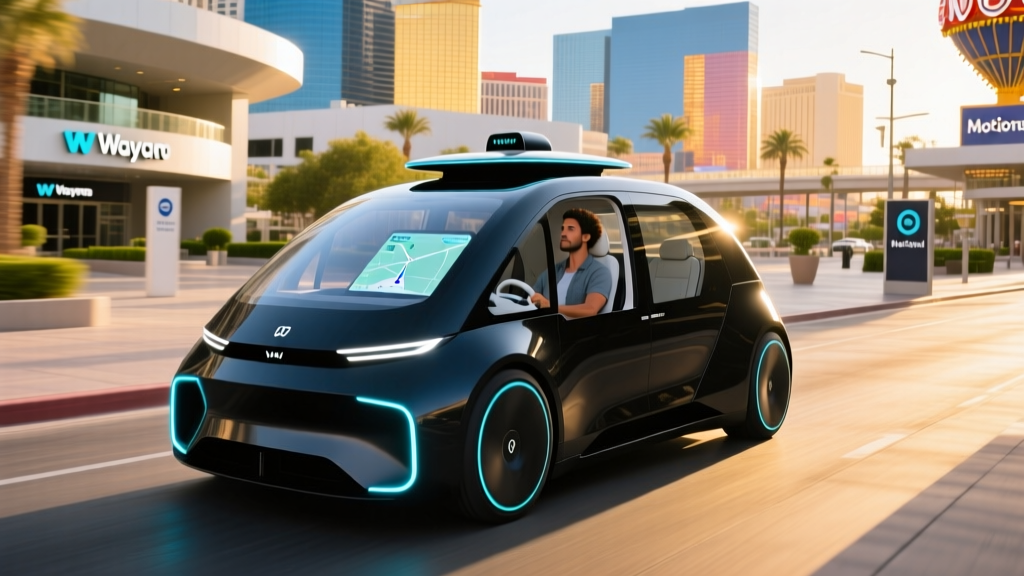
Waymo is the dominant player. Their Las Vegas service launched commercially in 2024 after a phased rider-only beta, and by 2026 the geofence covers most of the tourist corridor — from the Mandalay Bay area north through downtown, including the Arts District and portions of Summerlin. The service is fully open: download the Waymo app, enter your destination, and if it falls within the geofence, you'll be matched with a driverless I-PACE.
Motional (the Hyundai-Aptiv joint venture) operates a smaller fleet of Ioniq 5 robotaxis. These are accessible through Uber or Lyft — when you request a ride in the covered zone, you may be matched with a Motional vehicle (clearly labeled in the app). Coverage is more limited, primarily focused on the central Strip and immediate downtown area.
Not yet available: Cruise (GM's robotaxi division) suspended all driverless operations nationally in late 2023 following a serious incident in San Francisco. As of early 2026, Cruise has been conducting supervised testing in select cities but has not resumed commercial driverless service in Las Vegas. Zoox (Amazon's subsidiary) operates its purpose-built robotaxi in Las Vegas for employee and invited-rider testing but does not yet offer a public commercial service here.
How Much Does a Robotaxi Cost vs. Uber or Lyft?
Robotaxi pricing in Las Vegas is designed to be competitive with conventional rideshare — operators are subsidizing rides to build ridership and gather data, not to maximize short-term revenue.
| Service | Typical Base Fare | Per-Mile Rate | Sample: Strip Hotel to Downtown (~5 mi) | Surge Pricing? |
|---|---|---|---|---|
| Waymo One | $2.50–$3.50 | $1.25–$1.75/mi | $12–$18 | No dynamic surge (fixed pricing model) |
| Motional (via Uber/Lyft) | Standard Uber/Lyft base | Standard per-mile | $11–$16 (comparable to UberX) | Follows Uber/Lyft surge rules |
| UberX (baseline) | $2.00–$3.00 | $1.10–$1.50/mi | $10–$16 | Yes, dynamic surge |
| Lyft Standard (baseline) | $2.00–$3.00 | $1.10–$1.50/mi | $10–$15 | Yes, dynamic surge |
Key pricing observations:
- Waymo does not surge. During peak times (New Year's Eve, major conventions, Saturday nights on the Strip), Waymo pricing stays flat while Uber/Lyft can surge 1.5x–3x. This makes robotaxis the cheaper option during high-demand periods — if a car is available.
- Availability is the real cost. Waymo's fleet in Las Vegas is smaller than Uber's driver pool. Wait times can stretch to 15–25 minutes during peak hours, versus 3–7 minutes for a conventional rideshare. You're paying with time, not money.
- No tipping. There's no driver to tip. A $15 Waymo ride costs exactly $15.
- Promotional pricing. Waymo frequently offers first-ride credits (typically $5–$10 off) and referral bonuses. Check the app for current promotions.
How Safe Are Robotaxis? Real Data, Not Hype
This is the question every prospective rider asks, and it deserves an answer grounded in published data rather than marketing claims.
Waymo Safety Data (Through 2025)
- Total autonomous miles driven (nationwide): Over 30 million fully driverless miles as of late 2025, across Phoenix, San Francisco, Los Angeles, and Las Vegas (Waymo Safety Report).
- Injury-causing crash rate: Waymo's fully autonomous vehicles were involved in injury-causing crashes at a rate approximately 85% lower than human benchmarks in comparable urban environments, per Waymo's published comparison to NHTSA data.
- Police-reported crash rate: Approximately 57% fewer police-reported crashes per million miles compared to human drivers in the same operating cities.
- Contact rate with other vehicles/objects: Lower than human benchmarks for most collision categories, though slightly higher for low-speed contact with stationary objects (e.g., construction barriers in edge-case scenarios).
Sources: Waymo Safety Reports, NHTSA
Context that matters:
- Robotaxis operate primarily in geofenced, well-mapped urban areas at moderate speeds (typically under 45 mph). This is an inherently lower-risk environment than highway driving or rural roads. The comparison to "human drivers" is therefore somewhat favorable to robotaxis — they're not attempting the most dangerous driving scenarios.
- The Cruise incident in San Francisco (October 2023, where a pedestrian was struck by a human-driven vehicle and then run over by a Cruise robotaxi) demonstrated that edge cases — particularly involving other humans behaving unpredictably — remain the hardest problem. Cruise's subsequent nationwide suspension showed that regulators take these incidents seriously.
- The NHTSA Standing General Order requires all operators of Level 4 and Level 5 vehicles to report crashes within one day. This means robotaxi safety data is more transparent than human driver data — every incident is public, while the vast majority of human fender-benders never make a database.
- Las Vegas-specific incident data is limited because the fleet size and total miles driven in this market are smaller than Phoenix or San Francisco. No fatal robotaxi crashes have occurred in Las Vegas as of early 2026.
Under the Hood: The Technology Stack
Las Vegas robotaxis rely on fundamentally different technology approaches, but both achieve Level 4 autonomy through sensor redundancy and high-definition mapping.
Waymo (Jaguar I-PACE, 5th-Gen Hardware)
- LiDAR: Custom-built spinning and solid-state LiDAR units generating a real-time 360° point cloud — effective to 500+ meters, functional in darkness and most weather
- Cameras: 29+ high-resolution cameras covering 360° with overlapping fields of view for object classification and traffic-signal recognition
- Radar: 6 radar units for velocity detection of moving objects, functional in rain and fog where cameras and LiDAR degrade
- HD Mapping: Pre-built centimeter-precision maps of every street in the geofence, updated continuously; the vehicle localizes itself within this map in real time
- Compute: Custom Waymo-designed compute platform processing sensor fusion, prediction, and planning at high frequency
Motional (Hyundai Ioniq 5 Robotaxi)
- LiDAR: Multiple roof-mounted and bumper-integrated LiDAR sensors (Hesai and Motional proprietary units)
- Cameras: Surround-view camera array for lane detection, signal recognition, and object classification
- Radar: Corner radars and forward-facing radar for adaptive cruise and object tracking
- HD Mapping: Pre-mapped operational domain with real-time localization
- Redundancy: Dual-redundant braking, steering, and compute systems — if one system fails, the vehicle can pull over safely
LiDAR vs. camera-only: Both Waymo and Motional use LiDAR as a primary sensor, in contrast to Tesla's camera-only approach for its consumer FSD system. LiDAR provides direct depth measurement independent of lighting conditions — a significant advantage for driverless operation where there's no human to compensate if a camera misinterprets a scene. The trade-off is cost: each robotaxi carries $50,000–$100,000+ in sensor and compute hardware, which is why these vehicles operate as fleet services rather than consumer products.
Geofencing is essential: Neither system attempts to drive everywhere. The vehicle's operational design domain (ODD) is a pre-mapped, extensively tested area. If your destination falls outside the geofence, the app simply won't let you book the ride. This constraint is a safety feature, not a limitation to work around.
Current Limitations: What Robotaxis Cannot Do
Understanding what these vehicles can't handle is as important as knowing what they can.
- Heavy rain and monsoon conditions: Las Vegas summer monsoons (July–September) produce sudden downpours that can overwhelm LiDAR and camera systems. Waymo will pause service or restrict the geofence during severe weather events. Light rain is handled without issue.
- Construction zones: Major roadwork with shifted lanes, temporary barriers, and flaggers can confuse the system. If a route passes through an unmapped construction zone, the vehicle may reroute, slow to a crawl, or (in rare cases) pull over and request remote assistance.
- Parking garages and valet areas: Robotaxis cannot enter most parking structures. Pickups and drop-offs happen at street-level addresses only. If your hotel's main entrance is inside a garage or covered portico with tight clearance, the app will direct you to a nearby street corner.
- Highway driving: Most Las Vegas robotaxi service avoids limited-access highways. Rides primarily use surface streets. A trip that a human driver would take via I-15 may be routed on surface streets, adding time.
- Edge cases with human unpredictability: Jaywalking crowds on the Strip, aggressive human drivers, emergency vehicles in complex scenarios, and unusual road obstructions (fallen cargo, animals) can trigger conservative behavior — the vehicle may stop and wait rather than navigate around the obstacle.
- Luggage and accessibility: Waymo I-PACE vehicles have trunk space, but there's no driver to help with bags. Wheelchair accessibility is limited — Waymo has been testing accessible vehicles in Phoenix but Las Vegas availability is restricted as of early 2026.
- No multi-stop rides: You cannot add intermediate stops. One pickup, one drop-off.
- Age restrictions: Riders must be 18+ to book. Unaccompanied minors are not permitted. Waymo has begun allowing riders as young as 16 with parental consent in select markets, but check current Las Vegas policy in-app.
The Regulatory Landscape: Who Approves Robotaxis in Nevada?
Nevada was actually the first state to pass autonomous vehicle legislation (AB 511 in 2011), and the state maintains a relatively permissive but structured regulatory framework.
- Nevada Department of Motor Vehicles (DMV): Issues autonomous vehicle testing and deployment permits. Operators must demonstrate insurance coverage (minimum $5 million), submit safety documentation, and maintain crash reporting.
- NHTSA (federal): Oversees vehicle safety standards. The Standing General Order requires crash reporting for all ADS-equipped vehicles. NHTSA can issue recalls or investigations — as it did with Cruise following the 2023 San Francisco incident.
- Local jurisdictions: Clark County and the City of Las Vegas can impose local operating restrictions, speed limits, and geofence requirements. The Las Vegas Strip falls under Clark County jurisdiction, and the county has cooperated with robotaxi operators on infrastructure (e.g., designated pickup zones near major hotels).
- No federal autonomous vehicle law:Despite years of proposed legislation, there is still no comprehensive federal law governing Level 4 deployment. Regulation remains a patchwork of state rules. Nevada, Arizona, California, and Texas are the most permissive states for commercial robotaxi operations.
Practical Tips for Your First Las Vegas Robotaxi Ride
If you're planning to hail a self driving taxi in Las Vegas, here's what to expect step by step:
- Download the Waymo app (or use Uber/Lyft for Motional). Create an account and add a payment method.
- Enter your destination. The app will confirm whether both pickup and drop-off are within the service area. If not, it will suggest the nearest valid address.
- Walk to the pickup pin. Robotaxis stop at precise GPS coordinates. The app shows the vehicle approaching on a map — look for the distinctive roof-mounted sensor array on the I-PACE or Ioniq 5.
- Unlock the vehicle. When the car arrives, the app prompts you to unlock the doors. There's no driver — the back seats are empty. Buckle up (the vehicle won't move until all passengers are belted).
- Start the ride. Tap "Start" in the app. The vehicle pulls away autonomously. Screens in the back seat show a real-time visualization of what the car "sees" — other vehicles, pedestrians, traffic signals, and the planned route.
- Ride and arrive. You can monitor the route on the in-car screen or your phone. When you arrive, exit the vehicle and the ride ends automatically. You'll receive a receipt in the app.
Frequently Asked Questions
Can I hail a self driving taxi from the Las Vegas airport (Harry Reid International)?
As of early 2026, Waymo's Las Vegas geofence does not include Harry Reid International Airport (LAS) as a pickup location. You can take a robotaxi to the airport if the drop-off point is within the geofence boundary near the airport perimeter, but terminal pickups are not yet available. Use a conventional rideshare or taxi from the airport, then switch to a robotaxi for rides around the Strip and downtown.
What happens if the robotaxi gets confused or encounters an obstacle it can't handle?
The vehicle will come to a safe stop (typically pulling to the side of the road) and contact a remote assistance operator. This human does not drive the vehicle remotely — they provide guidance (e.g., "the construction barrier has moved, you can proceed") and the vehicle resumes autonomous driving. In rare cases, the vehicle may end the ride early and request you exit at a safe location.
Is it legal to drink alcohol in a robotaxi?
No. Nevada's open-container laws apply to robotaxis just as they do to conventional vehicles. Even though there's no driver, the vehicle is still classified as a motor vehicle on a public road. Don't risk it.
How does a robotaxi handle the Las Vegas heat in summer?
The Jaguar I-PACE and Ioniq 5 are production vehicles with standard climate control, and the cabin is air-conditioned normally. The sensor and compute hardware generates significant heat, but it's cooled by dedicated thermal management systems separate from the passenger cabin. Summer temperatures over 110°F have not caused service disruptions in Las Vegas, though extreme heat can slightly reduce the vehicle's battery range (the I-PACE has a 234-mile EPA range, but robotaxi operations involve frequent stop-and-go driving and constant sensor/compute power draw, so effective range is lower — vehicles cycle back to charging depots regularly).
Are robotaxis available during major Las Vegas events (CES, Super Bowl, F1)?
Yes, but expect significantly longer wait times. During events like CES (January, ~170,000 attendees) or the Las Vegas Grand Prix (November), demand spikes dramatically while some streets are closed or rerouted, which can shrink the effective geofence. Waymo does not surge-price, so the cost remains the same — but a 5-minute wait can become a 30-minute wait. Plan accordingly and consider booking well in advance if the app allows scheduled rides.
How do robotaxis compare to the Las Vegas Monorail or Deuce bus?
The Monorail runs along the east side of the Strip from MGM Grand to SAHARA Las Vegas — it's fast ($5 one-way, ~10 minutes end to end) but only serves Strip-adjacent hotels with no downtown access. The Deuce bus covers the Strip and downtown but is slow (45+ minutes end to end) and often crowded. A robotaxi offers door-to-door service for $12–$18 and is a good option for trips the Monorail doesn't cover — particularly cross-Strip or downtown destinations.
Bottom Line: Is a Las Vegas Robotaxi Worth Trying?
If you're visiting Las Vegas and want to experience Level 4 autonomous driving firsthand, Waymo One is the most accessible option — open to the public, competitively priced, and covering the major tourist areas. The technology is genuinely impressive: the vehicle navigates Strip traffic, handles signalized intersections, and manages pedestrian-heavy zones with a smoothness that surprises most first-time riders.
But go in with realistic expectations. This is not a replacement for Uber in all scenarios — the geofence is limited, wait times can be long, and the vehicle won't take you to Red Rock Canyon or the Hoover Dam. It's a compelling option for getting between your hotel and a downtown restaurant, or for the experience itself. For airport runs, suburban destinations, or trips outside the service area, conventional rideshare remains the practical choice.
The self driving taxi Las Vegas ecosystem will continue expanding through 2026 and beyond. Waymo is steadily growing its geofence, Motional is scaling its Uber/Lyft integration, and the technology improves with every million miles driven. For now, it's real, it's safe by the data, and it's a ride worth taking at least once.