Why Self-Driving Forklifts Keep Coming Up in Autonomous Vehicle Conversations
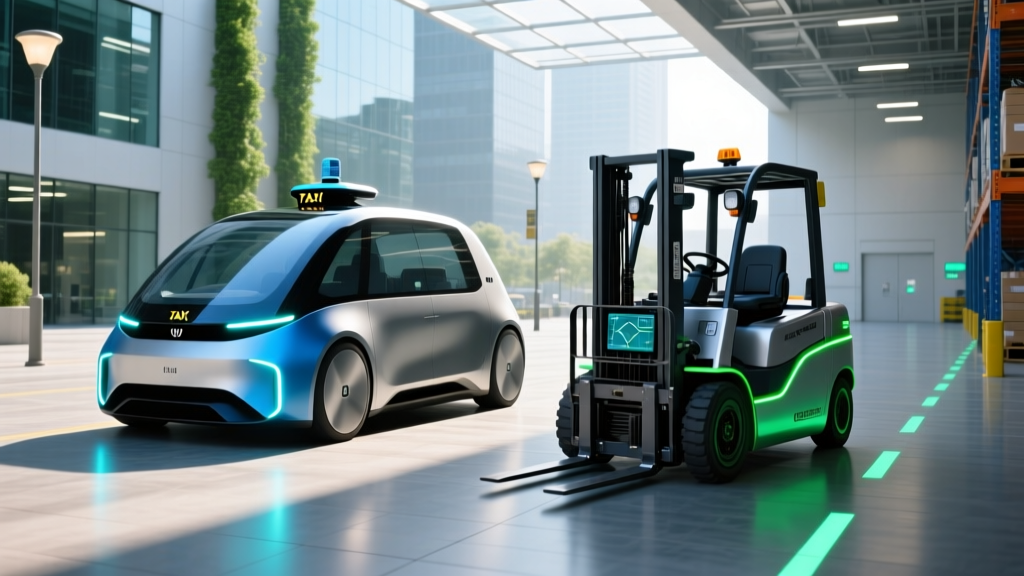
If you've been tracking autonomous vehicle news, you may have noticed a curious crossover: search interest in self-driving forklifts is climbing alongside headlines about Waymo and Cruise robotaxis. The reason is straightforward. Both applications represent some of the most commercially viable deployments of Level 4 autonomy available today—one on public roads, the other inside warehouses and distribution centers. Both rely on overlapping sensor stacks, both operate without a human driver in the loop, and both are reshaping how goods and people move.
This guide breaks down how autonomous forklift technology compares to the robotaxi services expanding across U.S. cities in 2026, what the real safety data says, and where each technology actually works today.
Understanding SAE Automation Levels: Forklifts vs Robotaxis
The SAE International J3016 standard defines six levels of driving automation, from Level 0 (no automation) to Level 5 (full autonomy everywhere). Both self-driving forklifts and robotaxis like Waymo operate at Level 4—but with a critical distinction.
| Level | Name | Driver Required? | Example |
|---|---|---|---|
| 0 | No Automation | Yes, full-time | Conventional vehicles |
| 1 | Driver Assistance | Yes | Adaptive cruise control |
| 2 | Partial Automation | Yes, hands-on or eyes-on | Tesla Autopilot, GM Super Cruise, Ford BlueCruise |
| 3 | Conditional Automation | Sometimes (must take over on request) | Mercedes Drive Pilot (limited markets) |
| 4 | High Automation | No (within operational design domain) | Waymo robotaxis, autonomous forklifts |
| 5 | Full Automation | No (anywhere, any condition) | Does not exist commercially |
Where Robotaxi Services Actually Operate in 2026
As of early 2026, fully driverless commercial robotaxi rides are available in a limited but growing set of U.S. metros. Expansion has been deliberate—regulators and operators alike have prioritized safety validation over geographic speed.
| Operator | City/Region | Service Type | Hours |
|---|---|---|---|
| Waymo (Alphabet) | Phoenix, AZ (metro-wide) | Fully driverless, paid rides | 24/7 |
| Waymo | San Francisco, CA | Fully driverless, paid rides | 24/7 |
| Waymo | Los Angeles, CA | Fully driverless, paid rides | 24/7 |
| Waymo | Austin, TX (expanding) | Limited driverless operations | Select hours |
| Zoox (Amazon) | Las Vegas, NV / Foster City, CA | Driverless purpose-built vehicle | Limited pilot |
| Cruise (GM) | Paused/restructuring | Operations suspended post-2023 incident; selective restart under review | N/A |
Waymo remains the dominant commercial operator. According to NHTSA's Standing General Order reporting framework, Waymo has logged over 5 million fully driverless paid trips as of late 2025, with the fleet now exceeding 1,000 vehicles across its three primary markets.
Self-Driving Forklifts: The Other Level 4 Success Story
While robotaxis grab headlines, autonomous forklifts have been quietly scaling inside logistics operations. Companies like Vecna Robotics, Locus Robotics, Seegrid, and Third Wave Automation deploy self-driving forklifts and autonomous mobile robots (AMRs) in warehouses operated by DHL, Amazon, and major grocery distributors.
These machines use many of the same core technologies as robotaxis—lidar, stereo cameras, ultrasonic sensors, and real-time SLAM (Simultaneous Localization and Mapping)—but in a far more controlled environment. There are no pedestrians texting in crosswalks inside a warehouse. The "roads" are marked lanes on concrete. Speeds rarely exceed 5 mph. This constrained ODD is precisely why self-driving forklifts have been easier to deploy at scale than their road-going counterparts.
Tech Stack Comparison: Robotaxi vs Autonomous Forklift
| Component | Waymo 6th-Gen Robotaxi | Typical Autonomous Forklift |
|---|---|---|
| Primary perception | Custom lidar (360°), 29 cameras, 6 audio sensors | 2D/3D lidar, stereo cameras, ultrasonic |
| Localization | HD maps + GPS + IMU + visual odometry | SLAM + floor markers + reflectors |
| Compute | Custom Waymo Driver hardware, ~500+ TOPS | Embedded GPU (e.g., NVIDIA Jetson), ~20-100 TOPS |
| Operating speed | Up to 65+ mph | 1-5 mph typical |
| Environment | Public roads, mixed traffic | Warehouse floors, marked lanes |
| Connectivity | 5G + fleet remote assistance | Local Wi-Fi + fleet management software |
| Typical cost per unit | ~$150,000-$200,000+ (vehicle + sensor suite) | ~$50,000-$120,000 depending on lift capacity |
Robotaxi Pricing: What a Driverless Ride Actually Costs
Pricing for Waymo's driverless service in 2026 varies by city, time of day, and distance, but generally tracks close to Uber/Lyft standard rides—with some notable differences.
| Metric | Waymo Robotaxi | UberX | Lyft Standard |
|---|---|---|---|
| Base fare | $3.50 | $2.50 | $2.25 |
| Per mile | $1.45 | $1.30 | $1.25 |
| Per minute | $0.28 | $0.22 | $0.20 |
| 5-mile trip (est.) | $12.15-$14.50 | $10.50-$13.00 | $9.75-$12.00 |
| Surge pricing | No traditional surge; demand-based pricing limited | 1.5x-3.0x common | 1.3x-2.5x common |
| Tips | Not expected (no driver) | 15-20% customary | 15-20% customary |
The no-tipping factor is where Waymo often reaches parity or even savings on longer rides. A 12-mile airport trip that might run $28 on UberX with tip could be $22-$24 on Waymo. The tradeoff: Waymo's geofence means you can't take it everywhere, and wait times in outer coverage zones can run 8-15 minutes versus 3-5 for a human driver.
Safety Data: What the Numbers Actually Show
• Over 5 million fully driverless paid trips completed
• Over 30 million autonomous miles driven across all operations
• Contact rate (any physical contact with another object): approximately 57% lower than benchmarked human drivers in equivalent urban environments, per Waymo's published safety reports
• Most reported incidents are minor low-speed contacts, not injury-causing collisions
• Cruise's October 2023 pedestrian-dragging incident in San Francisco led to California DMV permit suspension and a company-wide operational pause; Cruise has been restructuring under GM with a phased, supervised return in select markets
For self-driving forklifts, the safety picture is different and in some ways simpler. Warehouse environments are regulated by OSHA's powered industrial truck standards (29 CFR 1910.178). Autonomous forklift operators report significant reductions in rack-damage incidents, product loss, and pedestrian near-misses compared to manually operated forklifts. Seegrid, for example, reports that its vision-guided vehicles have logged over 5 million miles in production environments with zero reported serious injuries attributable to the autonomous system.
The critical difference: a forklift moving at 3 mph in a controlled warehouse presents a fundamentally lower kinetic energy risk than a 4,500-pound robotaxi navigating mixed traffic at 35 mph. Both are Level 4, but the consequence envelope is vastly different.
Regulatory Landscape: Who Approves What
Robotaxis and autonomous forklifts face entirely different regulatory regimes, which explains much about their respective deployment speeds.
Robotaxis must navigate a patchwork of state and federal oversight:
- NHTSA sets federal motor vehicle safety standards (FMVSS) and collects incident data via Standing General Orders
- State DMVs (California, Arizona, Texas, Nevada) issue testing and deployment permits
- State Public Utility Commissions (e.g., California CPUC) authorize commercial passenger service and fare structures
- Local municipalities control curb access, parking, and first-responder coordination
Self-driving forklifts operate on private property and fall under:
- OSHA workplace safety standards for powered industrial trucks
- ANSI/ITSDF B56.1 safety standards for low-lift and high-lift trucks
- Internal company safety protocols—the facility operator approves deployment
- No DMV, no CPUC, no public road access required
This regulatory simplicity is a major reason self-driving forklifts have scaled faster in unit volume than robotaxis. A logistics company can pilot autonomous forklifts in a single warehouse in weeks; a robotaxi company needs multi-agency approval across years to launch in one city.
Current Limitations of Both Systems
Robotaxi Limitations (2026)
- Geofencing: Waymo operates within mapped boundaries—typically 80-200 square miles per city. Cross-city or intercity trips are not possible.
- Weather: Heavy rain, fog, and snow degrade lidar and camera performance. Waymo has improved wet-weather operations in Phoenix and LA but suspends service during extreme conditions.
- Construction zones: Temporary lane shifts, missing lane markings, and flaggers remain challenging edge cases requiring remote assistance or conservative routing.
- Emergency vehicles: While Waymo vehicles are programmed to pull over for sirens, multi-vehicle emergency scenes with complex hand-signaling can cause extended stops.
- Accessibility: Current Waymo vehicles require passengers to enter/exit independently; wheelchair-accessible options remain limited.
Self-Driving Forklift Limitations
- Floor conditions: Wet floors, debris, and damaged lane markings degrade navigation reliability.
- Mixed traffic: Facilities with heavy foot traffic and manually driven forklifts require extensive sensor tuning and speed restrictions.
- Loading complexity: Pallet detection works well for standard 48x40 GMA pallets but struggles with damaged, non-standard, or irregularly stacked loads.
- Truck loading/unloading: Dock-to-trailer operations remain partially manual at most facilities; fully autonomous trailer loading is still in pilot stages.
- Capital cost: At $50,000-$120,000 per unit plus integration, autonomous forklifts require significant volume to justify ROI versus $25,000-$40,000 for a conventional electric forklift.
Is This Truly Self-Driving or Driver-Assist?
This is the question that matters most, and the answer is unambiguous for both applications: Level 4 robotaxis and self-driving forklifts are genuinely driverless within their operational domains. There is no human in the driver's seat. There is no steering wheel being monitored. The system handles the full dynamic driving task.
This is categorically different from Tesla's FSD (Supervised), GM's Super Cruise, or Ford's BlueCruise—all of which are Level 2 driver-assistance systems that require an attentive, engaged human driver at all times. Marketing language around "full self-driving" for consumer vehicles has created widespread confusion. The SAE level is what matters, and Level 2 is not Level 4.
For self-driving forklifts, the operator isn't even in the building on the same floor in many cases—fleet management software dispatches tasks, and remote supervisors monitor multiple units from a control room. For Waymo robotaxis, passengers sit in the back seat of a vehicle with no driver, no steering inputs from a human, and no expectation of takeover.
FAQ: Autonomous Vehicles and Forklifts
Where can I use a robotaxi service right now?
Waymo's fully driverless paid service operates 24/7 in Phoenix (metro-wide), San Francisco, and Los Angeles, with limited operations expanding in Austin. Zoox runs a small pilot in Las Vegas and Foster City, CA. Cruise remains in restructuring after its 2023 operational pause.
How much does a robotaxi ride cost vs Uber or Lyft?
Waymo pricing is comparable to UberX/Lyft Standard before tip, and often cheaper after tip since no gratuity is expected. A typical 5-mile urban ride runs $12-$15 on Waymo vs $10-$13 on UberX (plus $2-$3 tip). Longer rides favor Waymo more due to the no-tip factor and absence of traditional surge pricing.
How safe are robotaxis based on real data?
Waymo reports over 5 million driverless trips and 30+ million autonomous miles, with contact rates approximately 57% lower than benchmarked human drivers in equivalent urban settings. Most incidents are minor low-speed contacts. The Cruise October 2023 incident in San Francisco—in which a pedestrian was struck by a human driver and then dragged by a Cruise vehicle—demonstrated that edge-case failures can have serious consequences and triggered industry-wide regulatory scrutiny.
What are the biggest limitations of self-driving forklifts?
Floor condition sensitivity, difficulty with non-standard pallets, challenges in fully autonomous truck-trailer loading, high per-unit capital cost ($50K-$120K), and the need for facilities to adapt infrastructure (lane markings, Wi-Fi coverage, traffic separation) around the autonomous system.
Are self-driving forklifts and robotaxis the same technology?
They share the same SAE Level 4 classification and overlapping sensor technology (lidar, cameras, SLAM-based localization), but differ enormously in complexity, speed, environment, regulatory burden, and cost. A warehouse is a far more constrained and predictable environment than a city street, which is why autonomous forklifts have deployed at greater unit volume despite receiving less public attention.
When will robotaxis be available nationwide?
There is no credible timeline for nationwide robotaxi availability. Waymo's expansion is city-by-city, requiring extensive mapping, regulatory approval, and fleet deployment in each market. Industry analysts project 8-12 U.S. cities with commercial robotaxi service by 2028, but rural and suburban coverage remains distant.