Why a Self-Driving Forklift and a Robotaxi Share More DNA Than You Think
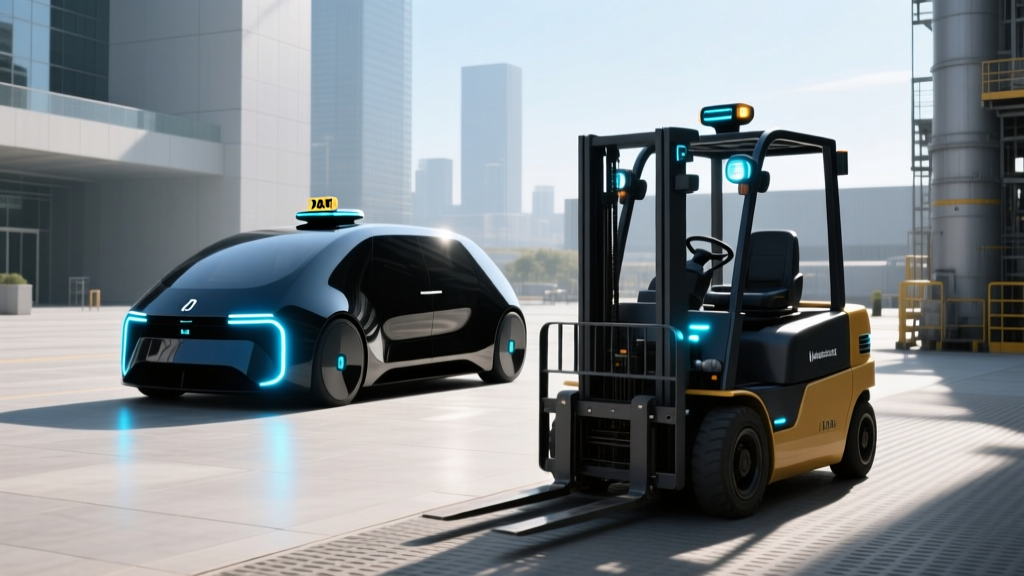
If you've watched a Waymo pull up to a curb in Phoenix or seen an autonomous forklift glide through an Amazon warehouse, you're witnessing two branches of the same autonomy tree. The keyword on warehouse managers' lips — self-driving forklift — and the one on commuters' minds — robotaxi — both describe vehicles that perceive, decide, and act without a human behind the wheel. But the SAE automation levels, sensor stacks, regulatory frameworks, and operating environments differ in ways that matter if you're evaluating either technology for purchase, investment, or everyday use.
This guide dissects both platforms side by side, using concrete 2026 data on safety records, pricing, service areas, and technical limitations. Whether you manage a distribution center or you're simply curious about hailing a driverless ride, the comparison below will clarify exactly what each technology can and cannot do today.
SAE Automation Levels: Where Forklifts and Robotaxis Sit
The SAE International J3016 standard defines six levels of driving automation, from Level 0 (no automation) to Level 5 (full automation everywhere, all conditions). Understanding these levels is non-negotiable before comparing any autonomous system.
| Level | Name | Human Role | Example |
|---|---|---|---|
| 0 | No Automation | Full control | Conventional gas forklift, base-model car |
| 1 | Driver Assistance | Hands on, system assists one axis | Adaptive cruise control, lane-keep |
| 2 | Partial Automation | Hands on, eyes on, system manages steering + speed | Tesla Autopilot, GM Super Cruise, Toyota Safety Sense |
| 3 | Conditional Automation | Eyes off in specific conditions, must take over on request | Mercedes DRIVE PILOT (limited highways, ≤40 mph) |
| 4 | High Automation | No driver needed within ODD (operational design domain) | Waymo One, Zoox, autonomous warehouse forklifts |
| 5 | Full Automation | No driver needed, any condition | Does not exist commercially as of 2026 |
Self-driving forklifts from companies like Seegrid, Locus Robotics, and Fox Robotics operate at SAE Level 4 within their defined operational design domain (ODD): a mapped, structured warehouse floor. There is no driver seat, no steering wheel, and no expectation of human intervention during normal operations.
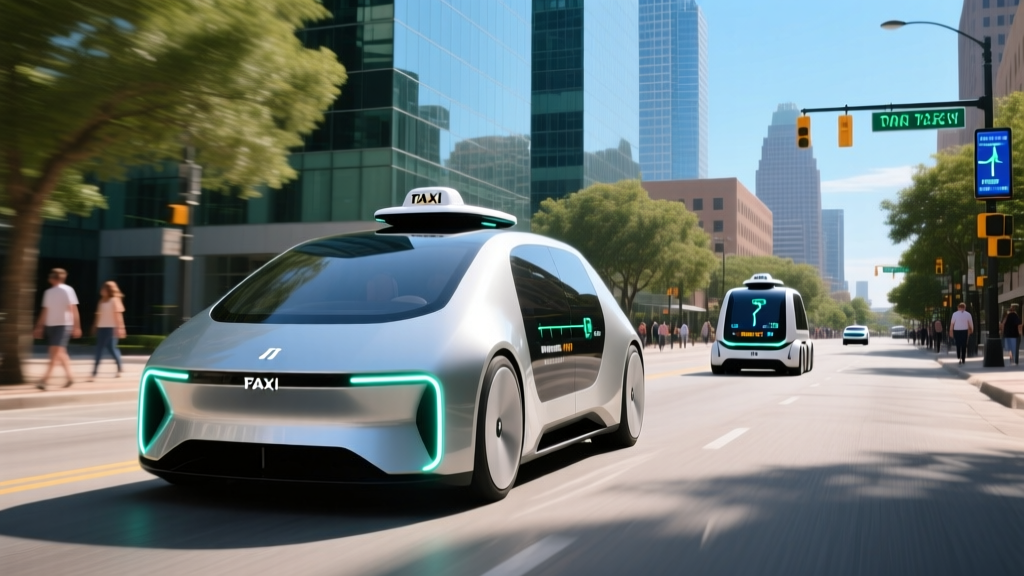
Robotaxis like Waymo One also operate at SAE Level 4, but their ODD is far more complex — public roads with pedestrians, cyclists, construction zones, and unpredictable weather. Both are Level 4; neither is Level 5. The distinction is the ODD, not the level number.
Critical distinction: Consumer driver-assist features like Tesla FSD (Supervised), Ford BlueCruise, and GM Super Cruise are SAE Level 2. The driver must remain engaged and is legally responsible. Level 4 robotaxis and autonomous forklifts have no driver — the system is fully responsible within its geofenced domain.
Where Can You Use Robotaxi Services Right Now?
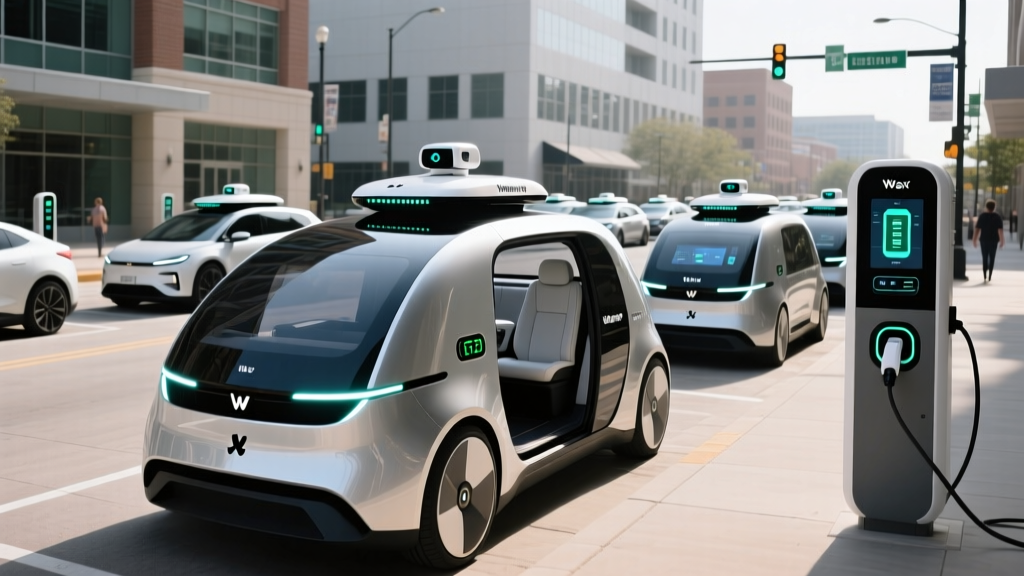
As of early 2026, fully driverless commercial robotaxi services are operational in a handful of U.S. metro areas. Expansion announcements are frequent, but only these cities have live, paying-passenger service with no human behind the wheel:
| Service | City / Region | Operating Hours | Notes |
|---|---|---|---|
| Waymo One | Phoenix, AZ (metro-wide) | 24/7 | Largest network; ~200+ sq mi coverage |
| Waymo One | San Francisco, CA | 24/7 | Full city coverage since late 2024 |
| Waymo One | Los Angeles, CA | ~18 hrs/day | Downtown, Hollywood, LAX corridor |
| Waymo One | Austin, TX (limited) | Limited hours | Initial launch zone; expanding |
| Zoox | Las Vegas, NV (strip corridor) | Limited hours | Purpose-built vehicle; invite-only expanding to paid |
| Zoox | Foster City, CA | Limited | Testing with early rider access |
Self-driving forklift availability is not geography-limited in the same way. Any warehouse, distribution center, or manufacturing facility in the U.S. (or globally) can deploy autonomous forklifts from vendors like Seegrid, Fox Robotics (FoxBot), or Balyo — provided the facility meets infrastructure requirements (floor condition, Wi-Fi coverage, lane marking or SLAM-mapping capability). There is no "city approval" needed because these vehicles operate on private property.
How Much Does a Robotaxi Cost vs. Uber and Lyft?
Pricing is where robotaxis need to prove they're not just a novelty but a viable daily-transportation alternative. Here's how Waymo One stacks up against traditional rideshare in markets where all three operate:
| Service | Base + Per-Mile Fare | Surge Pricing | Tip Expected? |
|---|---|---|---|
| Waymo One | $8–$14 | No surge (fixed algorithm) | No (no driver) |
| UberX | $9–$18 | Yes, 1.2x–3x common | Yes, 15–20% |
| Lyft Standard | $9–$17 | Yes, variable | Yes, 15–20% |
Waymo's pricing advantage comes from eliminating the driver cost (typically 60–75% of a rideshare fare). However, Waymo does not yet offer pooled/shared rides at scale, so for two passengers splitting an UberX, traditional rideshare can still be cheaper per person.
For self-driving forklifts, the economics are entirely different. A Seegrid Vision Nav autonomous forklift system costs in the range of $100,000–$200,000+ per unit (including software licensing, integration, and ongoing support), compared to roughly $30,000–$50,000 for a standard electric forklift. The ROI calculation centers on labor savings: eliminating 2–3 shifts of forklift operator wages (typically $35,000–$55,000/year each) can yield payback in 18–36 months for high-throughput facilities.
Safety Records: What the Real Data Shows
Safety is the single most scrutinized metric for any autonomous vehicle. Here's what we know from published data and regulatory filings:
Waymo Safety Data (Public Roads)
As of its most recent NHTSA disclosures and published safety reports, Waymo's driverless fleet has accumulated over 40 million fully autonomous miles across Phoenix, San Francisco, and Los Angeles. Key findings from Waymo's published safety data (through 2025):
- 75% reduction in police-reported crash involvement rate vs. human benchmarks in comparable geographies
- ~90% reduction in crashes resulting in any injury vs. human drivers
- Most reported incidents involve low-speed contact with other human-driven vehicles (rear-end, side-swipe) — not the robotaxi initiating the collision
- NHTSA Standing General Order requires all Level 4 operators to report crashes within 24 hours; Waymo has complied consistently
For autonomous forklifts, the safety data is less publicly aggregated (no federal database equivalent to NHTSA for warehouse vehicles), but the track record is strong within the industry. Seegrid reports that its fleet of 100+ autonomous vehicles has logged millions of hours in active warehouse environments with a zero fatality record and injury rates significantly below manually operated forklift benchmarks. OSHA data shows that conventional forklifts are involved in approximately 85 fatalities and 34,900 serious injuries annually in the U.S. — autonomous systems aim to reduce this by removing the most variable element: the human operator.
Both platforms share a safety philosophy of conservative behavior: autonomous forklifts stop rather than navigate around unexpected obstacles, and Waymo vehicles yield aggressively rather than assert right-of-way. This conservative approach causes complaints about "overly cautious" behavior but keeps incident rates low.
Technology Stack: Sensors, Compute, and Mapping
The hardware and software that let these vehicles operate without a human are where the engineering gets fascinating — and where key differences emerge.
Robotaxi Sensor Stack (Waymo 6th-Generation Vehicle)
- LiDAR: Multiple solid-state and spinning LiDAR units providing 360° 3D point cloud out to ~300 meters
- Cameras: 8+ high-resolution cameras for traffic light state, signage, lane markings, pedestrian intent
- Radar: Short- and long-range radar for velocity detection of other vehicles, redundancy in rain/fog
- Audio sensors: Detect sirens from emergency vehicles
- HD Maps: Centimeter-precision pre-mapped road geometry, updated continuously
- Compute: Custom Waymo AI processors handling sensor fusion, prediction, and planning in real time
Self-Driving Forklift Sensor Stack (Seegrid Vision Nav / Typical)
- LiDAR: 2D or 3D LiDAR for obstacle detection and SLAM (simultaneous localization and mapping) within the warehouse
- Cameras: Stereo vision for pallet detection, rack alignment, and barcode reading
- No GPS dependency: Indoor navigation relies on SLAM and/or magnetic/optical floor tape — GPS doesn't penetrate warehouse roofs
- HD Maps: Facility-level 3D maps built during initial commissioning, updated as layouts change
- Compute: Onboard industrial PC + cloud fleet management for task assignment and traffic coordination
The fundamental difference is environmental complexity. A robotaxi must handle an open, unstructured, adversarial environment (other drivers make unpredictable decisions). A self-driving forklift operates in a closed, structured, cooperative environment (the warehouse layout is known, other vehicles follow predictable paths, and humans in the facility are trained to coexist with the equipment). This is why autonomous forklifts reached commercial deployment years before robotaxis — the problem is orders of magnitude simpler.
Regulatory Landscape: Who Approves What?
The regulatory environments for public-road robotaxis and private-property autonomous forklifts are almost entirely separate.
Robotaxis (public roads):
- Federal: NHTSA sets vehicle safety standards (FMVSS). The agency has granted limited exemptions to companies like Zoox for vehicles without steering wheels or mirrors. NHTSA also mandates crash reporting via Standing General Order for all ADS-equipped vehicles.
- State: The critical authority. California's DMV and CPUC jointly regulate testing and commercial deployment. Arizona took a permissive approach, enabling Waymo's Phoenix launch with minimal state oversight. Texas, Nevada, and other states have their own frameworks. The patchwork means a service legal in Phoenix may not be legal in neighboring Scottsdale without separate approval.
- Local: City councils and police departments influence operational boundaries — San Francisco's Board of Supervisors has repeatedly pushed for tighter restrictions on Waymo and Cruise operations.
Self-Driving Forklifts (private property):
- OSHA: The primary regulator. Autonomous forklifts must comply with OSHA's powered industrial truck standards (29 CFR 1910.178), which govern training, maintenance, and operational safety. OSHA has not created a separate standard for autonomous forklifts, so vendors work within existing frameworks.
- No DMV/state approval needed: Because these vehicles don't use public roads, state transportation agencies have no jurisdiction.
- Insurance: Workers' compensation and commercial liability policies cover autonomous forklift operations, and insurers increasingly offer favorable rates for facilities that automate, given the reduced incident rates.
Current Limitations: What Neither Technology Can Do Yet
Robotaxi Limitations (2026)
- Weather: Heavy rain, snow, and fog degrade LiDAR and camera performance. Waymo operates in Phoenix (minimal rain) and San Francisco (mild climate) partly for this reason. Snowy cities like Chicago or Boston remain unserved.
- Geofencing: You cannot hail a Waymo to drive from Phoenix to Tucson. The vehicle will not leave its approved ODD — a hard boundary, not a suggestion.
- Construction zones: Novel lane configurations, temporary barriers, and flaggers directing traffic remain challenging edge cases. Waymo will often pull over and wait or route around rather than navigate complex construction.
- Unmapped roads: New developments, private roads, and rural routes are simply unavailable.
- Emergency scenarios: While vehicles detect sirens and pull over, they cannot interpret nuanced human direction (a firefighter waving them through, for example).
Self-Driving Forklift Limitations (2026)
- Floor conditions: Wet, uneven, or heavily damaged floors can cause localization errors or traction issues.
- Dynamic layout changes: If racks are moved or aisles blocked without updating the map, the forklift stops and requests human resolution.
- Trailer loading/unloading: Dock-to-trailer transitions (varying trailer heights, dock plate gaps) remain one of the hardest tasks to automate reliably; most systems still require human operators for this step.
- Mixed traffic: Facilities with heavy foot traffic, manual forklifts, and autonomous units running simultaneously require careful zoning and speed management.
- Outdoor transitions: Moving between buildings or operating in yards exposes the system to GPS, weather, and surface challenges it wasn't designed for.
Which Technology Matters More to You?
Choose Robotaxis (Waymo, Zoox) If:
- You live in Phoenix, San Francisco, Los Angeles, or Austin and want a reliable, surge-free rideshare alternative
- You're evaluating urban mobility without car ownership
- You care about the future of public-road autonomy and want to experience Level 4 firsthand
Invest in Self-Driving Forklifts If:
- You operate a warehouse, DC, or manufacturing facility with 2+ shifts of forklift operation
- Labor availability is a constraint (forklift operator turnover often exceeds 40% annually)
- Your throughput is predictable and your layout is relatively stable
- You can absorb a 18–36 month payback period on a $100K–$200K+ per-unit investment
Both technologies are SAE Level 4, both rely on LiDAR-camera fusion, and both have demonstrated safety records that outperform their human-operated counterparts. The difference is scope: a self-driving forklift solves a narrow, high-value problem in a controlled environment, while a robotaxi tackles the vastly harder challenge of navigating open public roads. In 2026, both are real, both are commercially available in their respective domains, and neither is anywhere close to Level 5.
Frequently Asked Questions
Is a self-driving forklift truly autonomous or does it have a remote operator?
Most commercial autonomous forklifts (Seegrid, Fox Robotics, Balyo) operate fully autonomously within their mapped environment with no remote driver. Some systems include a remote-assist feature where a human can resolve an edge case via a tablet or control station, but this is exception-handling, not driving. The vehicle is SAE Level 4 — no human is actively operating it during normal workflow.
How safe are robotaxis compared to Uber or Lyft with a human driver?
Based on Waymo's published data covering 40+ million autonomous miles, robotaxis show approximately a 75% reduction in police-reported crashes and a ~90% reduction in injury-causing crashes compared to human drivers in the same geographies. However, robotaxis operate in geofenced, relatively favorable conditions — they don't yet handle snow, heavy rain, or rural roads. The comparison is valid within the ODD but doesn't extend to all driving scenarios.
Where can I ride in a Waymo robotaxi today?
As of 2026, Waymo One offers fully driverless commercial rides in Phoenix (metro-wide, 24/7), San Francisco (full city, 24/7), Los Angeles (downtown-to-LAX corridor, ~18 hrs/day), and Austin (limited zone, expanding). You download the Waymo app, set your pickup and dropoff within the service area, and a driverless Jaguar I-PACE or Waymo's custom vehicle arrives. No waitlist in most markets.
How much does a robotaxi ride cost compared to Uber?
For a typical 5-mile urban trip, Waymo One fares run $8–$14 with no surge pricing and no tip. UberX for the same trip typically costs $9–$18 before tip, with surge multipliers of 1.2x–3x during peak demand. Waymo is generally cheaper during surge periods and comparable during off-peak hours.
What are the biggest limitations of self-driving forklifts?
The top limitations in 2026 are: trailer loading/unloading at docks (still mostly manual), sensitivity to floor conditions and unmapped layout changes, difficulty operating in mixed-traffic facilities without careful zoning, and inability to transition outdoors or between buildings without infrastructure modifications. They excel at repetitive horizontal transport and put-away within a single, well-maintained facility.
Do autonomous forklifts qualify for any EV tax credits or incentives?
The federal §30D Clean Vehicle Credit applies to on-road light-duty vehicles, not off-road industrial equipment. However, electric forklifts (autonomous or manual) may qualify for Section 179 expensing and bonus depreciation, and some state/utility programs offer rebates for electrifying warehouse equipment. Consult a tax professional for your specific situation — incentive eligibility varies by jurisdiction and equipment classification.