When most people hear "autonomous vehicle," they picture a robotaxi navigating downtown Phoenix. But some of the most commercially mature self-driving machines on Earth never touch a public road. The self-driving dumper—an autonomous haul truck that moves earth, ore, and overburden at mines, quarries, and large construction sites—has been accumulating millions of driverless miles for years, moving billions of tons of material without a human behind the wheel.
Unlike consumer vehicles stuck in the Level 2 driver-assist category, autonomous haul trucks from Caterpillar, Komatsu, and Hitachi operate at true SAE Level 4 within geofenced sites. As of 2026, the global fleet exceeds 800 units, and the technology is expanding from tier-one mining operations into mid-size quarries and mega-construction projects. Here's what you need to know about where self-driving dumpers operate, the technology that makes them work, and the safety record backing them up.
What Is a Self-Driving Dumper and How Autonomous Is It?
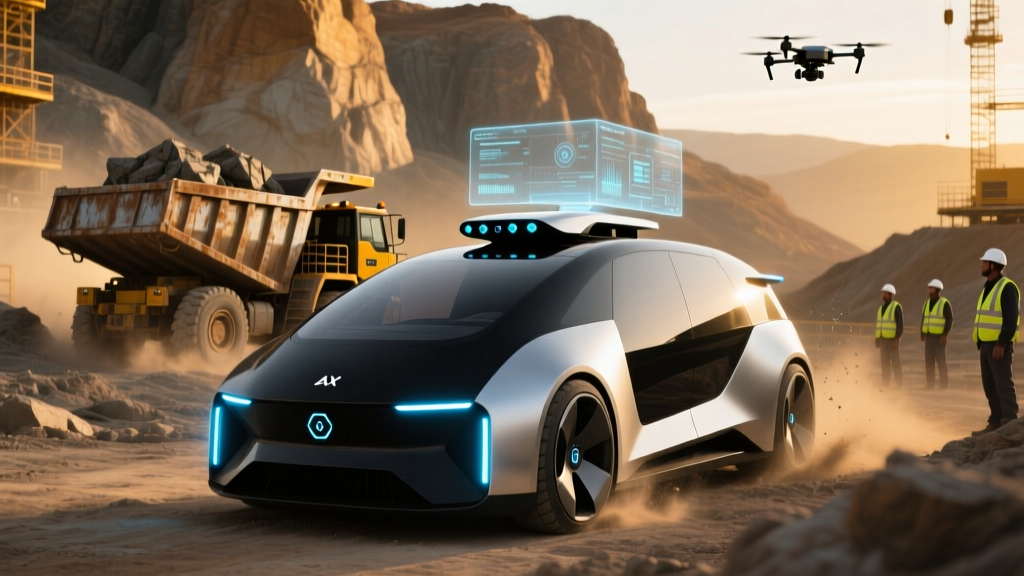
A self-driving dumper (also called an autonomous haulage system or AHS) is a large off-highway dump truck—typically 150 to 400 short tons payload capacity—that navigates a predefined haul route without an onboard operator. These vehicles transport ore from the pit face to crushers, waste rock to dumps, and overburden to stockpiles, running 23+ hours per day with only scheduled maintenance stops.
Autonomous haul trucks operate at SAE Level 4—they perform all driving tasks without human intervention, but only within a defined Operational Design Domain (ODD). In this case, the ODD is a geofenced mine or quarry site with mapped haul roads, controlled access, and no mixed public traffic. There is no steering wheel, no cab operator, and no expectation of human takeover during normal operation. This is fundamentally different from Level 2 systems like Tesla FSD (Supervised) or GM Super Cruise, which require continuous driver attention on public roads.
| Level | Name | Who Drives | Examples |
|---|---|---|---|
| Level 0 | No Automation | Human only | Legacy vehicles |
| Level 1 | Driver Assistance | Human + one system | Adaptive cruise OR lane-keep |
| Level 2 | Partial Automation | Human supervises | Tesla Autopilot, BlueCruise, Super Cruise |
| Level 3 | Conditional Automation | System drives; human on standby | Mercedes Drive Pilot (limited markets) |
| Level 4 | High Automation | System drives fully in ODD | Waymo robotaxis, autonomous haul trucks |
| Level 5 | Full Automation | System everywhere, all conditions | Not yet commercially deployed |
Where Self-Driving Dumpers Operate Right Now
Autonomous haul trucks are not consumer products you can hail with an app. They are deployed by mining companies and large earthmoving contractors at specific sites. As of early 2026, the largest operational fleets are concentrated in Western Australia's Pilbara iron ore region, Canada's oil sands, and Chile's copper mines, with growing adoption in U.S. coal, copper, and aggregate operations.
| Operator | Location | Platform | Fleet Size (approx.) |
|---|---|---|---|
| BHP | Pilbara, Western Australia | Komatsu AHS (930E/980E) | ~180 trucks |
| Rio Tinto | Pilbara, Western Australia | Komatsu / Caterpillar | ~200 trucks |
| Fortescue Metals | Pilbara, Western Australia | Caterpillar MineStar Command | ~150 trucks |
| Suncor Energy | Alberta, Canada (oil sands) | Komatsu 930E AHS | ~85 trucks |
| Freeport-McMoRan | Arizona / New Mexico, USA | Caterpillar / Komatsu | ~40 trucks |
| Codelco | Chile (Chuquicamata, others) | Komatsu AHS | ~60 trucks |
| Various quarries | U.S., Europe, Middle East | Volvo TA15, Cat 785D AC | Growing (10-30 per site) |
The Pilbara region alone accounts for over 500 autonomous haul trucks—roughly 60% of the global fleet. According to Mining Technology, Rio Tinto's autonomous fleet has moved over one billion tonnes of material driverlessly since its AutoHaul and AHS programs scaled in the late 2010s.
Technology Stack: How Autonomous Haul Trucks Navigate
The sensor and software architecture of a self-driving dumper shares DNA with urban robotaxis but is optimized for a very different environment: wide haul roads, predictable routes, massive vehicle inertia, and zero pedestrian traffic.
Core Sensor Suite
- LiDAR (Light Detection and Ranging): Typically 4–8 roof-mounted units providing 360° 3D point-cloud mapping at ranges of 200–300 meters. Essential for detecting berms, other vehicles, and obstacles in dust, rain, and darkness.
- Millimeter-wave radar: Forward and rear-facing units for object detection at speed, particularly effective in heavy dust that blinds optical sensors.
- GNSS/RTK GPS: Real-Time Kinematic positioning accurate to ±2 cm, combined with inertial measurement units (IMUs) for dead-reckoning when GPS is degraded (e.g., deep pit floors, tunnel entries).
- Cameras: Multiple HD cameras for object classification, signage recognition, and remote teleoperation fallback. Unlike Tesla's camera-only approach, AHS platforms treat cameras as supplementary to LiDAR/radar.
- Pre-mapped HD routes: Every haul road is surveyed and digitally mapped to centimeter accuracy. Trucks follow these virtual "rails," adjusting speed and path dynamically for obstacles, traffic, and road conditions.
Fleet Management & Control
Each truck communicates via dedicated mesh radio or private LTE/5G networks to a central fleet management server. Dispatchers assign loads, optimize routing to minimize cycle time, and coordinate interactions with manned equipment (loaders, graders, light vehicles) that carry proximity beacons. If communication is lost, the truck executes a controlled stop—it does not continue blind.
Safety Record: What the Data Shows
The safety case for autonomous haul trucks is one of the strongest in the entire autonomous vehicle industry, largely because the operating environment is so tightly controlled. There are no cross-traffic intersections, no pedestrians, no unpredictable human drivers sharing the road.
- Rio Tinto AHS fleet: Over 100 million autonomous kilometers driven with zero fatal incidents attributed to autonomous operation (source: Rio Tinto sustainability reports).
- BHP Pilbara fleet: Reported a 80% reduction in vehicle-to-vehicle collision potential events after AHS deployment, and zero lost-time injuries from autonomous truck operations.
- Industry-wide (ICMM member data): Autonomous haulage sites consistently report lower incident rates per million hours worked compared to conventional haulage, driven primarily by elimination of operator fatigue and distraction—two of the top causes of mine vehicle incidents.
- NHTSA relevance: Because these vehicles operate exclusively on private, off-highway sites, they fall outside NHTSA's on-road autonomous vehicle reporting requirements. Safety oversight comes from mine regulators (e.g., MSHA in the U.S., DMIRS in Western Australia).
The key safety mechanisms go beyond sensors. Autonomous trucks enforce speed limits precisely (no speeding on haul roads), never operate fatigued, communicate position to every other vehicle on-site, and stop immediately when their perception system detects an anomaly it cannot classify. A human spotter or light-vehicle driver entering the haul road triggers an automatic deceleration-to-stop unless the system positively identifies them and they carry an authorized transponder.
Pricing, Deployment Costs, and Economics vs. Conventional Haulage
You don't "hail" a self-driving dumper. These are capital equipment purchases or lease agreements between mining operators and OEMs. The economics differ dramatically from consumer rideshare or even commercial trucking.
| Factor | Conventional (Manned) | Autonomous (AHS) |
|---|---|---|
| Truck unit cost (300-ton class) | $5–6 million | $6.5–8 million (with AHS hardware/software) |
| Annual operator cost (per truck, 3 shifts) | $600K–$900K (3–4 operators) | $0 (no onboard operator) |
| Operating hours/day | ~18–20 hrs (shift changes, breaks) | ~23 hrs (maintenance stops only) |
| Fuel efficiency improvement | Baseline | ~10–15% (optimized speed/routing) |
| Tire life | Baseline | ~20–35% longer (consistent driving patterns) |
| Payback period | N/A | ~2–4 years depending on site scale |
| Fleet management software license | N/A | $2–5 million/year (site-wide) |
For a 50-truck fleet operation, the autonomous premium might be $75–100 million upfront, but the elimination of 150+ operator salaries (at $150K–$250K each in remote mining roles) plus productivity gains typically deliver payback within three years. This is why adoption has accelerated: the math works at scale.
Current Limitations: Where Self-Driving Dumpers Cannot Operate
Despite impressive capabilities, autonomous haul systems have defined boundaries. Understanding these limitations is critical for site planners evaluating AHS adoption.
- Geofencing required: Trucks operate only within pre-mapped, surveyed haul road networks. Expanding a pit or opening a new dump requires fresh surveying and route programming—typically days to weeks of engineering work.
- Mixed-traffic complexity: Sites with high volumes of manned light vehicles, drill rigs, and graders require those vehicles to carry proximity transponders and follow strict interaction protocols. Fully mixed sites without transponder compliance cannot safely run AHS.
- Extreme weather degradation: Heavy rain, dense fog, and snow can degrade LiDAR and camera performance. Some sites implement speed restrictions or temporary AHS suspension during severe weather events. Unlike a human operator who can "squint through it," the system conservatively stops if confidence drops below threshold.
- Not for public roads: These vehicles are off-highway equipment. They cannot legally or technically operate on public highways, city streets, or any environment with uncontrolled access.
- Load interaction requires coordination: Autonomous trucks must be loaded by excavators or wheel loaders that may be manned. The loading interface requires precise positioning protocols and communication between the AHS fleet server and the loading equipment operator.
- Capital-intensive entry: The upfront cost—autonomous-capable trucks, site surveying, network infrastructure, fleet management licensing—makes AHS impractical for small quarries or short-duration construction projects.
Regulatory Landscape: Who Approves Autonomous Haulage?
Because autonomous haul trucks operate on private, off-highway sites, they bypass the regulatory gauntlet that on-road autonomous vehicles face. There is no equivalent to the NHTSA standing general order that requires robotaxi companies to report crashes. Instead, oversight comes from mining and occupational safety regulators:
- United States: The Mine Safety and Health Administration (MSHA) oversees mine equipment safety. AHS deployments require site-specific safety plans demonstrating risk mitigation. MSHA has generally taken a performance-based approach rather than prescribing specific sensor requirements.
- Australia: The Department of Mines, Industry Regulation and Safety (DMIRS) in Western Australia is arguably the most experienced mining autonomy regulator globally, having overseen the Pilbara AHS expansion since 2008. Their framework requires safety case submissions, independent audits, and documented management-of-change processes when routes or fleet configurations change.
- Canada: Provincial regulators (e.g., Alberta Energy Regulator for oil sands) review autonomous equipment plans as part of mine operating approvals. Suncor's AHS deployment required extensive consultation with regulators and worker representatives.
- Chile: SERNAGEOMIN (National Geology and Mining Service) regulates mine safety, including autonomous equipment. Codelco's deployments have proceeded under existing mine safety frameworks with site-specific risk assessments.
Industry bodies like the International Council on Mining and Metals (ICMM) have published guidance frameworks for autonomous equipment safety, which many operators adopt as best practice even where not legally mandated.
Key Players and Platforms in 2026
Three OEMs dominate the autonomous haul truck market, with a few emerging challengers targeting smaller sites and quarry applications:
| OEM | Platform | Truck Models | Payload Range |
|---|---|---|---|
| Komatsu | FrontRunner AHS | 930E-5, 980E-4, 830E-AC | 240–400 short tons |
| Caterpillar | MineStar Command for Hauling | 793F, 797F, 785D, 794 AC | 150–400 short tons |
| Hitachi | Wenco Autonomous Haulage | EH3500AC, EH4000AC | 200–380 short tons |
| Volvo CE | TA15 Electric Autonomous Hauler | TA15 (battery-electric) | 15 short tons |
| Hexagon Mining | AutoMine (retrofit) | Aftermarket kits for mixed fleets | Varies |
The Volvo TA15 deserves special mention: it's a battery-electric autonomous hauler with a ~150 kWh LFP battery pack, targeting quarry and small-mine applications where routes are shorter and electrification's per-ton-kilometer cost advantage is maximized. It represents the convergence of autonomy and electrification in off-highway equipment—a trend expected to accelerate through 2030.
Frequently Asked Questions
Where can I see a self-driving dumper in operation?
These vehicles operate on private mining and quarry sites that are not open to the public. The largest concentrations are in Western Australia's Pilbara (BHP, Rio Tinto, Fortescue), Alberta's oil sands (Suncor, CNRL), and copper mines in Chile and the U.S. Southwest. Some aggregate quarries in Europe and the Middle East are beginning to deploy smaller autonomous haulers like the Volvo TA15.
How much does an autonomous haul truck cost compared to a conventional one?
An autonomous-capable 300-ton haul truck costs approximately $6.5–8 million, compared to $5–6 million for a conventional manned truck. However, the total site deployment—including fleet management software, network infrastructure, route surveying, and integration—adds $5–15 million depending on site complexity. The business case relies on eliminating $600K–$900K per truck per year in operator costs and gaining ~15–20% more productive hours.
How safe are self-driving dumpers compared to human-operated trucks?
The available data from major operators (Rio Tinto, BHP) indicates that autonomous haulage systems have lower incident rates per million hours worked than conventional haulage, primarily because they eliminate operator fatigue, distraction, and speeding—the top causes of mine vehicle incidents. Rio Tinto reports zero fatal incidents across over 100 million autonomous kilometers. However, comprehensive industry-wide comparative data is limited because off-highway autonomous vehicles are not subject to NHTSA's public-road crash reporting requirements.
What are the current limitations of autonomous haul trucks?
Key limitations include: strict geofencing to pre-mapped routes (expanding routes requires fresh surveying); degraded performance in heavy rain, fog, or snow; incompatibility with sites that have high volumes of uncontrolled mixed traffic; significant upfront capital requirements; and inability to operate on public roads. They are purpose-built for controlled, off-highway environments only.
Is a self-driving dumper truly self-driving, or is it just driver-assist?
Autonomous haul trucks from Komatsu, Caterpillar, and Hitachi are SAE Level 4—genuinely driverless within their operational domain. There is no human operator onboard, no steering wheel, and no expectation of human takeover. This is fundamentally different from Level 2 driver-assist systems in consumer vehicles (Tesla Autopilot, GM Super Cruise, Ford BlueCruise), which require continuous human supervision. The self-driving dumper is one of the most commercially successful Level 4 autonomous vehicle applications in the world.
Can autonomous haul trucks be electric?
Yes, though most current large-scale deployments use diesel-electric powertrains (diesel engine driving electric wheel motors). The Volvo TA15 is a fully battery-electric autonomous hauler with approximately 150 kWh of battery capacity, targeting shorter-route quarry applications. Caterpillar and Komatsu have announced battery-electric and trolley-assist autonomous haul truck prototypes for larger mining applications, with commercial availability expected in the late 2020s. Electrification is particularly attractive for autonomous trucks because the consistent, optimized driving patterns of AHS maximize battery efficiency and regenerative braking on decline hauls.